2 equal pistons in series - fixed at one end , load applied at the other end ...
both have push back force of 7k for arguements sake ...
do we need 7k or 14k to close ... im of the 7k persuasion and that if they were in paralel youd need 14k.
and the crux - will it take off on a conveyor belt !
I know i wont get an answer but i thought it would make for interesting debate
7K
2 in series but both fixed at one end?
imagine 2 shocks bolted together - then bolted to the wall ....
then pressed on from the unfixed end
Not really a piston expert, but it sounds similar to springs.
If you wanted to extend a spring by x cm, you would need y force.
If you wanted to extend two springs in series by x cm, you would need 0.5y force.
If you wanted to extend two springs in parallel by x cm, you would need 2y force.
Does that help?
GCSE physics question!
so in parallel then ?
didnt do gcse - plus you learn so much at uni when you are asked simple shit you over think it !
If it takes 7k to compress the - I'm going to say 'spring' here as it's easier for me to picture - then two springs end to end will still take 7k, the strength of the spring doesn't magically change.
What does change, and what muddies the thinking, is that the distance travelled for a given force will double.
(standard disclaimer)
Distance traveled for a given force will double, but preload will remain the same, i.e. it takes as much force as before before any movement happanes, but when it does its double.
its ok - my colleagues head has just exploded and sprayed across the wall. he cannot comprehend.
It's good to visualise/feel this kind of thing if you have two large similar elastic bands that you can use 'in series' and 'in parallel'.
Should be clear then......perhaps.
he might wrap said elastic bands round my neck .....
think hes coming to terms with i was right 😉
I've no real idea but I think it remains at 7 but don't we have to now consider the issue of time. The force will be the same but it will take twice as long. Or have I really even less idea than I think.
time doesnt matter - all that matters is both will move for a given applied load and that it will not just close 1 or close both half way.
Unlikely. I guess it depends how you apply the force, but hypothetically, the time won't change either, just the distance.
I think.
Assuming "perfect" pistons then 7k will fully compress both. Obviously the distance is doubled... Agree with you that if in parallel 14k will be needed to compress them both.
If I adjust my earlier post..
If you wanted to [s]extend[/s] compress a spring by x cm, you would need y force.
If you wanted to [s]extend[/s] compress two springs in series by x cm, you would need 0.5y force.
If you wanted to [s]extend[/s] compress two springs in parallel by x cm, you would need 2y force.
So if you want to compress two springs by 2x cm, you will need y force.
Therefore, you will need 7k (whatever that means - 7000N?).
real man, you're wrong I think.
F=kX where F is the Force, k the spring constant constant and X the distance.
2 identical springs in series means the distance is 2X, therefore force required to close 2X is 2F.
2 identical springs in parallel effectively means k is doubled, therefore force required is again 2F.
ie. the force required to close 2 identical springs will always be twice that required to close one spring. Whether they are in parallel or series determines the distance required to close them.
If a spring of length L needs 7kg to compress fully, when you attach two together in series you now effectively need to compress by 2L so wouldn't you require 14kg?
With 2 in parallel the answer is still 14kg is it not? or have I got the wrong end of the stick?
leggyblonde i think thats what i'm getting at!
or have I got the wrong end of the stick?
I hope not!
3.5
##
Cougar - Member
If it takes 7k to compress the - I'm going to say 'spring' here as it's easier for me to picture - then two springs end to end will still take 7k, the strength of the spring doesn't magically change.
What does change, and what muddies the thinking, is that the distance travelled for a given force will double.
(standard disclaimer)
##
(can't work out how to quote, sorry)
Well, yes and no - if you take a 7N/mm spring and chop it in half, it becomes a 14N/mm spring. If you make a spring exactly the same as the 7N/mm spring, but twice as long, then it becomes half as stiff, or 3.5N/mm
if you don't believe me go and find a plastic ruler, and hold it at one end and bend it. now hold it halfway along, it will be twice as hard to move the same distance. a coil spring is a straight spring wound in a helical shape.
distance travelled for given force will double - yes, because the spring rate is now halved.
"well, yes and no - if you take a 7N/mm spring and chop it in half, it becomes a 14N/mm spring"
Why???
Don't even get me started on the ruler thing!
Are we assuming the applied load is linear to the piston/shock assembly??
same reason it's easier to snap a long twig than a short one, same reason short handlebars are stiffer than long ones etc etc.
it's all a bit counter intuitive isn't it!
just noticed the op says force to close - ignore all my previous nonsense, it is just that.
Are they located in the northern or southern hemisphere?
The effective counter rotation can affect the conceptual spring wind direction of your piston arrangement.
42
or 41.7432958722596235623103285750123857 rounded up
real man, you're wrong I think.
No 😀
If you wanted to compress a spring by x cm, you would need y force.If you wanted to compress two springs in series by x cm, you would need 0.5y force.
If you wanted to compress two springs in parallel by x cm, you would need 2y force.
So if you want to compress two springs by 2x cm, you will need y force.
Therefore, you will need 7k (whatever that means - 7000N?).
Is right.
I can't be bothered to explain it though.
if you take a 7N/mm spring and chop it in half, it becomes a 14N/mm spring
I've just spent the last five minutes working this out so that I can construct an argument against this, the net result being that I think we're both right.
If you put two springs in series then the force required to move them a given distance halves. That's pretty obvious.
However, the OP asked about "fully compressing" a piston. In my GSCE physics terms, this is saying that it's compressing a spring, or a section of spring, by a given amount. Then, we're doubling the length of spring (ie, adding a second 'piston') and comparing the force required to move it, critically, *twice as far.*
Going back to the above quote, does it take more force to move a 14N/mm spring 10mm than it does to move a 7N/mm spring 5mm?
Going back to the above quote, does it take more force to move a 14N/mm spring 10mm than it does to move a 7N/mm spring 5mm?
yes, but i think you meant:
does it take more force to move a 14N/mm spring 5mm than it does to move a 7N/mm spring 10mm?
in which case, no the same
Yes, sorry, braino, that's what I meant. And I was doing so well. (-:
Is it on a conveyor belt?
Please explain the following RealMan, even just for me! 🙂
If you wanted to compress a spring by x cm, you would need y force.If you wanted to compress two springs in series by x cm, you would need 0.5y force.
I don't see how doubling the length of a spring where k remains constant means the force required to compress by x halves. That doesn't fit into the F=kX equation (where X should actually be deltaX)
Please explain the following RealMan, even just for me!If you wanted to compress a spring by x cm, you would need y force.
If you wanted to compress two springs in series by x cm, you would need 0.5y force.I don't see how doubling the length of a spring where k remains constant means the force required to compress by x halves. That doesn't fit into the F=kX equation (where X should actually be deltaX)
Because k is halved when you double the length of the spring. See earlier examples of rules/elastic bands/etc. k is proportional to the length and stiffness of the spring, so changing its length would alter k.
It is quite simple- k does not change with length, it is a constant!!
see here, example spring question 1.
http://psychometric-success.com/aptitude-tests/mechanical-reasoning-tests-springs.htm
Given this example and applying what we have learned- if you start with a single 7kg spring of length L 14kg is the answer to both.
end of!
"end of! "
you sure ?
are both the pistons in the same cylinder? or in two separate ones?
as per my shock analogy earlier - both are separate but joined together in series - and fixed at one end and pushed at the other !
[img] 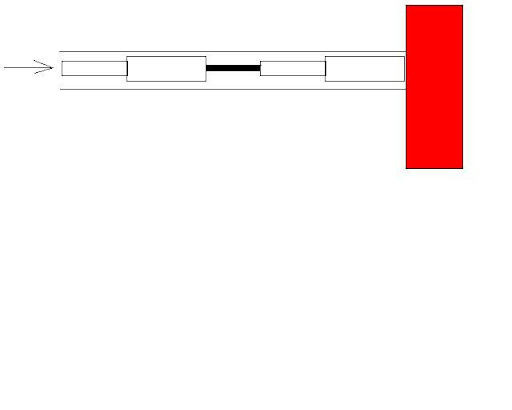 [/img]
all the suggestions so far seem to give the answer from a linear point of view, surely it's going to be on a curve?
i know the coefficient of the springs is spring is k1 and k2 and
kseries=1/k1 + 1/k2
but i dont care what the coefficient is - all i want to know is Force required to put both springs in fully compressed state and i cannot remember how to correctly relate coefficient to force - and my physics books are in storage atm !
Is propedal on or off?
haha, if only!
Trail_rat... that should be
1/Ks = 1/Ka + 1/Kb
So, if you have two springs, length l, with the same k so Ka = Kb therefore
1/Ks = 1/Ka + 1/Ka = 2/Ka
Therefore for the combined spring
Ks = Ka/2
From this we can say that if you double the length of the spring, you halve the spring rate.
And by the reciprocal of this, halve the length of the spring, double the spring rate.
Simples...
thank you funky nick.
1/Ks = 1/Ka + 1/Kb
d'oh 😳
hadn't remembered that one.
i remembered half of it 😀 - story of my university career !
obviously better than mine....