UPDATE: Reviews section refreshed, redesigned, searchable: Go take a look
I took my venerable Canon 60D (SLR) to Australia last summer and it suffered some sort of failure. No harm, no foul, it was very well used and abused and it's time to retire it.
So I'm looking for something to replace it. I have a fairly decent phone camera (Pixel 10a), but I'd like to have something better for (mainly) stills and (possibly) videos when and if the kids use it. My kids are heavily into swimming and I'm tempted to have a go at snapping some of that, although having looked at what sort of lens speed is needed, I'm not entirely sure I can afford it!
I prefer viewfinders.
I don't feel tied in to an ecosystem as I'd sell all my lenses as well.
Some decent deals around on Lumix S5D are tempting, also Canon 2000D, but these are just because they are deals rather than any more logical reason.
Will go to £1k for camera and a lens. Once I get going again, I would look to upgrade lens.
Basically - there's tons of options and it's been 15 years since I last bought a camera.
Any pointers gratefully received - even if it's "go to a camera shop and try one out". 😀
Go to a camera store and try them out 😁 seriously, do. Even if it’s just to handle them.
I changed from a canon 550D that I typically used a lovely Canon 50mm f1.4 lens with.
After lots of looking around I plumped for a Sony ILCE-6400. The kit lens is OK but I got a Sigma 30mm f1.4 for it. bulkier with the sigma but a neater package than the Canon with the Sony being mirrorless and all.
I considered at least one LUMIX and the other contender was the Fuji X something or other. The Sony just seemed right to me.
One route to consider would be used. Before getting the Sony I capriciously got a Canon M100. Wonderfully compact. I found it was no good to me without a viewfinder. I sold that without too much loss after a few weeks and did more looking and playing before buying again.
enjoy the choosing.
edit. If you go mirrorless get a spare battery or two. I was surprised at how quickly the battery ran out compared with my DSLR.
I'd also say go and handle a few in a store, especially mirror-less where the EVF is massively important, see how they feel in hand, do the controls fell well placed for you then research the lenses for that system. Talking of which do not ignore the crop sensor systems, some have some big advantages when it comes to lens size, weight, cost and selection. My go to walk around digital is a OM-Systems OM-5ii I have to either have a reason or be in the mood to lug my Sony full-frame around rather than that.
Bias alert
I've got a Pentax k5. Pentax cameras can use all their old lenses, so I thought it gets loads of fancy lenses that would be prohibitively expensive. I did, but I preferred modern lenses with auto focus which were still pricey.
What I actually use now is a go pro. It's software can take a snap with exposure and colouring that would take me 10 min to replicate on my laptop.
My wife was a semi pro wedding photographer when I met her and used cannons. Give her any camera and me a 1,000,000 time better one and she will get a better photo. Have us stood side by side and she will get a better photo.
I hate using her cannons as the controls are mildly different, which was the difference between getting and not getting a lovely shot.
So I'd suggest
-the most up-to-date version of your cannon.
-Software and processing, similar controls to what you have already learned. Just get a few lenses
-Spend some of your budget on a course/ tuition
a used canon 80d off ebay for £350? would be good for videos too.
Mirrorless for a few more stops and better autofocus,if you need that, but thats more money
Lots of different options already! I love this place 🥰
I've had a look at what's been suggested - built in flash is needed, and my right eye is dominant so central viewfinder is going to be better 'eye' think...
So, it looks like I need to go shopping in a physical shop!
If the body has died, presumably you still have a pile of glass so a modern Canon dSLR would seem the obvious choice?
Yeah i don't really get the sell all the lenses thing here.
Get a canon use the lenses you have will be waaaaay cheaper and less hassle than starting again unless there is something massively different to sway you.
Well, it might... But shiny toys are shiny toys so tempted to junk the whole lot (there's nothing super whizzy in the collection, and it's been widely used for 10-15 years)
Well, it might... But shiny toys are shiny toys so tempted to junk the whole lot (there's nothing super whizzy in the collection, and it's been widely used for 10-15 years)
Yeah but maybe take a look at what lenses cost these days.
A grand for the camera and some lenses starts to look very tight.
Don't get ne wrong i support the go wild option but its would still seem to be sensible to stick with what you have and get a body and something new to play with.
Well, it might... But shiny toys are shiny toys so tempted to junk the whole lot (there's nothing super whizzy in the collection, and it's been widely used for 10-15 years)
If you're junking them, my broke ass will take them.
Olympus om-d seems to offer portability.
smaller sensor receives twice as much light, so great for low light stuff. Means you need to use a longer lens to achieve bokeh for portraiture.
Features weather sealing without spending twice as much.
afaik, it’s Taylor Swift’s camera de jour.
in body image stabilisation too!
I'm just so disappointed that folks on here are trying to save me money! 😁
So, deals on the Canon range include this one:
I'll go and have a fondle of stuff in John lewis and other places...
I had a 60d, I upgraded it to a R6, it blew me away night and day different.
My 17-40 lens now seems very very wide.
Depending on what glass you have, the ef-r converter is well worth it. I still use all my old ef glass and bought an ef100mm macro.
The om systems get a good report card. I fancy one as they will focus stack with a flash gun.
smaller sensor receives twice as much light, so great for low light stuff.
Hmm. Not sure that logic flows.
There are lots of good cameras about. I own an omd em 5 ii. Which is great but in think i would not have bought it knowing what i know now. There are a few gaps in lenses and the models with better autofocus cost a bit more
lets assume you are living for a cropped sensor camera, Apsc or microfourthirds.
Here are my thoughts
Don’t buy the canon. They’ve locked down the mount so you can’t access the huge number of cheap third party primes. Their own selection of apsc lenses is poor
Sony would probably be recommendation but they are all of centre viewfinders, so they are out
Fuji have lots of cameras and lenses.i think the mid range zoom might put you over budget. If you can live with 18-50 then it’s a great option
Nikon have the z5 which looks good and is well priced used. There is a good twin lens kit or a good 18-140 zoom which would be my preference. The down side is no camera with in body stabilisation
Having previously been a Canon DSLR user (10d, 50d, 70d) I'm now a big fan of the micro four thirds system. I've had a few (Panasonic GX80, G80, briefly a G9, Olympus e-m10 mkii) and now settled on an e-m10 MK2 which is still lovely to use and gives great output despite being a few generations old now.
The range of lenses and the quality of output you get is fantastic. It's a 2x crop so with an Olympus 12-40 f2.8 and Panasonic 100-300 mkii I'm really well covered and only occasionally ponder a faster lens for indoor use.
As ever, the basic physics of photography remain unchanged despite 'advances' in tech - it's still the person behind the camera making the decisions who has most influence on image outut, and as ever, it's 99% composition and light which creates a great photo rather than strictly camera hardware.
That said, I would also say handling and familiarity with the camera and it's use/functions is important - just how to quickly change basic settings in rapidly changing conditions is important. I find the e-m1 MK2 great for handling - lots of physical buttons rather than going into menus each time you want to change ISO etc.... whatever you go with, spend plenty of time getting familiar with it before heading out into the wilds!
I wouldn't discount the canon due to them locking down the autofocus lenses from 3rd parties. I read they are half opening it up, letting 3rd parties reverse engineer the mount.
You do have access to every single ef (and ef-s???) lens so there's a massive selection provided you don't need things like the control ring etc. I found all my lenses were improved going from the 60d to the R6.
Thanks everyone. Lots of pointers there. I do quite like the look of the Canon R10, and therefore I can use the current lenses.
Being honest, I haven't looked after either the camera or the lenses really - plenty of times I've been chest deep in water on hols taking pics of kids. High humidity and chemicals etc. So I suspect the various elements I have are very low value.
If you're cheat deep in the water, what about the om systems tg-6 or tg-7.
I use that at work and it's waterproof and pretty tough. C. £600
Or go fully old school and buy the cookest camera every made.
My Nikonos os the absolute bollocks. Natively water and dust proof. Interchangeable lense.
Shame they never made a successful switch to digital.
Rich, if you go with the R10 mind the ef-rf adaptor adds a bit of length to the system. My R6 and lens is longer than the 60d and lens despite to body being shorter.
A couple of size comparison shots r6 on the left 60d on the right. 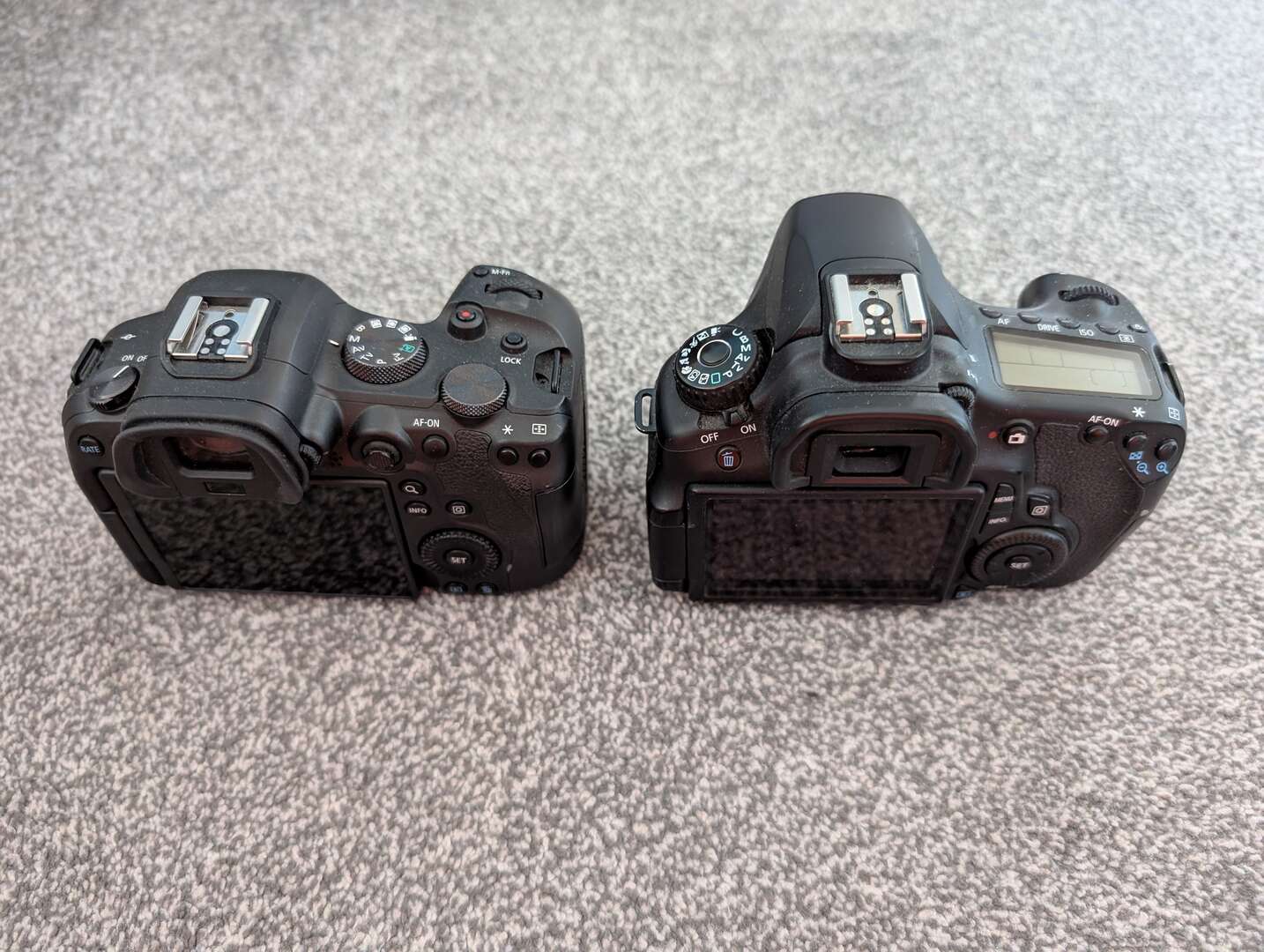
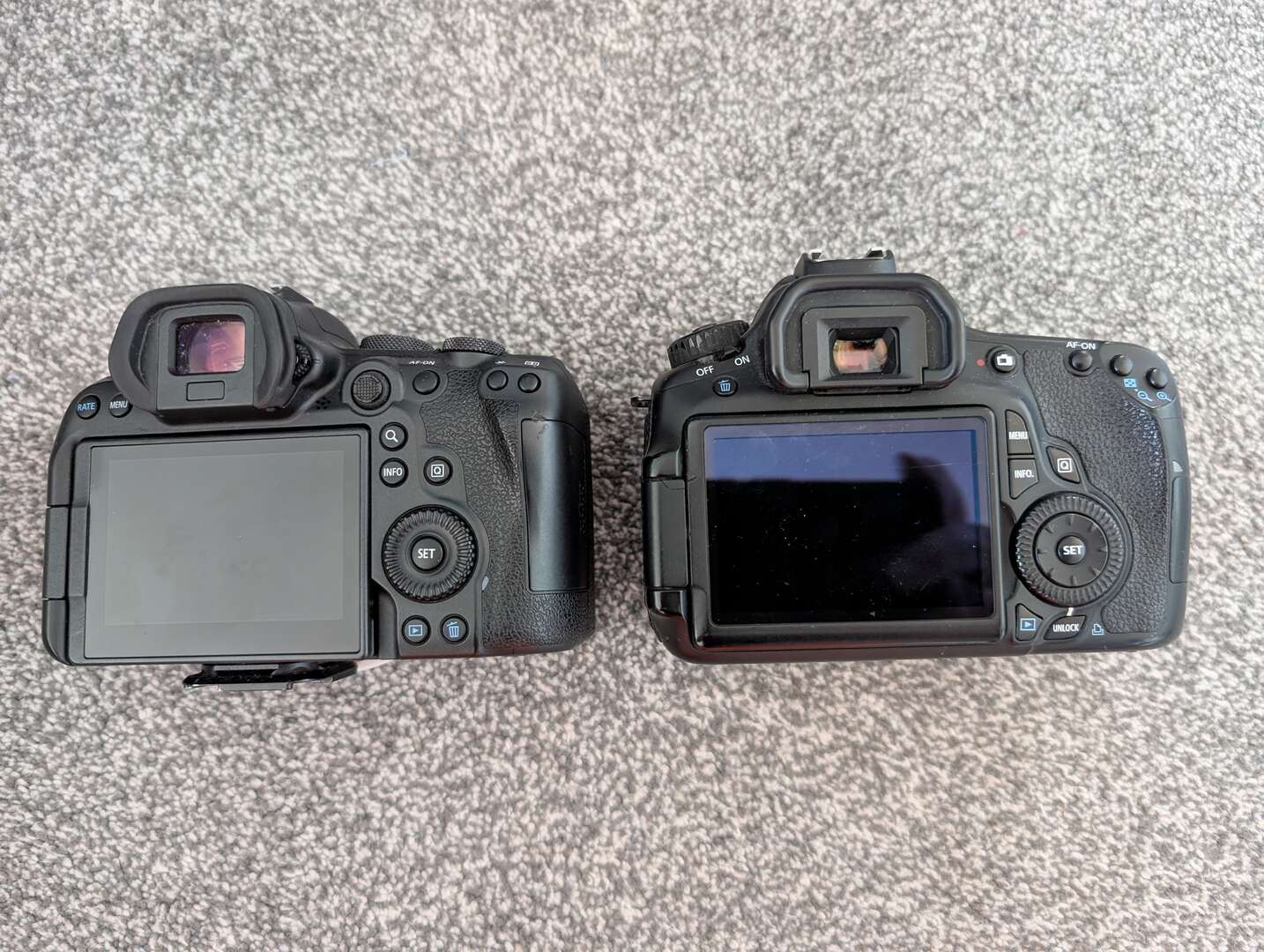
Additional complexity:
This too:
So far I've managed to fondle a Sony (which I didn't like - too angular) and a Canon R100 (which was too small for my manly hands) and a Canon R8 (which was nice). So I'm still heading in the general direction of the R10...
yes the sonys are very angular! I really liked that about them, it felt more secure in my hands as the edges would dig in, and the different angles meant i knew where things were.
You might like the Nikon bodies for the same reason I *didnt* like them - too big, too rounded
compared to a full-frame camera, the available light on a m43 isn’t so widely spread. Thus better low-light performance.
as a side note, we’d like to see camera manufacturers integrate Ray-Bans tech so that you could dispense with the EVF on those dinky little Fuji’s.
haven’t they already got the tech to work with dji’s drones?
compared to a full-frame camera, the available light on a m43 isn’t so widely spread. Thus better low-light performance.
Yeah so thats not how it works at all.
The amount of light on a sensor or a film is a result of the aperture and shutter speed. The aperature dictates the amount of light per mm squared the sensor size is irrelevant. Thats lens physics.
Pixel size dictates how a sensor reacts to light. Larger pixels gather more light. A smaller sensor can be created by either recuing the number of pixels but keeping the same pixel density it would perform aswell in the same light at the expense of definition OR by keeping the same number of pixels and reducing their size... Maintains Resolution and reduces the low light performance (because the pixels get smaller).
The caveat to that would potentially be technology or architecture of the sensor which might change the performance.
compared to a full-frame camera, the available light on a m43 isn’t so widely spread. Thus better low-light performance.
You’re incorrect. It’s hee haw to do with sensor size and everything to do with lens aperture and how long the shutter stays open, as above.
A f/2.8 lens on a m43 sensor will gather the same light as a f/2.8 lens on full frame.
However, a f/2.8 m43 lens will be considerably lighter and more compact than a full frame equivalent, but it will still gather as much light.
Size of sensor is a massive factor.
an m43 sensor doubles the focal length of a regular full frame 50mm lens to 100mm.
it’s complicated:
with m43, it is easier to obtain front to back depth of field with the greater available light.
does this mean that on a m43 camera, you would need a much slower lens to achieve a ‘bokeh’ effect?
It doesn't doubel the focal length. The focal length is the focal length the principal point of the lense to the focal plane where infinity is in focus.
That is the same regardless pf how big the sensor is.
A small sensor has "an equivalent" focal length which is the same angle of view of a full frame sensor (24x36mm from 35mm film days).
Using a 50mm focal length on a full frame is roughly equivalent to the human eyes field of view. By cropping the sensor that angle is reduced giving the effect of a longer lens but crucially changing neither the focus distance nor the the amount of light coming through for a given aperature.
What you are saying is literally impossible.
Smaller sensor = more apparent depth of field: yes, but it’s nothing to do with more light gathering.
My iPhone has a fixed f/1.8 aperture. The tiny sensor creates a high depth of field even with the tiny aperture.
If I used an f/1.8 lens on my full frame camera and used an equivalent focal range, maybe 35mm, the shutter speed would be the same as the iPhone i.e. gathers the same amount of light for the exposure. However, the full frame exposure would have less depth of field than the m43.
If I wanted front to back sharpness on a full frame, then I would typically use an aperture of f/11. For a m43, I could probably use f/8 to get the same effect, because of the small sensor. The shutter speed would be faster for the m43 at f/8 than the full frame at f/11. Both are still gathering the same light for the exposure though.
@north of the border.
that’s broadly similar to what Derek Forss discusses, above.
”the three factors affecting depth of field are
sensor size
aperture
focal length”
As he demonstrates, with an m43, you can obtain front to back depth of field in low light conditions (without camera shake, having to bump up the ISO, recourse to a tripod etc).
it’s worth bearing in mind that because an m43 doubles the effective focal length, you need to use a much wider angle lens to regain depth of field on an m43 (imagine how difficult it is to achieve depth of field with a crazy long telephoto lens).
but with your oh’s iPhone, we can’t merely assume what the focal length of the lens is, for comparison purposes.
it would really help if Apple included a legend, measured in focal length (17mm, all the way up to 150mm), rather than the current 2x, 5x, 8x).
im not entirely clear as to why the physics of the m43 system allow improved low light performance (assuming an equivalent aperture, and wider angle lens).
then again, no one completely understands how sound waves travel.
The way that I try to understand how sensor size affects depth of field goes like this:
imagine it’s a sunny day. You’ve got a magnifying glass and a football.
the magnifying glass will focus the light into a very hot pinprick.
if you were to place a concave lens between the magnifying glass and the football, the available light will be dispersed over a larger, less hot area.
now imagine there’s a limit to how long you can use the magnifying glass. 60 seconds with only a magnifying glass, and 60 seconds with the combined magnifying glass and concave lens.
there would be a marked temperature difference.
in other words, the smaller the target area that you are focusing on (sensor), the more concentrated the light.
So with photography, theres only a finite amount of light entering the camera between the shutter opening, and closing.
likewise, at another extreme, imagine the difficulties of taking a photo when it’s really bright…faster shutter speed, lower ISO (to help soak up the sheer abundance of light).
im not entirely clear as to why the physics of the m43 system allow improved low light performance (assuming an equivalent aperture, and wider angle lens).
Because it doesn't. You think it does because you are comparing equivalent focal lengths but you are looking at it in isolation.
Its a really basic principal. Think about it, take a full frame sensor set everything so it in focus and exposure is correct. Then take a bit of card and cut a m43 sized hole in it. Place that card over the sensor. Thats the only change you are making with a smaller sensor, there no magic bending of light happening. You get "more light" if you look at equivalent focal lengths because the lens is closer (doubling focal length halves the light intensity) but again for the same pixel count the pixels have been reduced by the same amount so it performs worse and cancels it all out.
Which essentially the point, to achieve what you are claiming you are changing something and when you change something everything else changes. Its all tied together.
There is nothing wrong with a m43 camera my gf1 is still my only digital camera, its ace, The size of trade offs are well worth it. My other "sensor sizes" include everything from a half plate to a minolta 16mm.
Now, if you don't like that you'll hate the next bit...
lower ISO (to help soak up the sheer abundance of light).
Thats not how ISO works on a digital camera. Its just amplification of the native lense signal strength.
compared to a full-frame camera, the available light on a m43 isn’t so widely spread. Thus better low-light performance.
I use a full frame system and a m43 system, I spend a lot of time working in low light environments, and I can absolutely assure you this is not the case.
I've got an eight year old full frame camera which knocks the socks off my very recently released (and highly rated for low light) m43 camera.
Pseudo science it all you like, reality is m43 is not better in low light that full frame.
I think I understand what you are trying to say:
m43 small sensor: to obtain front to back sharpness would be something like f/7.1 (a fairly large aperture, so the shutter stays open for a short time to gather the light).
Full frame 35mm sensor: to obtain the same front to back sharpness would be something like f/11 (a smaller aperture so the shutter stays open for longer to gather the light).
Assuming same focal length and ISO for the above, the shutter speed would be faster for the m43, say 1/15th second vs the full frame which would be 1/5th second.
is this what you mean by better in low light? It’s not better; it’s just potentially reducing shutter speed to obtain the same depth of field because of the small sensor. It still gathers the same light to make the exposure.
* reducing increasing shutter speed to obtain the same depth of field
The Panasonic lumix s10 has been released today-ish.
If you aren't bothered about full frame (or neccessarily shooting raw) Fuji have some of the very best SOOC JPEG's IMO. I'm forever hovering over an X-T5
horses for courses
Thread resurrection:
I have a Canon G16 from 2014. It still takes pretty good snaps and can print up to A4 but I'd like something better to be able to do occasional A3 prints. It's got a 5x optical zoom which I'd like to improve upon.
I'd like it to have real buttons and a viewfinder. Better WiFi support for moving files would be nice. It's mainly for landscapes when out walking with occasional city stuff on holidays
Any ideas what to get? Ideally smallish and easy to adapt to.
we'll need a budget, as the price of cameras goes from 0-♾️
I didn't realise cameras were so expensive until recently
Maybe £700 new or up to £500 used

