What’s an angry dolphin? I really hope I’ve not ‘angered’ OP?
I’m trying to get a feeling about what the OP has trouble with/where he is/what he has learned/how he has learned. I chose that specific tutorial for a number of reasons.
I’m being purely analytical and literal.
stevexc, yes I just meant that one tutorial, not the entire course of hundreds!
This specific episode seems to be entitled “How to draw buildings in 1-Point Perspective” but this is not something I’d find difficult at all… it’s by far the easiest part.
‘Easiest’ is still relevant and diagnostic. ie minus given measurements and plus the requirement to draw/construct your own horizon, VP and shapes freehand? To make a scene as convincing as or better than the one in the tutorial?
So why not do it? 30 mins at it even?
For my part I tried that same exercise last night (during insomnia hours) - and made a horrible hash of it, then ‘ran away’ leaving it unfinished. Constructive drawing is a notable weakness of mine. I aim to improve it to a standard good enough to assist both my painting and drawing. Yet I, like you ‘can draw’ certain things. Just better at some things than others. More ‘comfortable’ with some than others. Much remains unexplored because learning is a process (or else at standstill without structure/method)
Where this gets very very challenging for me is “and maybe some trees and bushes, we don’t need any details just a sketch”
Got it.
If the drawing guy had instead ‘and maybe some cones and cuboids...’ would you then find it ‘very challenging’? ie some formal topiary?
So when I see this it is do something incredibly simple … draw a set of buildings in a single point perspective but make it harder by not using a ruler..
yep OK….
Or even (in your position)- ‘Nah, too easy’ 😉
then do something incredibly difficult that’s not even in the title and sketch some trees and bushes
Hence I feel like either I’m missing the point… or you are?
I think maybe you’re looking very hard for a ‘point’ - instead of actually just completing the tutorial and then examining the results/experience? But yes, there were adjunct/minor ‘points’ to the bushes (and clouds) beyond the overarching subject/title.
I can draw the buildings in 1 point perspective. They have shapes and holes of simple shapes…
Yep.
Trees and bushes however are next to impossible… they don’t look like that. They have raggedy uneven shapes and bits you can see through and bits you can’t.
EUREKA! (I shout). - (more later)
I can’t even tell what general species they are in the drawing…
From my perspective they (bushes, clouds) were intended (per that tutorial) and sketched in simply, principally to put the buildings in a scenic context so that you the student are inspired to imagine/create/render your own.
I think that if one customarily observes and understand things hyper-literally, then I could see why you might mistakenly believe that was the purpose of that segment of the tutorial?
To create a faithful representation of a certain species of bush? With every leaf? My tutor covered exactly this when I was studying landscape painting - he said - ‘only a mad person would draw every leaf of a tree’. He taught me that to give an ‘impression’ of a scene in painting you must first learn to look at the fundamentals. Learn those first and then refine (or not) as per chosen style. Like a low resolution rendering.
To achieve this when sketching* a landscape I squint and look through my eyelashes when ‘blocking in’ tones, shapes, forms. This is the low resolution ‘construction’ phase of a scene for want of a better word. Actually called ‘blocking in’, most commonly.
He didn’t mean literally ‘mad’ of course, but that obsessive level of detail is best performed by the obsessive or else someone who is attempting ‘hyper-realist‘ painting. Yet to what end? Just take a photograph, right? Or use one and paste it right there🤣
This is the part I get completely dumbfounded
Unless there is some deep hidden agenda in this video then it looks to me like what the title is?
Quite the opposite. You’re maybe being ‘hyper-literal’ and over-focusing on the (non-constructive) organic shapes. As I say, they were just added in loosely to give some context of how a bunch of shapes drawn with perspective (here buildings) can become a ‘natural’ scene that one is attempting to convey (plops some bushy things about the place)
It doesn’t help me with the part I struggle with…
Just to be clear I wasn’t trying to help your drawing skills here, I was trying to diagnose where you have particular difficulty over and above the average - which at this level (as per chosen tutorial) I would say that most untrained adults would have a hard time creating such a convincing scene even to that basic level of completion.
ridiculously simple until the teacher wanted me to include people and palm trees or whatever…
What she didn’t seem to understand is why I could do a detailed perspective of the buildings but to all intents and purposes I might as well as just vomited over the page when it came to people and palm trees.
I chose that one specifically because i knew that you have some experience of drawing buildings from possessing architectural/technical/mechanical drawing skills (however you acquired them)
BUT I wanted to know how you felt when approaching a less ‘formal’ challenge where you are being asked to do a few things you may be less comfortable with.
In short:
1. Putting away formal measures/ruler and having the confidence to attempt to ‘re-invent’ a nominal scene similar to the one in the tutorial. (As a prep to finally inventing one from scratch)
3. Applying light/shade and tonal values, therefore questioning them.
The ‘not using a ruler’ thing is indeed to make it ‘harder‘. Or more correctly - to ascertain whether you (like most people) are uncomfortable without it, even when ‘only’ drawing a simple line or cuboid?
Or whether you (like most) can eventually learn the skill to draw an acceptable (say) horizontal line (or simple curve) AFTER some structured practice, yet your exacting hyper-literal, technical outlook/personal requirement of ‘drawing’ sets you up to ‘fail’ at conceptual/working sketches such as these because you are demanding of/uncomfortable without utter geometric/mathematical ‘perfection’ in everything that you create?
* https://en.wikipedia.org/wiki/Sketch_(drawing)
Maybe what I should ask now is - do you/did you ever enjoy doodling?
Do this 4 times over when you get some down time? Let me know the pain level on a scale of 1-10 :

What’s an angry dolphin?
Cross porpoises.
I got to wondering why for example if you can’t spell or add up it’s a disability but if you can’t draw or understand music it isn’t?
Going back almost to the start not being able to spell or add up isn't in itself a disability. It can put you at a disadvantage but not a disability. You tend to have to write and add up more than draw or sing in day to day life. Not being able to do the latter two doesn't necessarily put you at as much of a disadvantage. Hence the focus on literacy and numeracy in schools. There is a whole other thread in whether we value the arts and a government employment ad that suggests we don't. Anyway vaguely back on topic.
There are disabilities that impact on your ability to spell - dyslexia; do maths - dyscalculia; and draw - dyspraxia. Dyslexia is not just about spelling - back in the old days when it was just good old fashioned laziness and stupidity. Thankfully we are in more enlightened times. Each of them impacts on much more than a persons ability to spell, do maths or draw.
Sticking with the theme experience of dyslexics then and now; not being able to draw might not have been as a problem just a lack of talent. Now it may be more if you are poor at drawing, PE etc it could be a school would pick up on it. Being semi serious - if we communicated in pictograms then not being able to draw would be much more of an issue and get greater attention. Then you can go into symptoms of being on the autistic spectrum - which can include spacial awareness. Again this may impact on someone's ability to draw.
Cross porpoises.
Isn't that an essential part of talking on any thread.
There is a whole other thread in whether we
value the artstake the arts for granted, and a government employment ad that suggests wedon’tdo
Imagine life without the arts/art? I don’t think that it’s possible. What is possible is to imagine living in a consumer culture where most people couldn’t even name the arts? No matter if our world and our lives within it are full and enriched exactly on account of the arts? We weren’t always this reductive and superficial. Imagine everything and every skill being reduced to the purely mechanical, with none of the arts whatsoever?
In the Middle Ages, the Artes Liberales (liberal arts) were taught in universities as part of the Trivium, an introductory curriculum involving grammar, rhetoric, and logic, and of the Quadrivium, a curriculum involving the "mathematical arts" of arithmetic, geometry, music, and astronomy. The Artes Mechanicae (consisting of vestiaria – tailoring and weaving; agricultura – agriculture; architectura – architecture and masonry; militia and venatoria – warfare, hunting, military education, and the martial arts; mercatura – trade; coquinaria – cooking; and metallaria – blacksmithing and metallurgy) were practised and developed in guild environments. The modern distinction between "artistic" and "non-artistic" skills did not develop until the Renaissance. In modern academia, the arts are usually grouped with or as a subset of the humanities. Some subjects in the humanities are history, linguistics, literature, theology, philosophy, and logic.
The arts have also been classified as seven: painting, architecture, sculpture, literature, music, performing and cinema. Some view literature, painting, sculpture, and music as the main four arts, of which the others are derivative; drama is literature with acting, dance is music expressed through motion, and song is music with literature and voice
https://en.wikipedia.org/wiki/The_arts#Multidisciplinary_artistic_works
Anyway...just had a doodle as per the exercise. Haven’t done it before (only just recently got the book) and was surprised how much I enjoyed it. Having attention deficit issues means this is the perfect exercise for me. By ‘perfect’ I mean achievable without any noticeable pain/discomfort/frustration/evasion. If I had to sit and draw that house/buildings again I’d most likely be feeling miserable and defeated after 10 minutes.
Not because there isn’t a system, or that I cannot imagine/remember features of buildings... but because of the sustained effort of concentration required on a specifically ‘mathematical task’. Anyway, making fast heads with faces is fun for me as I just discovered.
thispersondoesntexist dot doodle
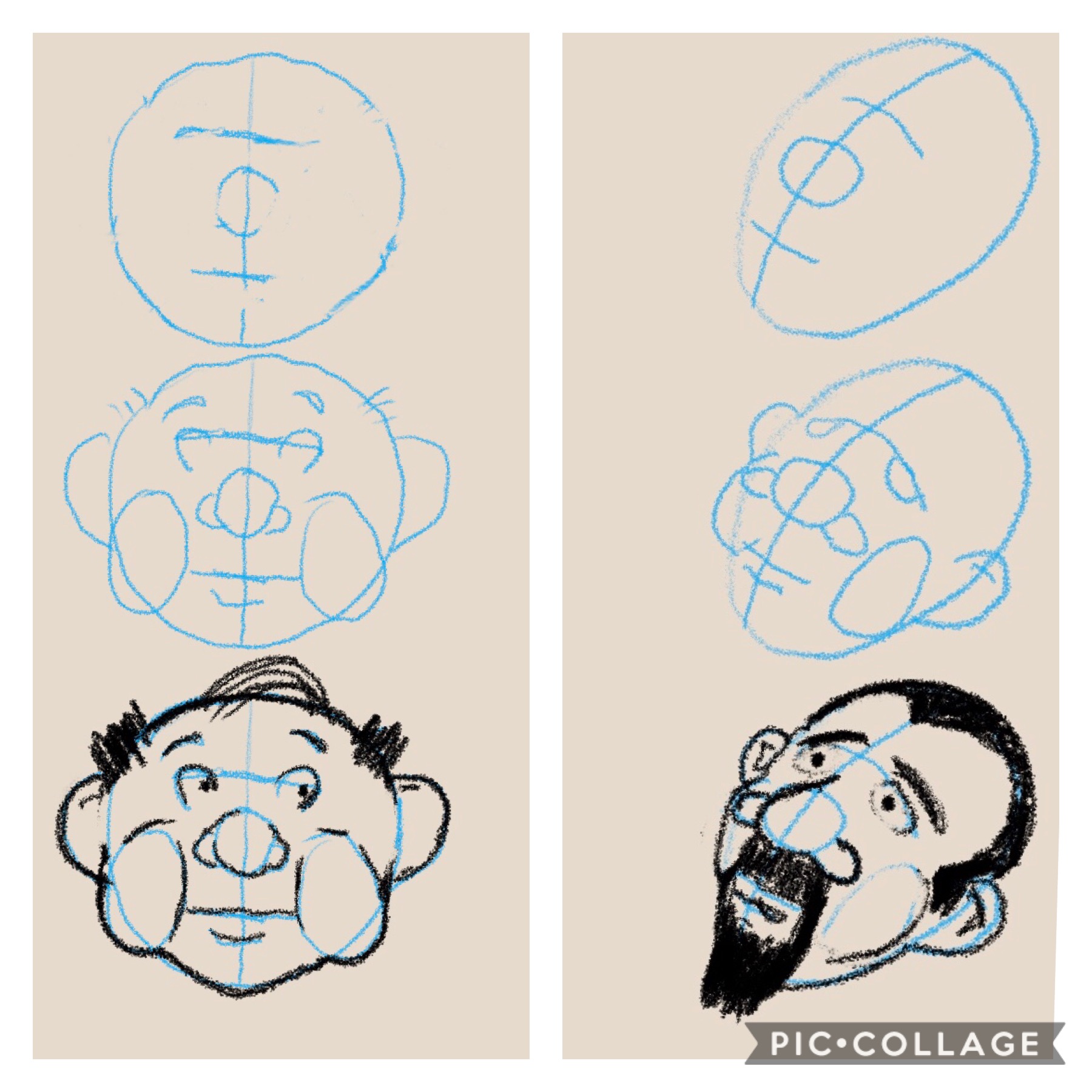
I'm not actually sure the point of 'Drawing' in this.
To the autistic, we think in a photographic way. But id be useless at explaining this.
To design i dont need a picture or design to work to because ive designed it completely in my head, inside, outside, somethings it seem a bit like autocad, as we revolve and view from different dimensions.
My father was the same and had spoken to me about it, and how in a part of his job CNCing big things for ship building industry, he said by eye he could picture the casting and work out the best way to machine it. All in his head.
I dont think my Father suspected he's a savant, but i dont know his own thought on his skills here as i didnt really know him till the end.
Finished his career as Principle engineer for BAEsystems.
Funny story(yup they're never ending, because of my own autistic 'traits' 😉 )
I was getting work done in the house and the builders were completely Fing up the times. After a few complaints Dad phoned the company and was put through to their project manager.
He told my Father the confusion was down to him trying to liaise the 20 staff.
Dad never swore, not in front of us anyway and this was the only time he did.
" It was at this point I knew I was dealing with a ****ing Idiot, and went on to explain that he had to oversee the work of approximately 30,000 people. Everything went past him. Obviously BAE you know what they make.
That is a lot of information to store, recall, correlate, but then you dont head that company unless you are in the highest of the population percentage, of which can be the 0.3%.
So who needs to draw ?, not I.
Actually there was another thing he told me pointed to the savant.
IBM supplied the computers, for the many formula that level of engineering works at. Probably the mid 70's.
Dad did his calculations on his slide rule, then fed the info into the computer and the answer came back wrong.
Dad knowing he was right and the IBM programmer had mad a error, so he said he worked through their program, and changed it to comply with his answers.
I can only speak for myself but it's only in recent years that I've got around to thinking, ASD isn't a disability, it's my superpower.
What makes someone "normal"? It's a numbers game, the neurotypicals outnumber the aspies (hence 'typical'). If the NTs were a minority we'd have support groups for them, because,
To design i dont need a picture or design to work to because ive designed it completely in my head, inside, outside, somethings it seem a bit like autocad, as we revolve and view from different dimensions.
... what do you mean, you can't do this? What's wrong with you? You're just not trying, are you.
If we're swapping anecdotes,
My previous boss is one of the few that's ever 'got' me. I'll gloss over my current boss who's worse than I am. But one particular exchange stuck in my mind.
He'd given me a fairly complex project to complete. A couple of weeks later he asked for an update, I told him it was maybe 90% complete. 'Great,' he says, 'can I see what you've got so far?' It took me a moment to parse the question as it didn't immediately make sense to me, and then when I explained, bless him, he understood and took me at my word.
No, you can't see what I've got so far, unless you put me through an MRI. I've spent the last fortnight thinking. I've worked on this at work; on the bog; on the drive home; lying in bed reading with it running as a background task because y'know, my subconscious is better than my conscious* at some of this shit. How do I show you that? I've done most of the heavy lifting, collating it all together and shoving it into a computer program / Word document / whatever is the easy bit.
Dad knowing he was right and the IBM programmer had mad a error, so he said he worked through their program, and changed it to comply with his answers.
I think I've just worked out who your dad was.
https://en.wikipedia.org/wiki/Kobayashi_Maru
… what do you mean, you can’t do this? What’s wrong with you? You’re just not trying, are you.
If I had a penny for every time a teacher or parent said that (regarding school work, calculations etc) I’d have, er, lots of pounds.
Same with music theory and cello (at school). I couldn’t concentrate. Was kicked out. Yet I loved music and by twenties I composed music with synthesisers and computers and would be absorbed for weeks at a time on one piece. Same with photography.
* - I've dropped this footnote into a second post because... I don't know, it's maybe a bit weird and I wondered if anyone else did this. I can (sometimes, if the planets align, it's not easy) actively deploy my subconscious. A bit like the old "it'll come to me if I stop thinking about it" adage, but I'll intentionally decide to shove a process into a different bit of my brain that's better suited to a task than I am.
Is that weird? Is that just me being weird? Like, it sounds weird even typing it and it's not something I've ever even really thought about before.
Trees and bushes however are next to impossible… they don’t look like that. They have raggedy uneven shapes and bits you can see through and bits you can’t. I can’t even tell what general species they are in the drawing…
This is the part I get completely dumbfounded.
Steve - since you like to distill things to equations there's probably a way to treat these seemingly random shapes to fractals. They may not end up looking exactly like a real tree but would be recognisable as being tree like - after all computers can be "taught" to draw organic structures.
I think what you are struggling with is the idea of a drawing being a clearly recognisable representation, which is at the same time not a perfect representation of what your see. I'm guessing you dropped (or were dropped from) art before it reached that stage. We had an art teacher who used to make us do weird exercises like draw with a pen without removing it from the page so it was one continuous line, draw blindfolded, paint by flicking paint from a toothbrush, draw only with a ruler (which generally is probably something to avoid if you are trying to sketch rather than draw for engineering), draw what your partner describes and you can't see, paint using only a very limited palette etc. I didn't like them at the time (I was much happier with detailed classic drawing) - but I can now look back and see that they were teaching how to analyse shape, light, shading, texture and transfer that to the paper. They were also a bit of a leveller as people who were classically good were doing something odd, and therefore not perfected.
But drawing people and animals is notoriously difficult. Whilst there are a few people who are true naturals at it most people are not that good to start with - tutorials (and teachers) will often break down the shapes into basic shapes just as you would with a house - then you just need to add fur!
Going back to the original question, of course its possible you do have some disability that stops you from being able to control your hand, just as someone with parkinsons, cerebal palsy or indeed someone who was vision impaired would find it harder to draw. Presumably if that is the issue then you would be more able to draw with a computer where you can easily adjust the position of lines/shapes etc? It would be interesting if you could describe to someone else how to draw what you want since you are able to imagine it.
* – I’ve dropped this footnote into a second post because… I don’t know, it’s maybe a bit weird and I wondered if anyone else did this. I can (sometimes, if the planets align, it’s not easy) actively deploy my subconscious. A bit like the old “it’ll come to me if I stop thinking about it” adage, but I’ll intentionally decide to shove a process into a different bit of my brain that’s better suited to a task than I am.
Is that weird? Is that just me being weird? Like, it sounds weird even typing it and it’s not something I’ve ever even really thought about before.
Cougar - don't think its that weird. In the late 90s I did some training as a "Ideation facilitator" and some of that was based around the idea of trying to get people to consider a problem without thinking about the specific problem because you tend to become focused on fixing it the "most obvious" or "literal" way. I actually get frustrated by people who do the opposite from you - and plough into the work producing a plan before they've understood the problem.
^^ poly you said exactly what I’ve been failing to say/show.
Nicely put.
I totally failed at technical art college after school. I also failed in school to secure a degree course at my chosen Art School, interviewer cited ‘lack of focus’
My lecturers at art/technical college (almost all of them) were (in retrospect) of the entirely uninspiring and wretchedly passionless type. They were at an ‘easy gig’ filling time. Destroying potential in us working class kids who’d for whatever reasons (you can draw spiderman, can’t you?) chosen ‘art’ instead of ‘technical’
I quit after the first year, and after failing my exams. Photography. Art. Art History. Fail. Fail. Fail.
22 years later I went (after subsequent careers in self-taught Graphic Design and self-taught photography) back to art school this time with a prominent painter/lecturer (also a top-rated author on the subject)
Utterly transforming. I had seemingly struggled to draw since forever. With pencils, with rotring pens. Everything was represented as an outline. One 20 minute lesson on ‘values’ and ‘form’ then changed my whole world. White light choirs moment.
I could see the landscape, and dreams, and faces, and concepts, and movies in my mind that I wished to animate
And that's the most telling part of that post. Because I can't and I rather suspect that Steve is the same. You had the ability but lacked the technical. I (we?) arguably have at least some of the technical but lack the ability.
Here's a question for you. You're talking about an ability to draw except you actually aren't, you're talking about an ability to create. Presented with a photograph or another drawing and being told "copy that" how would we all fare? Like, you need zero creative ability or understanding of perspective or lighting to be able to just recreate something, right?
what do you mean, you can’t do this? What’s wrong with you? You’re just not trying, are you.
I've a really bad hand tremor, so unless you can understand scribbles, I think it best not 😆 An annoying legacy from my Sidney Cooke ahem 'meeting'.*
It was actually a promise to my design lecturer to actually draw and not as just keep it all in my head.
* I know, I know there he goes again, adding the horrific to an otherwise wonderful thread. 😳
As above, its down to pictures. I and I expect most of the ASD world have an immeasurable inbuilt library of everything we've seen over our life. and one picture or train of thought can lead to other imagery that we'd use
Sometimes its easy to recall, but other times a picture or reference can then produce a set of reference pictures.
So what happens as above is you inquire as to why I cant draw too, which then is explained due to hand tremor, which then produces references.. I was going to add' why that is'
You have to remember that trying to explain this isnt actually easy unless you study the subject from outwith.
And that’s the most telling part of that post
Haha and I thought better to delete it to spare others the whole indulgent rambling mess 😉
But you may be right. Let me examine it.
I could see the landscape, and dreams, and faces, and concepts, and movies in my mind that I wished to animate
Let me choose one. A topical one.
I can see faces
Now. That can mean a few things.
1. I have average functionsl eyesight and can see light, shade, shapes, proportions, movement, form, colour, depth/perspective etc.
2. I can recognise a face as a ‘face’. Human face. Dog face. Rock face. Ok the last one was a test 😉
3. I can see a number of faces and differentiate between them
4. I can see faces with expressions and can determine that they are expressive
5. I have learned to read expressions to some useful degree*
*I worked for just over seven years with (profound) ASD, ADHD, PDA (support assistant in a school for young adults with complex learning needs) and understand how other’s facial expressions can mean lot of things/or nothing depending on ability/wiring
Ironically, I also seem to have difficulty always reading people’s motives and expressions. Not so terribly as to never get it right, but rough enough to affect relationships (existing and potential) and for me to sometimes literally ask people what they are thinking in order that I don’t misapprehend.
Mrs P can sense a ‘fake smile‘ for instance. She ‘reads people‘, that’s her language. Whereas I sometimes just see ‘a smile’, while missing that it’s actually insincere, or a ‘bored grimace’, or whatever else.
This affects my relations. But does not affect my practical ability/potential to study anatomy and life drawing.
Does that make sense?
*Edit I see some confusion potential. Let me correct.
I could view the landscape, I could view faces. I could view trees.
I could also (therefore) imagine concepts, and imagine similar trees to those which I had seen, and imagine similar faces to those I have seen, and ‘imagine‘ (assemble) movies in my mind that I wished to animate. All in my mind. I can observe certain things and remember many things about them
That’s hopefully much less misleading/less ambiguous.
Sorry all.... very limited time
Steve – since you like to distill things to equations there’s probably a way to treat these seemingly random shapes to fractals. They may not end up looking exactly like a real tree but would be recognisable as being tree like – after all computers can be “taught” to draw organic structures.
Cougar and Dyna-ti summed this up.
It's not what I "like" .. that's the easiest way I can explain it.
Equations are shapes and shapes are equations...
Dyna-Ti ... wondering how old your Dad is/would be... my Dad was at Lucas... amongst other things he did the Lightning tailfin structure.
But drawing people and animals is notoriously difficult. Whilst there are a few people who are true naturals at it most people are not that good to start with – tutorials (and teachers) will often break down the shapes into basic shapes just as you would with a house – then you just need to add fur!
I know 2 people who have been able to just do this "forever" (pre-school)...in the same way I see an equation / design (whatever) in my head fully formed they have it in their head. The one who is a professional artist has learned techniques but he hasn't according to him learned how to draw/paint just better ways to use materials.
Getting back to the drawing question.
Did you drop lucky on your ‘build up’ method, or had you previously studied drawing at any level?
I did art at school but dropped it when you had to choose O-levels. I don't recall being taught to draw in much the same way as I don't actually think I was taught to learn. After that I drew maps and plans or doodled squiggles. Main creative outlet was photography and the odd random arranging stuff like stones / wood - calling it sculpting would be overly generous.
I found drawing frustrating as I can't draw things the way I see them. I left it alone - occasionally not being able to draw was a pain. There are times in the day job when I need to have a drawing to help explain a specification. I cover this off by being the master of the Blue Peter school of annotated photographs and being able to knock up a mean diagram in powerpoint. The lock down drawings - car key fob, Garmin gps and a simple landscape. I just came at it from drawing is a problem to be solved - I can't draw as a whole can I assemble from parts seemed the next logical approach. There are lots of different styles whilst and you don't have to produce an exact replica interpretation is perfectly acceptable.
It was this is what I have / know, this is what I want to do - how do I do it. Guess in someways I turned it into a process. I was struggling with the idea of drawing figures - just get the proportions as an instruction was about as much use as chocolate teapot. Which is why the block approach made sense - I could see how build up / take away can combine with blocks to make a figure.
I caught something on BBC earlier this week - looked like some 70's or 80's painting programme. The guy was doing a landscape by building it up - it was then ok that's a proper technique. A brief thought before going off on they don't re-show modellers world; then it was off into is art more accepted by model making?
Back to drawing
Trees and bushes however are next to impossible… they don’t look like that. They have raggedy uneven shapes and bits you can see through and bits you can’t. I can’t even tell what general species they are in the drawing…
This is the part I get completely dumbfounded.
The landscape I drew had trees have a certain lollipop quality to them. If I look at it in terms of accuracy and detail it's shocking. I would really really like to be able to produce an accurate landscape but I've got photography for that. The aim of drawing was just to relax and be creative - the other bit's were nice to have.
I found drawing frustrating as I can’t draw things the way I see them
How do you ‘see them’? OP sees things as ‘equations’, for instance.
I find foreign languages frustrating. I can’t speak foreign languages the way I read/hear them. But I can understand what a language is. My own language was easy to learn, for instance.
I would really really like to be able to produce an accurate landscape but I’ve got photography for that
Oddly, as a (landscape) photographer I soon sought out painting and drawing classes because I got ‘ so far’ with landscape photography as a medium before it’s limitations (both as an art form and as an accurate record of colour, ‘atmosphere‘, light and form etc etc) became apparent at an inverse rate to my abilities as a landscape photographer. I began taking a sketchbook to shoots in order to use mixed pigment by which to notate and record (say) the colour of a hill in shadow, because the camera couldn’t record it. So then in post processing I had a physical reference in the pigment.
Those blue remembered hills really are blue. Sometimes a very light blue. I learned to use one of these to isolate the values and chroma to make an accurate record:

And that was just the start of things. It wasn’t just ‘colour’ that the camera was ‘missing’.
Our painting tutor had a box full of postcard (of paintings) he’d collected over the years from galleries worldwide. I realised that I’d never in my life studied either painters or paintings to any degree. Just seen them here and there. Gone to a few galleries. Forgotten them. Uhm and ahhd. Liked pre-raphaelites. Etc. Liked illustrators such as Harry Clarke, Beardsley. Some graphic/comic artists. That was about it.
Never studied formally. But now after years of being a photographer I was all of a sudden seeing all these paintings by artists throughout history. Countless different approaches to recording nature and the landscape. For me, sitting and sifting this pile of colour paintings was a eureka moment. An avalanche of colour, light, form, recognised shapes (and remembered smells), mystery, beauty, abstration and emotion. Being outdoors in nature was always my overwhelming passion. Hence photography. So why had I ignored painting?
Humble pie was eaten. A new desire (at 45 years old) to learn was activated and the (difficult for me, ADHD) pursuit of formal study began. Mileages vary. I so much wish that I’d had intelligent guidance as a kid.
I've not watched it yet, but this just popped up in my YouTube "up next" list:
I got to wondering why for example if you can’t spell or add up it’s a disability but if you can’t draw or understand music it isn’t?
is a disability if it presents a barrier to access.
You’re also talking about a ‘learning’ disability or difficulty. People with dislexia aren’t unable to read /write - it’s just more difficult to learn that skill. My brother is dyslexic - his working life is spent laying out and proofing text. It’s not especially difficult for him to do it was just difficult to learn.
Drawing is something - some skills like language and literacy and riding a bike you learn and never forget. Drawing is a practice it’s something you learn but then have to maintain to stay any good at it. I was selling paintings and drawings before I went to artschool. But I stopped drawing in my first year and haven’t really done it since. 30 years later I work in design for films and undertake £40,000 £60,000 art commissions.... but don’t go any drawing and couldn’t if I was asked to without a few years run-up
^ Have seen that. Didn’t teach me anything other than that I dislike ‘magicians’ who talk to adults as if adults are 5 years old 😉 ymmv
This is pretty good OTOH
some skills like language and literacy and riding a bike you learn and never forget. Drawing is a practice it’s something you learn but then have to maintain to stay any good at it
There’s also ‘riding a bike and ‘RIDING A BIKE!’
So why do I forget languages? I lived with French people for a few whole summers. I began learning French just by practising speaking with them. I can speak my own language pretty well but have great difficulty learning foreign languages. I just seem to have a blockage or am too slow-learning. And if I’m not speaking it all of the time I ‘forget’ a lot of it, but not all. I go backwards. Like with (accomplished) painting, anatomy, colour theory, mixing etc etc. I really have to do it AND teach it in order to ‘get it lodged into my muscle/memory’ and stay there. Is it something to do with myelin sheaths?
Anyway, ‘semi-conversant French me’ was 5 summers ago, and I have forgotten nearly all of that French language by now. My writing is also poor, yet it gets better if I practice and do a little study, and better still if I read a lot of good writers. Then if I go some years not reading or writing, then it slips back, somewhat like our drawing skills? You remember most of the basics when it’s actively being performed but to what degree do you write vs draw? Time spent actively using your (verbal and written) language skills vs your drawing skills?
What are the ratios?
oldman said
I found drawing frustrating as I can’t draw things the way I see them
Most people never studied drawing yet seem frustrated that they can’t draw(?)
I find foreign languages frustrating. I can’t speak foreign languages the way I read/hear them. But I can understand what a language is. My own language was easy to learn, for instance because I’m not dyslexic, don’t have a speech impediment, and I started very young and never quit study. I’ve taken long breaks in isolation but have stayed in touch with my language via the internet. My spoken language skills noticeably suffered in long isolation. Spoken language is also emotional, as is art.
One of my hardest tasks in teaching the ‘language’ of painting and art seems to be convincing people that they ever actually studied/learned the fundamentals of their own spoken language. They seem to think to varying degrees that it was magically conferred to them at birth.
ia. Dyslexia is not just about spelling – back in the old days when it was just good old fashioned laziness and stupidity. Thankfully we are in more enlightened times.
Dyslexia is a useful construct for some people but its existence is not science based or at least highly controversial. Link posted at bottom of page one.
Dyslexia is a useful construct for some people but its existence is not science based or at least highly controversial
Exactly the same as Autism then ?. 1970 no such thing and plenty of 'professionals'; claiming it didnt exist.
Cougar and Dyna-ti summed this up.
It’s not what I “like” .. that’s the easiest way I can explain it.
Equations are shapes and shapes are equations…
Apologies if like was a bad choice of words there. I’d love to explore shapes as equations more - because there is a lot of sense for that as geometric shapes - I wonder if I showed you a child’s drawing of a tractor consisting of two big rectangles one “horizontal” and one “vertical”, and a small circle and a big circle double the diameter for where’s how you’d describe that as equations. If the child then draws a swirling cloud of smoke from its exhaust are you saying you don’t see that as an equation any more?
If I present you with a tractor in real life (or a photo of one) - can you distill it down to the simple equations to make a crude child’s drawing or do you always want to draw a proper engineering representation?
Coming back to your original point, I doubt the teacher was looking for engineering accuracy or creative artistic flair - when they ask for a picture/diagram of something they are usually looking for you to communicate certain information rather than portray a perfect picture. Understanding what they want you to portray is something that really seems to have changed since I was at school and my children understand much more about what they are being asked to draw, how it will be assessed, and why they are doing it (and how they Learn) - it’s fascinating to see compared to the 80’s way of repeat and you will learn.
Take the TEDx above for example. I guess some people would say he’s not really drawing because the characters he represents are not in front of him. I’d argue however he’s shown a way to pick a few key features, very rough nose shape, hair style, eyes/glasses, mouth shapes, clothing style, and you could Not only tell the different characters apart but you could represent their emotions etc - in very little time. So just as I might be able to write a coherent post here, but won’t write flowing poetry or booker prize worthy prose you don’t need to be an artist to be able to draw (at the level you need to keep non-art teachers happy).
Here’s a question for you. You’re talking about an ability to draw except you actually aren’t
Not a question!
I am talking about acquiring the knowledge and skills required to be able to ‘see’, study and represent what I see in real life AND/OR what I have in my imagination. Either/or, or else a combination thereof. Art can be purely representational or purely abstract. Or any combination of other things.
ie Let’s say I wish to represent my dog in a medium. Let’s say this time a tonal sketch in three values. Now what process shall I choose?
There seemingly endless variants of endless methods. Art has few ‘rules’ as a whole, yet ‘rules’ vary per style/process/method employed.
So for sake of discussion, let’s say I choose one or combination of any of the following methods :
1. Acquire/study/learn life-drawing skills, classical Atelier etc- and using oil paints, medium and brush sketch a representation of dog from life (direct observation of subject in life) or via taxidermised (word?) dog
2. Take a photograph of dog with (whatever lens) and be a ‘human photocopier’. ie trace/grid/make marks, fill colours etc. Essentially construct a 2d drawing of a 2d photograph. Use only three tonal values.
3. Combine classical Atelier ‘constructive drawing’ skills as per 2 yet imstead of live subject use a photograph for reference and so ‘fake’ a life study by using the photo as a (objectively inferior) substitute for the same dog in life.
4. Borrow my mate’s laser measuring gubbins*, measure pooch, make a mega-high res 3d print of dog. Then go to 2.
5. Trace someone else’s photo or drawing of same breed. Add a white spot where my dog has a white spot.
6. Make a cartoon representation of dog by using fundamental drawing skills you’ve acquired/learned and also by adding recognised stylistic flourishes ie exaggerating/distorting features, exaggerated foreshortening, etc
7. Same as 7 except using wide angle lens photo of dog, import into drawing app and trace (or freehand, or grid-copy) the photo as a drawing on a separate layer. Delete the reference layer and print the drawing.
*They actually scan/ major sculptures in museums at mad resolutions
It goes on and on...
What many people don’t seem to get is that there is A PROCESS to get from A (want to represent dog) to B (points to sketch or ‘completed’ representation of dog)
<quote>you’re talking about an ability to create. </quote>
Okay, but what representation isn’t also ‘created’?
Mrs P says I’m ‘autistically’ splitting hairs here, because I even say that a photocopy of a photo is still a ‘creation’. She may be right, but it’s still the way I see it. I have to deny the truth of the matter that someone took the photo, someone printed it, someone made the lens, the photocopier, the paper etc etc...
So someone/people are still behind the representation of the dog no matter how we arrive at it.
Where the hair-splitting occurs (again I had to ask for help here) is where we are talking about ART. What is the difference between ‘copying’ a 2d photograph like a human 2d copy machine vs learning and acquiring the fundamentals of drawing/sketching/painting and then producing something that would be ART? (#neverendingthreadwhatisart)
What is the difference between using a photo reference of your subject, vs a classical painter in history using an optical tool such as a camera obscure or camera lucida in order to assist their construction of a painting?
Not all drawing is drawing from life. And drawing from life (ie classical Atelier) is for most people like learning any other advanced skill squared. Even then there are many approaches and and many different students who may or may not flourish using this approach or that...but then THIS method clicks then they’re off and at it like a hot mess.
It’s more difficult still if you as a student (at any age) and set out blindly without a method. You wind up blindly imaging that doing it ‘wrong’ over and over will magically improve towards ‘right’ If you just keep on bashing away with no methodology in sight. Like thinking you should be able to learn a Mandarin dialect by keep moving your mouth in time to a muted video of a Chinese person speaking. ‘Turn the sound on’? ‘No, that’d be cheating...’
Presented with a photograph or another drawing and being told “copy that” how would we all fare?
How would I be able to answer that on everyone’s behalf? We’re all different people, each with different experiences, assumptions, acquired skills, mental blocks, learning deficiencies (acquired or intrinsic, temporary or permanent), learning advantages (same), different adopted methods, comfort zones, discomfort zones, expectations, confidence, aversions, insecurities, misapprehensions or attractions etc etc etc towards the task at hand.
As an artist who in later life has undertaken training and study in painting - I’ve never once been asked to ‘copy that photograph’, although I have been asked to choose a (black and white) photograph as a learning tool when studying values. It was one of the first things we did. We were instructed to use a pencil and mark out rough ‘blobs’ of tone in three grades (light/med/dark). A high contrast subject/photo was encouraged otherwise it would have been difficult if not impossible to begin learning the process of value sketching. To replicate the proportions of the photo we photocopied it, rubbed the reverse of the copy with charcoal and then used as a handmade carbon-copy. Just to get the outlines. Then the work started. We had to observe the original and represent the subject in the photograph by first blocking in (here with paint) using just three tonal values and minimal blending.
So I can speak for myself today.
But how would I fare at other times of life? Same question? Using what method? What medium? Rules? No rules? Before or after my acquiring skills in photography? Before or after spending hours and months and years doing unstructured sketching/doodling? When I was 6 or 12? 15 or 30? When I was 45 or following art school/painting instruction? Without any practice or instruction I probably wouldn’t have a clue what to do. I’d probably just trace it or steal it like an artist 😉
Why not specify a method/approach of drawing? How many can you name? Here are just ten:
https://www.artistsnetwork.com/art-mediums/drawing/10-different-drawing-approaches/
Like, you need zero creative ability or understanding of perspective or lighting to be able to just recreate something, right?
Sarcasm? Are you saying that we should assume that anyone should just be able to ‘copy’ things? But you don’t say how? By what method. And who? And beginning with which knowledge/skills?
I find this all to be totally fascinating. I’d love to know how you would fare if you completed that cartoon face tutorial a number of times. Whether or not you would develop confidence or understanding in any way shape or form. If you would be able to understand the difference or progress/move between ‘copying’ marks to ‘building’ form’? Or what your ‘pain level’ is to complete it just once following the guidance?
@stevextc, have you ever attempted to train/improve your pencil control? Simple lines and shapes as per short video below? (Ignore the hulk arm segment) If so do you enjoy experimenting? Have you ever doodled or sketched as a form of ‘play’? If so, guided (ie make an oval by simple constructive drawing, noe measurements provided) Or unguided? (ie just keep freeform ‘guessing’ at an oval shape, no guide)
Or does it cause ‘pain’ quickly because of what you feel to be overwhelming ‘freedom’, or else other difficulty encountered?
Likewise, does form drawing/constructive drawing cause ‘pain’ if you decide to SKETCH a scene of geometric forms from your own imagination? Even a series of say three different sized cuboids?
Wood you say that you enjoy art? (Not creating it, I mean enjoy experiencing it in it’s many forms/disciplines?)
* erratum
woodwould you say
wta?? Never done that before, AFAIR. Must be degenerative 😬 Help ma boab!
Take the TEDx above for example. I guess some people would say he’s not really drawing because the characters he represents are not in front of him.
Some would, but they’d be mistaken.
There are the regular dictionary definitions and the art glossary definitions, all similar. ie (Sample from the Tate Gallery)
Drawing is essentially a technique in which images are depicted on a surface by making lines, though drawings can also contain tonal areas, washes and other non-linear marks
Other definition (random dictionary, representative of most)
noun: drawing; plural noun: drawings
1.
a picture or diagram made with a pencil, pen, or crayon rather than paint.
"a series of charcoal drawings on white paper"
I’d argue however he’s shown a way to pick a few key features, very rough nose shape, hair style, eyes/glasses, mouth shapes, clothing style, and you could Not only tell the different characters apart but you could represent their emotions etc – in very little time.
So just as I might be able to write a coherent post here, but won’t write flowing poetry or booker prize worthy prose you don’t need to be an artist to be able to draw (at the level you need to keep non-art teachers happy)
That’s almost correct, but completely wrong 😉
To please this tutor - I’d like to know that YOU know that you don’t need to be able to draw to be artist, and neither do you need to be an artist to be able to draw.
The ‘Drawing Is Fun’ approach is a good point to raise. But the most important thing he said there IMO was ‘how many of you believed that you couldn’t draw’. Even if his formulaic cartoons were only a couple of steps beyond
It nonetheless does give people confidence and self-belief to tackle something new. And that is generally the biggest roadblock towards exploring, learning, progress and enjoyment. That ‘drawing‘ is only achieved by magical talented people’ trope has dogged the arts for decades in this country and elsewhere. It’s like a conspiracy against fun and learning.
Graham there may even have cribbed from the Loomis book and formulated a ‘lite’ version of Loomis’ exercise as per the page I posted.
I actually find the Loomis one easier to perform, and yet it’s progressive/encouraging because the (head/face) forms are constructed, ie there is a method vs simply a ‘trick’ (for want of a better word)
Loomis cleverly makes the ‘cartoon face’ challenge very, very simple - yet also builds in the opportunity to improve, play, and explore very rapidly. Whereas I think if I’d stuck with Graham’s Ted Talk exercise I’d be drawing ‘Spike‘ from that same angle, and with different hairstyles....forever!
You (or anyone) might enjoy that Loomis book. It’s a classic (1939!) and for good reason.
All you’d require is:
Drawing paper
1 x light blue pencil
1 x 2B pencil
Eraser
Sharpener.
Here’s a link:
Even if someone only advanced as far as to page 22 in their lifetime? What an achievement to be able to draw heads/faces/characters at that level? I sought it out recently to have a go myself and see what develops. If I can get there then work it up to caricatures of actual people would be fun.
Cant see how not being able to draw is a disability.same with maths. However maths drained me at school as I couldn't hold enough of the steps in my brain at anyone time.i learnt it all on rote and some years later at college got a GCSE grade c.at school same with English.idid well getting a GCSE grade b.got 8 gcsesat school a to c mostly b grades.wish my maths had been picked up on as it turned out I was quite good at maths but had undiagnosed adhd and as for being slow in English undiagnosed dyslexia although. I taught myself to spell through over learning when I was young. think the dyslexia helped me in technical drawing and technology where I got an a grade so it doesn't surprise me that architects are good at visualization. I was able to visualise concepts and got on well.i do alright now and quickly being on stimulants although I do do things differently.i once had to endure a supervisor who micro managed everything I did which was his response to me doing things differently although I had a zero error rate and found things straight forward enough.used to drive him crazy when I did things differently although it made no difference to the outcome.some people are just so stupid.most people just let me get on with it all.i can also draw well and can do creative things well.i like being left alone. I can also do things easily enough listening to music even hard dance rave tracks. As I always bang on about I also am an aspie which gives me the ability to really get stuck into subjects I like for hours on end and makes me very analytical. So there are different ways off thinking with many strengths.it was just the concentration thing that used to hold me back.however it did not do that much damage as I found boring tasks exciting and mostly found most things easy.concentration sorted now so I can do harder things quite easily and quick enough.did I say how great stimulants are lol.
To answer the op learning disabilities adversely effect you and can make life in general tricky.lots on people can times have problems concentrating sometimes might not be good at maths or drawing. Doesn't mean theres anything wrong with them although it is worth noting them as it might be more serious.lots if people just get on with it all.workplace bullying is a big problem though for those that are different.hopfully many more generally speaking average dumbarse hr people who are always nt and pretend to care about their employees will now recognize that their team doesn't need to be with lots of other people in order to function.however I am learning that with some people maybe that's the case so I'll give them a bit of slack.maybe when working from home they will work out people can work well and with flexibility and be trusted to do a good job and still function as a team. I always like to test hr as the best ones can be excellent.quite rare for the average place though big or small.maybe being at the office and having to have constant human contact with people could be viewed as a disability for many nt people.i also understand lots of these people may be suffering from lockdown mental health issues from lack of socializing and the new changes though so I have sympathy.things can be different if you work with people you really like.surely its upto hr and management to make these sorts of things happen and make everyone happy so people love being at work.i am sure some enlighted new skool places do.
Apologies for the rant and i think this pandemic is forcing change.
Apologies for the rant and i think this pandemic is forcing change.
Well, non needed for me ...
To answer the op learning disabilities adversely effect you and can make life in general tricky.lots on people can times have problems concentrating sometimes might not be good at maths or drawing. Doesn’t mean theres anything wrong with them
So this is my question .... lets say I was born with no hands
It might be taken as a disability to complete a exam paper...because unless the exam is to be a surgeon etc. it's not that relevant to doing a job that's being examined.
On the other hand say I wanted to be a physicist but struggled with mathematics then its directly relevant... having use of your arms / hands etc. is however irrelevant so you would be given a way around it.
So to explain the original question ... would it be fair/sensible/whatever to have told Stephen Hawkins that because he can't draw he can't be a physicist?
By that I mean if you sat him in the exam room with a pen, paper and came back an hour later he wouldn't even have his name on the paper. It seems obvious to me that he should have some account taken and not be forced to use a pen and paper because it's totally irrelevant to the exam.
However and just sticking with "ability to draw" it seems that this is highly rewarded/punished in many subjects to which it is total irrelevant.
I don't just mean biology or paleontology where anyone sensible would use a camera today... or writing guidebooks for the Lakes (where a few hand sketches apparently makes all the difference)... but making a history or geography homework or paper and awarding a better mark because of the beautiful illustrations. [My kid is way way better at drawing than I am... he gets homework and comments about how he got a better grade because ....]
To be honest to me this is akin to saying "your child is attractive or charismatic so I moved them up a group history"... or "your child has an ugly birthmark so we deducted a grade in their geography.
Can you imagine them putting that in writing? Yet they are quite happy to write "such a beautiful illustration .. they must have made such an effort"
The same can be said for handwriting... etc. because I think at least in part because it is viewed as a simple lack of effort unless you have a very specific condition with a name and label.
Lets spare a thought for the dyslexics for whom this is the most terrifying day of the year.
They’ll be lying awake in fear at 2 a.m. waiting for their cocks to go black
^ Points to millions of similar stories from ‘creatives’ who enjoy drawing, who claim that their schooldays were a misery and the whole work/education system is overwhelmingly loaded against them.
Illustration in biology is a thing. It can be circumnavigated? I don’t know, I failed biology. Yet wanted as a kid to be a naturalist. My first job wish/dream. But the academic side of it, the attention deficit...
I digress..
But you seem not to understand and yet also to understand (?) that drawing something is important even central for certain applications? Yet you do draw, and can draw. Just that maybe you struggle to approach learning/practicing new skills if you feel you should already be ‘good‘ at them?
And (example: biological illustration) it’s not (usually) to ‘make the student look pretty and clever’. Unless the lecturer/examiner is completely ignorant and has no idea about their job. In which case I’d be making a BIG stink in my kid’s school.
I found this:
Scientific drawings are an important part of the science of biology and all biologists must be able to produce good quality scientific drawings regardless of your artistic ability.
Drawings not only allow you to record an image of the specimen observed, but more importantly, they help you to remember the specimen as well as the important features of the specimen. You will be required to look at a large number of specimens during this course and you are much more likely to remember them if you have to draw each one.
Do you have maybe an antipathy or fear towards ‘creativity’? I can’t do maths at all. Equations forget it. Learning them is painful and ai forget quickly. Same with biology I got a D. And I love the subject. My path to photography was initially blocked because of numbers, calculations, technical talk, chemicals etc. I failed the exam. But eventually in later life I lost the fear somewhat and it once more became an ‘itch’, a ‘desire to explore’ and tried so I tried again (when disabled and bored/wheelchair bound/lost my teaching ass job to disability) and was time-rich - so taught myself using - taught self by trial error and research - how to make photographs and fine art giclee prints. Because I loved the landscape and was interested in it I eventually focused on that. It was part of a journey.
But I don’t feel as if I was victimised or disadvantaged or set up to fail at ‘photography’ (itself a massive subject) because I don’t understand optics and maths and couldn’t and still can’t tell you what
ci =
where f = spectral distrib. of light, si = sensitivity of ith
si(λ)f(λ)dλ, i = 1: 3, cone, [λmin, λmax] = wavelengths of visible spectrum
Means?
Makes sense?
Photography like drawing is many many many things to many people with different skillsets
But if you take a photo of a landscape it will miss so much information and you won’t even know it. I would, because I’m like a visual obsessive. I see things, not equations. Stand in a landscape I see chroma, texture, tonal values, colour intensity (I didn’t know this I had to be taught this) , aerial perspective, reflected shadows etc etc. I learned why photography was limiting as a representational tool. And why I was frustrated as a landscape artist.
So I had to learn buff up face learning new skills. Scary! But exciting.
I rarely sleep... I keep myself awake pondering the existence of Dog.
Illustration in biology is a thing. It can be circumnavigated. I’m sure. But you seem not to understand that drawing something is important. Yet you do and can draw. Just that you feel that you need to draw with a ruler?
And (example: biological illustration) it’s not (usually) to ‘make the student look pretty and clever’. Unless the lecturer/examiner is completely ignorant and has no idea about their job. In which case I’d be making a BIG stink in my kid’s school.
Scientific drawings are an important part of the science of biology and all biologists must be able to produce good quality scientific drawings regardless of your artistic ability.
Drawings not only allow you to record an image of the specimen observed, but more importantly, they help you to remember the specimen as well as the important features of the specimen. You will be required to look at a large number of specimens during this course and you are much more likely to remember them if you have to draw each one.
Obviously this was written by someone that can draw reasonably who perhaps found they could improve. Therefore they assume everyone can draw and it's simply lack of effort.
But I don’t feel as if I was victimised or disadvantaged or set up to fail at ‘photography’ (massive subject) because I don’t understand optics and maths and couldn’t and still can’t tell you
However, what if for every photograph you had to derive and calculate the f-stop and DoF for a set of wavelengths?
e.g. (just making this up to illustrate) ... and since Bez did a fanastic drawing of a Cartier-Bresson the other week... lets say the question was.
The merry go around is rotating at n rpm... the diameter is y and the chains holding the seats are length x.
a) Calculate the instantaneous velocity taking this from 5m back using a 50mm lens on a 35mm negative [SHOW YOUR WORKING]
1 mark
b) calculate the minimum shutter speed required to assure motion blur is less than 1/10th of an arc sec [SHOW YOUR WORKING]
1 mark
c) How would you change the composition
8 marks [note we will weight your mark very heavily based on how well you do the maths]
This is an inverse situation.... with experience you can probably guess the shutter and aperture but unless you can show your working they are going to penalise your answer on composition.
You will be required to look at a large number of specimens during this course and you are much more likely to remember them if you have to draw each one.
This is debateable, not everyone's brain works the same (you'd hope a biologist might realise that).... but more to the point is if a really poor drawing of each specimen take 8 hours but someone else takes 2 mins and does a brilliant one how does this make them a better biologist?
To give that context... lets take a example of something like micraster... (sand dollar)
I can recognise the genus and I can recognise the species, age and environment.
The "important" thing to learn is it's ass moves towards it's mouth as the genus evolves.
If I want to "illustrate" this I'll take some photographs and label them.
Try the search... how many are hand drawn?
@p7eaven:
To please this tutor – I’d like to know that YOU know that you don’t need to be able to draw to be artist, and neither do you need to be an artist to be able to draw.
Maybe I was wrong about being able to write a coherent post here then! That is in essence what I was trying to say...
Thanks for getting back Steve.
You are aware of the phrase ‘more than one way to skin a cat’?
Without too much more ‘digression‘ from me!
You’d probably also get good answers on a biology forum to see if drawing should be dropped as a barrier to entry, I’m entirely unqualified to say. I wish my parents had taken school teachers to task. Addressed my barriers. Etc.
As I say, my childish dream of a career as a naturalist was barred by a combination poor state schooling, poor teaching, class expectations/social mobility/peer pressure, undiagnosed ADD, aversion/slowness with maths/chemistry which our biology teacher focused on more than anything etc etc.
But here we are. I’m not on a crusade and have had to make peace with changing fortunes and equalities. My experience in 1980s secondary school was seemingly inverse to yours. ‘creativity/art/language’ was mocked at worst, and uncatered for. The factory/lab/garage/shop/bank/office/workshop is this-a-away...
Yet we both originally wished to have similar careers? That’s amazing!
I can take photos. You can take photos. I can draw. You can draw. Everyone can draw. Everyone can take photos. Ok the vast, vast majority of people.
But do you (mistakenly) only understand the term/definition of ‘drawing’ to be a very very specific and narrow category and method? And not to include ‘sketching’?
(I’d like to address your Cartier Bresson photo/drawing/example/question with a link? I do like his work). Where do I go?
PS How did you score on the 1-10 pain chart?
Maybe what I should ask now is – do you/did you ever enjoy doodling?
Do this 4 times over when you get some down time? Let me know the pain level on a scale of 1-10 :
I’d be grateful/chuffed. It’s diagnostic for me also. I really would love to understand as it relates entirely to my work with (painting) students and my own resistance to tackling urban/city landscapes on account of geometry/patience/ADD
I‘M slowly learning to work around the patience/ADD issue which gives me a certain style. If that makes sense.
p7eaven
I'll catch up more later... need to build a wheel for a mate and repair some tools.
singletrackworld.com/forum/topic/inktober-2019/page/9/#post-11437035
A cheat as I used remote fill in flash... but just happened to be walking by.
https://www.flickr.com/photos/paris-steve/697807584/in/dateposted/
You’d probably also get good answers on a biology forum to see if drawing should be dropped as a barrier to entry, I’m entirely unqualified to say.
Based on academic papers in palaeontology it isn't a required skill.
It's extremely rare and even hand drawn is commonly projected (e.g.)
However, would those who have "paid the entry" (as it were) support dropping it?
I suspect a lot of "I learned on a HT" type responses.
For information
The longer read on diagnosis, science and dyslexia
Essentially the academic paper by the guy in the Guardian interview.
It does raise some interesting points about diagnosis. My experience - diagnosed after all my studies had ended was the right adjustments were identified. I'll admit I have always felt it might not be the most appropriate diagnosis. They were more enlightened times but perhaps not the peak of understanding of the condition. The mitigations weren't giving me more and more and more spelling - that makes some but not a massive difference. The issue isn't being able to spell, or vocabulary size, or reading age, or when I started talking. It's that if you give me a paragraph and ask me to write it out by hand there is a very low probability it's going to come out word for word or spelt correctly. What goes into the eye does not usually come out of the hand the same way. Fortunately technology has come to the rescue so it's not as much of an issue as it used to be. I suspect the amount of tippex that used to be on my application forms was judged. 30 hand written applications no interviews. First typed one - interview. Just to save the thread from hints and tips on hand writing application forms (has anyone since the 90s) I did write out first and copy onto the form; and write in pencil and copy over; put lines on the form. There was still an unhealthy level of tippex which some may view as lacking care and attention or poor literacy.
It does raise some interesting points about diagnosis.
Also about adjustments made... and the "value" of it having a name, even if that name is not defined in a single way.

