
MegaSack DRAW - This year's winner is user - rgwb
We will be in touch
I've just seen the Labour Party finally admit defeat afer all these years. Caroline Flint (Shadow Energy Secretary), appearing on the AM show, said that when elected, Labour will break up the big six companies into more smaller companies to encourage competition in a free market to keep prices low.
It's no wonder the Onions are furious - "Thatcherite" Economics triumphs, it seems, and "Red Ed" Millibanana turns out to be a bit of spin deployed to get their votes in the leadership election...
Which big 6? Energy?
Caroline Flint (Shadow Energy Secretary)
You think I read your posts fully? 😀
They should just seize the supplies of gas and electricity back from them all and re-nationalise it.
Competition and free markets haven't worked for the consumer. They certainly have for the shareholders and fat cat executives.
So large private concerns in a "free market" don't bother to compete with each other and don't work in the public interest?
You ever tried to deal with a nationalised company on the continent? For example, getting a phone line connected and broadband set up? Here it takes 10 days, and you can pick and choose - there it takes three months and it ain't cheap.
The system more or less works as is - let's not break it. The energy companies actually make about 5p in the pound in profit, I don't think that's unreasonable and certainly nothing like mobile phone companies.
If anything needs taking out back and shooting, it's OFCOM. Look at Everything Everywhere, a monopolistic force if ever I've seen one.
So large private concerns in a "free market" don't bother to compete with each other and don't work in the public interest?
IIRC its why when we nationalised them all we had to have a regulatory authority to erm regulate them - its like they explicitly knew they could not be trusted to do anything other than maximise their own profits rather than serve consumers [ yes sometimes these are the same thing but not always].
You ever tried to deal with a nationalised company on the continent?
I have not perhaps you could tell us which continental countries ONLY have a nationalised telecoms industry and where you had your problems?
Have you seen how much profit an energy company makes per household? I'm sure I once read that if energy was supplied at cost to the provider (including its overheads), straight to you, you'd probably save £60ish a year.
Can anyone confirm that?
Edit. Don't know how reliable this is. http://www.energylinx.co.uk/news/2012/07/is-british-gas-making-too-much-profit.html
Competition and free markets haven't worked for the consumer. They certainly have for the shareholders
and those "shareholders".... are your and my pension fund. (particularly true for energy companies etc. with high yield.)
When did we all get pension funds ?
Have you seen how much profit an energy company makes per household? I'm sure I once read that if energy was supplied at cost to the provider (including its overheads), straight to you, you'd probably save £60ish a year.
Thats the con of the way the market has been set up, claiming only to make a small profit from consumer sales, while making huge profits selling into the wholesale market.
At least a mugger looks you in the eye when robbing you, these 'billing' companies are parasitic.
The labour party seems to be moving ever rightwards-- the 'leadership' anyhow, while the rank and file are told not to 'rock ' the boat in case the Daily Mail makes an issue of it!
I think that the Labour party , has so lost its way. they can't even read a compass.
Shame she'd not read her history, as all that will happen is that they re-create the current situation - and in a way, its exactly the same thought that Mrs T's transport minister thought in the 80's when he privatised the buses... He somehow expected the country to be covered in one-man band bus companies.
Because neither of them actually understand either how business works, or how costs can be reduced by been bigger. 😳
Is government intervention into private markets very Thatcherite?
IIRC its why when we nationalised them all we had to have a regulatory authority to erm regulate them
Only the natural monopolies tho? Not the ferries, not the car manufacturers, not the removals companies...?
Rudebwoy +1
The one party state is becoming more and more visible.
The sham of our democracy is boiling down to choosing which colour tie our leaders wear once every four years.
If the monopolies and mergers commission had a single ball between them they'd be investigating the ConLab cartel.
Meanwhile Labour in Scotland is abandoning the principle of universal benefits - they're really Tory-lite now, without the charisma.
Flaperon - MemberYou ever tried to deal with a nationalised company on the continent?
No, but I dealt with plenty in this country before the tory fiends privatised the utilities, and it was much better. Less fractured, more local knowledge and less deceipt.
druidh - Member
You do know that the Labour and Tory parties are simply operating a good cop/bad cop scam on you, don't you? The Tories are obviously the "baddies" in this instance. They implement all the nasty policies while the Labour party stand on the sidelines whinging. After a while, they "pop out for a coffee" and in come Labour, talking all friendly and pally but not actually undoing anything the Tories did. They are both complicit in this - it's to give the electorate the impression that they actually have a say in how the country is run via the ballot box and both parties need each other to survive.
As I was saying.....
[img] 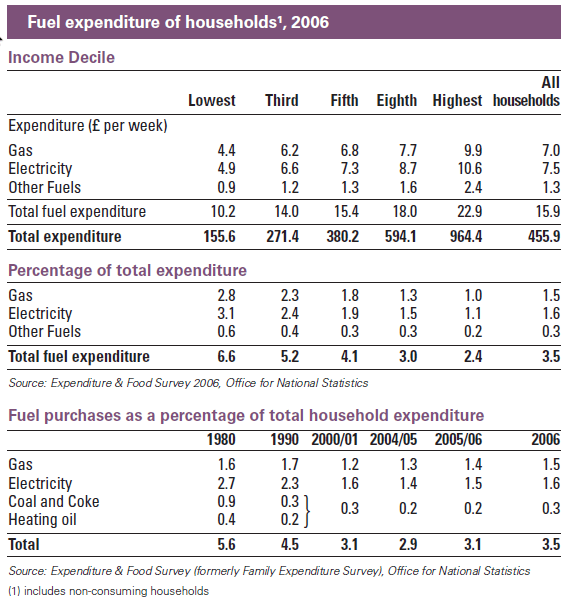 [/img]
Bottom of the chart - The percentage of household expenditure spent on fuel roughly halved after privatisation!
statistics eh?
uk average salries more than doubled between 1980 and 1990 alone !
[b]1980 7,585.53[/b]
1981 8,566.07
1982 9,369.56
1983 10,159.44
1984 10,779.08
1985 11,691.52
1986 12,615.15
1987 13,597.24
1988 14,778.08
1989 16,122.89
[b]1990 17,689.37[/b]
1991 19,045.83
1992 20,208.51
1993 20,817.53
1994 21,592.65
1995 22,257.04
1996 23,059.85
1997 24,028.75
1998 25,274.48
1999 26,492.52
2000 27,682.89
2001 28,900.94
2002 29,952.88
2003 30,977.15
2004 32,333.61
2005 33,634.71
2006 35,018.85
2007 36,347.63
2008 37,704.10
2009 37,580.11
http://uk.answers.yahoo.com/question/index?qid=20100315071014AA4sFWm
I also suspect the north sea coming online in the 80s was a massive factor in bringing the price down
Labour's final admission of defeat."Thatcherite" Economics triumphs
If you think opposition to monopoly capitalism represents a defeat for Labour and a victory for Thatcherism, then you really need to brush up on your politics Woppit.
uk average salries more than doubled between 1980 and 1990 alone
In real terms?
You see, there's this thing called inflation... thats why I pointed out that I was referring
The percentage of household expenditure
Because that gets round the inflation problem, of course, if you're telling me that the average household was significantly better off in real terms between 1980 and 1990, then I think we'd all have to agree on a rallying call of [b]Huzzah for Thatcherism[/b] in delivering this!
As for your point on North sea gas etc - you'll see from the figures I published that the biggest drop was in Electricity prices... where domestic market privatisation only really kicked in in the nineties.
In other news... Ernie, I see that Hollande, your chosen saviour of European Keynsian economics and socialism has announced France's harshest ever budget with 12 Billion of Austerity cuts. To be fair I notice he's also announced a 75% tax on incomes over one million Euro... expected to raise less than 200 million, even if nobody pisses off abroad to avoid it... I suppose thats Socialist Mathematics for you, 75% of nothing is morally preferable to 45 % of a million 😉
I read this morning that Ed was on about breaking up the banks unless they reform themselves. So taking on the vested interests in the city in the interests of us... The consumer
Sounds great!
Trouble is.... I don't believe a bloody word of it! It's all just mood music. Telling people what they want to hear. Same as CMD did before the last election. All vague sort of half formed and half-baked 'ideas'. Will any of it make it into actual policies? To be committed to in an actual manifesto? Not a bloody chance!!!
Labour, when in power, are even more craven to the city and big business than the Tories. Who have at least got the excuse that they all used to bugger each other in the same private school dormitories.
Zulu, I think your point may be correct [ prices dropped though we could debate why] but the stats you have used to show this dont show that cost have dropped. They show households spend a smaller percentage of their income which is not the same thing - energy efficient white goods is probably a bigger factor meaning folk use less. I assume you get the point as to why % of income spend does not necessarily tell us that the price has gone down we may just use less- hardly rocket science.
PS
I now only spend 5% of my income on petrol compared to 15% in 2000 the so therefore costs of petrol have fallen over the same period- the distanced I commuted is of course irrelevant in this isn't it.
Good theory, but over that period energy use per household barely changed:
[img]  [/img]
Probably fair to say that the 'dash for gas' made a big difference, with the cost being lower than that of coal fired power stations, but again you'd have to tie this in with both privatisation and, ahem, certain Thatcherite policies of the mid 80's...
Utility bills in our house consume 12% of our income-- whatever any graph might say,bills are going up by 'inflation' busting amounts, sometimes twice yearly.
the fact prices are going up doesn't necessarily mean the retail companies are gouging us - energy is traded internationally and the immediate consequence of q/easing is that the pound is worth less and hence it costs more to buy internationally traded products like oil and gas.
Good theory, but over that period energy use per household barely changed:
It was not a theory but a hypothesis.
You have still not proved your initial assertion that prices have dropped for example on that graph we can see the % of disposable income spent has decreased - this could be caused by either massive increases in earnings or by reduction of power prices. This is not even a debatable point you have not presented evidence to support your claim of a price drop yet so either do so or stop posting other stuff that also does not prove it
Any chance you could just cut to the chase. stop flirting and do something based on KwH adjusted for inflation - ie something that would accurately measure what we are discussing?
Again I suspect you are right but those tables dont prove it
So please show, in real terms that prices dropped per KwH.
You claim to be a scientist dont you? I thought at least some of what you said on here was not scribbling
this could be caused by either massive increases in earnings or by reduction of power prices
I think I conceded that when I commented that
if you're telling me that the average household was significantly better off in real terms between 1980 and 1990, then I think we'd all have to agree on a rallying call of Huzzah for Thatcherism in delivering this!
So, either way, Thatcher wins 😀
I was just about to say this thread, whilst having some good tables, needed a graph.
and you have still not proved your point that prices went down
Probably fair to say that the 'dash for gas' made a big difference, with the cost being lower than that of coal fired power stations, but again you'd have to tie this in with both privatisation and, ahem, certain Thatcherite policies of the mid 80's...
The dash for gas did make a difference, just as importing cheap coal from places like Russia and Columbia, all mined by workers on lower wages of course. I'm really happy that Zulu has pointed out the architect of energy privatisation. It's amusing that you crow about something that happened over twenty years ago, while conveniently ignoring the consequences of those actions today.
The private power firms began a steep climb in their charges to UK households, and by 2008, gas and electricity prices for British consumers (after accounting for inflation) had risen by 60% and 40% respectively from their 2003 level, significantly exceeding pre-privatisation energy costs.
And since then, despite a dip following the financial crisis and then a partial recovery in global hydrocarbon prices to below their 2008 levels, the cost of gas and electricity to people in the UK has risen by a further 20%.
And there was me thinking that according to capitalist ideology, privatisation, competition and deregulation in the UK should lead to more efficiency and lower prices. Of course, I forgot. It was also supposed to release funding for investment for energy infrastructure. Ironic when the likes of Scottish power which is awash with cash can make loans to it's parent company, while at the same time increasing energy prices under the pretence that it is needed to invest in infrastructure.
In reality it is the public who must always pay for investments by utilities, whatever the nature of ownership. But with privately owned utilities, the public must also pay for the costs of competition and fragmentation, as well, of course for the profits accrued by the firm's shareholders, top executives, and creditors.
EDF is 87% owned by the French Government. It runs 22% of electricity generation in the EU. Via its subsidiary EDF Energy, the French state-owned firm has also purchased Britain’s nuclear energy company British Energy in 2008, and EDF is now the largest electricity producer in the UK.
One has to note that 80% of France's power comes from Nuclear and so they are largely insulated from fluctuating fossil fuel prices like us in the UK. Some good foresight by the French there.
While EDF enjoys a virtual monopoly in France, it is publicly owned, and has its charges set by the state, and as a result EDF supplies electricity at the lowest production price in Western Europe.
The French got it right, and we, or should I say Thatcher got it badly wrong.
I suppose I could say something about railway privatisation and how it's costing twice as much in terms of subsidy than it did when it was nationalised, but that would go from raining on your parade to you standing under a waterfall.
Just an added bit of info (I work in the energy market). Mrs T, even though I can't abide her, did one thing right in the privatisation: she split the market into multiple units based on the PES (public electricity supplier) to give competition. 12 suppliers in all. Most of the new companies, after 1998 deregulation to sub 150kWhr customers, divested themselves of their metering divisions, focussing on retail, distribution, generation and wholesale markets as the metering operation was seen as a cost and not a revenue-generator. Hence the formation of Accuread/Siemens metering as they consolidated.
Retail tends not to bring in much money per customer. Wholesale does, and distribution brings in a nice steady flow for their companies on the sub-30KV lines (above that is national grid). Wholesale is seen (in my co) as an offshoot of generation.
Whats a bit more interesting is how our European colleagues privatised. Germany, for example, split its electricity market into two companies. For a big country. As a result one company we know of: E.On, has loadsa dosh to go out and buy other countrys' suppliers France hasn't privatised yet owns a big chunk of our market. (This was also a complaint about BT & British Gas - moving from state monopoly to private one).
I wonder how the pro-free-market-at-any-costs Conservatives think about our free market energy market subsidising the French left-wing government?
The only positive out of this is that the UK customer is more savvy. There's about a 25% churn in the UK market, but very little churn outside of the UK.
Sorry if this info is a biti disjointed, I'm just brain-dumping to add info to the discussion.
... So taking on the vested interests in the city in the interests of us... The consumer
What???
Noooooooooooooooo.....
All hope is lost, Thatcher has won.
People used to think of themselves as citizens. Now it's consumers.
It's over.
ElBent-- i totally concur with your analysis.
AdamW- how can 25% churn be a positive- these are billing companies, parasitic organisations that have been 'created' to filch money off 'consumers'-- and yes the trick has been repeated on the railways, and the NHS is next in line-- these are all essential parts of a modern society, capitalists will always seek ways to exploit this.
No, but I dealt with plenty in this country before the tory fiends privatised the utilities, and it was much better. Less fractured, more local knowledge and less deceipt.
you do know that they had no choice if they were going to invest in the infrastructure without loading the national debt
Where is TJ when we need him? He was always good at these [s]arguments[/s], I mean, discussions!
He was banned.
Hi Rudebwoy
The only positive I see is that people are more willing to ditch one and go to another, as a market should work, as compared to our European cousins who stick with who they have regardless of cost.
I have modified my personal position over the years. In a properly-regulated market vendors should be able to pump power into the grid, but since the grid is singular that should stay nationalised. Same for the wires for telephony, the pipes for gas and the entire water industry: if I think my water company is too expensive how do I change companies to one cheaper? They are local monopolies so should not exist in a so-called free-market economy.
Unfortunately the regulators are toothless puppets of the industries they "regulate", and all politicians are the same. So we're all doomed! 🙂
ernie_lynch - MemberHe was [s]banned[/s] banned.
FTFY
and the entire water industry: if I think my water company is too expensive how do I change companies to one cheaper? They are local monopolies so should not exist in a so-called free-market economy
for households there is little point in competition to be the provider as the costs would outweigh any potential gain
fo non-household the arguements are different and there is a strong case for a competitive market as the incumbent water company doesnot seek to provide the cheapest service for the customer rather they seek to perpetuate the status quo
there are efficiencies to be made in supply and in retail activities that would not occur without a fundamental change which requires a competitive market to be created.
However it tends to be the bigger companies that benefit (national billing, bespoke supply agreements) and the smaller players get squeezed as was shown when Scotland created a retail market and non-household complaints went up by a factor of 4
AdamW-- to say you have choice is a bit misleading,a choice of which name is on the bill, whoop de woo, the deliberate use of obfuscationary tariffs is de rigour for all these companies(same as phone cos')designed so that you can never be sure of what exactly you are paying for. I did ask one of EONs finest to explain it, but he admitted it was a constantly evolving 'dynamic'--his words !
The truth is that if the french have the cheapest bills, then that would indicate that they have the most efficient system? non
[b][i][u]Free the Embra One! [/u][/i][/b]
TJ should never have been given that much of a ban.
And that's coming from one who crossed keyboards with him on far too many occasions. TJ was one of STW's good guys. Despite his foibles, his inability to argue, he was and is a good person.
Bring him back. Please.
Unfortunately the regulators are toothless puppets of the industries they "regulate", and all politicians are the same. So we're all doomed!
you mean like the new Chairman of Ofwat who CEO at AWG when they did whatever they are being investaigated for under the Competition Act?
Flasheart + 1
Whatever he was he was not nasty
The truth is that if the french have the cheapest bills, then that would indicate that they have the most efficient system?
they bill by peak capacity IIRC, which minimises infrastructure requirement that therefore makes the bill cheaper
should be done here as part of the whole climate change policy
+ 2
(well, he could be nasty when he was losing an argument, but he [i]generally[/i] only gave as good as he got)
+3
But the enormous increase in site traffic and premier sign-ups suggest that it was good for business.
Ninja-tastic tonight......
I thought there was a "no complaining about banning" rule?
Well that sounds pretty dire if it's against the rules to express the opinion that you regret that someone has been banned. I haven't heard of that rule myself.
I think there might be a "no making up the rules rule"
for households there is little point in competition to be the provider as the costs would outweigh any potential gain
So for the home owners it makes no sense to privatise.
fo non-household the arguements are different and there is a strong case for a competitive market as the incumbent water company doesnot seek to provide the cheapest service for the customer rather they seek to perpetuate the status quo
But due to the physical placement of the pipes that is not possible (unless somehow we got a nationalised water grid). So it makes no sense there either.
there are efficiencies to be made in supply and in retail activities that would not occur without a fundamental change which requires a competitive market to be created.
Not sure what this means. There isn't a competitive market. If so, where's the competition? Possibly between metering companies or billing operations but that's nibbling around the edges, its not a truly competitive market. Why does a competitive market produce the efficiencies? What's to stop a nationalised market making efficiency savings?
However it tends to be the bigger companies that benefit (national billing, bespoke supply agreements) and the smaller players get squeezed as was shown when Scotland created a retail market and non-household complaints went up by a factor of 4
So, if I understand properly, company X buys water company Y and absorbs their billing/retail operations which reduces costs. So they reduce their workforce and increase their profits. And we don't benefit as it is still a local monopoly. And if they did pass it on it would be in the order of pennies per year.
Unless I'm misunderstanding stuff, which I'll happily accept if shown.
I'd sooner have the people in work, myself and the profits put back into the utility.
The deregulation of the UK energy market was not a simple competition versus monopoly argument and is not a Thatcherite invention. It is a living example of what economists call a "contestable market" and was driven initially by an economist called Baumol. The idea of lots of buses running round the country is a mis-understanding of this priciple. Google "contestable markets" or Baumol for an explanation.
Energy prices went on a long period of real price declines from the late 1980 and 1990 (leaving out the VAT blip in 1995) due (according to Ofgem) to the price controls of the regulator and the impact of competition. Prices bottomed in 2000 and then started to see a sustained increase in real terms from Autumn 2005. They peaked in 2007 (82% above the 2000 low).
In international terms, energy prices in the UK are relatively low and ofgem concludes that "the UK has long had among the cheapest domestic gas in the EU". Fuel poverty fell markedly between 1996 and 2004 but has risen since then but remains below 1996 levels.
The rise in prices is driven by five factors - wholesale costs, supply costs, gov costs, VAT and margins. Not surprisingly it is the first one that is most important. Inconveniently for those who argue that in the deregulated market we are being massively ripped off, is the fact that supply margins account for only 5-6% of total cost. Plus Ofgem recently concluded (the Energy Supply Probe) "there was no evidence that price rises were passed on more quickly than price cuts and no evidence that the big suppliers were acting as a cartel."
Wow. There's a lot of anger in there THM.
So there ought to be. The country needs a proper oppostion to the coalition not "we'll do much the same but be slightly nicer" Ed.
Anger? What anger? Just clarifying the driving force behind UK energy market design and giving some facts to support the debate. Its actually a very interesting case study for A level Economics student and often examined (along with buses, rail, etc). If you study some of the material, you may just want to readjust your initial conclusion slightly and you did ask for evidence.
It was just the Thatcherite comments (don't think anyone has mentioned her).
Disagree partly, however. Markets can only be good if you have more than one vendor... 😀
But, as shown by the massive financial collapse since 2008, we all know that markets don't work. They break things over and over and over and over again. And give Economists something to hypothesise over.
So, we need to try something different.
Adam - are you being serious? In the OP and afterwards on the first page. Like many things, giving Thatcher the credit, or otherwise, for the idea of contestable markets is stretching the truth somewhat. She may have taken this on board, but she didn't come up with the idea.
Disagree partly, however. Markets can only be good if you have more than one vendor...
Actually not true in either theory or practice. Under certain circumstances, monopolies can be better for consumers than lots of competition. Again basic A level economics.
DD - yes markets do not work in all circumstances which is why we have mixed economies ie, a combination of state and market allocation of resources. The financial crisis was not simply a failure of markets, indeed if you watched Stefanie Flanders program on BBC2 last week, some would argue (eg Hayek) that it was a caused specifically because markets were not allow to operate. Just how free is/was the supply of money/price of money for example?
She is presenting Marx tonight, so we can have an alternative explanation to the crisis. A good series all-in-all - Keynes, Hayek and Marx presented well and related to the current crisis.
So, we need to try something different.
Unfortunately for us, the only answer from these muppets seems to be 'more privatisation'. Only we'll turbo-charge it this time. Hell... why not? Its all gone so well, so far. Lets get G4S or Serco running the NHS. What could possibly go wrong?
The terminal lack of imagination, and slavish adherence to a completely discredited economic philosophy, by all parties, at the moment is truly tragic
Amen.
It's the same old same old. When markets fail and make the lives of millions a misery, it's because they're not "true" markets. It's because government interferes with them. Or all the parties are not given the same information. Blah, blah, blah. It's honestly very tiring to hear people who earn their money by moving a set of figures on one screen to another, and shouting boo-ya while high-fiving the guy sat staring at ten screens on the other side of the desk defending "markets".
Whatever way they're structured, whatever information the participants have, whatever level of guvvermint interference there is, they fail. Over and over and over and over and over and over and over again.
So, in essence, we need to try something different.
Adam - are you being serious? In the OP and afterwards on the first page.
Apologies - I tend to not read the whole lot and this page hadn't gone on about Thatcher.
Like many things, giving Thatcher the credit, or otherwise, for the idea of contestable markets is stretching the truth somewhat. She may have taken this on board, but she didn't come up with the idea.
Don't really care about that. Didn't like the policies of the woman but have modified my views slightly based upon whether it is good for the consumer or not. Again I still wonder how a monopoly that has a profit motive can be good for the customer.
Disagree partly, however. Markets can only be good if you have more than one vendor...Actually not true in either theory or practice. Under certain circumstances, monopolies can be better for consumers than lots of competition. Again basic A level economics.
For us to even consider this you must define 'Under certain circumstances'. Without that your comments can't really be understood. What do you mean? Based on that sentence we could give the entire country to someone like Serco/Microsoft/Apple/etc. and let them run everything as a monopoly. Or the certain circumstances may mean something which is rarely met so everything should be nationalised.
Socialism is evil, doesn't work, and corrupts the capitalist system, acting as a bar for the true entrepreneurs and wealth creators to go about their business - ensuring we all benefit from the trickle down economics of continual growth.
Oh...erm.... shit.... we appear to have completely and utterly ****ed up! On a truly biblical scale. All while paying ourselves enormous amounts for our genius, of course. The whole system we created is about to implode, taking the entire countries economy with it. HELP!!!!! Can we have a publicly funded bail out please?
Well... I'm not sure... that sounds a bit... you know.... a bit 'Socialist' to me?
Adam - the circumstances: monopolies may achieve substantial economies of scale (large plants, centralised admin, less duplication etc). This may lead to their marginal cost curve being substantially below that achieved in perfectly competitive markets. In this scenario a monopoly may produce more goods at a lower price than a firm in a competitive market. That would be good for the consumer. A second set of circumstances is where a monopoly makes sufficient profit to enable it to invest in R&D and other investment and possibly become more efficient that an firm operating in a more competitive market.
So the basic idea that more competitive markets produce a more efficient allocation of scarce resources is not as watertight as some might believe.
....from which simple beginnings Baumol came up with idea of contestable markets.
Under certain circumstances, monopolies can be better for consumers than lots of competition*. Again basic A level economics
You know I think you don’t even put in any effort to be this patronising. What I don’t know is whether you mean to or whether it is an accident
yes markets do not work in all circumstances
They don’t really work in any circumstance - you can see this by the fact no govt, no matter how right wing, wishes to trust the market so everyone regulates it. Despite this we still get boom and bust. That is basic economics and history 😉
What DD and Binners said
* http://tutor2u.net/economics/revision-notes/a2-micro-monopoly-economic-efficiency.html
If anyone cares – easier if you ignore the graphs at the start for non economists
Adam - the circumstances: monopolies may achieve substantial economies of scale (large plants, centralised admin, less duplication etc). This may lead to their marginal cost curve being substantially below that achieved in perfectly competitive markets. In this scenario a monopoly may produce more goods at a lower price than a firm in a competitive market. That would be good for the consumer. A second set of circumstances is where a monopoly makes sufficient profit to enable it to invest in R&D and other investment and possibly become more efficient that an firm operating in a more competitive market.
Thanks for the clarification! I guess the sticking point would be the price-point at which they sold to the customer, which may need regulation (e.g. specifying they can't charge more than a certain percentage) else they could create a widget for X but sell it to their monopolised customers at 10X, 100X or 1000X. But this should be the same whether the monopoly is public or private. I would also guess that without competition to create better widgets the monopoly may be able to chuck out many widgets but not improve their product (obviously dependent upon what it is). But that's most probably a different argument.
They don’t really work in any circumstance - you can see this by the fact no govt, no matter how right wing, wishes to trust the market so everyone regulates it.
In which case, lets stop the arguments that the crisis and the recession are directly the results of market failure. We agree they weren't.
But good idea to quote the Eton master's revision site as he concludes "It is important in essays and data questions when you are analyzing imperfectly competitive markets where the concentration ratio is high to mention [b]some of the potential advantages of suppliers having monopoly power.[/b]" Neither he, not I are being patronising. Its a basic truth that needs to be pointed out - especially if you want people to score A*s!!
edit for cross post - Adam, that is correct. And the monopoly provider could equally use the the same circumstances to rip you off. Excuse the "basic economics" statement, if that came across incorrectly but this is a cornerstone of the whole idea of contestable markets and it is normally taught in first year economics (AS of A2) - that's what I mean by basic!
they weren't.
They were.
Basic A Level Economics I think you'll find.
A bit too early for panto season DD, so we can agree to disagree!!
In which case, lets stop the arguments that the crisis and the recession are directly the results of market failure. We agree they weren't.
Yes of course that is what i am saying, it perfomed beautifully but was hampered by regulation 😕 Well done have your A star in deliberate internet misconstruing 🙄
Its like speaking to an archbishop about god -and economics requires the same level of faith
Why's Caroline Flint being broken up into 6 pieces? Seems a bit harsh.
AdamW - Member
Unless I'm misunderstanding stuff, which I'll happily accept if shown.
So for the home owners it makes no sense to privatise.
privatisation is a different issue to a competitive market, privatisation has enabled off balance sheet funding of UKLtd water and wastewater infrastructure. Compare England and Wales to Scotland and NI for the future issues in getting the funding to improve the infrastructure to meet EU directives
But due to the physical placement of the pipes that is not possible (unless somehow we got a nationalised water grid). So it makes no sense there either.
more than one type of water can be provided,for example there has been little use of incentives to encourage the reuse of treated urban wastewater for industry. You assume that everyone gets potable water they don't. Additionally legislation exists that allows new sources of water to be introduced in to existing networks and to allow the cross border import of water. The system is based on water resource zones so the molecules of water don't need to reach the customer from the source.
There isn't a competitive market.
yes there is AWG are getting investigated for breaching the CA98
If so, where's the competition? Possibly between metering companies or billing operations but that's nibbling around the edges, its not a truly competitive market.
example 1: I suggest you look at your water companies water resource management plan which this year requires them to offer others the opportunity to bid to do projects to get more water for example Thames Water OJEU notice
example 2:google "insets", they are Ofwats favourite form of competition
etc
Why does a competitive market produce the efficiencies?
because nobody likes to lose customers, a quick read of the WICS website shows that they think there have been considerable efficiencies (admittedly they would, it's their market)in Scotland
What's to stop a nationalised market making efficiency savings?
because people budget for growth rather than to save their customers money and reduce turnover, the incentive in a competitive market is that if you don't do it they will switch to someone who does. Nationalised markets lead to cross subsidies and mickey mouse tariffing such as the debacle in the North West with site area charging and the scouts and sports clubs or that household bad debt adds £15 on to everyone's bill
So, if I understand properly, company X buys water company Y and absorbs their billing/retail operations which reduces costs. So they reduce their workforce and increase their profits. And we don't benefit as it is still a local monopoly. And if they did pass it on it would be in the order of pennies per year.
a national billing arrangement for a company such as ASDA is worth £100K plus in efficiencies in billing for one utility service.
evidence is also that retail competition incentivises the use of meter data to reduce bills, hence why all public sector premises with a connection 25mm or more can get free datalogging and trend analysis. The real saving for the customer is to get better management of their consumption saving 100% of the cost of water and wastewater (waterin-water out) for the water saved rather than a few % on the tariff
teamhurtnomore--
steph f - "she's doing Marx tonight, should be interesting"- you not wrong, will be perverted in the extreme 😉
Shall watch with interest to see 'her' take on Marxist economics/revolutionary theory
Wonder if she will look at Marx in the round-- his economics was part of his revolutionary stance-
Good for Ed Milliband for inviting Michael Sandel to present at the Labour conference. He is an amazing lecturer with one of the most popular course taught at Harvard. As the FT concluded: Harvard Guru outclasses party ranter. There should be more of that thing to enliven political debate. As the FT noted, Sandal was followed by Yvette Cooper and, "Her speech was humourless, ranty, full of fake anger and not worth $100."
http://www.bbc.co.uk/iplayer/tv/bbc_parliament/watchlive
Rudeboy - that's not what I meant by "doing"!! Leave that to Ed-squared!! 😉 But I think this has been a really interesting series and three excellent programmes - ok, two so far. But I am sure that tonight will be equally interesting on Marx. Like the others, I expect history, biography, and lessons for causes and, more importantly, the answers to the current crisis.
Do not expect an 'answer' to an economic crisis, they are the ebb and flow of a capitalist system-- as DD has been asking-- we need a new system !
...and that is?
For me it can only be a socialist system , which despite rumours has never been allowed to develop and flower anywhere, as you are aware without a world wide revolution there is little prospect of socialism in 'one' state surviving let alone growing.
Trotskys theory of permanent revolution would be apt, but i do not expect many supporters for that on here !