
MegaSack DRAW - This year's winner is user - rgwb
We will be in touch
When screwing cabinets to each other (hopefully nicely hidden behind hinge plates), should I drill a pilot hole for the screw? it will only be a 30mm wood screw into chipboard (I assume). Most "hi tech" screws these days make all sorts of bold claims about not needing pilot holes, but I don't want to ruin an expensive kitchen carcass.
it can't hurt if you do can it?
I guess it can't hurt, no. Assuming no ham fistedness with the drill 😉
Try it and see, you're unlikely to ruin it. Mfrs could be in big do-do if they make false claims, and the screws may not work with a pilot hole?
Are there no predrilled holes for gadgets to connect the units? the kitchens I have fitted have this.
If base units fix high up so fixings can't be seen! Pilot depends on gauge of screw, also might be worth while using a small countersink just to let the head in flush. You can also get a fixing in behind the back board of the unit. Usually a 50 mm gap to the wall.
No predrilled holes for gadgets / bolt thingies. Nice tidy finish, so it's a case of swinging hinge out of the way, screw through into next door cabinet, put hinge back and you don't see the fixings then.
Guess I can always try a screw into the back service void section and it won't matter if it looks messy as I'll never see it again!
You already have a range of 4 or 5mm holes for the hinges / shelves running the full height of the cases fron tand back / both sides. Just level them, clamp the cases together, drill right through from one case to the next then couple them using pairs of male / female panhead bolts. Once you tighten these up they sit almost flush. Surely no real need to hide behind hinges even with glass fronts?
No need to pilot hole, they won't hold properly if you do.
What thickness are the carcasses? If 15mm, use a 4 x 25mm screw, if 18mm, use a 4 x 30mm screw.
Think about which side you screw from, most units have a side that won't be seen as much when you open the door.
Always use a quick clamp to bring the two sides together tightly first and hold them in perfect alignment before screwing.
I usually put at least 5 or 6 screws into each cabinet, under the hinges at the front and two right where the shelf goes. Then a couple right at the top and bottom at the back where they won't be seen. Getting in the service gap can be hard and makes removal later almost impossible without damage or removing the worktop. I glue my backs in as they inevitably pop loose.
The only time I ever countersink is if working with real timber.
I always use either wurth or spax screws which are self countersinking.
You could also use cabinet bolts, but I much prefer screws.
Thanks - TheFunkyMonkey. yep 18mm carcasses so I'd already got 4 x 30mm screws identified. Nice touch putting a couple of extra screws in where the shelf goes (of course if that moves then I'll see the screws!).
Hidden screws seems like the best option for a clean finish.
Thanks all.
What you need is a bradawl.
The most used tool in my toolbox (after th'ammer).
Good call, my most used is *#%¥, followed by my bent long nosed pliers!
When I fitted an IKEA kitchen it came with specific widgets for joining adjacent units.
I suspect the correct name for them may be "pairs of male / female panhead bolts" as HeatherBash says.
edit - a quick google tells me they are called barrel bolts or sex bolts - nice name.
[img] 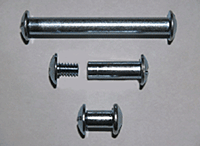 [/img]
pilot holes are not needed if both panels are of the same material eg chipboard, but are required if differnt chipboard to mdf or chipboard to solid wood, as the densities are different the screw can'pull' on a board and crack it
in either case make sure you clamp the panels together b4 fixing
when I first started fitting kitchens (1865 or thereabouts) I used to fill all the unused holes with the daft plastic plugs they supply; now I don't give a monkeys. Worrying about seeing screwheads inside a kitchen cabinet is a worrying symptom of Asbergers IMO.
If you are fixing a piece of wood to another one, say a floorboard down to a joist, then it is always a good idea to drill a THROUGH HOLE in the floorboard so that the theads on the screw don't grip IT as well as the joist (this is known as Classic Plumbers Syndrome and always results in loose boards and heads that aren't sunk flush).
Self drilling screws are fine except in the above scenario where you really are trying to force one piece of wood against another.
A PILOT HOLE is a fine hole that you drill in say a piece of hardwood to stop the screw from splitting it, usually 3mm for a 4 gauge screw and 3.5mm for a 5.
Watch when using connector bolts that you dont make a horrible mess when the drill breaks through and that the bolthead doesn't intefere with draw runners or hinges.
I prefer to through drill one of the cabinets (5mm)then clamp units together and fix with 35mmm by 4 screws leaving the heads slightly above the flush.