UPDATE: CLASSIFIEDS section refreshed, redesigned, searchable: Go take a look
I doesn't sound cruel at all, it just sounds like you don't understand the issue. There was a time when all telephones throughout the world were pretty much identical, they all did exactly the same thing - you picked them up and answered, or dialed a number. Going out and buying your own phone was pointless as all phones everywhere were identical. Nationalisation was not the issue - countries with private telephone companies also used featureless phones. Then came technological breakthroughs and everything started to change, when this occurred choice became an option and buying your preferred choice was actually possible. Again, nothing to do with nationalisation.
Corbyn's going to romp it.
Or the pollsters will lose any remaining credibility.
[img]  [/img]
anagallis_arvensis - Member
Can you all not just realise that Corbyn is never going to be PM anyway
I dunno, have you considered the choices in 5 years time, Corbyn, Osborne or Boris! 😆
The breakthroughs that you mention were exploited by private companies in pursuit of profit, enabling the explosion of choice that we experience today.
The idea that a centralised economy controlled by mostly hapless and inept politicians and ideologues is going to work on any level, is ludicrous.
Any attempt to direct things from the centre instead of allowing free markets to work has always ended in abysmal failure. That the idea is workable is still claimed by it's champions, even after all this time and experience, speaks volumes about humans' capacity for self-delusion and tendency to cognitive dissonance.
Left - wing manifestos seem to consist of little but "La la la la I'm not listening".
And so on...
[i]Left - wing manifestos seem to consist of little but "La la la la I'm not listening".[/i]
that's true for *all* manifesto's - "we know what's best for you".
All politicians say they're listening but I think they only actually hear what suits them.
Only YouGov have been foolish enough to predict the result. All the others aren't risking their credibility 🙂
They've been running profiles of the candidates in the Guardian over the last couple of days. One on Liz Kendall, one on Yvette Cooper. They both pointed out there belief that Corbyn would be a disaster, blah, blah, blah... yet over 2 broadsheet pages completely fail to advocate a single solitary belief, principle or policy of their own, that might provoke anyone into voting for them.
It appears its now ingrained in the Labour mindset to not actually say anything it all, under any circumstances, for fear of scaring the horses. Even when the polls show that your about to get absolutely trounced. I suppose you could call that Millibandism?
We know what's best for you - sums it up really, no you don't, you think you do. And that's not your job anyway - you are our representatives, don't forget that.
But economic revisionism is great. To extol the virtues of a declining industry that despite protection was in long term decline over many decades, or a more modern version of the world's largest industry supplier who still cannot generate returns anywhere near its cost of capital while ignoring the role of global liberalisation as a catalyst/driver for the development of the global telco industry is breathtaking or given the subject matter here, merely amusing!!
Still it's a bloody hard PR jobs selling Jurassic policies - imagination and SOH required clearly
The 2001 white paper from DTI gives a better narrative IMO
The breakthroughs that you mention were exploited by private companies in pursuit of profit, enabling the explosion of choice that we experience today.
Still you don't understand the issue. When nationalised post office telephones made massive profits. It was perfectly capable of "exploiting" technological breakthroughs - why wouldn't it be?
I think it's you who's guilty of "La la la la I'm not listening".
When nationalised post office telephones made massive profits.
They were profitable but not massively so and their return on capital was poor.
[i]their return on capital was poor. [/i]
Although the percentage return was higher than the interest being paid on the capital debt that was supposedly paid off with the results of selling it.
Which is bloody stupid.
When nationalised post office telephones made massive profits.
Which weren't subsequently invested in any new product beyond the basic range available. No competition.
Perhaps they were confused and thought they were producing electricity meters.
So now we're arguing over the relative size of post office telephones profits. The reason we are discussing the GPO/BT is because it was given as an example of a failed nationalised company which was a burden on the taxpayer.
It clearly isn't a very good example of that. But then the poster has already admitted that he wasn't looking for "good examples". So it's probably worth leaving it at that 🙂
So now we're arguing over the relative size of post office telephones profits.
Nope. I'm arguing about the dumb idea that nationalised industries and a centrally "planned" economy will ever produce anything other than stagnation and disaster.
And for you Woppit :
[img]  [/img]
A 1950s telephone from a non-nationalised telephone company. Looks identical to a nationalised one from the same era, why do you think that is?
I'm arguing about the dumb idea that nationalised industries and a centrally "planned" economy will ever produce anything other than stagnation and disaster.
Has anyone told the present government? They are going to let state owned companies build a nuclear power station at Hinkley Point! It can only possibly end up as a disaster, right?
And how long is it since de-nationalisation? During which time developments resulting in improvement and choice, have taken place?
Or are you suggesting that all this would have happened without privatisation? In which case, if it all happens anyway under a nationalised industry, where does the case for a better railway system than the one we now have, being an advantage of nationalisation, stand?
You can't have it both ways.
You can't have it both ways.
I'm not having it both ways. I'm saying that nationalisation is an irrelevance with regards to the points you are making.
EDIT : With regards to the railways I think the case has been made - most people, including Tory voters, want them brought back into public ownership. Even Tony Blair was forced to concede that and he made a commitment to bring them back into public ownership. Obviously it turns out that he lied and he broke his commitment, but hey, that's Tony Blair for you.
dunno, have you considered the choices in 5 years time, Corbyn, Osborne or Boris!
I am working on the assumption that anyone I feel vaguely like voting forcwouldnt get elected. He wont win an election.
Good to see our very own UKIP rep expressing concern about nasty foreigners. Keep 'em out,
Forget all the lessons of international trade and comparative advantage. Keep Johnny Foreigner at bay. Nigel may be quiet but his legacy endures....
I've just read Andy Burnham's profile in todays Guardian and from this I've gleamed
a) He likes his footy
b) He likes watching The Great British Bake Off with his family
c) He actually lives in his constituency and doesn't like Westminster
As for policies? Beliefs? Ideology?
As with Liz, and Yvette..... who knows?
I'm not having it both ways. I'm saying that nationalisation is an irrelevance with regards to the points you are making.
Not at all. There is no evidence to suggest that nationalised industry leads to any of the improvements of the type that I have outlined, in any of the countries that have tried it. Quite the contrary.
C'mon Binns, there's plenty
Andy's VisionMy vision for Labour is simple: we must be the Party that helps everyone get on in life. (No s**t Sherlock)
People at all levels of society share the same hopes: a secure job; a decent home; a good standard of living; prospects for their kids; and proper care for their parents.
But, in our insecure, modern world, for far too many people, these dreams are dying.
It will be the mission of the Labour Party I lead to revive them - and turn the light of hope back on.(Amen)
Labour wins when we speak convincingly and passionately to the aspirations of everyone.
But the truth is we have lost our emotional connection with millions, not just in Scotland but in Wales and England too.
I will take Labour out of the 'Westminster bubble' and reach out to voters everywhere.
I will be a leader people can relate to, whose voice will carry into all the nations and regions of our country.
And I will lead a Party that helps every person, every family and every business - whoever they are, wherever they come from - get on in life. (hmmm....)
Andy's Signature
What more do you need?
Hmmmmm... all stirring, emotive stuff, but slightly light on the detail. its like he's writing a letter to Santa
Essentially its like a collection of those motivational posters so beloved of 'Merican corporate offices, with a picture of a sunset or a lofty mountain peak. Except that the posters you see in 'Merican corporate offices, with a picture of a sunset or a lofty mountain peak, have a bit more substance than the collective outpourings of Liz, Yvette and Andy
No "commanding heights" there, then.
[img] 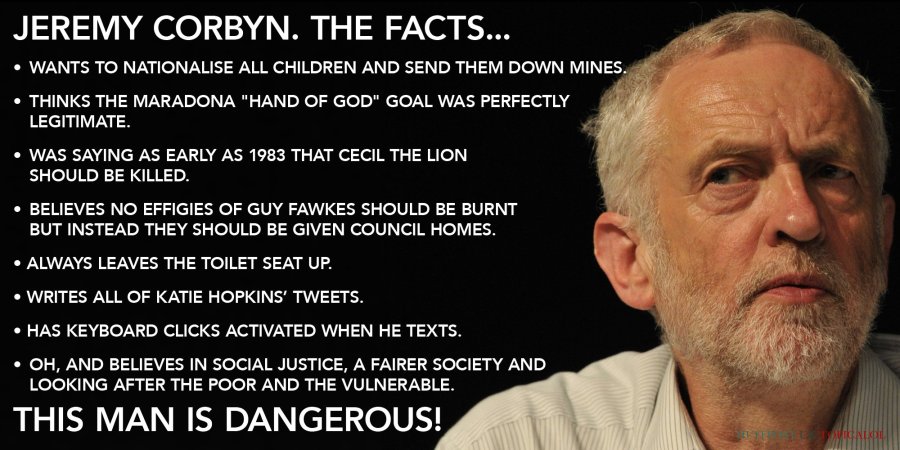 ?7[/img]
Well it amused me...
Don't forget his worst crime, has a 3 foot long steerer on his bike too.
Labour wins when we speak convincingly and passionately to the aspirations of everyone.
The success of Corbyn can be summed up in this one puke-inducing sentence. Apart from the fact it doesn't mean anything, it contradicts itself as it certainly isn't passionate or convincing. I'm not sure what worse, this or Ed Miliband's 'We need to define a new narrative where capitalism works for normal people' bollox.
For balance, I'm beginning to tire of Corbyn's repeated use of the word 'conversation'. If he's not careful he's going to end up talking to a lot of people and doing nothing.
the panto continues on the wonderful medium of twitter
https://twitter.com/campbellclaret/status/631008862875873280?lang=en-gb
how dignified!!
He's behind you.
Given the expertise demonstrated above, I have suggested an approach to our resident UKIP supporter - no future role for Johnny F!
The breakthroughs that you mention were exploited by private companies in pursuit of profit, enabling the explosion of choice that we experience today.
I note you are shifting your argument from whether public/private entities are better are inventing new technology to who's better at exploiting those technologies. perhaps this is because you know the old state telecoms companies were not too bad at developing new technology.
...yet over 2 broadsheet pages completely fail to advocate a single solitary belief, principle or policy of their own, that might provoke anyone into voting for them.
And for that reason he gets my vote.
I've just read Andy Burnham's profile in todays Guardian and from this I've gleameda) He likes his footy
b) He likes watching The Great British Bake Off with his family
c) He actually lives in his constituency [b]but reportedly rents out for profit the flat he owns in London whilst himself living in another flat 1/2 mile away and expensing that to us[/b] and doesn't readily admit to lik[s]e[/s]ing the spoils of Westminster
[b]d) he wants us all to believe he never saw himself as a politcian even though his own wife says he's always talked about it[/b]
[b]e) he would like us to remember he is against privitisation of the NHS and is pro-patient even though as health secretary he presided over PFI deals that saddled the NHS with £billions of debt and spent years refusing to meet the families of patients who died at Mid Staffs or accept there was a problem with NHS care that warranted further action
[/b]
I've fixed that for you
Hey Ernie
Here's a[url= http://www.cps.org.uk/publications/reports/the-performance-of-privatisation-vol-ii-privatisation-and-its-effect-on-the-exchequer/ ] nice little article [/url]detailing the contributions to the treasury before and after privitisation of BT and several other ex public companies. If BT were contributing "massive amounts" before privatisation they were contributing up to 3 to 4 times that amount annually post privatisation. And that's without the funds to the treasury from the sale itself.
Two quotes from the above link -
"British Telecom emerges from NERA’s economic analysis as a major contributor to exchequer revenues. Not only has the Government received over £13 billion in sales proceeds, but the exchequer has also ‘continued to receive over £1 billion a year after privatisation in the form of tax, dividends, interest and debt repayments’. As NERA observes: ‘Whereas in the four years before privatisation BT contributed up to £625 million a year to public sector funds, since privatisation it has generally contributed between £1 billion and £2.4 billion a year in addition to privatisation proceeds’.
And
NERA suggests that this is surprising. However, there is a straightforward explanation for this trend. Since privatisation, BT has been able to attract outside capital as well as self-finance the huge sums required to invest in the latest telecom technology. In addition, the company is now far more efficient than it was under state ownership and it has been able to diversify into a number of different business activities, both here and overseas. In turn, the taxpayer has benefited from this improved efficiency and pre-tax profitability.
I think I'll stop there.
Sounds to me Gowrie that like Woppit you haven't quite got your head round the idea that technology has moved on in the last 30 years.
30 years ago people weren't carrying phones in their pockets. That had nothing to do with "nationalisation", they weren't walking around with phones in their pockets in the US either where the market was privately owned. Telecommunications is a growth industry.
And I wouldn't get too obsessed with profits, sometimes governments choose not to secure the maximum profit for a state owned monopoly because unlike a private company the wider well-being of the customers/voters/people is considered.
For example the recent huge profits by the nationalised East Coast Line could have been reduced if the government had decided that lower fares would have been more beneficial to the traveling public. Private or foreign state owned companies have no need to worry about such things - only how to maximise their profits.
BTW I have no idea why you think anyone should be particularly impressed with the views of a free-market policy think tank with close links to the Tory Party.
Anyway, back to the leadership contest :
[i][b] "We face a Tory Party waging an ideological crusade against the state and our public services. We face an emboldened government which has used our electoral defeat to mount an undemocratic assault on the trade union movement
The scale of the challenge we face demands boldness and radicalism. A timid offer to the British people isn’t the alternative.
We need to put an end to the inequalities that set in at birth. The Tories have cut inheritance tax to promote inherited wealth — I’ve said that we would spend that money instead on tackling inherited disadvantage through a revolution in early years care.
We must eliminate low pay — because poverty wages are an outrage in a modern, wealthy nation. So we must drive up wages by giving greater powers to the Low Pay Commission and build a real living wage society. And we must give our public service workers the decent pay rise they need and deserve at a time when so much is being asked of them.". [/i][/b]
All good stuff, the sort of stuff that you might expect Jeremy Corbyn to write in his weekly column in the Morning Star. Only it isn't Jeremy Corbyn's Morning Star column, it's from an article by Tony Blair's most favoured candidate, Liz Kendall, which she wrote for the Morning Star in a desperate attempt to appeal to the left.
Liz Kendall attempting to portray herself as radical and left-wing in the Morning Star really is a measure of how effective Corbyn's candidature has been.
Wow quite the chameleon move by Liz... Also wouldn't be surprised if that was written by someone else....
Also wouldn't be surprised if that was written by someone else....
You don't say ! 😉
Here you go squirrel - better alternatives. Simple enough?
Not really.
You don't seem to actually be saying what these "better alternatives" are or why they are better. In fact you haven't actually said anything at all beyond private good, national bad.
And you complain about politicians with their empty soundbites and spin...
The scale of the challenge we face demands boldness and radicalism. A timid offer to the British people isn’t the alternative.
Yet thats exactly what we're getting. Nice of Liz to take the trouble to highlight the main problem with her own non-manifesto
[url= http://www.theguardian.com/politics/shortcuts/2015/aug/10/liz-kendall-andy-burnham-labour-leadership-video-worst ]Nice piece on the comparative merits of Andy and Liz's Youtube videos[/url]
Sounds to me Gowrie that like Woppit you haven't quite got your head round the idea that technology has moved on in the last 30 years.
Discussing anything with you is like trying to communicate by shouting down a dark tunnel full of fog.
The fact that technology has moved on in 30 years was exactly my point, enabled and exploited by private investment. I thought I'd made this clear.
It was you, with your slightly amusing poster from Bell Corp. in the fifties, who seemed to be saying that there was no difference between British Nationalisation and American Capitalism in producing technology. All focused on a small slice of history - the 1950's.
I honestly don't know why you claim one thing, and then the other, and expect to be taken seriously.
Woppit, don't stress it's the summer season - not traditionally panto time, but all the more relaxing and enjoyable for it.
Of course the massive development of telecommunications and the rapid acceleration of sector liberalisation were pure coincidences!
As an aside, the planning of work is step 14 in the road to serfdom!!! This comes after step 3 - the planners promise utopia - and step 4 - but they can't agree on what that is - each has his/her own pet plan.
Where are the libertarians when you need them 😉 fail to learn from (ancient) history and .......
Well, as it's summer, here is some beach reading for you. Always a good opportunity to get a broader perspective and maybe even show up next term with something resembling a clue.
http://www.goodreads.com/book/show/17987621-the-entrepreneurial-state
The fact that technology has moved on in 30 years was exactly my point, enabled and exploited by private investment. I thought I'd made this clear.
Yes you have made it clear that you think technological advances are all down to privatisation. This is of course nonsense.
It was you, with your slightly amusing poster from Bell Corp. in the fifties, who seemed to be saying that there was no difference between British Nationalisation and American Capitalism in producing technology. All focused on a small slice of history - the 1950's.
Nothing to do with "a small slice of history". Did you want me to show all the adverts since telephones first became available? 😆
You need to get over your privatisation fetish Woppit. Although I suspect that it's all a little hypocritical, for example I doubt very much that you shun nationalised health care in favour of private health care because private health care is more technologically advanced.

