Forum menu
[url= http://www.bbc.co.uk/news/uk-england-cambridgeshire-38063742 ]http://www.bbc.co.uk/news/uk-england-cambridgeshire-38063742[/url]
Strikes me that trying to confuse drivers into slowing down is not the best method of making the roads safer.
What about when the confused pedestrian or cyclist thinks its an extension of the path and their right of way whilst the oncoming car thinking its their right of way fails to anticipate the pedestrian stepping out.
It definitely works on the M6 smart section
What's the speed limit? 60? No 50! No 40! 60 again! 70 yesssssssssss! Oh it's 50 again etc
Brake light frenzy
Yes, in principle, creating an environment that is more pedestrian focused focuses drivers to expect pedestrians and adjust speed accordingly. But a larger stretch of this is far better than a small feature.
See woonerf for effective applications.
Yes. I think it was a dutch study that took out all traffic lights and right of way stuff in a town and made drivers work it out for themselves; as a result they slowed down thought about their driving and others and the roads were safer and flowed better as a result, given you neither had to sit at a red light waiting for it to change when the other way was empty, and weren't charging at the lights in an attempt to make it through on the last R of 'Amber' and actually then crossing on the first R of 'Red'
..charging at the lights in an attempt to make it through on the last R of 'Amber'..
Which is already illegal anyway despite how many people do it.
Never mind that:
The road, near the railway station in Cambridge, closed in March for the traffic calming works and reopened on Friday.
9 months FFS! Can someone at Cambridge highways department have a look at the Japan sinkhole video and have a serious think about resignations or sackings.
I'm not an expert, but from everything I've ever read about this kind of thing, I've got the impression that there is quite a bit of science behind it and the evidence strongly supports an answer of "yes"
Surely confusion would only work with new drivers (or women. lolZ). Once local people know it, they'll just fly across without slowing down.
I guess in the same mode as taking away street 'furniture' etc.
So [i]that's[/i] what they've been doing there!
I think the problem is more that people use that road to cut through between the railway station and Mill Road.
Doing something about the latter would make a lot more sense - it's almost got to the point of being a de-facto bikes-only zone sometimes, but not all the car/van drivers who use it seem to fully appreciate this....
Once local people know it, they'll just fly across without slowing down.
+1
The one problem I foresee is that ballbag drivers will get wise to them, then start charging at genuine roundabouts.
I'm not sure that throwing confusion into the mix with aggression, selfishness and 2 tons of metal will necessarily end well.
[i]I think the problem is more that people use that road to cut through between the railway station and Mill Road.[/i]
Shut the road for 9 months to lay some bricks would sort that issue for a while.
Yes. I think it was a dutch study that took out all traffic lights and right of way stuff in a town and made drivers work it out for themselves; as a result they slowed down thought about their driving and others and the roads were safer and flowed better as a result, given you neither had to sit at a red light waiting for it to change when the other way was empty, and weren't charging at the lights in an attempt to make it through on the last R of 'Amber' and actually then crossing on the first R of 'Red'
They've tried something like this on my commute route. No traffic lights before, just a crossroads on residential streets, both effectively one lane due to parked cars either side, with give way signs at the two side roads. Now the whole crossroads is raised and there are no signs or road markings whatsoever. I can see the theory, but the taxi driver who went straight across in front of me at 35mph last night obviously doesn't
..charging at the lights in an attempt to make it through on the last R of 'Amber'..Which is already illegal anyway despite how many people do it.
Though going through on amber is not illegal if you are too close to stop safely. If I had a following vehicle close behind me I would go though on amber rather than brake hard to stop.
Regulation 36(1)(e) states that the amber-alone signal shall convey the same prohibition as the red signal, namely that vehicular traffic (other than tramcars) shall not proceed beyond the stop line, except that, as respects any vehicle (other than a tramcar) which is so close to the stop line that it cannot safely be stopped without proceeding beyond the stop line.
And in practice show me an example of anyone prosecuted for going through on amber?
I'm pretty sure you've misquoted there.
Let me try:
the amber-alone signal shall [s]convey the same prohibition as the red signal[/s]mean go as fast as possible
I'm not an expert
Well said .As with most things in life , it is best to leave it to the experts
It looks a lot like the 'improvements' made to the front at Blackpool. Where there's no real definition between road and pavement nor where go and who's in the right.
Doesn't improve traffic flow, but it looks nice.
Though going through on amber is not illegal if you are too close to stop safely. If I had a following vehicle close behind me I would go though on amber rather than brake hard to stop.
Indeed, but if someone is [i]"charging at the lights in an attempt to make it through on the last R of 'Amber' and actually then crossing on the first R of 'Red'"[/i] then that isn't what is happening is it?
Going through because it changed from green to amber when you were already too close to stop safely is legal.
Observing an amber light ahead and speeding up to make it through before it goes red is illegal.
But yes, it does seem to be one of those motoring offences that many people consider to be purely theoretical.
Another ploy to bring Cambridge to a grinding halt-as if it needs it!
Yep, there they are in their planning department laughing their socks off at all the congestion they've caused.
The bastards.
🙄
I am assuming it's part of the 20mph limit anyway, most of Cambridge seems to be already.
Indeed, but if someone is "charging at the lights in an attempt to make it through on the last R of 'Amber' and actually then crossing on the first R of 'Red'" then that isn't what is happening is it?Going through because it changed from green to amber when you were already too close to stop safely is legal.
Observing an amber light ahead and speeding up to make it through before it goes red is illegal.
But yes, it does seem to be one of those motoring offences that many people consider to be purely theoretical.
There's the law and then there's what everyone* does. The point is that if the lights aren't there and you don't think you have priority then you're less likely to hurtle through thinking you'll be OK.
* using the agreed definition of everyone as relates to road traffic offences; eg: I saw a cyclist riding on the pavement once therefore all cyclists do it, the bastards. And they don't pay road tax or have insurance and they take up the whole road riding 2 across, etc.
So maybe actually enforcing that law (e.g. with traffic light cameras) might be way to get people to approach the lights at a more reasonable speed?
My brother has been involved in some housing estate design in NZ, that runs on this principle. The estates are quite large, with deliberate areas and streets that have a 'pedestrian' feel to them, cars relegated to behind houses, inside garages etc.
Apparently it has worked wonders - drivers are really, really slow if they do need to access the area. This encourages children to play out, and the streets become less about car access and more about a community....
[img]  [/img]
So maybe actually enforcing that law (e.g. with traffic light cameras) might be way to get people to approach the lights at a more reasonable speed?
Possibly but
1/ it doesn't address traffic flow, sitting at red lights when there's no-one else at the other direction
2/ I was was being hyperbolic to make the point; if the red lights were fully enforced by cameras then people would still be speeding towards them on green to try to make it before amber and the same situation ensues - because you have a'right of way' you just assume there's nothing coming rather than take responsibility for making sure
it doesn't address traffic flow
It does a bit, because if everyone stuck to the law then the amber and red phases could be shorter, as they wouldn't need an extra buffer for people diving through on "just turned red".
We have a crossroads that used to be a mini roundabout at the entrance to our village which isn't that different. They took down all the give way signs and got rid of the markings, all apart from the white disk in the middle. Because nobody knows what to do, everybody uses the junction courteously and very carefully.
I suspect it won't make anyone safer.
People who know it, will simply ignore it.
Most people who first find it will likely give it 100% attention, not great for anyone else and then 'ignore' it as it's meant to be.
Some people who first find it will treat it as a mini roundabout and pull out from the side road into the main road when turning right as they belive they have the right of way.
We have a tough enough time here navigating our new non-standard roundabouts. They've been optimised for traffic flow which is great, but it relies on people choosing the correct lane based on the signs and road markins (often hidden under cars) so you end up with 3 main groups of users. The majority who know them and/or read the signs and use the correct lane. A large minority who ignore the signs and default to the standard Highway Code rules (last read by them a few decades back) and finally a small, but very obvious group who simply pick whichever lane has the shortest queue and throw themselves at the entry/exit they want by putting their hand up to their 'mistake'. Let me assure you, confused road users, are not safe road users. There is a crash most days on one or more of them.
fin25 - MemberYep, there they are in their planning department laughing their socks off at all the congestion they've caused.
The bastards.
You can roll your eyes as much as you like, but increasing congestion to convince people to use public transport to reduce congestion was a favoured tactic of Cambridge CC.
Shut the road for 9 months to lay some bricks would sort that issue for a while.
I'd rather they just kept Tenison Road shut permanently. Mill Road has been much quieter for it.
yep. Infrastructure is not just about getting maximum flow of motor traffic, there's other user groups some crazy hippy councils give a shit about, you know, pedestrians and cyclistsbut increasing congestion to convince people to use public transport to reduce congestion was a favoured tactic of Cambridge CC.
See [b]woonerf[/b] for effective applications.
housing estate design in NZ, that runs on this principle. ....deliberate areas and streets that have a 'pedestrian' feel to them, .....drivers are really, really slow [b]if they do need to access the area[/b].
These hit the nail on the head. It *can* work to change the attitude on a street but the street has to be to be fundamentally low traffic to start with. It's a form of 'shared space'. It only works if you make the streets access only - you have to remove the through traffic. If you're still allowing rat running traffic no amount of fancy paving is going to make it more pleasant.
Exhibition Road in London demonstrates clearly that no amount of fancy paving alone will make any difference -
https://aseasyasridingabike.wordpress.com/2013/01/21/lessons-from-exhibition-road/
A fake roundabout on a fast road will confuse a few drivers the first time they see it then they'll ignore it.
Ah, the joy of standing at my local bus stop in Cambridge watching the arrival display count down only for the relevant bus to suddenly disappear from the matrix and be replaced by one which will arrive in 15 minutes----maybe--got to be better than that to convince most locals to use the bus
D0NK - Memberyep. Infrastructure is not just about getting maximum flow of motor traffic, there's other user groups some crazy hippy councils give a shit about, you know, pedestrians and cyclists
I'm not sure you fully comprehend what I wrote!
Besides, the specific example I was thinking of was a junction with the A14, not a popular cyclist or pedestrian route. 😉
possibly, not sure. I was agreeing that sometimes max traffic flow is quite intentionally not the objective (dunno whether we agree on the validity of it's use) and having a mild dig at those who think max traffic flow should be the [i]only[/i] objective of infraI'm not sure you fully comprehend what I wrote!
Our street sees [b]a lot[/b] of through traffic, only way they could stop it is to stick bollards half way along it (plenty of access either end), pretty sure the other locals would lose their shit if someone suggested it, and I reckon the attitude would be prevalent in most places.It only works if you make the streets access only - you have to remove the through traffic
There are some "quiet streets" just off my commute, signs up saying "no through road, access only", they get ignored.
Genuine questions, how would you do it? How would you get it passed car centric residents?
Blocks on sand in a road. I predict a coupla bin lorries and its cracked, 2 years max and its wrecked, ripped out and back the way it was.
P-Jay - MemberWe have a tough enough time here navigating our new non-standard roundabouts. They've been optimised for traffic flow which is great, but it relies on people choosing the correct lane based on the signs and road markings... ...There is a crash most days on one or more of them.
I dont know your roundabout but based on the one near me its group following the markings (that they do day in/out) but not paying any other attention that are the reason for all the accidents. Making people pay attention is the solution, that we have to try and trick drivers to do that is a sad state.
@DONK - retractable bollards? Residents have a transponder that they fit to their cars so they can get in and out (Emergency services do as well). Only problem then is for visitors to the residents.
Our street sees a lot of through traffic, only way they could stop it is to stick bollards half way along it (plenty of access either end), pretty sure the other locals would lose their shit if someone suggested it, and I reckon the attitude would be prevalent in most places.....
Genuine questions, how would you do it? How would you get it passed car centric residents?
That is how you do it but yes, it's a hell of a battle. Close to 60% of household in my borough don't even have access to a car, let alone drive on a regular basis, so you'd think it would be easy here. Anything but.
Genuine questions, how would you do it? How would you get it passed car centric residents?
That's the problem. People want other people to stop driving down 'their' road, but want to be able to drive themselves everywhere.
It's funny because if you asked people who live in a cul-de-sac how they'd feel about demolishing the 'cul' house and making it a through road they'd all be against it. But if you try to create a virtual cul-de-sac with a couple of bollards the locals kick up a fuss about having to drive an extra 1/3 of a mile (diddums).
The first 'mini-Holland' trial in London has just finished and that seems to have worked really well. The threatened traffic chaos apparently didn't really arrive. Instead traffic evaporated, air pollution fell and collisions dropped.
The main problem with the particular case highlighted in the OP is that people are inherently adept at learning. Considering that the council have already said that the design on the road is meaningless, anyone who approaches it more than once will almost certainly completely ignore it.
And a local road to me - bizarre paint and pinch points. Very clear how drivers have adapted.
(The muddy holes are meant to have trees planted (but I don't hold much hope for them surviving for long).
https://twitter.com/simonstill/status/801725808658235393
This is the Leonard Circus shared space in Hackney. Trees protected by metal cages but hasn't helped much.
[img] 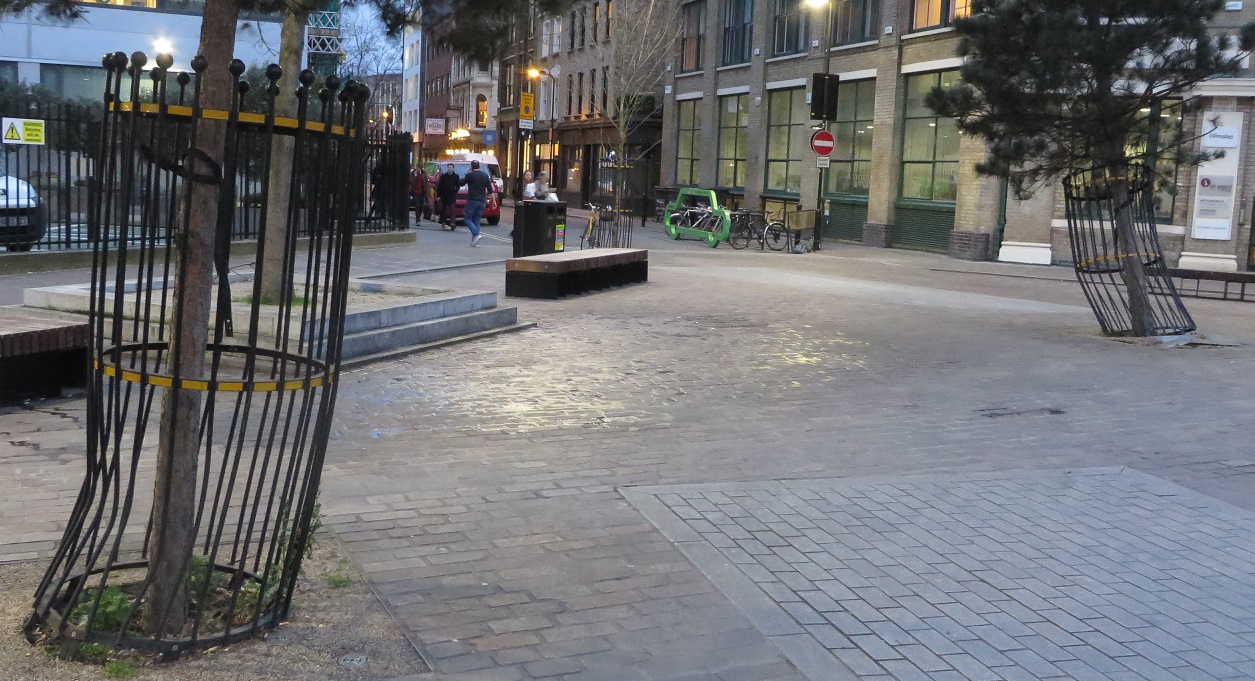 [/img]
I think the comparison to 'Woonerfs' is always a bit dodgy. Woonerfs don't need signs, bollards, kerbs, traffic lights etc because there is virtually no (motor) traffic on them, so there is no need for infrastructure that only exists because of motor vehicles.
Looking at Woonerfs and deciding that a lack of clarity makes them safe completely misses the point that they were already safe. And that safety means that you don't need to waste time and money building 'clarity', in the form of signs, kerbs etc, into the road. If you took a busy through route in The Netherlands and took away the signs (which is the nonsense that we try to do) it wouldn't magically become safe and the motor traffic wouldn't disappear. You need to stop these roads being through routes to remove the danger posed almost universally by motor vehicles.
I appreciate the traffic numbers are very different, but some of the principles can carry over.
Here's an example of a busy through road (amongst other on this website):
http://www.hamilton-baillie.co.uk/index.php?do=projects&sub=details&pid=35
Hmm, I'm very wary of that link. Ben Hamilton-Baillie is one of the people making the most money from 'selling' shared space to councils. Funny how the pictures are taken when the roads are deserted (7am on a sunday morning?). Take one at morning rush hour and see how inviting the road is for kids on bikes getting to school.
I don't think there is any argument that you can cause a slight reduction in speed by doing things like visually narrowing lanes and removing centre lines. It's quite another to claim that it's enough to change the character from a through road to somewhere kids can play.
that road he shows has 6-7000 vehicles a day. As supposedly dropped speed by a couple of mph (bu pt doesn't even say what to). If they've dropped from 40mph to 38 it's hardly made it a quiet village high street.
A few MPH drop is enough to make a big difference to noise pollution, especially with that much traffic.If they've dropped from 40mph to 38 it's hardly made it a quiet village high street.
Fair enough - not an example without bias there.
Now know-one's going to play there, but the increase in safety and perception of safety will increase in line with a reduction in speeds. I drive that road in the link and know it before and after. I also cycle on that road occasionally.
Before, I had a clear carriageway marked out and signage would tell me about the bend coming up. Now it feels narrower as the carriageway isn't marked and the bends feel tighter. The curtilage of the buildings feels closer.
Given that speed limits are rarely enforced, any physical change that slows speeds and forces more driver awareness is better that nowt.
Re speeds - I don't know but suspect its more like 30 down to 26/27mph.
We've pretty much reached saturation point with traffic these days, cars have become too successful for their own good and where you design for them you ruin it for everybody else. Designing for historic traffic growth is also a never ending battle, you make space for it, more people drive, you have to make more space for it, its use needs to be restrained like it or not, and the ideal way would be pricing road use as you drive to a level where traffic moves reasonably well. Little things like the OP posted are a microscopic contribution to that theory, but at least says we're taking a little back from the car drivers.
Mostly not, only a few bleeding heart liberal do-gooder hippys wanna curtail car driving. MOAR roads!cars have become too successful...//...its use needs to be restrained like it or not
hmm not sure. Unless you're using blackbox recorders* and start charging from the second you start the motor, it's not going to affect all the lazy chuffers heading to the shops/school if you dont have to move in/out of charge zones. Also if you only have charging cameras/sensors on main roads then rat run minor roads are going to be chocka.and the ideal way would be pricing road use as you drive
*another neat idea that would probably solve a lot of problems but the majority will rabidly shout down.