It's a godsend for people working shifts, or with more than one job. Also used by young people who have to keep moving their rented accommodation in different areas of the country because of the intermittent and casual work that's become so normal for new entrants to the workplace... they can keep voting in the constituency the grew up in while they're having to live the nomadic life.
"The current Tories may be ‘hard’ right "
Seems to be a complete reality distortion field. The Tory vote has collapsed because the party that currently calls itself Conservative is anything but. High tax, incompetent with public finances, country visibly going down the tube, increasingly Draconian thought crime legislation. To call the party that has set record immigration levels to three times that of the Blair/Brown regime xenophobic is a little bit unbalanced. The Cons will lose because con voters have had enough of the lies, broken manifesto promises, imposed joke PM Sunak and monumental incompetence.
You are confusing a party being “hard right” with a country being “free”.
Yeah you're right, but it's a good enough proxy IMO.
Scrap postal voting, it’s wide open to abuse.
And turning up at a polling station is not? There seems to be little evidence of actual voter fraud that if you are trying to fix the system - you are looking in the wrong place.
Im not sure it can ever be fixed. It’s all based on corruption.
I long predicted that our system of government would be eventually be run by millionaires and billionaires for their own benefit and those who support them. It’s probably over 20 years since i first came to this conclusion.
And thats where we are now.
I think it has been like that for a very long time and all that has changed is 24hr news and social media makes it harder to hide coupled with it being done in a much less discrete way.
And yet our freedom to protest
Has it really? What evidence to support this is there? I would agree its harder to strike than it used to be
Housing, that’s all one needs to consider for a positive answer. The size of income for affordability is beyond most minimum wage earners.
- It depends to some extent on their aspirations for where they live.
- Houses like the one I grew up in sell for £110-120K; the one my children grew up in is about 3x that.
- The first house I (we) bought was on a similar mortgage:income ratio to two new graduates buying the house I grew up in would be today.
- My kids probably won't be earning minimum wage when they first buy a property, just as I wasn't. When I was on crap earnings I was sharing flats and scraping by, just as my parents had done before me! My parents were not in any financial position to help me out, but we potentially might be in a position to help our kids out. So whilst the gov might not be responsible for that redistribution they would still end up "better off" than we were.
Final salary pensions.
- I don't have a FS pension
- My parents don't have a FS pension
- I didn't have a pension at all until I was in my 30's, my kids will have something as soon as earning (it will be a shite pension but starting early is important even with a shite pension)
- My kids can probably expect to inherit something before they reach retirement age (as indeed might I). Your legitimate observation about house prices also means that inheritances are growing significantly - albeit life expectancy* growing means they may not happen so soon.
Both you and I appear to be at the upper end of the income scale, my children are towards the other end.
- I'll buy into the "upper end" of the scale description. I don't expect my children to be on minimum wage when they leave education. Did you earn as much as your parents when you started working?
Without my/our help my two will not be able to afford a house close to their workplace and their pensions are going to be rubbish compared to mine.
- The starting assumption seems to be that people should own a house. Even when I was growing up that was not the default position - its a legacy of thatcher. So saying first generation to be less well off than their parents might be ignoring all those pre-thatcher generations? Of course right to buy has left a legacy of problems for generations to come... but it seems odd that the generations that benefitted are now grumbling that they might have to give the next generation a leg up.
- I don't know where mine will end up living/working. Certainly, if you want to live somewhere really nice this could be an issue - but I think those are aspirations that WE impart on our kids. When you look at the geography of where people live in the UK (and probably elsewhere) employers either move to areas where there is cheap labour or need to solve the access to housing (mines, mills etc did this by building - modern day by paying more).
- There's always been a balance between where you want to live / how much it costs / what you earn.
- I'm not sure the pension imbalance is as simple as a generational one.
"Certainly my son is the age I was when I left uni, and he will be better off than I was."
Of course there will be some families where this is the case. However broadly speaking it will not be. Generous final salary pensions are dead, as is stable career progression and affordable housing for the most part.
We're just going through father-in-law's affairs, as he has dementia and is in a care home. He was a mid-ranking professional, nothing particularly important, and his parents weren't rich so he never had any leg up at the start, was the first in his family to go to uni. Retired early in his 50s, his single salary supported a stay-at-home wife with 2 kids who went through uni. And he's worth over a million quid. Tell a teacher or uni lecturer or similar in their 30s that they are going to have saved up a million quid by the time they pop their clogs and they'd think you were off your tits on meth. He didn't even get particularly lucky on the housing bubble, it's mostly savings not property!
My flat was 2.5 times my earnings when bought. Now worth ten times the salary for the same job. Rental was 30% of salary now would be 60 %.
Two new graduates could not affird the house poly mentions if they are in public service
@edhornby add ban donations to political parties, ban fund raising for political parties
Introduce public funding for all parties and I think you have a winner
Two new graduates could not affird the house poly mentions if they are in public service
TJ are you saying 2 new graduates couldn’t afford a 120K house? Let’s say they have a 10% deposit - so a 110K mortgage.
Nurses / Teachers straight out of uni - £25K ish? . So a couple would be on £50k. I believe that for good credit risks lenders will offer 4.5x join income - so they’d have no issue getting a mortgage.
Of course there will be some families where this is the case. However broadly speaking it will not be. Generous final salary pensions are dead, as is stable career progression and affordable housing for the most part.
ok, well if those are your definitions I’m also less well off than my forebears having no final salary pension, and timing for housing market that was not ideal, etc. I think every 1980s miner would also like a chat about the stable career progression they had… don’t get me wrong a lot of boomers have done a great job of being fat and lucky and screwing the world for those that follow, and they’ll probably shaft us again - but I’m not convinced todays children are automatically worse off than their parents and this is a new thing; even if we assume that I am some sort of outlier. That is in no way an attempt to say the government have done a good job on these issues.
Edhornby and Gordinmor - I could get behind most of those! I’d not actually abolish HOL - I think it has shown itself to be sensible steadying force when HOC goes off the rails. Personally I’d have a much smaller house, perhaps 2-300 people. I wouldn’t bother electing them - the public are just going to appoint the same sort of nutters on poorly argued manifestos and the colour of their tie. I think you could “earn” a seat in the HOL by having been an MP and perhaps even some jobs like Judge or senior civil servants - people who are used to scrutinising law and policy. Points for various roles (pm would score more than a minister, minister more than a back bencher, etc) and time in office - so the Ken Clarke, Tony Benn, etc would still have potential to end up there. You’d end up with a council of wisdom - ideally with eligibility requiring people to leave their party behind, but certainly no whipping.
Older generations yes, current generation no, i.e. a 25 year old who has kids will not be better off that their children as both in same boat whereas a 60 year old with a 30 year old is not.
And blaming older generations is not really on as a LOT of us did not vote for Thatcher and we had no say in what housing was doing, what happened to pensions and so on. We were just born at the right time, buying somewhere to live and getting whatever pension was the norm.
And blaming older generations is not really on
Hmmm, sorry but Boomers (as a generation) still have much to answer for, they came to Political power when ? Early 90's- ish? just two things; climate change denial (the facts were known, even Thatcher recognised the danger) and the fantasy of "trickle down" economics have done more harm then pretty much anything else you care to look at, and both of those things are on their watch. It's hard not to see them as a group of folks who're 'generally' anti-science and economically illiterate. They're going to leave the place much worse then they were handed it. It'll be left the Gen X and millennials to recover from that and that's going to be 50-60 years of graft - if we last that long.
The kids are having to clear up the mess left by their parent's party.
Older generations yes, current generation no, i.e. a 25 year old who has kids will not be better off that their children as both in same boat whereas a 60 year old with a 30 year old is not.
A notable number of (anecdotal stuff incoming) of my generation and social grouping are effectively ****ed in terms of being better off than their parents, or even in terms of avoiding retiring into poverty. As would I if I had children, which growing up is not a choice I thought I'd end up making.
Their mortgages are taking them to retirement age and pensions can only be the absolute minimum whilst they are paying the costs of raising families.
Someone mentioned stable career progression up thread, was this ever really a thing? I've never been in a workplace where pay structures were not a pyramid, which by default limits progression. You cant have everyone at the base of that pyramid moved up, and by default the pay I've seen in organisations is 'banded' so long service and ability in role only returns so much.
Where do two graduates that are 40k in debt suddenly find 11k for a house deposit and the desire to live in an area that has 100k houses?
@poly I agree about the need for a second house but it's population needs to come from A much wider base than the one you describe so yes to educationalists poverty campaigners artists trade unionists and many more
It’s hard not to see them as a group of folks who’re ‘generally’ anti-science and economically illiterate.
You forgot their enormous sense of entitlement and vanity. I've lost count of the number of times someone in that generation (including my own parents and in-laws) has told me something along the lines of 'things were no different in our day, we worked hard and pulled our socks up and got on with it rather than having everything handed to us on a plate'. I'm not denying they worked hard, but the rest of it is bollocks because actually they were handed everything on a plate. Free education, stable secure jobs and wages linked to productivity, generous pensions and retirement, a liberal safety net and functioning health services, and then later a massive free handout to the tune of hundreds of thousands in the form of property price inflation. They think they got all these things because of their graft, but they didn't. They got them because of the political climate at the time which was largely a reaction to the cold war. And then when that was coming to a close they voted tory in their own financial interests rather than passing on that benign political environment to their kids. We've been left a shit-show, and they still expect us to pay for their triple-locked pensions!
"And blaming older generations"
I'm not particularly talking about blame older generations, I mostly blame people voting tory, they tend to be older, but not exclusively. I happen to know a lovely community of older people here who mostly wouldn't dream of it. They've still benefited from the policies however and some of them may be a bit complacent about it, they believe they "earnt" it but don't necessarily accept that this was effectively thrust upon them and some rebalancing is required (eg taxation).
"Someone mentioned stable career progression up thread, was this ever really a thing?"
My parents' generation, yes (I'm 55). It was very clearly dying out for me (and was a significant factor in provoking my move abroad), but still somewhat achievable in my niche. It has only got worse since.
Even with a pyramid there still used to be reasonable salary increases with seniority. There was also a big expansion in their era so the promotion bottleneck was much much looser.
Of course I only know my own niche (academia/research).
So if todays young people were handed the same things on a plate (free education, cheaper houses, better pensions) etc,. what do you think they would do - would they reject it all on the basis that is may not be as good for people in 40 years time?
I benefitted from things completely out of my control, what do you suggest I should have been doing when just buying a house, juts getting a work pension and so on?
It's not any individual's fault.
But, there's a responsibility not to squander societies future assets, and the political classes from the 1980 and 1990s have very much done that at the expense of their children and grandchildren. Politicians have aimed their policies at the largest group, and that is Boomers: Growing up, in their work places, and now in their retirement. This is a group of folks who've had their every whim catered to. I think the biggest impact for me is the gap between the (revolutionary) things they say, and the narcissistic way they behave, in that I think they came to believe that prosperity was the natural order of things for them and their children, and cannot seem to be persuaded that ultimately they've benefitted from that narrow era of almost unheard of post-war settlement and growth.
Worth remembering that the victims of 1980s mass unemployment will soon be coming through retirement. I'm already there and I did not land a job until 27. That scarring had a cost.
However there is a but, a big but: grant at university, as soon as I got a job I was straight into the housing market even though interest rates were high and wage low, during the short wait I had access to affordable renting, mobility was easier, you could easily "get on your bike" and freedom of movement gave me that job. If we ever get that degree of unemployment again, recovery will be much, much harder.
I think people who’ve benefited need to accept that some rebalancing is required, this means taxes and benefits targeting those who have the most and those who need the most.
Eg, earned income is taxed more punitively than unearned income, generally speaking. And huge tax-free inheritance windfalls perpetuate inequality. Houses need to be built over the objections of reactionary nimbys. Freedom of movement needs to be prioritised over the objections of jingoistic xenophobes.
But, there’s a responsibility not to squander societies future assets, and the political classes from the 1980 and 1990s have very much done that at the expense of their children and grandchildren.
I don't believe people knew that at the time. I certainly didn't as I could not see 40 years into the future.
I just did things like went to work (and got pension), bought house that was only 3 times salary and so on which was just what people did. To expect me not to do that because of stuff 40 years away is a bit unrealistic isn't it.
And what if whatever people are doing now, including younger generation, is at the expense of their grandchildren. Are they even thinking about it?
"And what if whatever people are doing now, including younger generation, is at the expense of their grandchildren. Are they even thinking about it?"
Mebbes aye mebbes naw ?
Should they be?
Are people even able to predict what will be the situation in thirty years time?
Should'nt people be able to take a decision that alters the effect of a decision taken many years earlier?
I don’t believe people knew that at the time. I certainly didn’t as I could not see 40 years into the future.
No but they do now (or should do!). This is the narcissism nickc is talking about. They (speaking generally of course) think everything they have is deserved, and they should continue to have all that stuff without having to pay anything back. House prices are a classic example, the boomer generation profited by hundreds of thousands each from something that they didn't contribute to at all, and yet now they won't accept tax on that unearned wealth either in the form of wealth taxes or inheritance tax. Same goes for pensions, they expect the younger generations to continue paying their final salary and index-linked state pensions while younger people have to swallow the reality of retiring later and having much less valuable pensions.
As a good anecdotal example, the 5live phonein earlier this week was talking about pension and tax changes coming into effect. A standard full-state pension is something like 9% better off thanks to the triple lock, and yet a retired caller on the show was complaining that she was going to have to pay income tax on a tiny proportion of it because the raise has taken her over the threshold for paying tax.
To expect me not to do that because of stuff 40 years away is a bit unrealistic isn’t it.
Again; it's not your fault. I cannot say that enough. The fault does lie though at the feet of politicians who should know those things, and who're paid to know those things. We haven't built enough houses, that's a policy decision to appease a generation of folks whose wealth (or more accurately their own assessment of their wealth) is inextricably tied to thier house value* We've robbed councils of council-taxation becasue of policy choices not to revalue those same properties for exactly the same reason. We've not allowed councils to build for the same reason, when Boomer's parents are dying off their houses are falling to ownership by Boomers and are being rented out, because being a private landlord or getting a mortgage for one is piss-easy. It's a set of polices designed to appeal to homeowners, and overwhelmingly in the UK now those people are Boomers, and those policies alone (that are there becasue of political decisions) are having a massive impact on future generations being householders. Politicians should've done something about this years ago, but won't becasue the largest voting block won't stand for it.
* I know that they want to pass on that house value to their children, and they do that from the best motives, but unearned and hoarded wealth is killing our societal equilibrium at a rate that's unprecedented.
For the hard of understanding – when I talk about children being worse off than their parents, I meant on a generational, statistical basis and not that every child will be worse off than their own parents.
@the_captain - yes I realise that; what I'm questioning is if it is true even at statistical level. I think it may be true for some demographics but the examples of house prices, final salary pensions etc are very much a "middle class concern". If you are at the council house, struggling to feed your kids end of the scale - I'm not saying its better now than it was but I'm questioning if its actually worse. We didn't have food banks in the 70/80s so perhaps it was better, but there was a lot of unemployment, 3 day weeks, etc. Rose tinted specs? I wonder if those who are sure their kids will be the first generation to be worse off, missed the generations around coal, steel, and other heavy industry who were just dumped in the 80s? The grand children of those generations are doing better than their forebears.
Where do two graduates that are 40k in debt suddenly find 11k for a house deposit and the desire to live in an area that has 100k houses?
40k in debt presumably = student loans? So not normal debt (although I loath them). The need to find a deposit has almost always existed - except for a short period near the millenium when banks lost the plot. I don't want to sound like a "they can afford £4 for a coffee" type, but people afford weddings, foreign holidays, nice cars, fancy phones etc - if you want a deposit for a house you used to make sacrifices to achieve that. Where did you get the deposit for your first house? The second half of your question was exactly the point I was making - IF you are willing to compromise on the house/location there are houses around (that sort of money gets you a 3 bed "four in a block" on the south side of Glasgow - its not Nottinghill, but there's much worse around). Sometimes people here remember life through their own aspirational middle class blinkers.
House prices are a classic example, the boomer generation profited by hundreds of thousands each from something that they didn’t contribute to at all, and yet now they won’t accept tax on that unearned wealth either in the form of wealth taxes or inheritance tax.
I am with you on inheritance tax and I would go for 100% inheritance tax. In reality that would drive behaviours but so be it.
Not with you on a wealth tax. My mum is someone who benefitted from housing prices but she has no money other than state pension so taxing her while alive is not exactly fair as again housing prices just happened to her (on a house she bought in 1962 and still lives in).
Same goes for pensions, they expect the younger generations to continue paying their final salary and index-linked state pensions while younger people have to swallow the reality of retiring later and having much less valuable pensions.
How are the younger generations paying for peoples final salary pension schemes? They are company pensions and nothing to do with anyone outside of that company with regards to paying for.
The young could have an even better state pension that the old have but we don't know as that is 40 years away and choices over retiring earlier can be made but the young would have to pay for that now just as others will have to pay more for them to retire earlier when they reach that age.
and they should continue to have all that stuff without having to pay anything back.
This in a nutshell, There needs to be hundreds of thousands of new homes - like the ones that were built in the post-war boom that the Boomers bought cheaply! But it'll hit the value of Boomers unearned wealth, so it won't happen. We have to be in this together, or not at all, we can't have just one generation nodding their heads and then voting for the party that'll promise to make them richer just like back in the day, those days have gone, and they're not coming back if this one generation continue to behave like they're the only group that matter.
How are the younger generations paying for peoples final salary pension schemes?
Are you aware that the largest single shareholder of Thames Water is a Canadian pension scheme? So, water was sold off, its bought by shareholder investment companies who have a responsibility to their shareholders - pension schemes mostly, to extract as much value from the investments as possible. Thames Water is now bust becasue the money that should've gone to making it better has gone to pay final salary schemes, Your children will cop the cost of re-nationalising the water and doing that work instead in the form of an increased tax burden .
How are the younger generations paying for peoples final salary pension schemes?
The pensioners of today are paid from the contributions collected from today's workers. That's how large pension schemes work and why pension defecits are such a massive problem. Same goes for state pensions on the whole although obviously those are funded from general govt expenditure. The result is the same though, older people getting more, younger people getting much less.
The trouble with making economic and other decisions that effect society in the longer term on a political basis is that any politician is likely to be guided by the proximity of an election. If we take some key roles out of the electoral process and put in an unelect.... nah let's not.
So lets try something else along with PR what about a directly elected Chancellor and Health Secretary on a 7 year term yet ultimately responsible to the PM who is elected in the normal way for the normal 5 years.
I don’t want to sound like a “they can afford £4 for a coffee” type, but people afford weddings, foreign holidays, nice cars, fancy phones etc
I'm not sure that sweeping generalisation is helpful. Amongst my peers the scenario you picture here is unusual. The majority cant afford any of the things on your list.
The majority cant afford any of the things on your list.
There's a much bigger problem than people being able to afford weddings and nice cars..
https://www.theguardian.com/society/2024/apr/02/the-britons-who-want-children-but-feel-they-cant
The pensioners of today are paid from the contributions collected from today’s workers.
No they are not. I have a very small final salary pension from my employer where I worked from 1988-1994. The company no longer exists but the pension fund is maintained and nobody is paying contributions into it.
My pension for the company I worked for from 94 to now has all been paid by me and the company and nobody outside of that is paying contributions into it.
You seem to be confusing state pensions with private company pensions.
No they are not. I have a very small final salary pension from my employer where I worked from 1988-1994. The company no longer exists but the pension fund is maintained and nobody is paying contributions into it.
Pension funds are generally protected from companies being liquidated or going into administration. Defined benefits schemes are protected by the govt Pension Protection Fund, or they take out separate insurance to ensure liabilities can be met. If however the company is still in business then pensioners are paid from the contributions (and return on investments) to the fund.
Yes I know. My question was "How are the younger generations paying for peoples final salary pension schemes?" which you have failed to answer. Nick had a go on your behalf but was clearly stretching to link pension investments in water company which is not the same.
What younger people are paying for is the state pension of those current claiming a pension just as they are paying any other benefits people are receiving. When they retire that younger generation will be paying it for them as I say that could be better or worse than now as it is 40 years away. Who knows the younger generation may vote for a party that provides higher state pension benefits at a higher cost to themselves being the current workforce
They are also paying for civil servants pensions the cost of which has gone up up significantly since 2008 whilst we have had negative real interest rates, this should stabilize now we have a realistic rate.
[img] 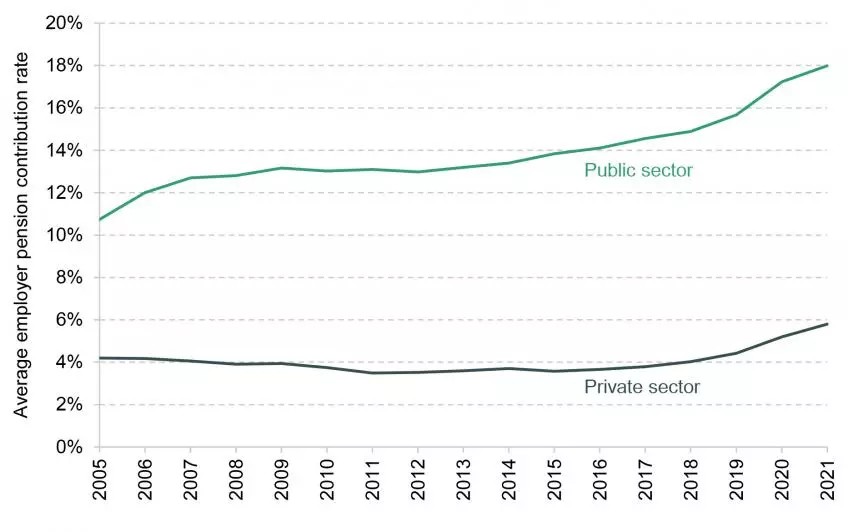 ?itok=AV_nmSW0[/img]
Many pensioners has lost out badly as well as there cash savings have been whittled away by the lack of a real interest rate.
What younger people are paying for
Pedancy aside are you denying that younger people are worse off than older people in terms of pensions? Why is that? Was it because the older generation never paid enough in to cover their future benefits? Who pays for the shortfall? Certainly not the pensioners because they refuse to accept any reduction in their pensions.
The worst provided generation for pensions is Generation X, younger generations started saving for their pension much earlier.

