Forum menu
So according to the CEO of the Rail Delivery Group, above inflation rail fare rises are justified as they are needed to encourage govt and the rail companies to invest more.
[url= https://www.theguardian.com/money/2018/jan/02/rail-bosses-seek-to-defend-train-fare-rises-amid-protests-at-stations ]“The fares are actually leveraging more investment from private sector and government,”[/url]
Do they think anyone actually believes this rubbish? Even if it was true do they think anyone would still accept it? Seems to me higher rail fares are a product of one thing, the fact that the network is massively over-capacity and they're taking advantage of this to charge more and reduce the numbers of people using it. If you can't match demand with supply, then reduce the demand. It's worked here, I for one will be riding my bike to work much more often from now on.
Used to cost me £750 a month to get to work, tickets plus parking. Bike not an option. One of the reasons I moved into central London as Boris bike commute was £7.50 a month, rest soent on higher living costs but 10 min each way commute vs 75min
UK infrastructure has suffered many decades of underinvestment
I'm sure my extra 15p a day will help out.
Higher Rail Fares are needed to encourage [s]higher investment?[/s] higher subsidies
FIFY...
Lord Adonis is calling for the resignation of transport secretary Chris Grayling for using hundreds of millions in taxpayers’ money to bail out private rail companies – a decision which the former government infrastructure tsar says is symptomatic of a government that has “broken down” under the strain of Brexit.
Same shit, same government position on fleecing commuter workers.
Listening to the Network Rail bonzo this morning was like “yeah, mannn.. but you’ll see four major projects come to fruition in 2018 .. so stop whining cockbags”
The rail network has suffered 100 years of underinvestment. It was never designed to be a user friendly cohesive transport system. More a higgledypigldy random localism best served by keeping locals, local. The expansion then sudden contraction of the network has always been governmental designed, one so they don’t have to spend money on it and two they travel by car so WGAF.
I wonder just how much money Brexshite is costing, when the alternative would have been to plough all that cash and hotels bills and huge government departments overspend and wasted time into a cohesive transport system that allows users to get from one place to another seamlessly.
I wonder just how much money Brexshite is costing,
Ironically [url= http://www.insider.co.uk/news/brexit-costing-british-economy-350m-11716091 ]£350m/week according to the latest analysis[/url]!
Most countries recognize railways as part of their critical national infrastructure and have invested appropriately. One way this country could improve productivity is making sure it's easy and cost effective for people to get to work. For the last 25 years, much public money has been 'invested' in the dividends of shareholders and yet contract holders not held to account for poor performance. I heard someone on R4 this morning say that some in Government now see high fares as a means of managing demand i.e. deliberately pricing people off the railways.
[url= https://www.theguardian.com/uk-news/2017/nov/29/east-coast-rail-franchise-terminated-three-years-early-virgin-trains?CMP=Share_iOSApp_Other ]Someone has got to pay for Richards islands and spaceships[/url]
The East Coast Mainline is a genuine scandal. They’re sinking billions of taxpayers money to try and cover up the fact that their free market ideology has comprehensively failed
The last time a private contractor had to be bailed out on the same route, it was returned to public ownership where it delivered both a better service and a profit back to exchequer
In other words it committed the cardinal sin. It proved that ‘the market’ cannot deliver, and public ownership works
So obviously it was re-privatised, with exactly the same result
Who’d have thunk it, eh?
those ministers having forgotten that everyone needs to get to work not just the rich lawyers but also the cleaners
fare rises are justified as they are needed to encourage govt and the rail companies to invest more.
Do they think anyone actually believes this rubbish?
In a sense... what other tool is there if you want to offer investors a prospect of a greater return on investment? If trains are jam packed already you're not going to be able to offer a greater return from the prospect of selling more tickets to new customers so you can only sell the same number of tickets to the same customers for more 🙂
what other tool is there if you want to offer investors a prospect of a greater return on investment?
And there in a nutshell is the case for nationalisation.
I heard someone on R4 this morning say that some in Government now see high fares as a means of managing demand i.e. deliberately pricing people off the railways.
Well you've got a problem here (with current ideology at least) - the network is at capacity. So what are you gonna do? The cost of new railways is massive, so what private company is going to want to do invest there? We could go to the train sensing track tech, but oh look, the network is state owned.
So the only solution is lots of government investment. And look what happens at the ballot box?
[img] 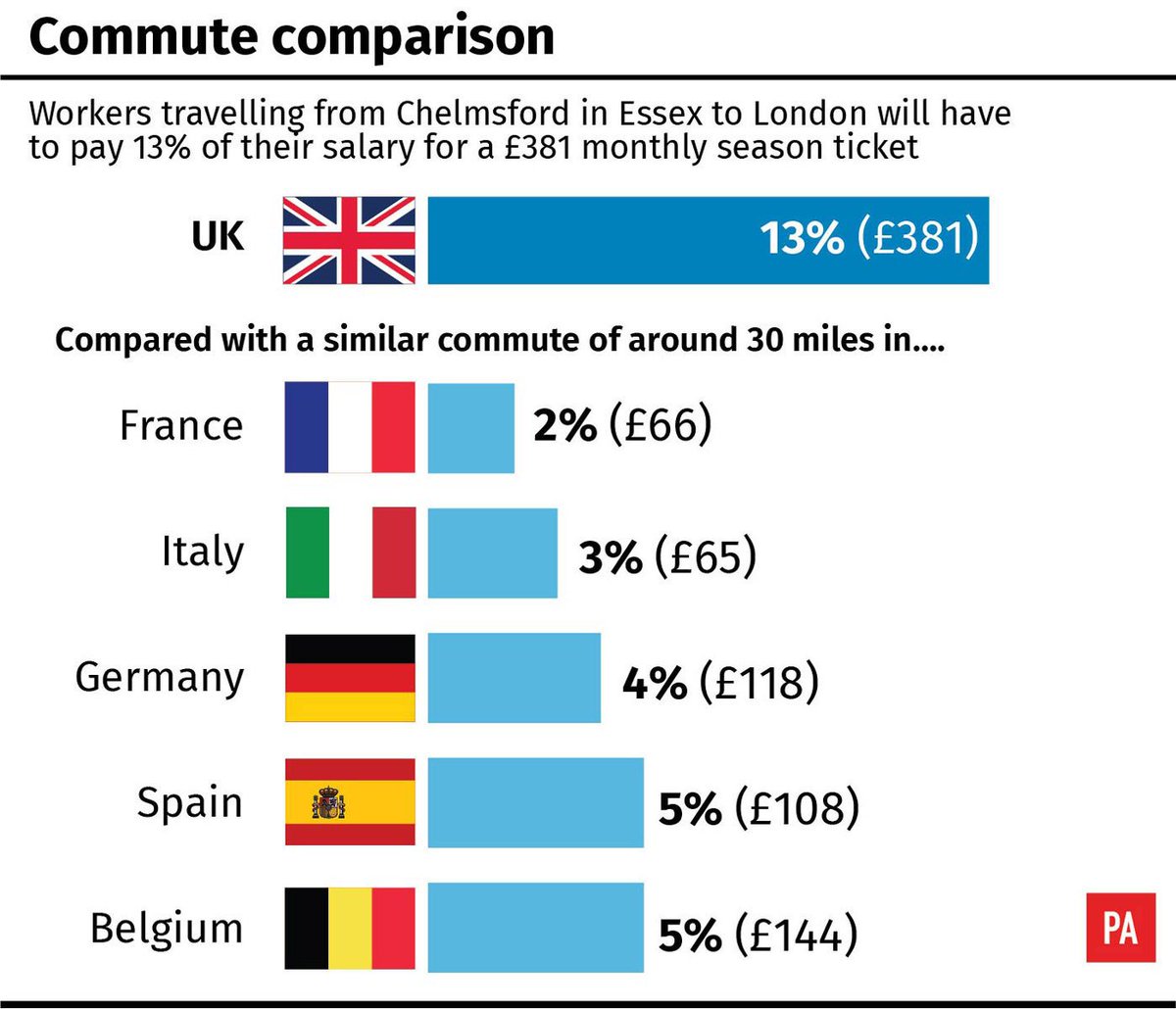 [/img]
deliberately pricing people off the railways.
It depends on how you view 'deliberately pricing people off' - if the problem is too many people travelling (whether its on private or public transport) then part of that problem is its currently (seen to be) cheaper to live somewhere other than where you work and pay to travel.
Obviously we want our transport system to be as good as it can be but if a system is oversubscribed its because its cheaper or easier than the alternative and one of the alternatives is 'living in the right place to begin with'.
Its a question of whether you respond to demand or shape that demand.
I think the question is how much should general taxpayers subsidise rail users? The 2015-2016 figure was £4.8Bn which has in real terms doubled since 1985.
Personally as an infrequent rail user if more funds are needed I would prefer rail users pay rather than taxpayers. Obviously frequent rail users will see it differently.
Personally as an infrequent rail user if more funds are needed I would prefer rail users pay rather than taxpayers. Obviously frequent rail users will see it differently.
As an infrequent rail user I'm happier that all those frequent rail users aren't on the road 🙂
and one of the alternatives is 'living in the right place to begin with'.
Most rail users are commuters who travel into city centres. They can't afford to live where they work.
Personally as an infrequent rail user if more funds are needed I would prefer rail users pay rather than taxpayers.
The public transport system benefits everyone not just those who use it. If everyone who used the train drove a car to work our cities would be polluted and uninhabitable, and the road network permanently gridlocked and/or taking up much more liveable space.
And there in a nutshell is the case for nationalisation
So that non-rail users should subsidies rail users?!?
Price is linked to RPI (not great but there you go) - on average train fares have rise 2.7% in real terms since 94-95 and passenger numbers have risen dramatically. Hardly cause for frothing...
If the majority want to subsidise my daily mode of transport that's their choice and fine by me. Very nice but not necessary really.
So that non-rail users should subsidies rail users?!?
No the fact that the rail (and wider public transport) network should exist to allow people to affordably travel to work and other places, and as such is a strategic national asset which benefits everyone, rather than existing to provide a return to investors.
Investment, satisfaction, usage etc all gone up (a lot) since privatisation, so seems odd that you are proposing a reversal of a trends that has delivered against your objectives.
Still very happy if others want to pay for my commute. Thanks in advance.
Investment, satisfaction, usage etc all gone up (a lot) since privatisation, so seems odd that you are proposing a reversal of a trends that has delivered against your objectives.Still very happy if others want to pay for my commute. Thanks in advance.
not on the east coast line it hasn't, except for those periods where it was effectively under public ownership, but you know that.
Investment, satisfaction, usage etc all gone up (a lot) since privatisation, so seems odd that you are proposing a reversal of a trends that has delivered against your objectives.
Classic Tory misdirection. Run it into the ground whilst you have control over it, then sell it to your buddies, give them loads of money and claim it's improved.
There's no intrinsic reason why state owned railways cannot work well. Just look at the rest of Europe. So-called private sector efficiency is a total myth.
Still very happy if others want to pay for my commute. Thanks in advance.
As you well know the price increases and ridiculous prices as a share of income (see comparison above with other countries) mean that people at the bottom are becoming priced out of using the train. I'm sure you have no problem with that as it means you'll no longer have to share the carriage with the plebs, but there are knock on effects such as higher carbon emissions, pollution, congestion, lost productivity etc. Strange that other 'advanced' european countries recognise that but we don't.
No the fact that the rail (and wider public transport) network should exist to allow people to affordably travel to work and other places, and as such is a strategic national asset which benefits everyone, rather than existing to provide a return to investors.
Which is why it is currently heavily subsidised. Nobody is suggesting stopping all taxpayer rail funding. Rail users paying a higher share of the cost seems reasonable.
The record rail user numbers would suggest that market forces are not yet pricing people off the rails.
Classic Tory misdirection. Run it into the ground whilst you have control over it, then sell it to your buddies, give them loads of money and claim it's improved.
and when they say they can't make a profit, after paying huge dividends to their shareholders, offer then even more money.....
The benefits of the pioneering Victorians is that we are still stuck with their infrastructure e.g. wiggly tracks and narrow bridges designed for steam trains - so no investment in bigger bridges that allow the use of double-decker coaches on busy commuter lines? Short-term contracts to rail companies don't encourage long-term thinking and investment, plus we give them get-out clauses around stuff like union disputes, track works that means they can wriggle out of penalties.
Paul Plummer used to be my director at network rail. The whole thing is a massive gravy train (no pun intended!) and rail users pay the price. I’ve never worked anywhere more inefficient than network rail - they couldn’t even cost a decent business plan at their last review. Absolutely unbelievable.
The talk about investment is true, but man they have an awful lot of overhead they could cut out. Some of it is truly shocking. But there is no incentive to do that (as the money just goes round and by placing on rail users the impact on the treasury is shielded) and the regulator lacks teeth.
deliberately pricing people off the railways.
Seems to be answer to everything here in good old blighty. Run it into the ground then **** it off! It's cheaper, easier and all the boys get their short term butties and early retirement out it.
The rest of us mules can work till we drop, while those that impose it retire early on gold plated pensions, laughing their cocks off.
I'm paying £168 a week plus another £43 parking to ride to work on a cramped POS that first came into service in 1952. How they have the audacity to charge what they do and provide the service that they do is beyond me.
Whilst I'm not especially in favour of tax payers money subsidising my commute, the rail companies really do need a shake up. More so Network Rail as the majority of the issues arise from their terrible infrastructure.
Investment, satisfaction, usage etc all gone up (a lot) since privatisation, so seems odd that you are proposing a reversal of a trends that has delivered against your objectives.Still very happy if others want to pay for my commute. Thanks in advance.
You're a difficult man to like..
usage etc all gone up (a lot) since privatisation
Correlation does not imply causation.
For usage given the increase in NI and no obvious differences when East Coast was under public management it really falls on you to make the case it does here.
For satisfaction. Again when compared with the limited public options the private sector doesnt stand out.
Still very happy if others want to pay for my commute
You seem to have missed the obvious point that the taxpayer is already handing over cash to subsidise your commute. The really irritating piece is the money being skimmed off to subsidise foreign railway companies and bosses bonuses.
people at the bottom are becoming priced out of using the train
And they then can't travel to get jobs....
Still very happy if others want to pay for my commute. Thanks in advance.
We already do. I've also paid for Crossrail, and goodness knows how many roads and hospitals in the North where I hardly ever go. It's called infrastructure spent, and whilst I'm not an economist but I thought it was usually considered a sound investment in a country?
Sorry flange - I was bought up to be grateful for unnecessary gestures of generosity. It’s called manners
The irony of all this very public gouging of commuters is that it's greatly increased public support for renationalisation. If we end up with Corbyn in number 10, this will be one of the key drivers for it.
YouGov's survey from May shows a majority of people now want the Railways, Post Office, Energy and water companies in public hands, I suspect those numbers have not gone down since then.
[img] 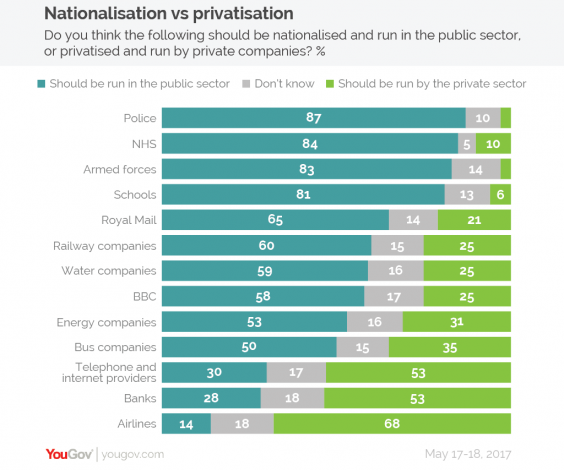 [/img]
Sorry flange - I was bought up to be grateful for unnecessary gestures of generosity. It’s called manners
Yeah, manners can cover for a lot of less appealing personality traits.
'That Dave, he's a condescending knobber isn't he'
'Yeah, but he's SO polite!'
'You're right, Dave's OK...'
“Knobber” exposes others
“Knobber” exposes others
Brilliant! I'll write that one down for future use...
Most rail users are commuters who travel into city centres. They can't afford to live where they work.
In scotland most rail users seem to be people travelling from City Centre Edinburgh to work in City Centre Glasgow passing trains full of people from City Centre Glasgow travelling to City Centre Edinburgh. 🙂
I did chuckle to myself this morning at the regional disparity in rail investment when the CEO of the Rail Delivery Group (Paul Plummer) was standing in London Bridge station gushing about the £1bn investment in that station alone, and in the next breath said that "the north" is set to get £1bn investment over the next 5 years - like "the north" is a comparable size to London Bridge. Butt-hole!
Job mobility. If you change your job should you have to uproot your whole family and spent thousands to move?
and spent thousands to move?
or spend thousands and thousands on travel so you can stay put.
The argument about needing investment from users has worn thin over the years
However.... the new GWR rolling stock is better in many ways and the on train staff must have had some customer care training...... hopefully the network improments + new rolling stock will improve reliability
European networks are probably not the best comparison as their capitals are tiddlers compared to London
or spend thousands and thousands on travel so you can stay put.
People move houses very rarely, perhaps once per decade, but now move jobs much more frequently. Since the 'job for life' era is now over (by design not accident I might add, from the same goverment which ran the transport system into the ground), it would be stupidly inefficient to expect people to move house when they move jobs, so the only other option is to provide the means by which they can commute. And that's not to mention wrecking people's lives by uprooting their kids from school, social support networks they've built etc.
Well you've got a problem here (with current ideology at least) - the network is at capacity.
As a rail commuter I don't see how it can be. Simply replace the two car train with a six car train and treble capacity with the same infrastructure. They fit, because six car trains do run on the same route.
The problem is that no new cars have been ordered in the past 15 years, so there aren't any to add. That's because the train companies get paid even if the ticket holders are left standing on the platform because the trains are full.
The solution - as recommended by the Public Accounts Committee - is to write into the train company charters that they provide sufficient capacity and for passengers to get a refund if they are left without a seat. That should concentrate minds.
Ahh the Train Regulator.
Pathetic impassive Treasury Select Committee nominated halfwits.
Lets not forget Southern Rail in this equation, 48mths of strikes and cancellations and the 'regulator" did nothing, the Tory MP's did nothing other that hide behind the tinted windows of their S-Class Mercs, no doubt searching on the Net for Sex Toys and organising their interns to go to the shops to collect the orders.
Any government appointed regulator is appointed as a visual front to take the flak from users, whilst doing nothing and representing only the governments position to do nothing.
Its a simple smoke screen and the UK falls for it [i]every time[/i]
Problem with both road and rail capacity is our (the public and our employers) daft requirement to stick to a pretty rigid 9-5, 5 day a week culture. To have a collective infrastruct capable of handling these self generated peaks and troughs is daft.
Rail companies don't help themselves with spreading the load mind - part week season tickets and off peak season tickets would get the commuters thinking more flexibly. Imagine an off peak season ticket that you could pay an auto top up for on occasional days (with perhaps an annual limit) if you needed to be in early for a meeting. Or a reimbursment if you made a certain percentage of your commutes in before rush hour to encourage you to travel in early.
People move houses very rarely, perhaps once per decade, but now move jobs much more frequently.
it would be stupidly inefficient to expect people to move house when they move jobs
I've had 16 addresses in 25 years. I see a house as a key tool for the work I do, in the sense that it has to be in the right place. It has never cost me more than a few hundred pounds to move house.
That said, I'm only playing devils advocate here. But for a number of factors people are living further and further away from where they work.
Some of those factors are to do with the continuity of employment in the 'job for life' sense that you could once expect to spend the arc of your career with one employer or work with in a town where comparable industries were clustered - but another is that households now more often have two bread winners, but rarely have two breadwinners who can both maintain a career in the same town, so at least one needs to commute.
Cheaper travel means people can rent or buy larger or nicer homes by moving to less central location. But the notion that people can or can't afford to live close to where they work needs to be taken with a pinch of salt - it can often really mean 'can afford something bigger or prettier of they're prepared to travel' or can't afford to live in the house they'd like. People, collectively, have made that rod for their own back. If travel was more difficult that bigger, nicer house they feel they deserve wouldn't be on the menu.
People only made these decisions because it was possible. If the result is those cheap transport options are now oversubscribed you can either address that by investing to meet that demand or by shaping the demand - make it impossible. Demand shaping happens all the time - more often than not we're unaware of it.
Job mobility. If you change your job should you have to uproot your whole family and spent thousands to move?
Would you clarify what you mean by that? What do you mean by ‘should’?
It has never cost me more than a few hundred pounds to move house.
I take it you rent rather than buy? I've bought three houses in the last 15 years, all modest by national average standards and each has cost significantly more than a few hundred pounds to sort.
flange - Member
I'm paying £168 a week plus another £43 parking to ride to work on a cramped POS that first came into service in 1952. How they have the audacity to charge what they do and provide the service that they do is beyond me
Whats a POS and what trains are operating that date back 1952, class 507 and 508 along with the caledonian sleepers are the oldest dating back to late 70,s
My last house move didn't give me much change out of 15k. The lion's share of that was stamp duty, which is effectively a tax on moving house. The government, in their infinite wisdom/incompetence has encouraged a mobile job market, whilst under-investing in the transport infrastructure to support that mobility, and then taxes home owners who have to move because of the previous two policies.
Imagine an off peak season ticket that you could pay an auto top up for on occasional days (with perhaps an annual limit) if you needed to be in early for a meeting.
National roll out of Oyster, and the associated capped fare benefits, has been a parliamentary recommendation since 2010 and government policy since 2012. Yet somehow seems hard to deliver.
Brunel managed to deliver the Great Western in less time (2 years for parliament approval then 3 years to run London to Maidenhead. He'd made an entire railway to Reading in the five years we've so far taken to fail to install an Oyster card reader at Reading station).
How they have the audacity to charge what they do and provide the service that they do is beyond me
They haven't got a choice, have they? They are a private company so they have to make a profit. Another disadvantage of using private companies for essential services.
Would you clarify what you mean by that? What do you mean by ‘should’?
I'm pointing out that people sometimes have pressure to change job, but also have pressure to keep living in the same house for various reasons. So if you face these two pressures then commuting is the obvious solution. But if you then make that harder, then these people will be unable to achieve a positive outcome whatever they do. So people will be miserable, and that is not a good thing.
Personally as an infrequent rail user if more funds are needed I would prefer rail users pay rather than taxpayers.
I like this thread. You can work out all the people who secretly vote Tory.
Yet somehow seems hard to deliver.
Hard to deliver because giving passengers - sorry, customers - the means to always pay the lowest fare possible is much more difficult than allowing them to overpay or incur losses due to changes in their travel plans. In this great country there is no concept of providing value for money to consumers/service users. The market decrees that it is the responsibility of the consumer, not the provider, to seek the best value. Yet with rail there is no 'market', only a weakly regulated protection racket which provides a take it or leave it offer for a shit service. It's hardly a surprise that people support nationalisation.
I'm paying £168 a week plus another £43 parking to ride to work on a cramped POS that first came into service in 1952. How they have the audacity to charge what they do and provide the service that they do is beyond me.
Where is this then?
I was under the impression that the oldest UK rail stock (other then the Island Lne, which is a basket case), is stuff from 1976.
Even then, it has all been refurbished a number of times - the HST 125's are still top class performers as one example from 1976.
Travellers using the Caledonian Sleeper service between London and Scotland have to put up with Britain’s oldest trains, at 42 years old.Merseyrail, which runs trains in Merseyside, has the second oldest fleet at 38 years old.
In terms of capacity Blackfriars will soon be dealing with 24 trains an hour
Northern run some sheds too, old converted bus shells no less.
Very comfy train this morning and this evening and smack on time. Pleasant way to work and the nice Chinese owners have even sorted out the WiFi
Lot cheaper and pleasanter than driving
Cannot say what I want to say courtesy of the “thought police”
sorted out the WiFi
you be careful. I'm told it's bad for you.
😀
Northern run some sheds too, old converted bus shells no less.
Actually some of the Pacers and class 155 are based on Leyland National bus body parts, the sides and seats along with the Leyland TL11 engine, the chassis is a purpose built frame, and there is no bogie, just 4 wheels fixed to the underfame.
So not actually old converted bus shells but purpose built vehicles , constructed by LEYALND
Northern run some sheds too, old converted bus shells no less.
From the 80’s though.
A pos, watch men in black ford pos piece of s***
If only us northerners got our fairs invested in local infrastructure. When I catch the train with a pennines muddy mountain bike it appears cleaner than the majority of the carriage.
My line has been promised new trains for the last 25-30 years
So not actually old converted bus shells but purpose built vehicles , constructed by LEYALND
Lol, does this look like a purpose built vehicle to you?
[img]  [/img]
The private ownership thing is all wrong, imo. Don't get me worry there is a need for it, same as there is a need of public ownership, again it's the problem that socialism and capitalism as viewed as independent systems.
IMO they shouldn't be. Each system on it's own leads to inefficiencies, one gets hamstrung by the workers, the other gets hamstrung by the owners. There should be a strategic to a fro in and out of the public and private systems. When one stagnates and seems incapable of delivering improvements, change it up, and around and round we go. Public ownership to influence general strategy(aimed towards the public good), private ownership to streamline those ideas.
So not actually old converted bus shells but purpose built vehicles , constructed by LEYALND
TBF the original prototype that did see service for a while was basically the bus body strapped to the rail chassis. So much so it was too narrow and the gap to be he platform was huge. Later models, like the ones still running, were widened.
Shoddily modified is the phrase you're looking for..
If there was a magazine for crap trains, they could call it 'max train'.
THM> I was bought up
Freudian slip classic!!
For those that believe because they drive their cars, then public money shouldn't be invested in railways also think the only families with children should pay for schools / education and the unwell for hospitals? The reason we've reached this situation is a succession of short-term, mis-applied free-market thinking.
In scotland most rail users seem to be people travelling from City Centre Edinburgh to work in City Centre Glasgow passing trains full of people from City Centre Glasgow travelling to City Centre Edinburgh.
My Edinburgh city centre office has 50-60 staff in it, none of whom live In Glasgow. Plenty come in from in between though!
For those that believe because they drive their cars, then public money shouldn't be invested in railways also think the only families with children should pay for schools / education and the unwell for hospitals? The reason we've reached this situation is a succession of short-term, mis-applied free-market thinking.
Yep, without efficient railways the investment on roads that would be needed just to get the level of usability we have now would be equally scary monitarily. Anyone in the South of England who attempted to drive on the trunk roads on Boxing day when there were no trains running when even without commercial traffic on the roads the system could not cope will attest to how much we need the railways to do their bit.
We moan and groan about it (like many do about the NHS) because the user experience is not perfect but it still manages something just short of 2 billion passenger journeys a year which is pretty awesome never the less. And as anyone who has travelled on an Indian railway will acknowledge our concept of crowded is very 'western'. Quite a bit cheaper there mind! Not saying there is not room for improvment but everything needs to be considered in context.
Indeed
Yeah. That's how I like to consider conditions too. If it's not as bad as India I should not complain.
I've travelled on Indian railways general class. Yes it's standing room only but that's substantially better than Southern rail at Shepherd's Bush where you can't get on the train at all.
irc - MemberI think the question is how much should general taxpayers subsidise rail [s]owners, shareholders, and foreign governments[/s]
FTFY. Right now, we subsidise profitmaking businesses. Weirdly we have no opposition to nationally owned railways as long as it's not us that owns them. And 90% of all investment in the network these subsidised trains run on comes from the public purse.