UPDATE: Reviews section refreshed, redesigned, searchable: Go take a look
OK, now that Cougar's query has been concluded (ha!), how about this one. We have this exact junction setup near us and it causes frequent arguments in the local FB group. Who has priority: red car or blue car?
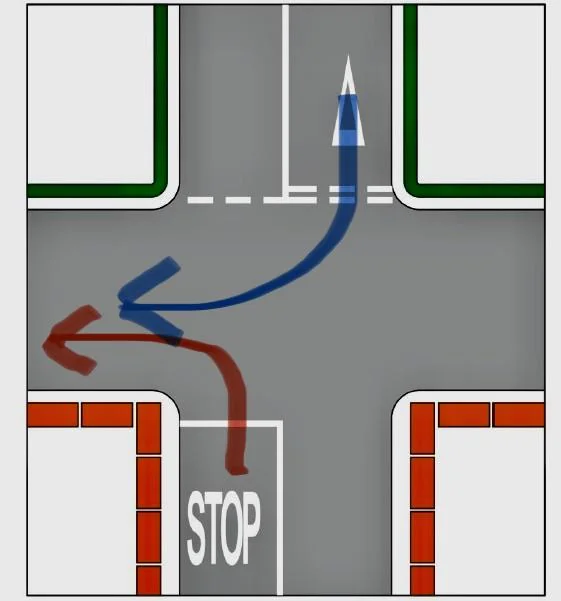
The double lines for the blue car means "Give way to traffic on major road" the solid line and the big word saying STOP means stop, so I would assume that the blue car has priority over the red.
Rule 171
You MUST stop behind the line at a junction with a ‘Stop’ sign and a solid white line across the road. Wait for a safe gap in the traffic before you move off.
Laws RTA 1988 sect 36 & TSRGD schedule 9 parts 7 and 8
Rule 172
The approach to a junction may have a ‘Give Way’ sign or a triangle marked on the road. You MUST give way to traffic on the main road when emerging from a junction with broken white lines across the road.
Laws RTA 1988 sect 36 & TSRGD schedule 9 parts 7 and 8
The double lines for the blue car mean "Give way to traffic on major road" the solid line and the big word saying STOP means stop, so I would assume that the blue car has priority over the red.
I don't think there's a distinction between a stop and a give way line, other than that a stop means you should come to a halt not just slow down?
Rule of thumb I've always applied is count the number of give way lines. Blue car crosses 3, red car crosses 1*, therefore red should go first.
*or it could be 2 if there was a give way line, but it's still the same outcome.
I don't think there's a distinction between a stop and a give way line, other than that a stop means you should come to a halt not just slow down?
I would assume that the red car at the stop and give way to traffic junction would include the blue car opposite emerging onto the road.
For what it's worth, I think with hindsight my original instincts were correct. Neither of us had priority, we were both correct in proceeding and the error here was the other driver shortcutting rather than going around the roundabout.
£100 and 3pp error
In Saudi back in the '80s you would claim right of way at junctions by being the first to sound your horn. That meant "coming ready or not".
OK, now that Cougar's query has been concluded (ha!), how about this one
In theory if you arrive together then the give-wayer will get away first and take priority because their views should be better and they don't have to stop.
If you both stop for a passing vehicle then whoever gets moving first is on the major road first.
while you roundabout experts are all here - is my understanding that you cannot do a full circuit of a mini roundabout (i.e. to go back down the road you came on?) correct?
It's a "should not" rather than an illegal "must not"
I would assume that the red car at the stop and give way to traffic junction would include the blue car opposite emerging onto the road.
The same logic would apply in reverse too though.
If red stops, then pulls out, blue has to give way until the road is clear.
It could also be looked at in terms of who is the car that has to give way if both cars did pull out at the same time, red would quite clearly be established in their lane and ahead.
If there's a clear road, then it makes no odds to blue if they give way to red, they would still be occupying exactly the same piece of road. If they both pull out at the same time then red just ends up ahead to no detriment of blue (other than it might have to ease off a little to allow sensible gap).
In theory, the one going right should be indicating so they get right of way.
That is really not how indicators work.
When you look at the wording in rules 171 & 172, the blue car must only give way to traffic on the main road, the blue car is traffic that the red car must give way to before entering the main road.
The diag doesn't show size of road, but I would assume that the stop line is on the minor of the three roads forming the junction.
Assuming all three roads are the same 'size' there would just be give way markings on both joining the main road then the car turning left would have priortiy over the car crossing the centre line.
Red car / blue car at cross roads - only difference to a normal cross roads is that red car must come to a stop. Both must give way & red car would have priority, just the same as if red car were going straight ahead.
The double lines for the blue car means "Give way to traffic on major road" the solid line and the big word saying STOP means stop, so I would assume that the blue car has priority over the red.
That's a bloody weird layout and I'd complain to the (county?) council.
That said, I would concur with your analysis. I think.
Truth be told, any junction that even starts these sorts of conversations likely needs a rethink. With the caveat that plenty of people are morons, if a group of driving gods mostly experienced drivers of (I'd like to think) mostly above average intelligence such as the STW Forum denizens can't agree or at least reach something approaching a consensus then something is badly wrong.
Rule of thumb I've always applied is count the number of give way lines. Blue car crosses 3, red car crosses 1*, therefore red should go first.
Err... what?
For what it's worth, I think with hindsight my original instincts were correct. Neither of us had priority, we were both correct in proceeding and the error here was the other driver shortcutting rather than going around the roundabout.
The other car had right of way, you were in the wrong. Arguing that he came from straight ahead and not the right is just rubbish.
The highway code even has a picture illustrating exactly this occurrence under rule 190 (which is about double roundabouts, but the same applies).
The Highway Code - Using the road (159 to 203) - Guidance - GOV.UK
The other car shouldn't have cut over the painted circle though unless they were so big they physically couldn't turn around it. So if there had been a crash then you could have argued that the cause was their illegal maneuver but if they'd gone round and hit you anyway it would be your fault..
Rule 188 - "All vehicles MUST pass round the central markings except large vehicles which are physically incapable of doing so."
There's a really poor on near me which has 2 lanes on the entry from the east, but only space for 1 car on the roundabout. So in that case you' have to argue that unless it was 2 motorbikes (or nothing in lane 1) then every vehicle is physically incapable of going around it. In that case it would probably be 50/50, you were both failing to give way. you should have given way to the right and anticipated that they needed to cut the roundabout. They should have taken care when cutting the rounabout.
51.398221,-0.875366 - Bing Maps
I just want it on record that I agree with everyone in this instance.
Err... what?
In order to turn and go the way the arrow indicates, blue car needs to cross the central road marking. Which is the point @thisisnotaspoon and @Dickyboy are making
The diag doesn't show size of road, but I would assume that the stop line is on the minor of the three roads forming the junction.
In my example, main road traversing L-R is bigger with both the road with the give way and stop lines being equal size - it's a continuation of the same road. The road with the stop line has worse visibility and is a downhill approach, so I assume the visibility aspect is why it has the stop line vs give way. The give way road has better (but still restricted) visibility and is an uphill approach.
When you look at the wording in rules 171 & 172, the blue car must only give way to traffic on the main road, the blue car is traffic that the red car must give way to before entering the main road.
That's my take on it. However, in practice when I'm turning right out of the give way road I'm very wary of anyone approaching or waiting at the stop line opposite me. Better to ensure they're not going to assume they have priority.
Truth be told, any junction that even starts these sorts of conversations likely needs a rethink.
Bingo. I assume everyone else is inferior (cos I'm a driving god obvs) and doesn't understand the correct way to deal with this junction.
It makes no sense at all to say that the blue car has any priority over the red car, in this scenario or if the red car were going straight ahead - as it fly's against all conventions of road driving priority in the UK, if you are crossing another vehicles path like this you give way. I'm just glad the chance of crossing some people's path on here is probably vanishingly small.
Again, see Big Jobber on YouTube or Facebook.
This example is a cut-mini roundabout job.
https://vm.tiktok.com/ZNRgSqmYq/
The diag doesn't show size of road, but I would assume that the stop line is on the minor of the three roads forming the junction.
The terms major / minor in this context don't refer to the size of the road, it's just down to the road markings. Both red and blue are turning out of minor roads.
Imagine a typical T-junction, you are approaching the give way line on the minor road and can turn left/right onto the major road. A car approaching from your right on the major road can turn left onto a minor road (that you're on). The same convention applies if the T-junction is actually on a corner, or it's a roundabout (a circular major road with several minor roads junctioning to it).
When someone says "turning left minor to major" they just mean turning out of a T-junction, "turning left major to minor" means turning into it.
i would seperate the requirement to stop or give way entirely from the priority moving off.
One must dead stop, one doesnt have to, but they both have to give way equally. After that its whoever moves first. if the red car sets off, then the blue can easily follow, if the blue sets off first the red should give way to their manuever, rather than try and block them as they cross traffic.
At the very least they should be as loud inside the car as outside.
Oh thats a good idea.
The other car had right of way, you were in the wrong. Arguing that he came from straight ahead and not the right is just rubbish.
He didn't come from the right. We both arrived nose-to-nose.
The highway code even has a picture illustrating exactly this occurrence under rule 190 (which is about double roundabouts, but the same applies).
That diagram shows one car already on the roundabout. This must be some usage of the word "exactly" that I'm unfamiliar with.
Christ on a bike.
Watch the video I posted above! The guy is a motor claim liability expert - and he talks about the law in the video (briefly).
He didn't come from the right. We both arrived nose-to-nose.
Which on a roundabout means he's coming from your right doesn't it, which side of your car did he almost hit? The right! What else do you think the highway code could possibly mean? It doesn't matter if the roads are arranged at 120deg, 4x 90deg, or any other geometrical variation.
Even if you were to be that level of absurdly pedantic and get your protractor out to check that the roads are indeed 180deg apart or greater, they would probably still be on your right and not head on unless you were on the wrong side of the road on approach to the roundabout!
That diagram shows one car already on the roundabout. This must be some usage of the word "exactly" that I'm unfamiliar with.
The car's probably aren't the same colors either, totally different scenario.
Summarize topic:
Ultimately, the discussion concluded that while the Highway Code provides guidelines, real-world scenarios often require drivers to use judgment and common sense. The consensus seemed to lean towards the idea that neither driver has strict priority, and the best approach is to avoid conflicts through clear communication and yielding when necessary. The conversation highlighted the need for better road design and driver education to prevent misunderstandings at roundabouts
Brilliant! Complete wate of time then! 😂
Being obtuse does not strengthen your agument.
Believe me, I know. 😁
But that's exactly the angle that the other driver would need to collide with your NS wing

