UPDATE: CLASSIFIEDS section refreshed, redesigned, searchable: Go take a look
When I was looking at buying some all season tyres I found this group test very helpful. All pretty empirical and quantitative. The stopping distance in the wet and the aquaplaning speed of the non premium brand is what really swung it for me - 10m further to stop from 100km/h and 15km/h lower speed to start aquaplaning.
https://www.tyrereviews.com/Tyre-Tests/2024-Sports-Car-All-Season-Tyre-Test.htm
eg the Michelin Cross-climate 2 is a popular choice but for my use its not the best choice. Yes it does very well in the snow for an all season tyre but it's not great in the wet and aquaplaning.
As somone poised to buy Cross Climate 2s for my Enyaq on the basis of the internet's views, what should I be looking at instead? SW based so wet is a lot more prevalent than snow, and the summer Pirelli Scorpions it came with light up the traction control light whenever its damp.
I think the latest Cross Climates are improved with a slight bias back towards wet-dry performance rather than outright snow bias....
I've always taken the view that I might save £150-200 by going for a set of budget tyres over premium ones. Obviously, there is a difference in wear rate between front & rear, but on average would get 2-3 years out of a set of tyres, so a couple of quid a week difference. I'd say its worth it for the premium ones.
Interesting seeing peoples thoughts on this.
I do not believe that the different tyre brands benefit from shared knowledge in the same group. i would expect them to be developed in silo'd departments with the appropriate budgets as is the case for many things.
I have had the pleasure of owning some cars that are very tyre specific. Having just a different brand would mean it swapping ends with amazing ease. Ive also had premium brands that were nothing sort of shocking for road use. As somone above it all depends on what your doing. You probably wouldn't use an xc tyre for a DH race etc....
i do think that you are more likely to get a better performing tyre with a bigger brand. The bigger the company the bigger the budget for R&D (and marketing that we are sucked in by) the more likely to get an improved product.
I wonder what the "good cars" ive had in the past would be like on modern day rubber?
Many car manufacturers are now fitting Hankook, Falken etc to their new cars a the factory.
The top of the range Audi/BMW etc might have Pirelli or Conti super-dooper rubber but most cars (i.e. the ones we all drive every day) don't need £300 tyres to go to the shops in the drizzle or zoom down the A1M to see Aunt Margaret.
Another issue is load rating - a lot of people think this is only for vans but large SUVs and electric cars are very heavy so they need load rated tyres.
munrobiker's review link shows there's not much between the top 4 all-season tyres but the differences would only become apparent when in extremis. If Ms OTS is a raggedy edge driver then she'll need the best tyres you can afford, if at the Driving Miss Daisy spectrum then anything bar the ditchfinders would do.
Thanks all, some thinking to do.
If Ms OTS is a raggedy edge driver then she'll need the best tyres you can afford, if at the Driving Miss Daisy spectrum then anything bar the ditchfinders would do.
She is at the driving miss daisy end, thankfully.
I suspect I'm going to go for kunho/nankang rather than the M,C,P,G end of things for her mini.
My Polestar is also due to arrive tomorrow, and I'll be putting all seasons on that as well - slightly different proposition being a heavier EV. Decisions, decisions.
The top of the range Audi/BMW etc might have Pirelli or Conti super-dooper rubber but most cars (i.e. the ones we all drive every day) don't need £300 tyres to go to the shops in the drizzle or zoom down the A1M to see Aunt Margaret.
Yep true, but although I do generally Grandad around and get absolutely nowhere near the limits of my Michelins, nor presumably a ditch-finder, I do like the feeling that should I want to stop very quickly, come across a freak road condition etc etc I've given myself the best chance.
i do think that you are more likely to get a better performing tyre with a bigger brand. The bigger the company the bigger the budget for R&D (and marketing that we are sucked in by) the more likely to get an improved product.
Same here - various relatives of mine have or do work for Unilever in research - different market of course, but I do generally buy their products because I know for a fact the lengths they go to with their research to improve the products. (Although, yes, I know it's ultimately market-driven and not perfect all the same.)
We had a very crap set put on the run about from Kwik fit (needed in a rush).
They were absolutely fine at first, but seemed to ‘go off’ really quickly and became awful in the wet.
Swapped them to Falken at a local independent fitters for the roughly the same price.
I take the view that between the upper mid and top end tyres it is very much a case of diminishing returns. But then those patches of rubber are the only things connecting me to the road, I can afford to pay a bit more so currently am running pilot sport 4's on the back and ps 5's on the front of my mazda 3.
Even if they give me a couple of % extra when I really need them it is worth it.
a set of budget tyres over premium ones.
It's not binary. A full spectrum between the cheapest and the most expensive and the price isn't always correlated to performance.
If Ms OTS is a raggedy edge driver then she'll need the best tyres you can afford, if at the Driving Miss Daisy spectrum then anything bar the ditchfinders would do.
I disagree with this. When you do an emergency stop from 70mph, it doesn't make a difference.
If it were me I'd go to ATS and get 4 Goodyear Vector gen 3- a quality allseason that copes really impressively well with snow and ice, works great in the cold and wet which is imo where tyre performance is most important (because of all dodgy conditions, cold and wet is the one you're most likely to be in, the one you're going to pay less attention in, the one you'll be going faster in and you're more likely to be tired in), pretty good but not amazing in the dry but who cares, and just a wee bit fuel inefficient and noisy compared to a summer tyre.
It's a good tyre and for my 225/45/17 it's £360 for 4 which is not cheap but not expensive. It's passed the "drive on ice without much fuss but then you get out of the car and fall on your arse" test and the "come round a corner and oh **** it's all snow" test superbly for me and does really nothing bad.
Long version...
Main thing for me is that a customer it's just incredibly difficult to really know. Quality brands are an easy guide, even if not necessarily a perfect answer but it makes it much easier, we can instantly hack away probably 2/3ds of all possible choices and even if we lose some good options with them that's still useful. Just like being a maxxis guy or whatever for bikes, every manufacturer has good options but nobody's going to try them all or comprehend all the options. Nobody's going to look up a review for every possible option and even if you did most reviews are bollocks anyway and even good ones may be of limited relevance to you. I have at a guess about 10 brands I'll consider and it's not an informed decision really, it's just a very useful axe to lop off indecision with. I need a good reason to step outside of that 10.
And of course "good" isn't a sliding scale either. What's better, a PS4 or a Kumho Ecsta? It's the PS4, it's better... except why? well the PS4 lasts longer. OK but it's more expensive and you might not even get all the miles out of it, you might puncture or just life expire them. Well sure but the PS4 is grippier too! Yep but you have to drive like a maniac for it to matter. And they both aren't very good in the cold and wet, and suck entirely in the snow. In the end for most people they're going to perform pretty equivalently and the differences might never arise (oh and they both suck on track so it's not like that extra grippiness is ever super useful even at the pointy end. In the end the extra performance is for crime.
Average tyres got really bloody good, a 6/10 low test performer today is probably still a very good tyre. Even right down pretty low, competence is expected. And that 6/10 performer could easily work better for you than a 9/10 test leader, if it's more fit to your purpose. Is your car fast, slow, heavy, do you do dirt roads, snow, lots of night or wet or winter miles, etc etc. Are your tyres a ridiculous size, because on modern cars they very often are.
HOWEVER, modern tyre demands aren't all positive. Everyone wants low noise, good economy, long life, and good grip and that's led just about everyone outside of allseasons to the "slicks in a row" engineering, they all look like this:
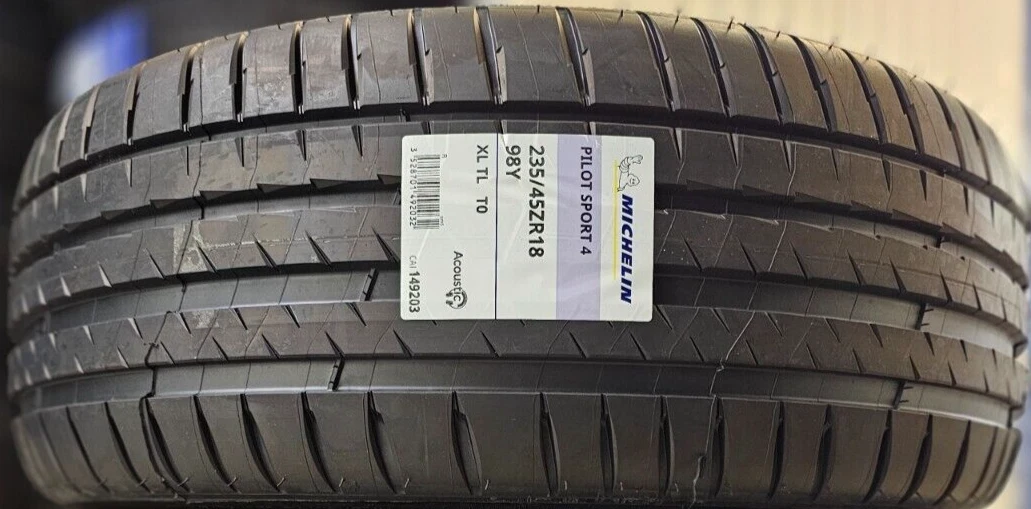
And slicks in a row works great until you add snow or mud and then it is disastrously awful. Today's best tyres are worse at that than an adequate tyre 20 years ago, even when new, but the limited crosstread wears out in the first 25% of the tyre's life. You can absolutely go and buy a 10/10, super high quality tyre and then still land in a ditch just exactly the same as on a set of actual ditchfinders.
And even if you could really know what the perfect tyre is, is it even in stock? Is it in one of the eternal churn of discount deals that are pertty much designed to make real pricing incomprehensible?
The Michelins have a VERY soft sidewall and puncture easily too...
They do when it’s a sheetmetal screw that’s gone through the edge of the tread - something that was only picked up during an MOT check. They’d been on the car for a while and were close to legal tread minimum. I’ve still got the other pair of CrossClimates on the rear, swapped from the front, and I’ve now got Continental cross climate equivalents on the front, ultimately they’ll go on the back one the Michelins get too low and be replaced with Continentals. They’re a bit cheaper, and get very good reviews. I can’t really tell the difference, I’m not driving a performance car, just a medium sized Ford crossover with a 1.0 litre engine.

