UPDATE: CLASSIFIEDS section refreshed, redesigned, searchable: Go take a look
I mean where do you buy a lynx ?
The last time I was in Harrods (25-ish years ago) the pet department had a Caracal for sale.
Do Lynx eat capercaillie?
That will put the cat among the pigeons, so to speak.
Although the aggressive one at Nethy area will probably put up a good fight....
Were we getting Irish "boat people" 25 years ago,
Pine marten prey on capers and lynx prey on pine marten, so maybe it evens out.
Sounds like a bit of a salty diet for a Pine Marten…
Unilateral action worked for beavers I guess, why not lynx? Release enough of them somewhere remote.
Its just the folk i was debating this with were unrealistic.
There are two Kielder proposals. One by the wildlife trusts and a few other charities and then the lot louder, for a time, one by one of Paul O’Donoghue's offerings. He comes up with various reintroduction schemes which are often overly simplistic and ambitious.
He is somewhat controversial eg this references him getting involved in a Welsh scheme. I expect you met his team and if so then you need to clear your mind and start afresh. Look at:
Lynx to Scotland: As name suggest about reintroducing to Scotland, consists of three reputable groups. Start with their FAQ about sheep predation.
Missing Lynx project : Reintroduction in Northumbria, Cumbria and Southern Scotland. Consists of the wildlife trusts plus Lifescape (which is also one of the lynx to Scotland partners).
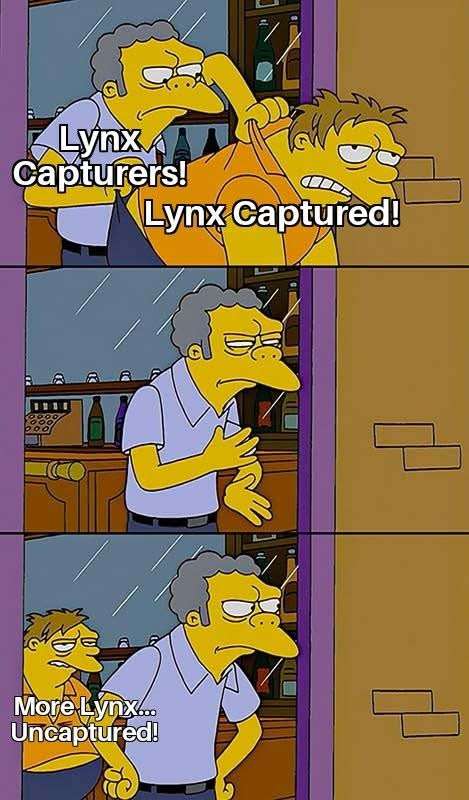
Do Lynx eat capercaillie?
I asked a capercaillie expert this and he reckons the capers are such bastards that they'll be quite low on the lynx's food list.
Release enough of them somewhere remote.
The think is, even 'remote' places have famers, game keepers, hill walkers, local dog walkers etc. Having a predator there, even if they were very shy, would not go unnoticed for long.
Are the any photos from the other sightings, or are we back to blurry images that could easily just be a chunky domestic?
Something that stood out for me with one of the images taken, is just how obviously it wasn't a domestic Cat. A lot of the previous "big cat" photos has just been awful considering almost everyone wanders around with megapixel sized cameras in there pockets.
Quite interesting how they all interact. Humans reintroduced Capercaillie in this area so are very protective of them. Humans also reintroduced the wildcat and I see the Scottish Wildcats pick up driving around slowly with a big antenna tracking them every day. They also recently reintroduced beaver and we are also culling and controlling deer numbers. So on top of all this we now have Lynx.
The think is, even ‘remote’ places have famers, game keepers, hill walkers, local dog walkers etc. Having a predator there, even if they were very shy, would not go unnoticed for long.
I've mentioned this on STW before, but it's worth repeating.
Ben Mee, owner of Dartmoor Zoo, which is a mile or two from Newnham on the edge of Plymouth:
Mr Mee bought the run-down zoo in 2006, after discovering a buyer could not be found and that the majority of the animals would have to be destroyed. At the time the zoo was home to several pumas.
A week after arriving at the zoo, in Sparkwell, Mr Mee said he and his brother made a sighting of a wild cat, and assumed one of the pumas in the zoo had escaped.
“On my seventh day in the village, having just bought the zoo and working out what to do, my brother and I and another guy saw a puma in the village, and we assumed that someone had released one of our puma. We were appalled and rang up the zoo and got someone to shine a torch on our cats to check they were still there. They were.”
“I said to the guy who worked here the next day ‘What on earth is going on, there’s puma in the village, I’m sure of it’, and he said, ‘Oh yeah, there’s puma here. Up on the moor they’re breeding.’”
He said: “There is no definite answer to how they got there, but there are several possible avenues I’ve heard and they’re all doing the rounds now.”
But he said that from his experience of working with the animals they would not need to eat vast amounts of livestock and, in small numbers, could remain hidden in an area as large as Dartmoor.
“I’m a sceptic, not a fantasist,” Mr Mee said. “But if you spend any time sitting still near a hedgerow, there are little animals in there and they’re all food, and there’re hundreds of square miles of it here.
“They could survive on less than a kilo and a half every other day. A rabbit would do it for more than a day, a lamb would be very tempting. If it takes on anything bigger there’s a risk. Predators like that would rather catch a few rabbits than one deer because they can kick you and break a rib, and then you can’t run and then you die.”
In his book, he says that an experienced zoo keeper was in the car with him when he saw the puma, and they were able to ID the sex and rough age of the animal. When he asked about it back at the zoo, the keepers said that when the zoo's cats were in heat they'd find big cat spoor outside the compounds. For those that have raced at Newnham, this was spotted on the road between the Chinese at Plympton and Dartmoor Zoo. Just remember that when you're doing your night laps, if we ever get to do a 24hour race down there again!
Of course, he could just be lying about it but I'm not sure why.
I'll mention it again; the northern Eurasian Lynx is a specialist in hunting roe deer first, that's the niche they evolved to fit and are very good at it. There's an awful lot of spare capacity in this niche currently and there are numerous reserve prey species available, like calving or sick red and sika deer, hares, rabbits, rodents, foxes, geese and ducks... even beavers. The relevant experts are very clear that introduced lynx will manage just fine and will breed successfully.
The greatest benefits will quickly follow, as the deer quickly realise that they are not safe lingering in cover and learn to keep moving. Or get eaten... Forests regenerate, biodiversity rockets and we all win.
Just look at Yellowstone and their wolves.
Of course, he could just be lying about it but I’m not sure why.
I can certainly think of a reason the owner of a Zoo would say something that would get people interested in the area, who may also be interested in captive examples handily nearby...
I’m heading up there in a couple of days, I’ll let you know if I see one
Looking at the video I just saw, I've caught wilder feral cats than those. Absolutely shocking that someone would abandon them at any time of year but the current the weather conditions only make it worse.
Having a predator there, even if they were very shy, would not go unnoticed for long.
Not necessarily. Lynx are notoriously hard to spot. Welshfarmers anecdote on the first page covers it nicely. Its not impossible but people can spend their lives in the area without seeing them. Sure given a couple of years and a decent population sightings might occur but they would be easily dismissed.
It would need some people competent at searching for tracks and sign to stand a serious chance.
A lot of the previous “big cat” photos has just been awful considering almost everyone wanders around with megapixel sized cameras in there pockets.
I do always enjoy looking at them and finding something useful for scale such as a tree protector which makes it clear that they really aint a big cat. A mate of mine has a siberian which sadly is a house cat only since I suspect it would trigger a few reports if it got out. Seriously chunky thing.
This report suggests the lynx were recently released.
“They had definitely been illegally released because they were 100 yards from a pile of straw bedding that contained dead chicks and, interestingly, porcupine quills – the bedding was peppered with porcupine quills,” he said.
“They were very tame and you could see they had been released from a nearby layby because there was the straw there too. They were only 100 yards from that spot and the road. I don’t think they would have survived in the wild.”
I can certainly think of a reason the owner of a Zoo would say something that would get people interested in the area, who may also be interested in captive examples handily nearby…
Advertising your own zoo on the basis that you're a bit crap at keeping the toothy predators captive isn't the normal way to do it.
Imagine if a gang of Scottish Wildcats rocked up,ate all the sausages and gave the Lynx a going over 😉
Just seems like a no brainer to me - too many deer, Lynx can help solve the problem. Might go someway to fixing the upland ecological desert. Lynx relatively recently extinct in the UK - maybe they'll take a few sheep, but not really a big issue as the farming of sheep is uneconomic anyway, so what's a bit of compensation?
The rest of Europe is fine (has learnt to be fine) with having lynx and wolves around, so not sure what the issue is really.
Imagine if a gang of Scottish Wildcats rocked up...
I'm reading a book called Rebirding at the moment and there's a section about the bounties paid for various kinds of wildlife in the 17th century. Wildcats were common at the time everywhere in the country and 5000 bounties were paid out for them through the century at a penny apiece. At the same time white tailed sea eagles would have gained you 8p, and a hedgehog would have been 4p. Hedgehogs must have been ferocious beasts in those days!
There have been instances of Lynx-sized wildcats recorded in the U.K. in the past, at least two being hit by cars, IIRC. Puma are masters of keeping under cover, lots of examples of bikers coming face to face with them in urban areas of America, especially around LA, although the current fires will change that.
Unilateral action worked for beavers I guess, why not lynx? Release enough of them somewhere remote.
That’ll be the colony down on the River Otter, then, who seemed to exist quite happily for a decade or so before the Government caught wind of them being there. Nobody has ever discovered how they got there, and thankfully the official bodies responsible were persuaded to let them be as an established study group,.
The thing with beavers is they don’t leave furry corpses littering the countryside, which upsets people, they just clear a lot of riverside overgrowth, and slow watercourses, alleviating flooding further downstream. Entitled landowners get pissy, but fishermen seem to like the idea - according to a conversation I had with a fly-fisherman on a local river, who’s all for having the beavers there for exactly that reason. The landowner had actually asked him if he had a shotgun! He gave a fairly salty response to that enquiry.
There are otters in the same river, a mate has filmed one from the road eating something, possibly crayfish - the river is quite shallow in places, and signal crayfish have eradicated the native white-clawed crayfish, I’ve turned stones over and found several within around a square metre, so the otters will be a huge benefit reducing their numbers; the otters, along with the beavers, are a fairly recent introduction in this stretch of the Bybrook, downstream from Castle Combe - there was an earlier release of otters at Castle Combe about ten-12 years ago, they seemed to go further down towards Bath.
I’m reading a book called Rebirding at the moment and there’s a section about the bounties paid for various kinds of wildlife in the 17th century. Wildcats were common at the time everywhere in the country and 5000 bounties were paid out for them through the century at a penny apiece. At the same time white tailed sea eagles would have gained you 8p
Same as Eagle Owls, which were native up until the 19th century, but like sea eagles were wiped out by humans. They seem to be making something of a comeback, quite possibly through birds flying across the North Sea from Europe. Unfortunately, official bodies are calling for them to be removed, as ‘they’re not a native species’, which is bollocks, there’s plenty of evidence to support their existence here; storks and cranes are being reintroduced, one of those species last bred here over 400 years ago! So why are those acceptable and eagle owls not? I leave it to you, dear reader, to work that one out.
Advertising your own zoo on the basis that you’re a bit crap at keeping the toothy predators captive isn’t the normal way to do it.
At the time, I don't think he'd yet made the admission/claim he'd released them, that came later.
Imagine if a gang of Scottish Wildcats rocked up
Advertising your own zoo on the basis that you’re a bit crap at keeping the toothy predators captive isn’t the normal way to do it.
At the time, I don’t think he’d yet made the admission/claim he’d released them, that came later.
Did Ben Mee admit to releasing cats? There was a claim that the previous owner and Paignton Zoo had released some on the moor, but I haven't heard anything about the current Dartmoor Zoo owners doing it.
like sea eagles were wiped out by humans. They seem to be making something of a comeback, quite possibly through birds flying across the North Sea from Europe. Unfortunately, official bodies are calling for them to be removed, as ‘they’re not a native species’, which is bollocks,
I was at a talk about sea eagle reintroduction in Wales a few months ago and they have to jump through a lot of hoops here that they don't in England because sea eagles aren't seen as native this side of the Severn.
https://www.eaglereintroductionwales.com/whitetailed-eagle-programme
Did Ben Mee admit to releasing cats? There was a claim that the previous owner and Paignton Zoo had released some on the moor, but I haven’t heard anything about the current Dartmoor Zoo owners doing it.
You're correct, I had that the wrong way round.
Still, for nearly all of these sightings, I don't really believe them without good photos, animals remains, or the shit.
Scottish wildcats are meant to be vicious.
@CountZero once went to a falconry place where they said they'd lost their eagle owl in the middle of a display. It turned up one morning about a month later sat on top of its cage, having evidently not eaten badly while it was away...
Equally, you can argue that humans are not native here either and should be removed...
In Scotland, the illegal beaver introduction is very widely understood to have originated from a particular hill estate on the edge of Perthshire and has expanded into every connected watercourse, now numbering well over 2000 individuals. And that's despite the legalised cull of 'rogue' individuals under licence. As a landowner, you can define rogue yourself and hey presto, licence granted to exterminate the furry tree munchers. A handful of lynx living up the Glens would make a much better quality of impact than shooting.
2 more spotted - https://www.bbc.co.uk/news/articles/cz6pxdxe4j9o
If they haven't been released then have they been there naturally?
They seem to be making something of a comeback, quite possibly through birds flying across the North Sea from Europe.
There has been a slowly growing reintroduction effort. Started in Scotland way back in the 70s on the East coast and then early 2000s on the West coast.
In England started on the Isle of Wright about 5 years back and think there are a couple more release sites planned.
Wales has the plan for around the Severn estuary.
I was at a talk about sea eagle reintroduction in Wales a few months ago and they have to jump through a lot of hoops here that they don’t in England because sea eagles aren’t seen as native this side of the Severn.
And yet when it comes to releasing nonnative pheasants and red legged partridges there are basically no restrictions.

We should skip Lynx and Wolves and go straight to the big guns and reintroduce bears.
Joking aside, I hope they catch and prosecute the person that released the Lynx. Sounds like they're not true wild animals if caught so easily.
I’m reading a book called Rebirding at the moment and there’s a section about the bounties paid for various kinds of wildlife in the 17th century. Wildcats were common at the time everywhere in the country and 5000 bounties were paid out for them through the century at a penny apiece. At the same time white tailed sea eagles would have gained you 8p
I read a similar book about scottish nature depletion, it had an extensive section on the number of animals destroyed during the victorian era on shooting estates. It had excerpts from the estate records - there were hundreds and hundreds of native animals and predatory birds killed every year on single estates alone, all listed in the estate accounts. The countryside must have been teeming with wildlife. All destroyed for grouse and deer.
I'm mildly hopeful this story might at least raise the profile of re-introduction. I am lucky to have seen beaver in the wild, and lots and lots of sea eagle. I really didn't expect to see a Lynx in scotland, and i'm sure I won't. But it is pretty damn exciting to think they could be out there, and maybe others will feel the same too now.
That sounds like scaremongering to me. Have you got any lynx to prove that it is a common occurrence?
When do rabbits get scarce btw…..is there a rabbit season?
Northern Canada so a completly different ecosystem and i think a different lynx so hardly applicable here and certainly a different rabbit
Apparently the rabbit population have cycle of sucessful breeding and then a population crash
Obvously lynx do well when there are lots of prey animals but when tbe rabbit population crashes uou end up with a lot ofvery hungery lynx.
They have attacked dogs in dawson. Well doccumented
Not really applicable here i would have thought
Komoran
One of tbe things i realised when in Canada was hiw depleted our wildlife is. Eagles everywhere for example.
I have Lynx and Wolves locally, no bears though, don't get them this far south. The wolves i've seen a couple of times at a distance, and Lynx prints in the snow in the garden this winter, which is quite amazing, as we've only had a bit of snow...
A friend has seen bears near his families holiday cottage, but that's about a 12 hour drive north of here!
There has been a slowly growing reintroduction effort. Started in Scotland way back in the 70s on the East coast and then early 2000s on the West coast.
In England started on the Isle of Wright about 5 years back and think there are a couple more release sites planned.
Are you referring to sea eagles? Those are re-introduced birds, the eagle owls, on the other hand, don’t appear to be deliberately introduced, or are possibly escaped birds. It’s still a controversial topic as to the owl’s numbers in the U.K., they’re the most widespread owl in Europe and Asia, and they’re in Scandinavia, there are reports going back several hundred years of their presence here -considering small American birds appear here, and regular bird visits by other species that are now resulting in breeding colonies, so a bird the size of an eagle owl should be able to cross the North Sea from Scandinavia.
There’s apparently around 3000 eagle owls in captivity in the U.K., there’s no requirement for a licence, only a notification if the bird is sold, so escapees would probably end up as a wild bird.
There are now great white egrets, little egrets, and cattle egrets breeding here, I’ve seen all three in the wild, including around Chippenham, none are introduced birds.
As an aside, and referring to beavers, they’ve been filmed with a remote camera down on the Avalon Marshes near Glastonbury, one of them working on the trunk of a tree that must be nearly a metre across. It’s believed they came via the River Brue over the last month or so.
Don't have any photos of the british ones, but in honour of the brexit thread, heres a Polish pilot instead

@dakuan - nice photo, spectacular bird! There’s a Stellar’s Sea Eagle turned up in America, they’re usually found in Siberia, and they’re chuffing huge! I hope to see a sea eagle at some point soon, the IoW birds cover huge distances, and I have seen an osprey carrying a large bream on the edge of Chippenham, so fingers crossed.
One of tbe things i realised when in Canada was hiw depleted our wildlife is. Eagles everywhere for example
Scotland's wildlife is suffering serious depletion, there is no doubt of that. It is widely recognized in the professional circles, but I don't think it makes the headlines because of things like the Sea Eagle reintroduction and recovery making such a splash (ho ho).
But it should be shouted out all the time, and I think people would care if they knew that wildlife was struggling, and that behind the obvious success stories, the less glamorous birds and animals need help now.
Canadian wildlife is an interesting comparo. I kayaked almost the entire west coast of Canada and up into Alaska, and yes you will see so many Sea Eagles you get sick of them. You will see many Humpback whales, Orca if you are lucky, Sea lions, Seals and Sea Otters aplenty. Bears too. But the sea birds we love here, not so much.
In Scotland we lack many of the big mammals, but sea birds used to be our remarkable ace in the hand and an absolute natural wonder. In the mid 90's I kayaked around the top of Scotland and the colonies of birds on and around the cliffs of the NW were an absolute cacophony, thousands upon thousands of them circling, diving, swimming. Beaks full of food, chicks high on the cliffs waiting to be fed. An unforgettable assault on your senses.
Now, you won't experience that remarkable scene - bird numbers have crashed in the intervening years and the colonies have been decimated. That is bloody sad.
Second pair now caught - https://www.bbc.co.uk/news/articles/cwy7jpzr252o
Just to add to @mert 's comments based on Swedish experience (sorry, turns into a long post). I know barely anyone who has definitely seen a lynx, even people living for 50+ yrs where they are fairly common and tracks are common in winter (various spots where I used to ski you'd see fresh tracks each day through much of the winter). If they have a sighting it's usually just a flash in the headlights crossing the road. There's something like 1000-1500 in the whole of Sweden, and area far bigger and generally far more suited in terms of habitat, cover, prey, disturbance than the UK. Numbers are probably accurate as there's an annual cull(!) with legal limits.
In Sweden they take reindeer or roe deer (depending on location) and hares, but in the UK there's no reason rabbit and possibly red deer calves wouldn't be on the menu as they can despatch prey multiple times their body weight. Never heard of the beaver being a major prey species but fox can be and really anything mammal that exists in the UK would be possible if not always likely target. They also regularly take birds (locally e.g. birch grouse, capercaillie and anything else not paying attention on the ground) and basically anything else like amphibians they find - opportunistic and skilful hunters.
With regards to livestock/pets, pets are not likely to be predated upon, certainly not dogs (though I suspect any wide ranging cats would be seen off fairly rapidly). Lynx are extremely shy, risk averse, and will avoid conflict/human presence as far as possible even if they do sometimes live in close proximity. They aren't going to risk a bite from a small dog or pose a threat to humans of any size under any circumstances.
Sheep and lamb are taken in Sweden but the farmers I knew were never really animated about the presence of lynx in the area. Wolves on the other hand would be a concern if spotted (usually out on a snowmobile) or if footprints were seen (rare). I should add that I don't remember any instances if livestock being taken by wolves either, or bears for that matter. However I'd expect the pattern to be different in a UK context as sheep farming is much less extensive in Sweden and most animals are overwintered inside. Compare again with Norway where sheep grazing often occurs in forested/semi forested settings that lynx favour. I'm not sure any useful conclusions can be drawn from either of these as neither particularly resemble UK practice.
Not sure what that tells anyone about the potential for UK reintroduction. Plenty of prey out there and several areas with good habitat but unrealistic humans on either side of the debate probably don't help things beyond that - releasing domesticated cats certainly doesn't. I wouldn't be hugely enthusiastic if I were a Scottish Wildcat though.

