UPDATE: CLASSIFIEDS section refreshed, redesigned, searchable: Go take a look
ASHP
still using elec to heat your home. Naughty Dobbo!
🙂
Also UFH should be left on for long periods but lower temps. It doesnt cycle well as there s lag in heating up the slab. I have mine set to 18degrees for most of the day (as I work from home) it doesnt take much energy, but letting it go cold during the day and have it try and fire up again in the evening to 20dges say would take a while. Quick extra heat comes from the log burner anyway.
Very true, if you have a heat pump setup it is common to run it 24 hours a day in cold periods but then reduce the flow temp down to around 35ºC.
The 1500ltr thermal store seems to last for a surprisingly short time 🙁 My problem is we have to have cold starts fairly frequently.
I know, better than coal though? 😳still using elec to heat your home. Naughty Dobbo!
The 1500ltr thermal store seems to last for a surprisingly short time My problem is we have to have cold starts fairly frequently.
thats odd. Mines only 720l and will last 4-6 hours or so in winter (20degree loss before recharge)
Why the cold starts out of interest?
Mines only 720l and will last 4-6 hours or so in winter
I was hoping 1500ltrs would last a day+ 😆
Why the cold starts out of interest?
We live between 2 houses.
I was hoping 1500ltrs would last a day+
Ive heard of a scottish biomass powered underground store of 20+ tons of water, heated with a something like a 75kW boiler. Lasts a week 🙂
Insulate properly first then work out what you need. This may be a lot less than you originally thought. A guy round the corner fitted a fancy new gas boiler with lots of radiators. He then got on with insulating and fitted a wood burner. He's now realised that firing up the wood burner once a day is pretty much all that's needed. Most (if not all) of the radiators are unnecessary and the boiler is way oversized.
insulation wise what options are there? That will not rob the room of space. other than:
-decent windows/doors (low U thermal glass etc)
-Cavity wall insulation
n.b I need to be careful with this as 100 year old porous bricks can be a problem with the wrong type
-loft/roof insulation (must remain Slate I believe)
part of my problem is to do my extension I need to knock down the dodgy old extension where the boiler is currently housed. and i don't want to have to go back after wards and put more pipes etc in /not sue some
so suck and see isn't that easy
If you are planning on re-doing any plasterwork, then you should consider insulated stud or insulated plasterboard (polystyrene backed). You would lose, say, 50-75mm of perimeter depth but gain loads in U-value.
Its not ideal as your thermal mass is still on the outside of the insulation. If I were to buy a gopping 1950-70s house I would take the roof off, re-do the roof line and externally clad in local timber with insulation behind it. Deep window/ door reveals, but all the thermal mass would be in side the insulated envelope.
Something like silver TLX insulation can add loads of uvalue to even 50mm of kingspan (et al) in a roof where space is tight. Ideally your loft should have 300mm of mineral wool or equivalent.
this is TLX over 50mm of xtratherm (hidden) just where it meets 100m of mineral coming p the cavity wall. We were short of depth to work with in the pitched section of roof before the ceiling comes across.
[img]  [/img]
[img]  [/img]
allow for 100mm of depth of insulation above your concrete slab and then a further 75mm of screed (which envelops your UFH pipes) on top. Pipes clip down to insulation:
[img]  [/img]
[img]  [/img]
this is a cut away of the screed where we cut out the insulation to make a concrete pad for the thermal store so you can see the depth over the insulation beneath
[img]  [/img]
small rooms so extra studs internally is something I really want to avoid
roof line can't be changed, oh thinks it's about 1910-1920's
window reveals even have to stay the same and even be replicated in the extension too from what I've read of the planning rules
oh we'll also be re-doing all the lights to low power ones, probably LED
only had few conversations with planing so far but it's pretty restrictive where we are. Don't want to butt heads with them for ages so will try to work as best we can with them to get what we can, space and energy efficiency.
oh we'll also be re-doing all the lights to low power ones, probably LED
build yourself a rig (better still I think I still have one I built for me) and buy a range of individual models to test. You really need to be comfortable with the colour and shape of the lamp output before you commit to 10s of them at £20 each.
There's over 100 in the barn, 3 different models ranging from £3.50 to £20 each.
So Stoner you went with Plastic for all your plumbing then by the looks of it?
plain plastic or the Alloy lined plastic stuff?
seems so easy to work with compared to copper and soo! much cheaper
I just worry about the fixings a little
and what's all this about air ingress is that through the pipe itself or the fixings?
My Bro' is a sparky and is doing a lots of LED stuff now
so should be able to get stuff to test no prob's
I'm off now, will be back Monday, off to do a [url= http://tinyurl.com/66bxzd5 ]140m Run/Bike/Kayak C2C[/url] this weekend
yep Hep2o thought except for radiator tails and in the boiler room obviously.
Plain 15mm and 20mm for hot and cold and barrier stuff for the radiator and UFH feeds to minimise oxygen absorption in the indirect heating circuit.
Great stuff to use as I could do a lot of it, with no prior plumbing training, and no copper skillz needed.
we pre-holed the joists to run to sets of services (wet and sparks) down the length of the building. It means in future if I ever need to drop in, I know to the nearest 100mm where they are anywhere in the house.
[img]  [/img]
[img] 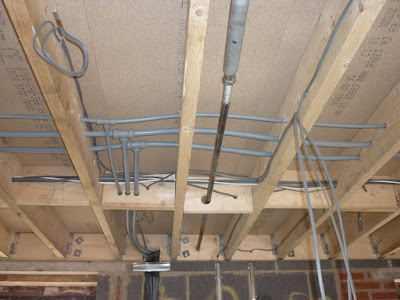 [/img]
[img]  [/img]
and then they break through into the boiler room
[img] 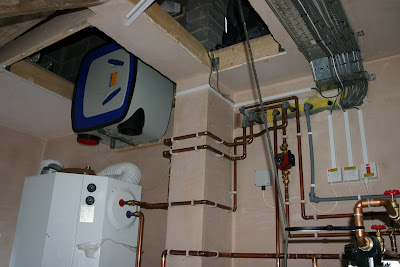 [/img]
EDIT have fun then.
I'm not so sure about this "insulate the outside" lark. Having a house that is more responsive to heat input is better for us and may be better for the OP. The reasons:
We go away for the weekend and holidays in winter. When we get back it only takes an hour or two with the wood burner to get the place cosy. With plaster and brick walls it would take several hours.
For equal u the total energy bill is smaller if you accept lower temperatures for some periods of the day. Heat loss is proportional to temperature difference and running a lower temperature difference cuts losses. In our case we light the wood burner at about 17:00 and by the time we are sat watching the news on TF1 at 20:00 it's about 20°C. Temperature then declines through the night to about 16°C when it's cold outside. I'm quite happy with that through the next day and it rarely drops further thank's to sun through the windows and appliances being used.
The percieved warmth in a room depends on the wall material. Stone feels colder than wood when you are standing next to it for the same temperature. In French it's called "l'effet de paroi froid". Insulating the inside with wood makes a room feel warmer than it is.
In older houses with damp walls wood on the inside protects you from the damp whilst doing nothing to stop humidity being driven to the outside of the wall and away. Waterproof renders and polystyrene keep humidity in as well as the rain out.
Just had a chat with my other neighbour who's tied to oil. He's just taken delivery yesterday of 1,500 litres for £1,000 = 7.2p/kWh @ 92% efficiency! My previous calc (6.5p) was at £300 per 500L.
He needs two of those a year 😯
[url= http://www.boilerjuice.com/heatingOilPrices.php ]Boilerjuice[/url] is reporting it at 57.5p per litre
[img]  [/img]
Still expensive though and come the snow it'll rocket.
He might have been rounding up in his head, but was calling it 60p/Litre.
Just had a bit more of a look through the earlier post as I'm a bit more with it today!
I like your set up Stoner, that's a dual fuel boiler then, logs or pellets, nice touch. I wonder if you need to use the thermal store with pellets as they can be regulated so much. The option I was looking at would be to have a large remote pellets store blown filled then use a vacuum feed to the week tank that built in to the Windhager boilers. I was planning on removing or valving off the thermal store as the boiler can modulate much like a conventional boiler.
The other option is to have a solar coil fitted to the thermal store, it has a blanking plate for the coil to be fitted.
I'd half though about removing the half the roof of our workshop/shed and putting thermal solar on it to feed the tank. I'd like PV but the shed not south facing, it's either west or east 🙁 The house is south facing but I don't want solar on the roof.
Our shed:
[img]  [/img]
Here is a [url= http://www.windhager.co.uk/public/frontend/downloads/systemdesign/thebiomassguide.pdf ]Biomass Guide[/url] it's about Windhager products but still interesting to see system configs.
By the way what national park are you in 29erKeith?
[url= http://www.greenbuildingforum.co.uk/forum114/?CategoryID=22 ]Green Building Forum[/url] Another useful link to a good knowledge forum.
[url= http://www.boilerjuice.com/includes/echoPriceGraph.inc.php?d=730&s=XL&min=0&max=0&avg=1&a=1&ot=1 ]Oil prices for the past 2 years[/url]
Well it was up to 73p last winter (6.9p per kWh 8O), and I expect it to go the same way again as soon as it gets cold.
I should try and work out how much my firewood costs me.
This year I've had to buy a new saw and PPE, so probably spent £300 and collected about 15 m3 of hardwood.
EDIT to correct mistake
Volume of wood 15 m^3
Volume as Cord 4.41 (1 cord= approx 3.4 m^3)
BTU per Cord (millions) 30 (Oak / Beech Mix
KWh per m^3 2585
Total Value 38768
Efficiency of OCH 92%
Efficiency of WBS 75%
Energy in 1 tank of oil 12000
Converted energy of 1 tank of oil 11040
Converted energy of wood collected 29076
There for 15m^3 = 2.63 1200 tanks of oil
Price as oil £1,896.25
Cost to me this year £300.00
Effective price per kWh £0.0103
Smugness coefficient at not having to ring oil supplier 1000000
Stoner - it'd be good if you could check the maths 😀
Id recommend using a thermal store with any biomass/solar set up. My neighbour doesnt have one (except for a small buffer in his boiler) because apparently its so smart it can hit efficiency even when cycling. His solar has a separate tank though.
Mine all goes to one place. Just seems so much simpler. I even have space for at least 2 mor eheat sources if I wanted too, and whilst I have a backup (very backup, logs would come first! 😉 ) immersion heater in the boiler tank, I can also fit two of them to the thermal store as well.
In fact if I ever fitted PV, rather than sell to the grid for a paltry 3p/kWh (not the same as FITS remember, you still get those no matter what you do with the elec) I could use a 12v immersion coil as an energy dump for surplus elec in the thermal store 🙂
You can mount solar thermal vertically, on that south facing wall where the round window is BTW.
Vaccum transport systems, as far as Ive been able to find out, seem very expensive - about £1000. Im sure an old henry vacuum cleaner could be adapted to do the job for a lot less...or if more puff required a commercial unit.
geoff - will do in a bit - got to go out.
PS - dont trust Boilerjuice figures.
http://heating-oil.blogs-uk.co.uk/dcc-claims-profiting-boiler-juice-price-hikes/
That what the flashings for in the end wall, I though of a veranda with a PV roof, supported by chunky wood frame covered by vines me cooking on a wood fired pizza oven sipping wine on a hot summers night, 😆 , oh well..............You can mount solar thermal vertically, on that south facing wall where the round window is BTW.
I think the thermal store will stay and only be isolated if ASHP comes in to the equation. £1000 is what I was quoated for the kit, to do it with pipes etc.
Did you do most of the build yourself or project it, must have been great fun to do, design and see progress.
I did the design and managed the project, whilst also jobbing on site 5 days a week for my builder mate who did the tricky buildingy stuff.
I installed the UFH and solar thermal. I worked with a specifier and plumber and HETAS guy on the boiler installation though.
It was a fantastic project. And I learnt huge amounts - mostly how not to be scared of having a go.
Solar thermal would make a better pergola roof as you have light pass through between the tubes. PV panels would block it all out 🙂
this is mine:
[img]  [/img]
more [url= https://picasaweb.google.com/bakehousebarn/SolarProject ]here[/url]
Thats a pretty impressive setup, having them as a ground mounted array gives you the advantage of exact angle and and direction as well, plus you can have a large m2. To make it worthwhile for heating you need a good amount.
Quick fire questions!!
Is the feed to you thermal store run in 22mm?
What distance is it?
Do you loose much temp on the run?
Do you get RHI for it?
To have PV it's not worth it unless you're pretty much facing south, not so sure with thermal as the install costs are that much lower.
[i]Is the feed to you thermal store run in 22mm?[/i]
DN20 insulated steel flexible tubing. 22mm copper at manifold and in boiler room.
[i]What distance is it?[/i]
17m + boiler room runs of about 3m
[i]Do you loose much temp on the run?[/i]
No idea, but I run the hysteresis quite wide, so it starts pumping at +8 and off at +6 so that the pump isnt running when theres a risk of moving hoter water out to the manifold than Im getting back in.
[i]Do you get RHI for it?[/i]
No. The quote for having an MCS certified installer stick an MCS certified system in was 3.5x as much as mine cost which wiped out the benefit of the RHIs.
I had a thread covering most of the detail, here:
http://www.singletrackworld.com/forum/topic/solar-water-thermal-panels-the-installation-w-pics
I'll have a read through that thread with a cup of tea!!
If this is covered in that thread say, but, when you have the boiler running and heating the thermal store how do you prevent it filling the thermal store down to the bottom down to the solar coil? Else you'd be just having a small gain from the solar or even a -ve.
Separate tanks. (with a 😉 for Stoner). In winter I use the solar tank as a feed for the main tank; a pre-heater. In summer everything feeds direct off the solar tank bypassing the main tank. I've also plumbed the washing machine so it can be run off either tank during the fill cycle and switched to cold water for the rinse.
If I were Stoner, I'd fit a 300l tank with a coil fed from the solar panels plumbed so that by opening and closing a few valves (Five in my case) either tank can feed the domestic hot water circuit direct or the solar tank can be used as a pre-heater for the thermal store.
I like the idea of Ed's pre-heating tank but I dont have the space now.
I rely on stratification to maintain as low a temp as possible in the thermal store.
In summer, it's not a problem as the boiler is off, but when it's running turbulence from the 85deg hot water inserted at the top of the 2m high tank raises the bottom temp to about 50degs. Which is not great for solar capture. It does still work, because my array manifold easily gets to 60+ degs in autumn, but later in the season it may not be so great. Of course as long as the energy absorption of the array exceeds its losses, then eventually there will be a positive temp differential between the Solar manifold and the tank - so it should always eventually work , but the higher the temp, the higher the losses.
This autumn I am working on various temp settings in the boiler to find the most efficient one.
Will report back in a few months when I think Ive got it.
That was why I wondered, the pre heat tank is common in larger commercial jobs, here is a layout of a recent job:-
[img]  [/img]
Good if you use a lot of hot water. But for heating systems I suppose it's harder to make the most of the solar water during the winter for heating, as the thermal store will have heat.
Diagram makes a lot of sense.
SO do you fit many of these systems?
I do Building Management Systems software and graphics that control large commercial systems the Olympic Velodrome, large district heating projects, PFI stuff, nothing domestic. Nearly all jobs have biomass, CHP and solar nowadays with a strong slant on energy monitoring, metering and analysis.
a strong slant on energy monitoring, metering and analysis.
now that Id enjoy.
*pushes NHS glasses up nose*
This is just some of the analysis Ive been doing on my system
[img]  [/img]
My analysis amounts too "ughhh, brrr, the shower's cold, time to start sending the water through the main tank and switch on the immersion heater". It hasn't happened since the Spring but soon will as the sun drops in the sky.
Madame is in the shower as I type, "is it hot enough?" "Yes, it's lovely".
"is it hot enough?" "Yes, it's lovely".
"room for one more?"
😉
Looks impressive, needs some green!! You'd have a field day with some of our systems, hundreds of sensors to monitor.
On the photo of of my underfloor pumps the round grey boxes are for sensors to monitor system temps, the controller goes on the DIN rail above. It's similar to PLC process control with SCADA front end if you know control systems. Some jobs are interesting, we did the control for what I believe is the one of the largest Biomass jobs in the UK at UEA, a biomass gassification unit (a couple of stories high) produces gas for a 1.5 MW CHP unit and absorption chiller with own woodchip drier. They planted a wood to feed it! [url= http://www.uea.ac.uk/estates/CHP+leaflet ]UEA Gassifier[/url]
It's similar to PLC process control with SCADA front end if you know control systems
I dont, but damn it, if I did, my wife would sleep in another room 🙂
One of my day job projects was building a financial model for a combined heat and power biomass plant. Profit and loss, isnt nearly as interesting as kWh/tonne .... 🙂
Im planting 400+ willow stands for short rotation coppicing to help with powering mine.
Hi all, loads of info/ideas here for me to look into.
@Dobbo New place is inside the New Forest
Some pretty big systems compared to my requirements, which will be a bit more modest. I'll definitely do as much insulation as I can I'll definitely be doing thermal solar after that still very undecided
plenty to think about with regards making the best of the solar 1-2 stores/buffers?
biomass all to store or some direct to CH??
UFH too??? quick/slow start ups?
losts of ????????? but thanks all
I've got loads of time to do plenty more research/thinking
I have not read all of this but you should get a quote for ground source, no sourcing of fuel, no fuel storage, cooling as well as heating. I am not sure whether your garden is big enough for a horizontal loop but you can always have a bore hole, albeit more expensive. Link it up to solar panels to provide some of the electricity and your exposure to electricity price should be pretty limited.
GSHP was a brief thought but I don't think there's space for GSHP without bores which makes it very pricey + solar PV to make it work too even more expensive. Also as far as I know it works best with super insulated homes which we'll struggle to do due various limitations (age and construction, planning, no ducting, space and cost)
also no south facing roofs to make the most of PV
South East and South West roofs means Solar water heating is still cost effective though I think!
OK I could probably get some numbers for you if I can be bothered to read the whole thread - if not super insulated then a base load plus top up could be used. Apparently when done with CHP on a commercial scheme the numbers are staggering, whether this can be achieved in the domestic market with what is currently available I have no idea.
Prof David Mackay the scientific adviser to DECC reckons there will be 20 million heat pumps in the UK by 2050.
Méfiez-vous des chiffres ronds! (beware of round numbers)
I love it when ageing professors pull figures out of their hats for dates long after they'll be dead.
Heat pumps are great, 37% (musn't use a round number) better than burning gas domestically for the best of them in energy terms. But, big but, they still need electricity and replacing 20 million GCH units with heat pumps will bring the grid down even at currect electricity production levels. There are houses out there that simply don't need heating, one social housing programme featuresd on telly in the cold east of France went through last winter with no heating and a minimum inside temperature of 15°C (though I suspect less committed occupants would have plugged something in at 18°).
Renewing/renovating the housing stock would be my solution of preference.
Heat pumps are great, 37% (musn't use a round number) better than burning gas domestically for the best of them in energy terms. But, big but, they still need electricity and replacing 20 million GCH units with heat pumps will bring the grid down even at currect electricity production levels.
I suspect that most of the early taker up'ers will be replacing oil, bottled gas and conventional electric heating. If I had mains gas heating, I'm not sure I've seen anything to convince me to change to a heat pump, cost wise anyway.
Stoner - are you using UK sourced pellets for your boiler? Just thinking about whether you are tied to oil prices via imported pellets relying on long distance sailing.

