UPDATE: CLASSIFIEDS section refreshed, redesigned, searchable: Go take a look
Every once in a while, someone will ask on here for advice on 'camping in Europe' or 'Cycling in Europe' or whatever.
Now, of course I know exactly what they mean, and I can even vaguely understand how such phrasing has been born out of habit. BUT, it is, of course, geographically, culturally, and historically incorrect, so I'm wondering why people continue to do it.
I, myself, always refer to 'the Continent', and sometimes if I'm trying to provoke a reaction, 'the Mainland'. It wouldn't even dawn on me to say 'Europe', in the way that I can't imagine someone who lived in St John's, Newfoundland, but was visiting Toronto to say that they were visiting 'Canada'.
So... do you think of yourself as something different to a European? If not, why not? If so, why? What terminology do you use?
Very proudly European here.
Partly, because I can't stand the way my countrymen behave sometimes.
Im English, everything over the channel is european.
in the way that I can't imagine someone who lived in St John's, Newfoundland, but was visiting Toronto to say that they were visiting 'Canada'.
......Yet the same guy will happily refer to going to America despite his home already being part of North America.
I might say mainland Europe, but I'd be more likely to specify the country - 'camping in France' or 'Cycling in France'.
in the way that I can't imagine someone who lived in St John's, Newfoundland, but was visiting Toronto to say that they were visiting 'Canada'
Your analogy doesn't work. Newfoundland is part of the country called Canada.
(I think)
I'd probably refer to "mainland Europe" if I were to differentiate it from the UK.
It's probably all wrapped up in the UK's island mentality and vastly overinflated sense of pompous self-importance. I'd wager there's plenty of people who don't realise that even if we leave the EU we'll still be in the continent of Europe. Probably best not to draw attention to that though, or the more rabid Brexiters will want us out of that too. Probably by attaching a huge tug boat to Cornwall or something.
genetically
yes
[img] 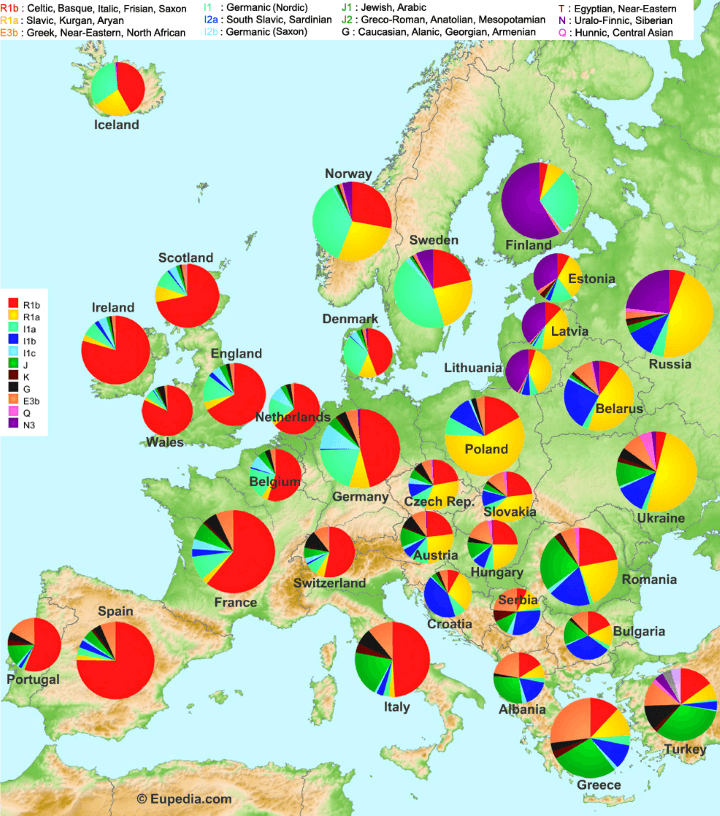 [/img]
everything else is just in our heads
Your analogy doesn't work. Newfoundland is part of the country called Canada.
And the continent Canada is in is North America, just for added confusion.
......Yet the same guy will happliy refer to going to America despite already being part of North America.
Yes, but here's the thing:
As the extra word implies, there is a distinction between being [i]North[/i] American and American, in the same way that I doubt a Peruvian would fail to hear 'the USA' when someone said 'America'. There is no single country in Europe simply called 'Europe'. The US has such an established history of being called America that it is inextricably linked with the use of the term.
miketually - Member
but I'd be more likely to specify the country
Yip.
i hate those type of pie chart things.... i'm colourblind!
I do love that chart.
I am an independent nation state
The US has such an established history of being called America that it is inextricably linked with the use of the term.
A real answer to your query might lie in historical context, specifically the two world wars, which were predominantly fought in Europe, in several countries simultaneously, but no land fighting ever took place in the UK.
Most of the news reporting at the time referred to the "war in Europe " as a shorthand for the "war in France and Germany and Belgium and Poland and Italy etc etc" and it's probably kinda stuck in the national conciousness ever since
Yes, we do not live in a special little continent all of our own. The UK is part of Europe, as much as it might irk some members of Society, to claim otherwise is the claim Japan isn't part of Asia because it's an island at the far end of it. The UK will always be part of Europe, unless we somehow move it to another continent, which seems impractical to say the least.
It's a Transatlantic thing
Our American colleagues will often 'get a plane to Europe' (or Yrp as it's pronounced) as if it's Jersey or the Isle of Wight
to claim otherwise is the claim Japan isn't part of Asia because it's an island at the far end of it
I often think of this analogy. I mean, I wonder if the Japanese always refer to themselves as being something other than Asian. Surely when we all think of 'Asia', we include Japan?
Surely when we all think of 'Asia', we include Japan?
Maybe we do but maybe the Japanese don't?
PJM1974 - Member
Very proudly European here.Partly, because I'm appalled by the way my countrymen behave sometimes.
POSTED 28 MINUTES AGO # REPORT-POST
I think ultimately we have an "island mentality" in that we are part of Europe but feel that distance from the mainland that the Channel provides, i would love to feel more European and hoped things such as the Channel Tunnel would mean we could whizz over to any European city when we fancied and visa-versa, but we seem to be doing more and more to become as insular as possible from europe and now infighting between the UK countries too.. Tis a shame
Proud European here (Belgian in-laws) and I would never say I am going to Europe as I am already in Europe.
TBH, using the US as an example of usage of geographical terms is fairly pointless given that many Americans see the world as "USA" and "everywhere else." I once overhead an American tourist ask "so whereabouts in England is Scotland?"
Not that I've got room to talk, mind. I'm geographically challenged at the best of times.
FWIW I think of myself as British, then European, then a confused combination of English and Scottish.
When people say this I just subconsciously slip 'mainland' into the sentence for them.
I once overhead an American tourist ask "so whereabouts in England is Scotland?"
I was once told by an American that I spoke English remarkably well*
*actually "real good".....ironic innit!
Diamond also proposes geographical explanations for why western European societies, rather than other Eurasian powers such as China, have been the dominant colonizers,[2][6] claiming Europe's geography favored balkanization into smaller, closer, nation-states, bordered by natural barriers of mountains, rivers, and coastline. Threats posed by immediate neighbours ensured governments that suppressed economic and technological progress soon corrected their mistakes or were outcompeted relatively quickly, whilst the region's leading powers changed over time. Other advanced cultures developed in areas whose geography was conducive to large, monolithic, isolated empires, without competitors that might have forced the nation to reverse mistaken policies such as China banning the building of ocean-going ships.
https://en.wikipedia.org/wiki/Guns,_Germs,_and_Steel
Geography and history, innit. For thousands of years we've been fiefdoms, city states and then countries based on geography and resources. Transport and technology have rendered most land borders irrelevant, but not the Channel, which puts GB literally and symbolically apart from 'Europe'.
I'm European first. We say "Europe" instead of "The Continent" beacasue it's shorter. Usually we mean western Europe, this side of the Iron Curtain, as opposed to Scandinavia or eastern Europe, which is that side of the Curtain.
it is, of course, geographically, culturally, and historically incorrect,
I reckon it is correct, though unspecific. Camping in Brighton or Hebden Bridge could equally correctly be described as camping in Europe.
I have, on occasion, replied to posts like "where to go in Europe"/" which European riding destination" suggesting Scotland.
What was that old newspaper headline about fog in the Channel?
What was that old newspaper headline about fog in the Channel?
All mine, all mine?
[img]  [/img]
C'mon!
Greetings from Istanbul*
Our jingoistic conniptions are embarrassing compared to how turks embrace their variety.
* no, really, am in lounge at attaturk Airport..
Stoner - I think that you might have to ask the Greeks & Armenians & Kurds about how the Turks embrace their variety.
Had fun trying to explain to an American what and where Wales was. They still didn't understand it and thought it must be like a county in England.
Actually "an American", while America can refer to anywhere in the Americas (north or south), "an American" is more usually a reference to someone from the USA? Does someone from Brazil or Canada consider themselves an American or just Brazilian and Canadian? There's no term specific to someone from USA*. North American can still cover Canada.
* - if you don't count Yank 😉 , and even then, aside from insulting, it's technically specific to the Yankees of the northern states during the civil war, though more universally used by foreigners to refer to anyone from the USA.
I won't comment publicly about turkey for work reasons, but would make a distinction between turks as people and turks as government. I guess much as most people in here would not want to be tarred with a Theresa/BoJo/Davis kind of brush when being referred to as Brits
I thought it was pretty well understood that "American" meant someone from the USA. The only reference to North Americans I can think of would be the native "North American Indians".
If I was in conversation with someone who didn't know where Scotland was then I would say it's in Europe. I can identify with being a European.
I probably wouldn't even mention Britian.
As i type this the BBC News channel has a fruit farmer from Kent complaining they have a lack of migrant workers this year to pick fruit......i wonder why!?
deadkenny - MemberHad fun trying to explain to an American what and where Wales was. They still didn't understand it and thought it must be like a county in England.
In their defence, a lot of Brits see - The UK / Great Britain = England.
I heard the likes of Gee Atherton talking about "going home to England" despite the fact he lives in Wales and has done for a very long time.
"England Expects"
Even sodding Bond, James Bond in the most recent film (I think) doing a word association game with someone "Country" "England".
IME the very people who can only say "England" when they meant "Britain" at the very same people who'll shout the loudest that "Wales isn't a country".
Wales isn't a country, it's a principality.
(Can open, worms everywhere.)
FWIW my Japanese colleague confused us one day by talking about her "Asian" neighbours. This was in Japan. She meant korean/chinese etc of course.
That's another US / UK difference. In the US, "Asian" almost always means Far East rather than Middle East. If I told an American friend that I had Asian neighbours they'd assume I meant Chinese.
you always see that diagram of europe that americans have tried to fill out. Would like to see the converse, the diagrams that europeans have filled out about the US states. I, for one, would fail utterly miserably!Cougar - Moderator
TBH, using the US as an example of usage of geographical terms is fairly pointless given that many Americans see the world as "USA" and "everywhere else." I once overhead an American tourist ask "so whereabouts in England is Scotland?"Not that I've got room to talk, mind. I'm geographically challenged at the best of times.
I'm off to Spain camping next week. We live in the Basque Country and it feels like going to another country even if it technically isn't.
I've been to Galicia. Not another country: another era! 😉

