UPDATE: CLASSIFIEDS section refreshed, redesigned, searchable: Go take a look
I have just been reading an article in the Evening Standard over the legitimacy of pop-up pedestrian / cycling zones in London and how black cab firms have launched a legal challenge against them.
Whilst in this instance I'm not disputing the validity of the taxi companies claim, it yet again brings into question why is our government and local authorities so bad at developing practical solutions for cyclists.
Traffic congestion
Air pollution
Journey times
Health / wellbeing
These are all pertinent issues. Ones which could be addressed with an appropriate cycling infrastructure, creating safe and legitimate highways for people to access work, school, town and cities. We all know this.
I just can't seem to find any information on the reasons as to why nothing of significance has been done.
I'm assuming cost? Cash-strapped councils? General disdain towards cyclists in the right wing press? Better things to spend money on?
It seems so glaringly obvious, but there appears to be no one single authoritative voice out there pushing for change?
Sunday evening cycle lane angst rant over and out.
Small numbers of well connected people who don't like other people getting things that they don't like. And they know how to kick up a stink.
We don’t get cycling and see it as inferior to those who “ pay to use the road”
In Rossendale we had a rail
link right through the valley
It wasn’t turned into a cycle way, they built factories on it 40 years ago
We simply don’t get it and are stupid for it
Rant over
The UK is woeful at implementing ANY infrastructure.
Everything is done to the lowest possible cost with no thought as to how it ties in with anything else and when it invariably goes over budget, more corners are cut or bits of it binned off until what you're left with has the dual effect of both annoying the hell out of *everyone* AND being useless.
We're heading that way with HS2 now. What could have been a genuinely transformational railway, tied in with Northern Powerhouse Rail, could have served for the next 100 years but what we'll end up with is a fast commuter line to Birmingham which will still piss off all the environmentalists, all the Northern leaders who want it as part of the "levelling up" agenda and have none of the benefits it was supposed to bring.
Same with roads - we tinker around the edges, trying desperately not to piss off motorists which basically means nothing ever gets done. The idea of taking away a single parking space or restricting motor vehicles in any way (like the post-Covid LTNs) is met with howls of outrages, campaign groups against it and assertions that "the UK is not the Netherlands".
Plus the mostly Tory Government of the last 20 years combined with a catastrophically dysfunctional DfT is completely wedded to roads and road schemes and simply has no ambition or intent to do anything else.
Where i live the town is so overpopulated with such narrow roads that cycling infrastructure is impossible. The town can't handle the volume of cars driving in/through it. It's a many hundreds year old market town with roads to suit the 5,000 or so that lived here in the 19th century. Now there are 37,000 of us
I think there is zero political will to do anything at national level. At local level, too many car centric councillors who hate cyclists just because - hence so many appalling temporary cycling lanes used as parking lots / removed during lockdown by councillors who never even went and saw them.
We’re heading that way with HS2 now. What could have been a genuinely transformational railway, tied in with Northern Powerhouse Rail, could have served for the next 100 years but what we’ll end up with is a fast commuter line to Birmingham which will still piss off all the environmentalists, all the Northern leaders who want it as part of the “levelling up” agenda and have none of the benefits it was supposed to bring.
Wasn't there a plan for a cycleway to be built alongside the route? HS2 was looking dubious the moment it they went for no through connection to Europe. Then there was the N of Manchester the benefit will be new rolling stock, you'd think rolling stock upgrades would be happening anyway.
Where i live the town is so overpopulated with such narrow roads that cycling infrastructure is impossible. The town can’t handle the volume of cars driving in/through it. It’s a many hundreds year old market town with roads to suit the 5,000 or so that lived here in the 19th century. Now there are 37,000 of us
That's really the crux of the matter. contention of resource causes conflict, human nature.
I agree with all of that.
The Tories have always positioned themselves as the 'party for business', though I'm yet to know of a bigger shambolic business deal than Brexit and HS2 is a £100 billion unmitigated disaster and it's not due for completion for another 20 years.
How these things do not go through a rigorous due diligence process that incorporates multiple different stakeholders that are indirectly or directly impacted by these decisions is beyond me.
Not enough public pressure of the sort that the Netherlands applied 50 years ago.
Is it a case of people (local councils) being forced to do something because someone else (government) at some point gave their word that it would be done, and therefore doing it grudgingly?
Not enough public pressure of the sort that the Netherlands applied 50 years ago.
Indeed.
In fact the opposite. We've just had the dreaded Facebook 'debate' about school drop off - parking, speeding, how many are driven not walk etc.
The howls of outrage that someone might be delayed 20 seconds by a new one way or 20mph scheme, perhaps moving the drop off area, are very real and very quick. I've not even gone there on the walking and cycling cut through we could put in between two estates...
It's not just lack of ambition, or incompetence in building these things, it's active resistance.
We are getting better but the UK seems to have a lot of Gammon types who have made being anti-cycling a position of no retreat in their culture war.
All of the above but IMHO ultimately because we have a centralised political system which is perfectly designed to prioritise 1. Party funders interests which are very unlikely to have anything to do with cycle infrastructure and 2. Economic growth over the health and happiness of the population. This leads to a lack of evidenced-based progressive, socially responsible policy making.
Simply a nation that is insistent on a car first mentality. A few of those social distance plant pot things were put down in a neighbourhood not far from me drivers were fed up with diversion so they decided to move them. Its a generalisation but a fair few people who drive seem to be pretty self entitled.
We don’t get cycling and see it as inferior
And the rest stems from that
UK. USA. AUS = Don’t do cycle transport. It’s a cultural thing. There’s no ‘way back’. End of.
70+ years of driving nails into the coffin of cycling culture (as transport and touring) will have had the reverse effect of any country that has continued/encouraged/planned for cycle-transport.
In the UK/US/AUS on the whole you’ll find that cycling for the vast majority is viewed as a niche ‘sport’, or else a sad reminder of odd and/or poor people who do things differently just to be different. Lately this has also expanded to inverse snobbery and cycling is seen as a vain, entitled, middle-class ‘lefty’ leisure-pursuit.
Cycling is seen here as:
For children (in the park)
For the poor (to get to work, or use as a tool with which to travel to a job interview)
For the drink-driver who lost their license
For the too-wealthy with cash to waste
For the weirdo with shopping bags hanging from handlebars
For the lefty student/lecturer to ponce about on between the train station and campus
Everything else is MTB/ebikes/bike park/bike-wagon territory and nothing do with infra.
Where i live the town is so overpopulated with such narrow roads that cycling infrastructure is impossible. The town can’t handle the volume of cars driving in/through it. It’s a many hundreds year old market town with roads to suit the 5,000 or so that lived here in the 19th century. Now there are 37,000 of us
Which is a symptom of decades of woeful infrastructure implementation.
At some point, developers will have come along and plonked a load of cheap identikit boxes around the place without any thought as to the related infrastructure, amenities etc. You can pretty much guarantee that every house has a driveway but there's no space inside for bike storage and no cycle lanes so car use is locked in from the start.
A few suburban developments of housing, a few supermarkets, all of which are intrinsically linked to car use (poor public transport, no park & ride, no cycle lanes) and everything evolves towards car use.
Next thing, the place is gridlocked so to "undo" this, the idea of a bypass is floated.
Bypass built and it's ever so convenient so the developers build a plot of identikit boxes along it. Which leads to more shops, more houses and next thing, the entire place is gridlocked again.
UK. USA. AUS = Don’t do cycle transport. It’s a cultural thing. There’s no ‘way back’. End of.
English speaking cultures then.!
When I was in Australia the cycling infrastructure was excellent.
A number of years back we had a shiny new leisure centre built under the guise of sport for all, about 2 miles for us. The carpark covered more space than the actual premises. No consideration for storing bikes. In all honesty you'd not want to cycle there anyway, they plonked it right on a major road in and out of the city.
Any cycle lanes we do have stop abruptly and usually merge with bus lanes, which car drivers ignore and I read recently that electric cars will be able to use.
Cycling infrastructure is a an after thought
They want you to eat to much get fat so hopefully they will not have to pay out your state pension.
Where i live the town is so overpopulated with such narrow roads that cycling infrastructure is impossible. The town can’t handle the volume of cars driving in/through it.
A perfect place to make the centre active travel only and cars get to go around that. Narrow roads weren't built for cars.
There are a huge number of reasons. But mainly that planning over the last 50 years or so has been disjointed and builds in car dependency because everyone has cars. Whether this is the size of development I.e small ones build can’t tackle the infrastructure alone. Yet large ones take years to get through and are even more unpopular. But done right they could reduce the need for journeys by car.
This government has made some of the right noises about infrastructure. But the cash to implement it is woeful. They announced a fund of £2bn for cycling and walking but have only announced £175m of funding spread across all authorities. RIS2 for instance is £27bn. Yeah road stuff is expensive but it shows what is still thought of as most important.
The active travel funds are tiny, and need consultation on every single one. As you can guess these are basically red rags to a bull/gammons. If we had the power to do as we like, things would be better.
They published LTN 1/20 which is is useful and goes beyond anything I’ve seen but for cycle infrastructure , rather than delivering an acceptable shared use path, has made schemes either impossible, due to space or has pushed costs up 4 or 5 times. So potentially it has stopped some good schemes.
Then there is behaviour. Fundamentally, the vast majority of people are too lazy. Driving a car is too cheap. Without serious national policy to stop small trips then the status quo will continue
Research shows people would make more active travel trips but there’s no backbone to get things done.
When I was in Australia the cycling infrastructure was excellent.
When and where? Maybe it spells hope for the UK?
Nonetheless, a recent study on Australian attitudes towards cyclists reads like a comedy/satire!
Co-author of the paper CARRS-Q Centre Director Narelle Haworth said the study revealed that the problem of dehumanisation on the roads was not just a case of car driver versus cyclist.
“The bigger issue is that significant numbers of both groups rank cyclists as not 100 per cent human,” Professor Haworth said.
“Amongst people who ride, amongst people who don’t ride, there is still people who think that cyclists aren’t fully human.
“The dehumanisation scale is associated with the self-reporting of direct aggression.
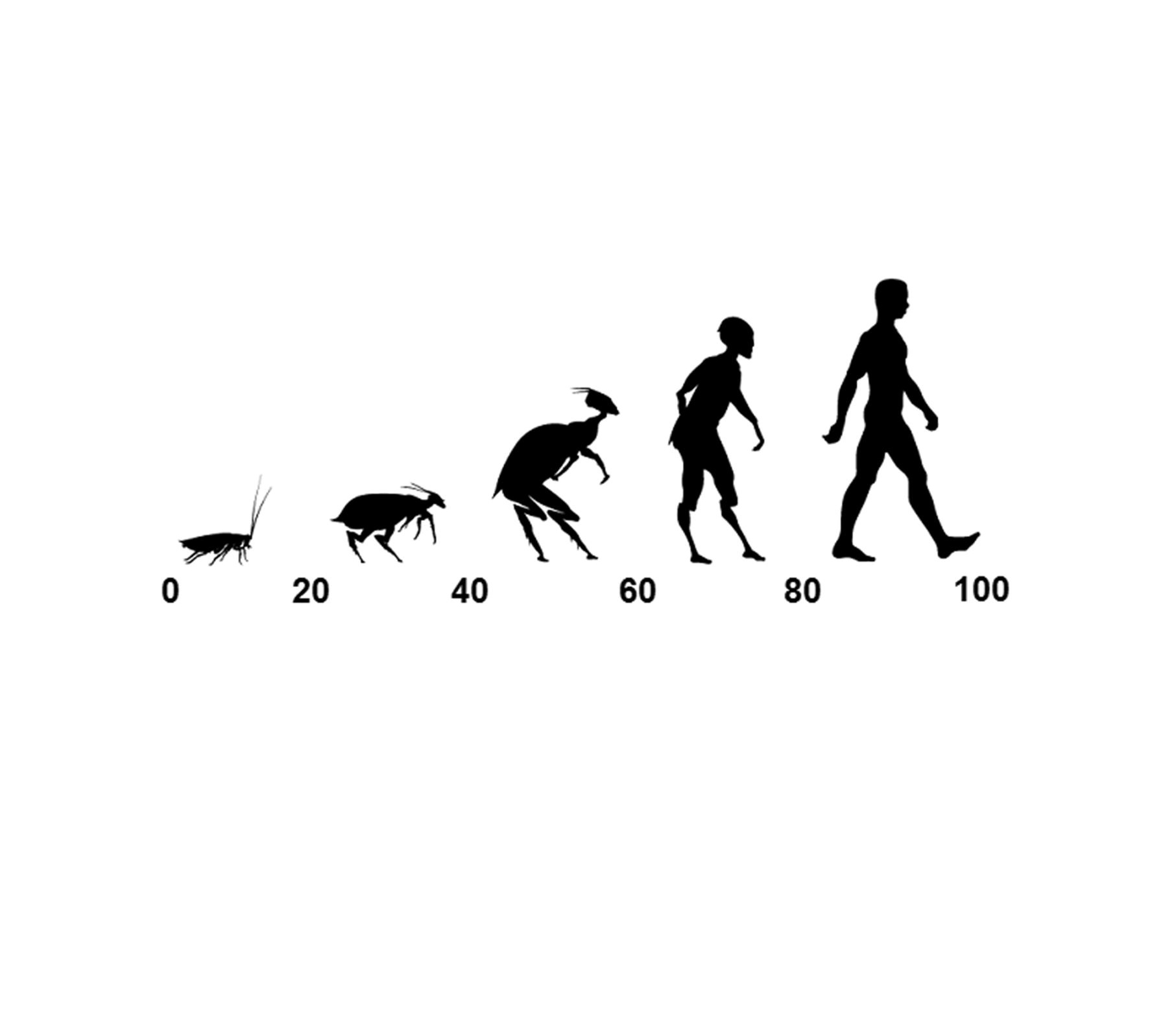
Participants in the study were given either the iconic evolution of ape to man image, or an adaption of that image showing the stages of evolution from cockroach to human.
Lead author Dr Alexa Delbosc, Senior Lecturer in the Institute of Transport Studies (Faculty of Civil Engineering) at Monash University, said the insect-human scale (below) was designed for the study because of the many informal slurs against cyclists comparing them to “cockroaches” or “mosquitoes”.
On both ape-human and insect-human scales, 55 per cent of non-cyclists and 30 per cent of cyclists rated cyclists as not completely human.
https://www.qut.edu.au/news?id=141968
This would suggest that cycling is so ‘subnormal’ down there that even the drivers who ride bikes seem also to dislike cyclists. That reminds me of the UK, if true.
Because Tories and money
Honestly, do we manage anything well in this country? Anything at all?
Where i live the town is so overpopulated with such narrow roads that cycling infrastructure is impossible. The town can’t handle the volume of cars driving in/through it.
There are ways round that.
@p7eaven
It was Perth, just over 10 years ago. Many of the main highways had parallel cycle routes and there were loads of cycle routes around the river. Additionally, all the public space was beautifully looked after. A real joy to ride a bike.
It really really annoys me, we went to Bruges and bikes have their own lanes and traffic lights and our cities are so crap in comparison.....
We went for a ride today and get towards the nearest town and there was some form of path coming the wrong way against traffic just separated by a white line....that was it. Trouble is our infrastructure was never built with the intention of sharing with bikes
This just cropped up in my Twitter feed, so kudos to Manchester City Council..
£2.3million plan to close streets to car traffic in Northern Quarter
What particularly impressed me was this from Piccadilly ward councillor Sam Wheeler - "The street plan of Manchester's city centre was not designed for cars, it was designed for people".
Well of course, it's so obvious but we need reminding. Our cities were not designed with cars in mind.
Trouble is our infrastructure was never built with the intention of sharing with bikes
Roads were built in the UK long before we had motorcars. You have a point, but more accurately it should be that our infrastructure built after the mid-20th century was mostly designed around cars. I hear many people make the point you're making, with the same fatalism, but historically speaking, cars are fairly new with only ~70 years hold over us.
70 years hold over us.
I've been cycling-commuting 40 of those and I’m still the only bicycle locked up at the local town supermarkets for 99.9% of the time. Even when I cycle into the city (Worcester). It’s just kerb to kerb car traffic. Mostly single-occupant cars travelling < 8 miles. All of the suburbs included. 25 mile commutes to rural areas I see no other cyclists either. Why would I? The culture of cycling (for transport) here is an outlier. An odd relic of a time long gone. It was already that when I was a boy. In 40 years it has changed marginally. Less than 1%?
unfortunately people believing this bollocks is exactly why cycling infrastructure is so poor in the UK. A cramped town/city with far too many cars is EXACTLY the sort of place that needs excellent infrastructure [i]to get people out of cars[/i]. Of course, there’s no will for it to ever happen, people will just claim it’s impossible without even looking into how it might be achieved.Where i live the town is so overpopulated with such narrow roads that cycling infrastructure is impossible. The town can’t handle the volume of cars driving in/through it. It’s a many hundreds year old market town with roads to suit the 5,000 or so that lived here in the 19th century. Now there are 37,000 of us
It's a culture yes. When I was living in Australia I don't recall once being abused or subject to 'punishment passes' or such by a motorist. In the UK, a significant minority of people see you as a road untermensch. There are several reasons I think; we have a lot of congestion and shitty road and motorists generally hate driving more than they care to admit, and historically a bike was what you used when you were too poor to own a car. On that latter point, the same problem afflicts lots of public transport. I think our laughable class system bears some responsibility come to think of it. I don't blame the 'posh' people for that as much as your aspirational Daily Mail Hyacinth Bucket ****s.
i_scoff_cake
It’s a culture yes. When I was living in Australia I don’t recall once being abused or subject to ‘punishment passes’
for me in Melbourne thats not my experience...hatred abuse and closes passes are the norm...I'm pretty immune to horn blasting and engine revving if I dare to take the lane to avoid parked vehicles which are common in the on street cycle lanes once you out of the small central business district.
bit of recent research here : https://www.abc.net.au/news/2019-11-20/curtin-university-study-examines-motorists-passing-cyclists/11719666
Project coordinator James Sinclair said on average a Melbourne cyclist gets passed by a car in a dangerous way three times during their daily commute.
"And for every hour on the road, a cyclist can expect to be overtaken at a distance of less than one metre five times," he said.
actually for me close passes aren't the scariest thing (excepting buses and trucks last month had 2 passes at less than 30cm at 80km/hr of that type...empty lane for truck to move across, no oncoming traffic for the bus) but its the physical threats and the fact that drivers will really go out of their way to make their anger towards you known
As to infrastructure some very good stuff but very disjointed and hard to connect routes and go reasonably directly but investment seems to be speeding up and old problems getting fixed...and some more progressive inner councils are reducing speed limits to 30
and 40km/hr across whole blocks but highways in the city falling under state roads are typically 60km/hr limit (plus a bit) even our local shopping strip with community centre a railstation and just one crossing has the speed limit set at 60km/hr
the article linked above mentions a $27m project in Melbourne to fix what is a busy / poorly laid out road which is used by many cycle commuters (plus trams) but has a very high car to cyclist collision rate and deters other....project was put on hold by state Premier on pretext that building the new railstations in the same area was already punishing the driving public enough
Think consensus seems to be Victoria is still a lot better than NSW and Sydney
Well of course, it’s so obvious but we need reminding. Our cities were not designed with cars in mind.
I've nearly fallen into the trap of arguing that our Victorian designed town and city centres don't have space for cycle infrastructure, when of course they definitely weren't designed to have space for cars.
Interesting views on Australian attitudes. I follow a group with a lot of Australian members and they seem to think driver attitudes are awful, which seemed to be the reaction after Mike Hall's death.
unfortunately people believing this bollocks is exactly why cycling infrastructure is so poor in the UK. A cramped town/city with far too many cars is EXACTLY the sort of place that needs excellent infrastructure to get people out of cars. Of course, there’s no will for it to ever happen, people will just claim it’s impossible without even looking into how it might be achieved.
Absolutely this.
The problem is that most people can't really remember a time before cars. Or older people might remember a time when a car was a rare and luxury item but it's become so ingrained that every aspect of our life (and of infrastructure) is built around fitting in more and more cars.
The question should not be "how do we accommodate more cars?" but "how do we start getting rid of cars?" And that is a combination and balance of carrot/stick. Add in cycle infrastructure, remove/restrict (some) vehicle access and so on. People use the infrastructure they're given and if you make it either very easy to drive or impossible to use any other transport, you build a car-dependent society.
Thanks for the info. Seems like Perth have a few good ideas. Like the UK though, it seems that they are obsessed with ‘shared paths’ putting cyclists and pedestrians together. Interesting perspective on cycle infra in Perth from a Netherlander:
The comments are worth a read through.
Compare with Sydney
Or the Netherlands!
I’ve been cycling-commuting 40 of those and I’m still the only bicycle locked up at the local town supermarkets for 99.9% of the time
this. If cycling was more popular, there’d be more infrastructure, if there was more infrastructure there’d be more cyclists...it’d be the brave councillor who decided that instead of filling potholes or build the by-pass the budget would be diverted to what most folk think (and they’d be correct currently) minority interests. Then you have to link it up, from where to where? There’s nothing presently so you’d be starting from scratch, and in 4-5 years time when the council changes, it’d all be abandoned...Blame short termism, the motor lobby, the perception of cycling, the weather...any of those.
we will never be a cycling nation in the same way that the Netherlands is.
The risk with asking for cycling infrastructure is that drivers end up thinking the roads really are for them. In Amsterdam I found that in industrial or commercial areas the cycle lanes, whilst wide and traffic free, had traffic lights crossing every single road, meaning it could take sodding ages to get anywhere. Cars definitely got the priority there.
I'm only in favour of limited segregation - the rest of the time roads should be designed to slow cars down and allow everyone else to share them.
Here in Milton Keynes we are very well served
There is a network of cycle lanes that are seperate from the roads all connected by underpasses, well maintained and very wide
And (thanks to the grid system and all those roundabouts empty, because people can drive everywhere 🤦)
They are a bit of an accident, originally called Pedways, were meant as shared use
They were accidentally labelled Redways on the first maps of MK, so I think that's helped people understand they are shared use.
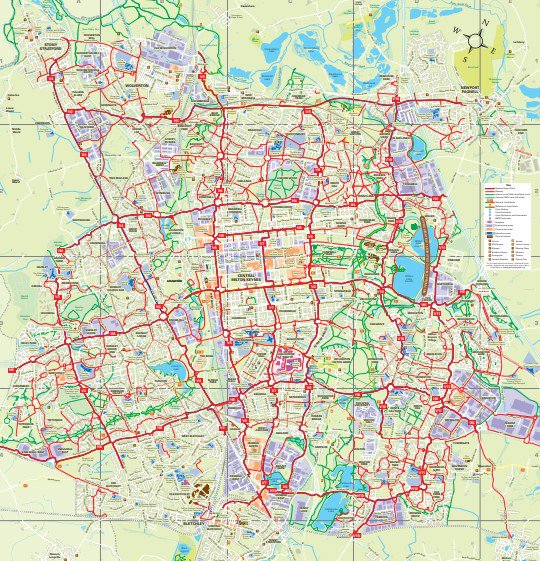


You can cross the entire city without ever having to cycle across a road
We have changing and shower blocks in the centre, proper bike storage lockers and loads of racks at the station


As well as a bike hire scheme & now loads of escooters
The first half of my commute is using some of the best cycling infrastructure in the country, and there are hardly any other cyclists!!
Its crazy its brilliantly kid friendly & really easy to cycle everywhere, yet hardly anyone does!!
I get on the train to London & then cycle through madness, some good, some terrible roads & crazy traffic but 1000s of other cyclists
MK isn't perfect, some redways lead to really naff road crossings, signs aren't always great, redways generally follow paths of major carriageways so can be non optimal for cycling
In the very centre it's also quite frustrating as cycle routes Peter out once you reach the main shopping centre as priority is given to the huge number of parking spaces, the car is definitely king in MK!
Its crazy its brilliantly kid friendly & really easy to cycle everywhere, yet hardly anyone does!!
Possibly the finest city cycle network in the UK (?) and yet it’s a white elephant.
Because it’s lazier/easier/drier/cleaner/warmer/quicker to travel by car.
It’s our culture. Car culture will not be changed now. Just as the Netherland’s cycle culture will not now swing the other way.
The rubicon was crossed. I’m sure most of you have seen the (excellent) youtube documentary about how the Netherlands changed it’s course in the 70’s. It’s only part of the story but one thing they had on their side for routing the onslaught of motorised traffic was a ‘save our children’ campaign, as the streets were by then dangerous places for children. Now children in 2020’s UK are shuttled to and fro short distances in vehicles, and spend their hours more often indoors looking at screens. This has been increasingly the case for many decades.
Again, the culture is set. I’d love to be more optimistic but I now it’s a lost cause. In the UK at least, the motor vehicle ‘won the war’ it started. There was little to no effective opposition.
Now in ‘lockdown’ world rural Worcs/Herefs, I can cycle to get my eggs and see nothing other than cars and a few runners. But the farm tracks and bridleways are mine all mine. I just can’t get to Hereford without taking deathtrap A roads, or else country lane and farm track detours totalling hours of additional riding. So I go on the train. Silly, for a 20 mile journey.
Yep that's it
MK is the same era though as the Netherlands growth in cycle infrastructure; the 70s. It was just at that moment that the car was becoming more accessible, but not quite the point at which it dominates so throughly that it becomes impossible to see past the behemoth it’s now become. Electric cars will still need roads and the current fuel stations will become recharge stations instead, then when it’s seen as green, job jobbed, no need for cycle lanes...
yeah been to MK a few times as have mates there, the cycling infrastructure is great & there's loads more green spaces etc than you might expect.Here in Milton Keynes we are very well served
However as you note takeup is poor so I think the designers actually got it very wrong. Following the US system, it's too compartmentalised (or whatever the correct term is), you have your suburbs, the central shopping area, business parks etc. There's very little [I]local[/I], so you can't walk, you have to use a vehicle... and it's been made SO appealing for cars with the dual carriageways, roundabouts and acres of car parking everywhere. A tram would probably help (I think one has been mooted?) but really stuff just needs to be closer together I think and it actually needs to be made LESS convenient to use cars.
That's where the previously mentioned cramped market town actually has real potential for cycling IMO - if you had a (e)bike or scooter hire scheme where you can get anywhere with a short journey of only a few minute, and it's already pretty unpleasant to drive because of the congestion, people might actual thing it's a better way to travel!

