<Okay so the rain has gotten to me>
The whole up and over J shaped non diving thing - seemed like a good idea(s)
Aside from fashion and improved research/damping in telescopics -Why didn't these succeed?
A good point. They rode well, tracked well and were a clever idea.
Aesthetics may have played a part. Look at the way people are hard pushed to accept the Spesh E150SL fork. It's a triple clamp, but not a DH fork. People find that hard to understand. Leading link forks sit in that category as well.
OK, so there's the Lefty, but that has a massive marketing budget behind it. Girvin/USE and the like didn't have that.
Whytes are a different thing, as they were totally integrated in to the frame, much like the simply brilliant Muddy Fox Interactive frame.
fashion ! it' all depends on what is important to you,,
White rims
just the right shade of purple anodising
silver riser bars
or baby blue painted frame,
oh no it needs a black stem
in my opinion it;s actualy how well your bike works,, and not what it looks like,,,, dont be a panda to fashion
Don't forget vectors too, I had a pair and they were pretty good until all the bushes went sloppy, which occured regularly!
[img]  [/img]
wicked Brave Warrior frame with a set of fork blades for rear chain stays!
CFH - The Dave Smart(?) Muddy Fox interactive was a great idea but Didn't it 'pack down' badly over consecutive stutter bumps?
IIRC there was a road bike prototype at Crystal palace bike show one year(?)
The USE is a good fork in some respects but in others is very lacking.
The good points to me were the rigidness and possitive steering, the anti dive worked very well. They also require virtualy no tools to strip down.
Bad points are that they're a bit primitive in the damping department and really difficult to set up.
One day they'd feel fine then the next day they'd feel not quite right despite no changes to the setup.
I sold mine in the end.
[img]  [/img]
Oh and BTW.
Aesthetics may have played a part. Look at the way people are hard pushed to accept the Spesh E150SL fork. It's a triple clamp, but not a DH fork. People find that hard to understand.
No they don't. They do however understand that loads of other forks out there work a lot better.
It did have some rebound issues, that is true. I think a modern shock system, maybe something SPV or similar would have made such a bike (not a frame/fork, but a while bike) work really well.
People who ride the Whytes, which were a similar integrated system, seem to love them, despite the looks!
Linkages flogging out too quick and pretty crap damping/shocks have been the main down fall of these beasts.
I would expect someone to have another go at it sometime soon. With newer shock technology maybe they can get something that works better than a standard telescopic??
I would like to see Dave Turner have a go at it... 😀
singlespeedstu, ever ridden with one of the E150s ?
Yep.
Well, in that case you'll have ridden a lightweight long travel fork which works better than most.
I quite liked my use sub, it would have made a lot more sense in 130-150mm than 100mm
@CF.
Really. Not the impression I got.
I think as said above the SUB could be a good fork with a better damping cartridge in.
Not niche enough for you, I assume?
Those who ride with them and who have got them set up right, love them. I've not ridden a better lightweight long travel fork.
Nowt to do with nicheness.
I think after a lifetime of racing off road I know what works on a fork and what doesn't.
i loved my use sub fork, lacking a lockout or the adjustment of modern forks tho, otherwise great.
also it prompted one of the local youths to describe my bike as "sick"
i can only think this was a positive sentiment?
re spec shox - having sold them in the past - most if not all spec own brand shox came back under warranty via the shop at some point,,,
garbage
paul
as SST has covered. I too had some USE Subs, and whilst the anti dive and stiff/tracking was fantastic, the small bump sensitivity was missing and unless you were braking there was very little suspension going on at all.
Sold and replaced by 20mm Reba 120mm 29ers.
Better set up means they cover suspension at all points in the ride with damping dealing with the diving.
Sorry - longwinded suspension geek post ahead. I have been fascinated by this for years since seeing the Creasy / diafazio hub centre steered bike in the early eighties.
The best of the alternative designs such as The whyte separate the steering from the suspension. However it cannot be used on a conventional frame. One of the advantages of that type of design is it reduces the forces on the headstock as the lower wishbone takes braking loads. also by separating braking from suspension you can control brake dive - thus meaning you can have softer springing as it doesn't need to have the springs controlling brake dive.
The use type still are compromised in that you are steering with the suspension and get high loadings on the headstock. You can however do clever things with brake linkages to give whatever degree of antidive you wish
With levers as you increase the travel you get further undesirable effects as the arc of the arm gets greater unless you use longer arms
I had a BMW motorcycle with a single wishbone front end. I liked its advantages. IMO the best of the alternate designs - controlled antidive, suspension units on frame not part of the steered mass, relatively conventional frames. I think this would be well suited to mountainbikes.
[img]  [/img]
BMW also did a double wishbone. The whyte was a simplified / compromised version of this set up. In the white the upper wishbone is also the steering linkage thus you lose some of the advantages of the true double wishbone but save weight in that you don't need a separate steering linkage.
[img]  [/img]
I had quite a bit of experience with the Whyte forks (PRST1 3000+ miles & PRST4 4000+ miles) and really liked them but they did have their weak points. The J path of the axle meant that forks tended to tuck under, and this could catch you out on steep descents if you weren't ready (six stitches in the cheek to show for that one), the lower fork pivot is a ball joint and has to deal with steering and suspension movement, this tends to wear out on a regular basis and tends to lead to some pretty unpleasant handling (much more noticeable on-road than off), the fork tends to blow through its travel pretty quickly if you run it soft enough to get the best out of it (but this can be overcome to a certain extent by a change in riding style ie keeping your back more than you would normally).
Overall I regret getting rid of my PRST4, it really suited the way I ride.
Whilst this is interesting in a geek-fest sort of way the reason they didn't catch on IMO is that regular telescopic forks actually work "well enough" for most folk. There may very well be "better" solutions for certain circumstances, but twin legged telescopic forks combine good bump absorption, good tracking, are lightweight and offer (mostly) easy servicing, and perhaps more importantly tuning. Unbeatable really.
Nickc all of those things can easily be engineered into alternative designs altho I agree that teles are good enough for most. Having ridden a lot on that BMW with the telelever front end it really is far better than teles.
I think the main reason is that alternative designs really need frames to suit - which locks you in. the types of alternative designs that can go on conventional frames are too compromised to offer any advantage. That and the conservatism of the average bike buyer. Teles are also a mature technology
A wishbone suspension and frame to suit can be lighter as it has more direct load paths thus you don't need a very strong steering head and by separating suspension and braking forces can run more supple springing without diving on the brakes. You also get reduced stiction and thus better small bump absorbtion
Quite. But it's not really important. People can ride around any issues that tele forks have, and seem quite happy to do so. The forums aren't full of folk complaining "where does my travel go when I brake hard?" it simply isn't enough of an issue for alternative designs to get a foot hold, and there's no incentive from the likes of Marz, Fox or RS to invest the money into new deigns.
Fair enough. I have a design in my head for a single wishbone frame / fork - one day I might even build it
I think there is a big export market to S.Korea so they still make the SUBs (at least until recently, that is).
what about the bimota tesi motorcycle(i think it was that one)that had hub centre steering,also that yamaha that had a similar design.were they any good/could that technology be used in mountain biking?
Raceface - the issue there is to you have an arm that is at axle height - it needs to be bowed to allow the wheel to turn - limited lock and width are the issues so I don't think so for MTBs There are a variety of these designs in the motorcycle world - but none have really caught on
[img]  [/img]
ah i see!!!
I got a set of Look Fournales - carbon fibre leading link forks. All I can say is that riding them is [i]interesting[/i]... not bad, just [i]different[/i].
They're very torsionally stiff, very, very light and a piece of piss to maintain. The J-shaped axle path thing is kinda odd - there's a tendancy for it to pitch you over the front, just at the point when you are about to get pitched over the front - if you see what I mean. But that's ok, I just adjust my riding style and avoid stupid steep rocky, steppy stuff. (Never really liked that sort of stuff anyway). ...Then there's the sensitivity of the fork. It's got a little bit of 'give' for small bumps and rises, but it's quite resistive - it feels almost as if there's too much air pressure in the shock. However, once you hit a certain big hit point - it just goes 'BANG' and slips right through most of the travel in an instant. Like I said.. not good.. not bad either. Just different. You kindof adapt your riding style to suit it. I quite like it really.
I think the appeal of telescopic forks over leading links is that - in terms of fork travel they are by definition linear and 'simpler' - therefore it's easier to develop a more progressive feeling fork. AKA - [i]they just work[/i] as another poster said. That's my tuppence worth anyway... I'm still a bit-part leading link fan though. 🙂
I have a set of old Girvins and their action is much better than the Look Fournales.
The Fournales are nice and light though. What lets them down is inadequate damping IMO, you have to put a heap of pressure into them to stop dive. After using them for a while I discovered a better light fork, an On-One Carbon 😀 It doesn't dive at all for some reason.
I am tempted by the German-A fork. I've got a version on my 20" wheel Dahon and it handled well on a gentle ride around the 'Puffer course.
Telescopics may be a mature technology, but it's a wrong technology.
the Bimota tesi,,,, great bike/crap bike
i used to work for a uk superbike team who raced a works tesi,, fantastic bike everything was independently adjustable ,,trail caster steering ratios etc,,, you could nt work on the engine without taking it out,
the problem was the rider we had was fast but had little feeling for any of the adjustments he just rode around problems,,
now the mountain bike bits,, i had a lot to do with designing the whyte , and recently spent a week at brooks university testing bikes on a 4 post suspension rig basicly each wheel is on a hydraulic ram which can be programed to to up and down at differt frequencies and amplitudes
the accelometers are placed on the the bike on the front and rear wheel, hub and near seat and near handlebars
amongst lots of interesting things was the amount of stiction in front forks even a set of well loved ones i thought were good ,, and new forks were bad ,,, the whyte forks were active right from the first small movements,,
also the slacker the headangle of the bike the more stiction the forks had due to the extra bending on the fork ,,,
read a book by tony foale on motorbike suspension seems very dated now but it's still relevent he builds a bike with virtical forks v ugly but a massive improvment
enough rambling ,,,
[i]Telescopics may be a mature technology, but it's a wrong technology. [/i]
Eh?
Is antidive (and leading link suspension) usable when longer travel is called for?
I'd always thought that antidive would lose it's effectiveness when long travel forks required compression and trail reduction to get around sharp corners, and this was what made telescopics more effective on dirt bikes- without brake compression a modern bike won't get round unbermed corners effectively. Is this correct, or can LL type forks and forks with antidive get the needed geometry changes?
The J-shaped axle path thing is kinda odd - there's a tendancy for it to pitch you over the front, just at the point when you are about to get pitched over the front - if you see what I mean. But that's ok, I just adjust my riding style and avoid stupid steep rocky, steppy stuff. (Never really liked that sort of stuff anyway). .
Which is precisely the bit that puts me off them. I *LOVE* stupid steep rocky, steppy stuff.
i have never had that pitching over the front feeling with my prestons I always thought there wasnt enough weight on the front and with a tendency to run wide in corners (understeer) so both mine run 24 inch front wheels lower front , more weight on the front wheel, more grip ,,
The beauty of a true double wishbone suspension is the axle path can be tailored by adjusting the length and angle of the wishbones to do anything you want and by altering the way the shock is mounted controls spring rates. for example you can have it set up to dive in the early part of the travel but not at the end, you can have rising rate spring rate, You can have short trail throughout the travel, and most importantly as Vinney says stiction thus small bump sensitivity is reduced. etc etc.
Disadvantges are complexity and high loadings on the balljoints, indirect steering path
I had a Girvin vector fork on my proflex back in the 90s. It never worked very well, and then the linkages went sloppy. I replaced it with Marzocchi bombers which was a superior fork in every way.
Vincent girder fork 1950
[img] 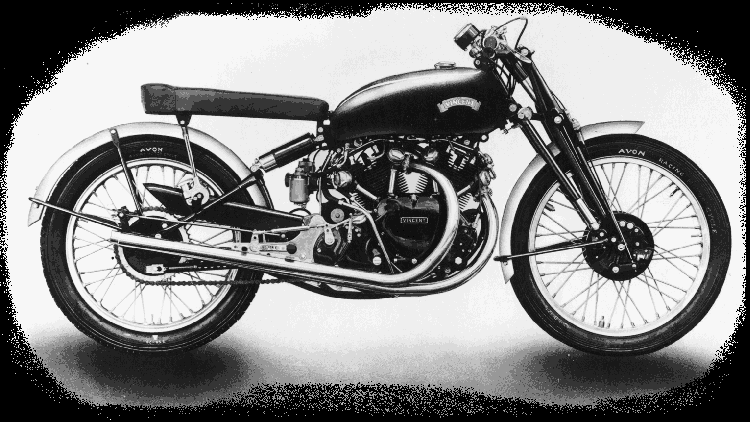 [/img]
Leading link forks, still used in sidecar MX today.
Remind you of anything?
[img]  [/img]
[img] 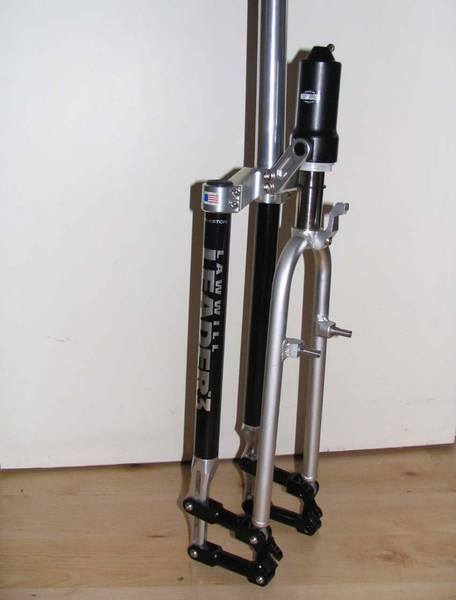 [/img]
Had a ride on one of these way back when and it felt great. Of course, that was compared with Mag 21's etc...
dont be a panda to fashion
Quote of the day - love it 🙂
(Mr MC posting) TJ, as I'm sure you know the irony of BMW using their telever systems is that BMW pioneered the telescopic fork when everyone else was using leading link stuff.
Never ridden a telever BMW but one of the criticisms I often hear is a lack of feeling connected to,, and receiving feedback from the front tyre, expecially during breaking- possibly as riders have become programmed to associate fork dive with breaking force and front tyre grip?
nickc - Member
Telescopics may be a mature technology, but it's a wrong technology.Eh?
Read Ade Ward's post
What I dont get is why its only MTB that hasnt gone down the upside down telescopic fork route that motorcyles have.
I run Maverick sc32's by the way.
MrMC - it felt different for sure and took thousands of miles to get used to. I think a lot of what you said was road testers not having time to get used to it. They aso have rubber mounted bars which does not help feel.
However the advantages were obvious as well - braking over bumps did not lock the wheel as the suspension still worked and soft spring rates were comfy .
i ran a pair of Lawill Leaders for about two years, quite a few years back.. i thought they were very good. The action was very supple, and the constant steering angle was noticable, and welcome.
The links were always a bit sloppy, so wheel tracking was poor on cambers, and once the entire fork imploded whilst steaming along. The upper shock mounting plate was twisted free of the shock. (masive wheel lock, highside, superman to faceplant)
I machined up some new shock bits and got two extra inches of travel out of it, which did start to do strange things to the handling. Mert Lawill designed this as a flat track racing fork where there were few bumps, and little in the way of sharp steering changes, and this is where they would still work well.
i now like the steering angle changes on my long travel bike, and use the action for pinning sharp corners, and berms etc:
[i]Munqe-chick
Never ridden a telever BMW but one of the criticisms I often hear is a lack of feeling connected to,, and receiving feedback from the front tyre, expecially during breaking- possibly as riders have become programmed to associate fork dive with breaking force and front tyre grip?[/i]
I've got an 1150GS. You just have to trust it and get used to it. Once you do it's great. You can brake late into corners and it stays on-line with no dive unlike my CBR600 which tries to straighten up at the slightest touch of front brake.
How much of that is down to telelever vs telescopic forks or 19" vs 17" front wheels I dunno.
tinsy - Member
What I dont get is why its only MTB that hasnt gone down the upside down telescopic fork route that motorcyles have.I run Maverick sc32's by the way.
Posted 10 hours ago # Report-Post
dont realy know,,,, maybe worry about damage to lower legs, suspect its those fashion pandas again
[URL= http://inlinethumb39.webshots.com/33446/2476194170036898833S600x600Q85.jp g" target="_blank">
panda 1 have you seen my purple anodized pedals
panda 2 no you need white rims
panda 3 you cant run that silver stem
panda 4 he is not actualy there as he is out riding his bike!
Fashion Pandas!! I love it!!! 😆
I AM a Fashion Panda!
SC32's never really recovered from the early "tests" (is holding the front wheel between your knees and moving the handlebars really a useful test) where people said they flexed. Flex has never been an issue in my experience and I've got SC32's on four of my bikes.
I've got SC32's on four of my bikes.
Is that like me owning several Alfa's? I mean, in the way that at least this way, you'll usually have one close to working?
SC32's never really recovered from the early "tests" (is holding the front wheel between your knees and moving the handlebars really a useful test) where people said they flexed. Flex has never been an issue in my experience and I've got SC32's on four of my bikes.
i've seen/heard you say this before, and obviously you're happy with them, but having gone from revelations to pikes, which have less flex, and having ridden a lefty in the past ( which has virtually no flex at all ), i personally couldn't get comfortable on a fork where the front wheel isn't pointing where my bar position suggests it should. your mileage clearly varies but i think this may be a case where you are the only one in step! 🙂
I think riders and bikes have worked around the dive issue. On my Patriot with 180mm (ish) forks I adjust my riding for dive - leaning forwards and backwards as appropriate. I guess it's a bit like those new-design non-querty keyboards - great idea but no-one wants to re-learn how to type.
When I was in college getting into biking I sat down and thought really hard about how to make the ideal suspension fork (they were very new then). I decided you should have square fork tubes with roller needle bearings in. I found out many years later that that's how Headshocks and Lefties work.. dammit 🙂
Which makes me wonder - Lefties must have much less stiction than other forks, but what should be amazing plushness never seems to be much of a talking or selling point. Any Lefty riders want to tell me what they think?
(is holding the front wheel between your knees and moving the handlebars really a useful test)
not sure it is,, you can proberly apply more force doing this than you would see during normal riding
but it is a good way to ensure that everything is bolted together and tight,,
i suspect Flex you do feel is down to the tyre which is proberly the least stiff part in the whole system
molgrips - on the lefty point, yes, assuming they're working well (eg not in need of service), they work noticeably better when loaded. The only problem with that as I found is that when cornering hard, with a telescopic fork, the fork actually helps resist dive due to the drag caused by the loading - the lefty type fork (or headshok for that matter) doesn't stiffen and it's quite strange feeling the fork dive into the travel - also steepens the front end up making it pretty twitchy. Of course, it does have the benefit that the fork actually works much better at sucking up impacts when cornering hard.
Again, it's something that's not necessarily good but we've got used to with telescoping forks and it's quite hard/strange to learn to ride differently.
you can proberly apply more force doing this than you would see during normal riding
Yeah but it's a relative test. That fork flexes more than this one. But it's also interesting to note that the wheels flex a lot too so you have to watch that too. A slacker built wheel could make a fork look bad.
i am not convinced about any single sided fork my reasons are
Anything in double shear (std fork) can be made lighter and stiffer than an item in single shear (lefty sub)
take your front wheel out of your bike and pretend to be a normal fork hold the axle either side of the wheel now try holding it just on one side,,
this is why most most gp bikes have gone away from single sided swinginarms it can be lighter and stiffer supporting the wheel both sides
but I do admire people trying stuff ,,, someone has to inovate but there a few dead ends on the road to the perfect suspension system
take your front wheel out of your bike and pretend to be a normal fork hold the axle either side of the wheel now try holding it just on one side,,
I agree with your point but the test abobe isn't really relevant though - you're effectively comparing a fork (two legs) with the same fork with one leg removed. Single sided 'forks' are beefed up considerably, including larger, stiffer axles and you can't replicate that with your hands/arms
FWIW, I've ridden a couple of leftys and they certainly don't seem to flex noticeably more than most normal forks aimed at the same market (eg XC) and they're not heavy either..
. Single sided 'forks' are beefed up considerably, including larger, stiffer axles and you can't replicate that with your hands/arms
clubber thats the point isnt it,, you have to build in more stiffness to account for the leg missing on the other side ,, so you have to add more material and increase the size of axles bearing etc to achieve the same stiffness,,
i dont know the weights of any of the single sided forks or any comparable "normal forks" but i'm sure someone will
it will be an interesting comparision
i know my preston forks are the lightest , but that is because the shock isnt part of the steered fork less steering inertia ( is that a good thing? )
well no one ever suggested you could take a normal fork, cut one side off and it still be stiff. The question really is whether with all other factors added in (eg Cannondale's use of square sliders with rollers rather than tubes and bushings, different axles - QRs/Maxle/lefty tapered axle, etc), a one legged 'fork' is more than the weight of a telescopic fork for the same stiffness.
Like I said, my experience and off-the-top-of-my-head recollection of weights for leftys suggests that they're lighter...
Ade,
my mech eng isn't strong enough to give you the proper definitions, but there's a whole root square thing going on with the lefty/othersinglesidedfork, to do with the surface area ( i think! ). for the same reason that increasing regular fork stanchions from 32 to 36mm gives a considerable increase in stiffness, this same principle is taken to the extreme on the lefty. you can bin off one side, beef up the other, and achieve an increase in stiffness AND a reduction in weight.
"Like I said, my experience and off-the-top-of-my-head recollection of weights for leftys suggests that they're lighter... "
if that is right ,,,it's lighter and stiffer than a normal fork then there has to be a catch ,, price,, then why havnt i got one,,,
o yes i have two whyte prestons
Dell i'm not qualified enough to comment but sounds very feasable big thin wall tubes are strong and stiff
Weights here: [url] http://weightweenies.starbike.com/listings/components.php?type=suspensionforks [/url]
Lefty seems to vary between 1.3 and 1.7kg (2.9 to 3.7lbs) which seems pretty light to me...
upside down forks are hard to make as stiff as you can't have a fork bridge / brace across the top of the sliders so need a very rigid spindle to give the assembly rigidity
it's a square thing IIRC, and if it weren't for incorrect market perception displayed perfectly by ade, single sided forks would dominate the market IMO, esp for longer travel lightweight stuff...
I think that Cannondale WANTED specifically to use roller needle bearings for smoothness and durability. So to do that you have to make it with beefy square tubes which would make it very heavy if it were a normal double-sider. I'm sure they tried that first. So they started with the headshock, but when more travel was needed they had to come up with the lefty. Of course, they could make forks like everyone else but where'd be the fun in that 🙂 IIRC the damping let the headshock down, so it would be interesting to see someone like MZ or RS who are good at damping produce a fork or shock with needle rollers...
Again I seem to remember that the top-whack team edition lefty that was all cast Ti and carbon was something like 2.7lbs. £1200 or something daft tho.
So to do that you have to make it with beefy square tubes which would make it very heavy if it were a normal double-sider. I'm sure they tried that first.
They did - the first moto forks they did were two sides with square sliders. Stiff but fairly heavy
cynic-al - Member
it's a square thing IIRC, and if it weren't for incorrect market perception displayed perfectly by ade, single sided forks would dominate the market IMO, esp for longer travel lightweight stuff...
i'm sorry i still fail to see how standing on one big fat leg is better than standing on two little legs ,, but i expect we will agree to dissagree on this point,,,
but life would be boring if we all had the same thing and agreed about it,,,,
I am not overly keen on telescopic forks ,, as can be seen in my earlier posts
ade - it's the same for most bike components - larger diameters allow for stiffer (relative to weight) structures - eg stanchions, frame tubes, cranks, etc.
FWIW, the prices of cannondale's leftys have always made me suspect that the relative light weight is at least partly down to the use of expensive materials rather than the design alone.
i'm sorry i still fail to see how standing on one big fat leg is better than standing on two little legs
It's not - it's just that the bearings they use require a fat leg - so two fat legs is heavier than one.