On my last fat bike I had schrader valves so I briefly used a digital gauge that came with my car. It wasn't ideal but did the job as a stop gap.
My new bike has presta valves so I thought it was time to invest in a decent gauge designed for the job.
So, presta fitting, preferably a bleed function.
Seen both the Topeak D2 and the SKS but what are people using and what are your experiences ?
I use the D2 - main thing is that it seems to be consistent so you know if you pick 6psi (or whatever) as the 'right' pressure you can recreate it every time.
I run tubeless so tend to check pressure fairly regularly on fat and standard bikes before rides and the digital guage is very quick for this.
I've never bothered. The squish test has served me well 🙂
For a good digital then D2. I have one for general use.
If, like me, you want to get full on PSI paranoid then meiser accu-gage analogue is excellent. Ive the 0-15psi version.
The new[url= https://fabric.cc/products/pumps/accubar-pressure-gauge/ ] Fabric Accubar[/url] thing looks ideal, but I've never seen let alone used one. I've got one of the Topeak digital gauges somewhere, but it's fiddly and I'd rather have something that works inline with a track pump.
I find 650b+ tyres are properly pressure sensitive, so one of those is on my shopping list for 2018.
I bought an accu-gage from the US Amazon site, they include taxes etc in the shipping cost and it worked a lot cheaper than eBay or any of the UK based sellers I could find.
I'm certainly not paranoid about pressures and normally just work with the standard squish test that scotroutes mentioned.
I'm still feeling my way with differing pressures so I guess I need something to re-calibrate my squish test against to measure 8psi rather than 30psi !
After doing much research, I bought one of these from this seller.
It came quickly and due to the value isn't subject to import tax/duty.
I'm pleased with it and it does what it says on the tin.
@BadlyWiredDog - that has given me an idea, maybe I should just look at ways of incorporating a better quality calibrated gauge into my track pump.
Hmmmmm
the Shwobble one is good. no bleed, but it's quick to use, so it doesn't cost you much time.
I've used the Topeak D2 one as well, and it lets a lot more air out when you're trying to seat and seal it on the valve.
that has given me an idea, maybe I should just look at ways of incorporating a better quality calibrated gauge into my track pump.
Let me know if you find anything.
I think you'll end up using a separate digi gauge, or spending much more on some fancy low pressure/high volume fatbike pump with a special gauge.
@nedrapier - I have direct access to gauge manufacturers with my work, just not really bothered thinking about it before as its never been an issue.
Fair enough! Crack on.
Post back? I'd be interested.
I've an SKS pressure gauge for use with the fat tyres, has 0.5psi increments but as above, it's more about the consistency than an absolute value.
has 0.5psi increments but as above, it's more about the consistency than an absolute value.
Yes, exactly, consistent and a small range that can actually be read !
The gauge on my current track pump doesn't start reading until about 10psi, probably with an accuracy of +/- 50% as well !
Use the Topeak D2 on my mountain bikes. Max tires are 2.4 inch so.
Like the Topeak.
For me important: if I make some test runs with a certain pressure and change the pressure I like to be able to repeat the "old pressure" setting. This works very well with the Topeak. (No idea if these 27 psi or so are really exactly 27 psi.)
What I like as well: when going on a long tour with one major peak I take the Topeak with me and lower the pressure on the mountain to have an exact pressure for the downhill run.
Nice toy / helpful tool.
😉
Fat tires: guess you like to be even more accurate?
@BadlyWiredDog - that has given me an idea, maybe I should just look at ways of incorporating a better quality calibrated gauge into my track pump.
The problem you need a way to hold the valve on the tyre open, and then put another one-way valve on the pump side of the gauge. Otherwise, you're just measuring the pressure in the hose and just hoping that it matches the pressure in the tyre the other side of the valve.
If you use schrader valve then it's fine you could just install one of those accu-gauges near the head, as the head keeps them open and the pump relies on it's own valve.
@andreasrhoen - due to the low pressures on the fat tyres a slight difference in pressure makes a huge difference in feel. I'm typically running about 8-9psi (I think....).
@TINAS - exactly, these things are never straight forward. It might be time to take the track pump apart and see what check valves are already in the assembly.
@andreashoen - the thing with fat tyres is that the pressures are so low that a change of just 1psi is pretty dramatic. At normal UK temps my front tyre needs to be between 8 - 8.5psi, if it drops to 7.5psi then handling gets weird especially on hard pack and even more so on tarmac because of the massive grip and the gyroscopic effect.
Temperature also has an effect because of the large volume of the tyre, as the temperature drops so you need to lower the pressure. It's the ideal gas law at work: PV/T = constant. Volume is (effectively) constant so you end up with P/V = constant. You can end up with pressures in the 2psi range!
whitestone, presumably you're getting into pretty extreme temperatures there? Is it something you need tothink about at more normal UK temps?
What would be the equivalent psi at -5deg C, roughly, to 8psi at 25degC?
@splash-man, @whitestone:
interesting!
That's very low indeed... + "range" between good & bad around 1 psi ???
Mmmmhh - Topeak D2 might be not the correct tool then...
😥
I've got both the SKS and the Topeak digital guages and don't find either of them to be reliable or accurate at MTB pressures.
I suspect the problem (as mentioned here http://singletrackworld.com/wp-content/uploads/2017/12/the-7-top-tools-of-the-trek-enduro-mechanic/ ) is that they get fouled by tubeless jizz.
The only guage I've seen with a filter is https://www.efficientvelo.com/product/bleedin-gauge/ but they're looking like over 100USD shipped to the UK (probably with customs charged on top).
Yes we are talking minus double digits Celsius here 😯
Here's a [url= http://45nrth.com/blog/post/rules-of-fat-dialing-in-tire-pressure ]45Nrth blog[/url] about it. [url= http://lacemine29.blogspot.co.uk/2016/01/fat-tire-pressures-for-snow.html ]This has more info[/url] but is as much about snow conditions as temperature.
[url= https://www.bikerumor.com/2015/01/08/tire-pressure-and-the-cold-bontragers-psi-conversion-chart-will-keep-you-inflated-this-winter/ ]This post[/url] has a table relating the different pressures/temperatures.
I use an Accu-Gauge. It also agrees with my Leyzane digital pump.
As for temperature and tire pressure Bontranger have made a handy table...
[img] 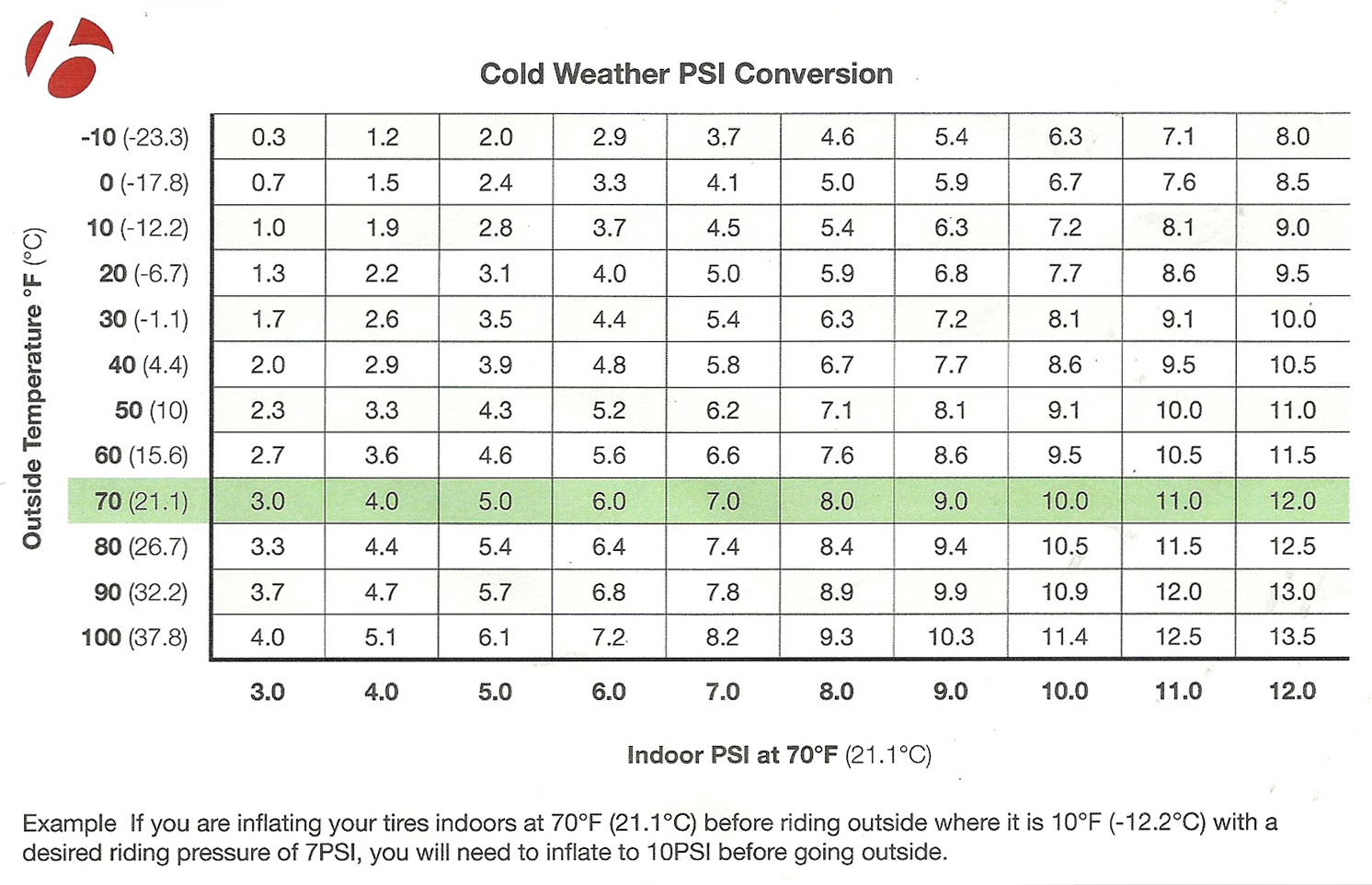 [/img]
Edit: Dammit - too slow 😀
Not sure how much it affects MTB tyres but on a motorbike you always take tyre pressures cold, as the tyres warm up so does the air inside which expands, increasing the pressure. Gaining 10psi isn't unusual in summer, obviously that's with a tyre which can get almost too hot to touch so nothing like an MTB tyre, but 15psi at 25 degrees will be a different volume of air than 15psi at 0 degrees.
Not sure how much it affects MTB tyres but on a motorbike you always take tyre pressures cold, as the tyres warm up so does the air inside which expands, increasing the pressure
You're supposed to on cars as well. I can't believe speeds are sufficient on a bike to raise the temperature more than marginally and theres much less thermal mass of rubber to retain it.
cheers for the graph, much more difference than I was expecting within standard British temperature range. Even std South of England temp range. Even on the same day.
Cheers gents - that table makes interesting reading.
As nedrapier says, even in the south we can have a large temp swing.
The Topeak worked ok for me, ++1 on consistency over accuracy- at sub 10psi the chances of a non-direct read dial gauge being particularly accurate are very low. For me, the Topeak is an acceptable combination of consistency, believability and portability. In Fat circles there seems to be a trend toward big brass dial gauges that probably are more accurate but far less convenient. I suspect there’s equal parts OCD and steampunkish wilful difference here for most that aren’t actually crossing frozen continents (although fair play to those that do!)
I think a lot of the ‘consistency’ conversation comes down to chuck design- where fractions of an already low psi are very significant, any ‘pffft’ when removing the gauge might actually mean the current pressure is significantly no longer the pressure measured a few moments ago. Multiple repeats would obviously make this worse.
For value, I quite liked the BBB gauge, but it did seem to have a very lossy connector.
Meiser Accu-gage (sic) as above.
0-15 PSI for fatties [url= https://www.ebay.co.uk/itm/Meiser-Accu-Gauge-0-15psi-Presta-Valve-Dial-Low-Air-Pressure-Gauge-Fat-Bike-Tire/322004932237?hash=item4af8fd568d:g:3BoAAOxy~dNTH-DX ]~£18[/url] (Bought one, arrived quickly, no duty).
0-30 PSI for chubsters [url= https://www.ebay.co.uk/itm/Meiser-Accu-Gauge-0-30psi-Presta-Valve-Dial-Low-Air-Pressure-Gauge-Fat-Bike-Tire/222000597371?hash=item33b044497b:g:JMIAAOSwnDxUmhwM ]~£17[/url]
Edit: Same seller as Rustychain.
Bleed function is of limited use with a fatty - just press the valve down for a few seconds, the pressure is not as twitchy as with skinny tyres.
I think a lot of the ‘consistency’ conversation comes down to chuck design- where fractions of an already low psi are very significant, any ‘pffft’ when removing the gauge might actually mean the current pressure is significantly no longer the pressure measured a few moments ago. Multiple repeats would obviously make this worse.
I have the same problem getting repeatable readings from both the SKS and Topeak when taking pressures from my car tyres - it's definitely not losses in use.
That shop also has the 0-60psi which is what's needed for non chubs. got to be worth a go at that price. https://www.ebay.co.uk/itm/331788180945
I know the ‘losses from gauge/pump while disconnecting’ thing is one of those old threads that never quite dies like ‘what tyres...’ etc, I just think that while at standard bike pressures it’s negligible losing a bit from pressurising the device, the lower the pressure gets the more significant it’s likely to be. Having said that, volume is wildly different between a fat bike and a mtb, so possibly without a way to quantify the volume of ‘pffft’ I’m talking out of my @rse... 😀
the lower the pressure gets the more significant it’s likely to be. Having said that, volume is wildly different between a fat bike and a mtb
It's negligible, even for an MTB. To drop 0.5 PSI on my fat bike, I have to press the valve in for a few seconds.
I fell for all the pressure para when I got a fat bike, got the topeak and used it twice.
Now I take a pump and if the bike feels good I just ride it, if it feels weird and the tyre feels softish I put a bit more air in, if the tyre feels hardish I let a bit of air out.
Yes we are talking minus double digits Celsius here
Except the gas laws are on an absolute temperature scale where room temp is about 292k and 'minus double digits' is still a comparatively toasty 263k, so the pressure drop is more like 1psi even at that extreme.
if it feels weird and the tyre feels softish I put a bit more air in, if the tyre feels hardish I let a bit of air out.
This is true but when swapping between tyres they have a very different feel so would be good to have a datum to start at and then adjust from there.
Or do all that soft/hard playing, find something that works and when you pump your tyres up, go to the same and ride, without wondering "Are my tyres softish or hardish?"
Or you can go for a ride and find out that your tyres are hardish after you skid out on a climb or lose it on a root, or find out that they're softish after you dink your rim into a rock when you probably shouldn't have.
Has anyone tried sourcing a low pressure guage and replacing the one on their pump? The issue seems to be that guages are accurate in the middle of their range and a typical 160psi or higher pump guage is no good below about 50psi.
Something like [url= https://www.amazon.co.uk/60PSI-Pressure-Gauge-water-Manometer/dp/B008R12POS/ref=pd_cp_328_4?_encoding=UTF8&psc=1&refRID=Q6PFPYK010THDHAQTQR6 ]this[/url] or [url= https://uk.rs-online.com/web/p/products/8655948/?grossPrice=Y&cm_mmc=UK-PLA-DS3A-_-google-_-PLA_UK_EN_Test_And_Measurement-_-Pressure_Measurement%7CAnalogue_Positive_Pressure_Gauges-_-PRODUCT+GROUP&matchtype=&gclid=CjwKCAiA1uHSBRBUEiwAkBCtze0brco5qOZsmpaiswGVhZRs91dO4t5MmGYkTpQWLYxE_v88Xg7dbxoC0R8QAvD_BwE&gclsrc=aw.ds ]this[/url]
The connection on the back looks about the right size relative to the face but is described as 1/8th or 1/4 which seems too small
The very similar to the type of gauge I was going to try.
The ones I can get from work are 0-35psi, a 50mm face and I think a 1/4" gauge fitting.
I am looking to take my track pump apart this weekend if I get a chance to check connections.
Ah was going to say that the Bontrager scale seemed excessive, but of course this illustrates the difference between gauge and absolute pressures.
Pump up your tyres outside would be my advice - and of course I'd never thought of the fact that fatbike tyres will be more sensitive due to being closer to atmospheric.
Do they have a similar one for altitude corrections?
Ah. So my RennKompressor guage has a thread of about 12mm (1/2"?). I've just replaced the (high pressure) guage on my Silca (which was what got me thinking about this) and that was smaller but i don't think as small as 1/4"
So my RennKompressor guage has a thread of about 12mm (1/2"?)
How have you measured it ?
I suggest you check thread dimensions on a chart before jumping to conclusions as to what the actual thread size it. That could actually be a 1/4" thread...
How have you measured it ?
I suggest you check thread dimensions on a chart before jumping to conclusions as to what the actual thread size it. That could actually be a 1/4" thread...
er, [url= http://www.ring-plug-thread-gages.com/PDChart/G-series-Fine-thread-data.html ]yes[/url]. The SKS will be 1/4 and the Silca 1/8th. Now, could you explain to me why a 1/4" thread is around 12mm?
The thread size relates to the ID of the pipe designed to fit into the thread.
So for example the pipe fitting into a 1/2" BSP thread will be approx 15mm but the thread will measure approx 20mm or 3/4".
Clear as mud isn't it 🙂
Clear as mud isn't it
Plumbing fittings remain an unholy mess of mixed metric and imperial specs - I just can't comprehend how we can still have not properly switched to metric 53 years after the process started.
So that works. £5.80 for a 1/4" 60psi gauge from https://www.ebay.co.uk/itm/253007752858 and I've got a RennKompressor that should be accurate in the 20-40 psi range.
Hopefully the length of the hose and the space at the base of the pump should mean that any tubeless jizz
won't get as far as the gauge.
Plumbing fittings remain an unholy mess of mixed metric and imperial specs - I just can't comprehend how we can still have not properly switched to metric 53 years after the process started.
Mainly because so much of our housing stock still has imperial sized pipework. We are on a private water supply, the alcathene pipe to the house was put in in the 1970s and is 1". We did some work on it a couple of years ago: imperial to metric converter joint, a bit of metric pipework then another converter at the other end!
I've got my gauge as well but need to take the pump apart to change it !
I have a Lezyne digital trackpump which registers from 3psi - not worried too much about absolute accuracy, just that what settings I need for what tyres in what conditions. I've ridden in conditions where it was simply about having enough air to hold the tyre on the rim and feeling the tyre bottoming-out on the rim - some arctic racers simply go by the number of wrinkles in the tyre sidewall as a guide. In those conditions, you're rarely riding fast but it can be difference between riding at 4mph or pushing and post-holing up to your knees in snow.
I have 2 D2s, they're both fine but they read slightly differently which is irritating- consistent but clearly not both accurate.
Wasn't that convinced by my accugage, the relief valve is incredibly slow which makes finetuning annoying. That's not that big a deal but it just made it worse than the topeak to use
Took my Joe Blow apart only to find that I can't change the gauge grrrrrr
I have borrowed a D2 from a friend it the seal is horrendous losing loads of air each time you check.
Time for Plan B
I bought a [url= https://fabric.cc/products/pumps/accubar-pressure-gauge/ ]Fabric Accubar[/url] on my own advice. I think it's pretty good. More expensive that swapping out a gauge on an existing track-pump, but has the advantage that you can use it with multiple pumps and it's just about light enough to carry on the trail. Works great with a Lezyne Alloy Drive and has the advantage of not unscrewing the valve core like the Lezyne connector likes to.
Means you can tweak pressures on the trail and match them to previous settings that work for you, which I've found problematic with the squidge test, probably because I lack the ultra-sensitive finger pads of other posters.
It has a a pressure bleed button, which works fine, and, if you attach it to a tyre at a pressure above 40 psi, which is the maximum the gauge measures, it'll automatically release pressure until it reaches 40psi. You can use it as a stand-alone gauge as well, though obviously if you do that you can only measure and/or reduce pressure rather than increasing it. But hey, you carry a pump as well, right?
Feels reassuringly solid and well made and can be used on both Presra and Schraeder valves. If I was being picky, I'd say that the markings on the gauge face could be clearer between the main 5psi divisions. Seems good for both 650b+ and standard mountain bike tyres, but a bit low - 0 to 40psi - for my cross bike.
Not cheap at about 30 quid, but saves buying a new track pump wth a low pressure range and is more versatile too.