Assuming Rider A is on a 10kg MTB and making a 10 mins climb with Gearing ratio Z
Assuming Rider A is on a 13kg MTB of simillar geometry, componentry etc but with a weight of bike of 13kg and same gearing ratio of Z.... How would his times compare in theory ?
Then... Assuming Rider A carries 5kg in his camelbak on the same ride on the 10kg bike... then does the same ride without camelbak, how would he compare ?
I guess the important point i'm getting to here is, "what makes the main difference, weight of bike or weight of rider?"
Errmmmm - which one is fitter and has the best doctor?
They're the same person... each and every one of the scenarios.
The train going to Euston has a journey time of 1:45
How much does he weight? It's about percentages and power to weight.
Road or mtb? The rougher the trail the more bais towards the bike.
Which bike fits the rider best?
<Clarkson> POWER <Clarkson>
He weighs 67kg. It's on an MTB on a non-techincal fire road.
The bikes fit exactly the same, they're the same bike, 1 is made of carbon, 1 is made of Alu, but same geometry exactly, but in this scenario the Alu weighs 3 Kgs more.
Same wind direction and temperature?
My point is that there are hundreds more variables that have an effect - 5kg here or there isn't going to make much odds.
Who gives a monkeys? Get out and ride.
Just idle curiosuty really. I guess it's based upon
"would a lighter bike make me quicker...."
Of course there's loads of variables.. I accpet that
In your scenario I don't think it matters where the mass is, some quick calcs taking into account drag, rolling resistance and gravity everything else being equal;
1 mile climb, 180m vertical gain;
67kg rider, 10kg bike, no camelbak = 593 seconds
67kg rider, 13kg bike, no camelbak = 615 seconds
67kg rider, 10kg bike, 5kg camelbak = 630 seconds
I think when all's said and done, the overall weight of bike and rider is the key. Not sure how much difference the ratio makes, if any.
Errmm, how about looking at it as simplistically (is that a word?) as possible: If you suddenly lost 1kg of excess flab from your stomach, your power to weight ratio would increase by the exact same amount as if you suddenly lost 1kg of metal from your frame
How would his times compare in theory ?
Purely empirical of course but off road my Voltage FR is as fast and in some places faster than my Cannondale Rize going uphill. The Voltage is a freeride bike approx 35-36lbs with 200mm of travel and the Rize is yer typical 140mm FS trail bike prob 26-27lbs. Wildy different geometry but very similar gearing.
Q: why?
A: The Voltage has more traction. It doesn't get deflected by obstacles or spin up on loose surfaces. The difference is small but significant and it means my more of my effort is translated into going forward. The other big difference is that the Voltage is simply heavy. I used to think that this automatically meant draggy but the tyres roll easily, the drivetrain can be turned easily with one finger and the wheels spin effortlessly. Once the initial inertia is overcome it flies along.
None of this applies on smooth trails or tarmac of course where the lighter bike simply rolls away.
Purely empirical of course
You probably mean 'anecdotally' ....
What is Rider A's mass?
Surely it's all about what proportion of the combined rider + bike + kit you are actually reducing.
Let's say Rider A is 80kg so in the first case you have:
Case 1: 80 + 10 + 5 = 95kg
add 3kg to the bike and you have:
Case 2: 80 + 13 + 5 = 97kg
97kg all up mnass that's a 2.1% increase in mass, so is it reasonable to expect either a 2.1% increase in his climbing time (for a 5 minute climb that's an extra 6.3 seconds) or 2.1% more work required to maintain the same climbig time... seems fair, non?
Put Rider A back on the 10kg bike and remove that 5kg camelbak
Case 3: 80 + 10 = 90kg
that's 5% less mass than Case 1 and 6.5% less than case 2...
realistically you are probably going to be dealing in a world of 2 - 5% of all up mass savings when your comparing a 22lb bike to a 28.5 lb bike depending on your BMI and propensity towards packing the kitchen sink... In terms of financial cost there's probably a several hundred quid involved in a takeing 6-7lbs off the bike Vs relative pennies for leaving the camlbak in the shed...
So clearly the bigger impact on mass comes from leaving (an overloaded?) camelbak at home, but then you need to probably factor another ~1kg back in as it's reasonable to expect you'll be taking a bottle, spare tube, pump and multi tool as a bare minimum...
TBH I try to travel as light as I can at the minute while still having the kit to get me out of any reasonably forseeable situations... I'm less fussed over saving bike mass, I'd prefer it to be heavier but durable, carry a minimum sensible amount of kit, and then focus on reducing the mass of the meat sack sat on top...
Biggest variable is always the rider as a pricey 10kg bike could equally support a 60kg racing whippet or a 115kg biffer, and no doubt their lap times would vary significantly...
The weight of the bike doesn't make much difference when riding up a smooth gradient.
The weight of the bike makes a big difference to handling though, and also when going fast on technical tight singletrack. When you're constantly accelerating, braking and changing direction the extra power you need for a heavy bike adds up to a fairly significant amount.
I used to have a 37lb coil sprung Patriot, when my other bike was a 27lb Fisher Cake. The extra weight was less than 5% of the total, but long climbs on the Patriot were bloody murder and made me lag far behind my mates on their usual bikes.
You can calculate all day but it's fairly obvious that light bikes FEEL much quicker even if the number of seconds isn't important. Of course, it's only ever important in XC races anyway.
I think a large part of it is that if your riding mates start to pull away you'll have to try that bit harder to keep up, and even a small amount of weight makes a big differenc when you are on your own threshold, because when you are at that threshold even a small increase in power (less than the 5% required to overcome a heavy bike) pushes you into the red zone where you'll become knackered very quickly.
Weight loss of the rider can be achieved at cost=0 so do that first, then decide on what to do about weight of bike
Well rider/bike/kit mass isn't the only variable to consider, a bikes geometry and suspension action might not suit the type of riding: Mechanical advantage for pedaling up climbs can be traded of against handling or vice-versa, you might well have draggier tires (at lower pressures?) that adds a couple of percent more to the required energy input to move it, the combined factors can soon all stack up...
molgrips GF Cake - Vs - Patriot case probably had all of the above as a factor as well... ?
We live in the age of the ~30lb DH bike, I'd still not like to try and pedal a 61 deg HA / 2.5" (sub 25 psi) tired / 8" travel / 1 x N (road bike cassette) bike back up the hill however light it is...
Save 5lbs on the bike and you 'notice' it there and then.
Save 5lbs on yourself via some training / more riding over a month and it's less instant and not as noticed, but you will be going faster than your '5lbs lighter from posh bits on my bike' scenario.
Unfit riders on light bikes are cheating themselves of the advantages of weight training.. A fit + lean rider spending most of their time on a heavier bike will do best come race-day on race-bike.
Good topic this. I wonder about this stuff as my bike is heavier than my riding buddies.
I have an orange five (pretty standard kit on it) and he has an Ibis mojo HD.
I weight just under 10 stone and i'd say he weighs around 12. He always beats me up hills, but that's because he is fitter. If I got up to his fitness levels in theory would I be quicker? 🙂 Not that any of this matters... I just want to take the piss out of him buying a deeply expensive light carbon bike.
Weight loss of the rider can be achieved at cost=0 so do that first,
£0 yes, but it's often rather hard. And if I am already trying to lose weight, then I could still spend money on my bike too, coudn't I?
It's not either/or.
you might well have draggier tires (at lower pressures?)
You are quite right, the Patriot had a number of issues hindering the climbing. The bike that replaced it after it got nicked was an XC spec Patriot, air sprung etc etc which weighs about 31lbs, including Kenda Nevegal blue groove tyres. When I got it it was still a bit of a chore, but removing the buffalo hide tubes and going tubeless for lower rolling resistance made a massive difference. I can now ride it happily all day, and only the somewhat more upright position is a slight hindrance over the 5. I equalled my PB at Cwmcarn on it - I was 2 mins slower on the climb than I was on my 5 but 2 mins quicker on the descent.
Having said that, my Kona Heihei is far quicker than both of them up the climbs obvioulsy but also on the singletrack. It rolls much better with its Racing Ralph tubeless tyres, but also accelerates far better out of corners with a stiffer frame and lighter wheels.
It is shocking that noone has asked for confirmation on wheel size. Given that this is a constant I would suggest that the first rider to the top is the one of the light bike without the bag.
Next up is the one who is 3kg fatter but still on the light bike.
Next up would be the light bloke on the heavy bike followed by the heavy guy on the heavy bike.
My assumption is that the trail is the same. Power is the same and wheel size is constant (clearly anyone with bigger wheels will be quicker).
My reasoning is that dynamic weight (on the rider) is better than weight on the bike. So having a poo before a ride is not as good as having a lighter bike.
Ask Pythagoras, he'll know.
Interesting thread Weeksy 😀
Who the heck is this 67kg rider you're referring to? It sure as heck isn't you or me 😀 lol
For what it's worth, I weigh 92kg, my bike weighs 14 with water and tools.
My power up 'that' climb was 340 watts so 3.2 w per kg 🙂
http://www.analyticcycling.com/ForcesLessWeight_Page.html
Play to your hearts content, then ride your bike a bit more and step away from the cake, fatty.
And I was in 'traction mode' (well on the shock, not the forks lol)
As Kleber knew that Anquetil knew, you can climb slightly faster if you move your bottle from the cage to your jersey pocket at the bottom of the climb.
I have a 29er Scandal at 23.4 lbs and a Niner A9C at 16.2 lbs and I weigh 148 lbs
Being light the 7.2 lbs difference is 5% of my body weight and would be hard for me to lose on my body so very worth while.
The biggest benefit is the weight loss on the wheels which was the best part of 2 lbs and makes the bike accelerate like a rocket and is real world noticeably faster up the hills. My ride times on regular loops from 15 to 50 miles are consistently faster by around 3-5% if not more on the hillier rides.
So you question is subjective more about where the weight is saved, if it is saved on the bars, seat, frame etc that small amount of weight loss will be barely perceived but if saved on the wheels would provide a very real speed gain
makes the bike accelerate like a rocket and is real world noticeably faster up the hills.
Oh please, do give over...
Every time there is a weight thread on here people come out with the most amazing superlatives, the massive difference, the wonderful acceleration, the fantastic performance upgrade, and no one, not a single bloody one, ever backs it up with some real world numbers.
Why?
Because however great the difference feels, there is never that much difference when you actually try to measure it.
people come out with the most [b]amazing[/b] superlatives
.....oh the irony!
Now, I'm not suggesting you follow all of Michele Ferraris advice, however, I think this sums it up:
[img]  [/img]
OT: Good book, well worth a read ^^^
Unfit riders on light bikes are cheating themselves of the advantages of weight training.. A fit + lean rider spending most of their time on a heavier bike will do best come race-day on race-bike.
"Weight training" by riding a heavier bike is classic. I mean, you couldn't ride a harder gear on the same light race bike in training to increase the intensity could you? 😉
😯I wonder about this stuff as my bike is heavier than my riding buddies.
That's either one heavy bike you've got or some real lightweight mates.
I bet I have more real world experience than you to judge having two bikes with similar Geo with thousands of miles on over the same loops all gps logged and my statements is based on actual ride times not solely how it feels"
I am not a tard who believes in every stupid old wives tale, I have a carbon frame and an aluminium frame and you can't feel any difference from the material, all this steel is real, Ti this that and the other is all rubbish, but rotational weight is a fact, you may want to re-read my post as I even said weight lost elsewhere is pretty pointless and that is coming from someone who has spent 6k on a bike to make it crazy light because I like the challenge and building light bikes.
And as for cheating myself I am sure I would waste most people on my weight weenie 32:18 singlespeed as I have trained hard and am very fit so storm up the hills
The bitterness towards people on lightweight bikes always amazes me, normally is seems to be bitterness from people who can't afford to spend on a bike.
I ride unicycles as well and have some a stunning 36" ti Triton (like the looks not the frame material) and Loved how friendly and non agro the community is no-one cares what wheel size yo run (we have far more choice) whether you ride MUni, Trials, Street etc, maybe you have to be a bit loony and not have any ego (you do look a bit stupid lol) so you don't get all this raaar your stupid for doing blah or OMG why do you ride wheel size blah
Meh
I like things with wheels, I like being out in the wild, I like tech and the excitement of buying stuff and talking about it.
Time to step away from the internet
😯 Now deep breath and relax.
Case 1: 80 + 10 + 5 = 95kgadd 3kg to the bike and you have:
Case 2: [b]80 + 13 + 5 = 97kg[/b]
I guess the grammur police don't do numbers 😀
no one, not a single bloody one, ever backs it up with some real world numbers.
Why?
It's cos we don't have that data. We may waffle on about this stuff when we are sat t our office desks being bored, but most of us are still a long way from being sad enough to spoil a good ride by faffing around collecting stats!
Keep your bike ..loose a bit of weight ..you'll climb better ...that's all you need to know
light rider on a heavy bike is faster than a heavy rider on a light bike.
I have no real world figures but I've never seen a heavy guy who could climb well but I've seen hundreds of little guys who could.
Watch the tour, the heavy chaps are crossing the line just in front of the cut off for the most part, it's the guys who weight the same as a 12 year old boy who win in the mountains.
This is what a fast road bike climber looks like:
[img] 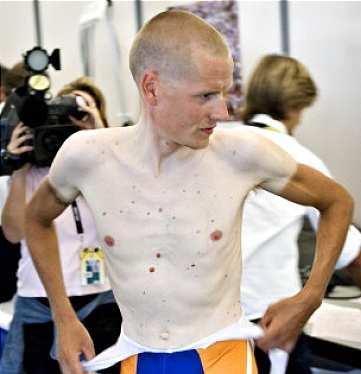 [/img]
Just going to throw this in:
Froome
Height 1.86 m (6 ft 1 in)[2]
Weight 69 kg (152 lb; 11 st)
Not that light...
Wiggins
Height 1.90 m (6 ft 3 in)[4]
Weight 69 kg (150 lb; 10.9 st)[
Also not that light...
Schleck
1.86 m (6 ft 1 in)
Weight 68 kg (150 lb; 10.7 st)
Crikey, he weighs the same.
Nibali
Height 1.80 m (5 ft 11 in)
Weight 63 kg (140 lb; 9.9 st)
Clenbutador
Height 1.76 m (5 ft 9 1?2 in)
Weight 62 kg (137 lb)
Ah, getting lighter.
So in the '13 Tour, a 69kg man climbed better than a 62kg man. And in the '12 Tour, a 69kg man beat a 63kg man. Crazy times!
And worse, Indurain won a tour or two, and he comes in at
Height 1.88 m (6 ft 2 in)
Weight 80 kg (176 lb)
What's any of that got to do with power-weight ratio?
Any sized bloke could win it if he produced enough power 😉
So the tall guys weigh more? How odd. Maybe we should look at a height/weight ratio but the principle is still the same. If you're dead skinny, you're far more likely to be a good climber than if you're a dead muscley.
I'll accept that Indurain is an outlier though.
as I have trained hard and am very fit so storm up the hills
you rock, your race results must be amazing.
What's any of that got to do with power-weight ratio?
They'll on be on bikes that weigh the same, no? And now we're talking about power-weight ratio, its harder for bigger guys to maintain the same power-weight ratio.
mrmonkfinger, I'd take those published weights with a pinch of salt. I don't think there's any official weigh in and riders often publish optimistic weights probably to get some sort of psychological advantage. I'm sure I read somewhere that Armstrong was always a good few pounds over whatever his published weight was.
Edit: As for power to weight, anyone who trains with power will know how hard it is to increase power compared to losing weight (up to a point), and that any power loss due to loss of weight is typically small enough to result in an actual increase in power to weight.
Without their wattages, listing their weights is irrelevant.
Without their wattages, listing their weights is irrelevant.
If you know weights you can have a pretty good estimate at wattages, hence why a lot of riders don't publish accurate weights (or at least they didn't in the days of rampant doping.)
if its any help, i put on about 1stone just under (usually just about 11stone and at the min im 11st 10lbs after a holiday of eating shite!) ive noticed on the climbs im feeling it more, legs feel heaveier and generally dont feel as light and nimble!
but i guess if i stayed at 11 stone and added 1stone of weight to my bike id notice it, so its the same sort of principal for body weight i guess!
crosshair - Member
Without their wattages, listing their weights is irrelevant.
You quote Strava wattages a lot... However, how would Strava know my wattage ? I don't believe i've entered weight, height, etc, i don't have a power meter... so where to Stravas wattages come from ?
SO the simple answer is...
"stop eating cake you fat sod and drop some weight"
Fair enough.. i know where i am now and where i need to be after my holidays lol
Who quotes Strava wattages? Not me, they're rubbish! They probably have a formula for it but I've no idea how they work them out, they are usually wildly out compared to my power metre.
I'm going to copy/paste this whole discussion and submit it to a physics journal.
Oh, and there's an experiment in this video that's interesting:
Weeksy, there's a place in your profile to fill in personal and bike weight on Strava.
Every test I can find on the web that's compared Stravas Wattage algorithm to a power meter says its pretty close- if anything slightly pessimistic.
It's even more accurate as an average (longer the segment the better) and is very close on uphills where head/tail winds have less of an effect.
Obviously every tiny peak you zoom in on might not be spot on, but as an average and as a reliable, consistent training guide, by all accounts its very good.
Every test I can find on the web that's compared Stravas Wattage algorithm to a power meter says its pretty close- if anything slightly pessimistic.
that's not what i've read...
Any links Thomthumb?
Strava Calculated Power vs. Power Meter
We have seen that in most cases our watts number are very close to the numbers provided by a Powertap or SRM. Note that Strava calculated watts are not the watts produced at the crank but the watts produced by the rider-bike system, this will create a slight difference between the powermeter data and the Strava watts. Lack of good chain lubrication and low tire pressure can rob you of the watts you see on your Powertap or SRM. Other reasons watts can be inconsistent include strong winds and bad elevation data reported by the Garmin.Our calculations are most accurate when climbing given accurate rider and bike weight.
Weight training" by riding a heavier bike is classic. I mean, you couldn't ride a harder gear on the same light race bike in training to increase the intensity could you?
Not the same thing.
A higher gear will mean higher intesity, more energy at any moment in time (i.e. power/watts) but you will get to the top of the hill quicker so the total amount of energy used will be the same.
A heavier bike (or some weights in you pocket/bag) will mean it takes more power to maintain the same speed and will take more energy to get to the top of the hill.
It is the weight if the bike and rider together that primarily determines whether and how fast a rider might be able to ride up the hill. Compared to the rider the weight of the bike is by far the lesser component so in practice the rider weight will be rather important. Still, technically, the weight mentioned in that all important power to weight ratio is the weight of the bike and rider combined. No one would consider the power to weight ratio of a car to apply only to the motor (think rider), the whole weight of the car must be taken into account for this ratio to be meaningful.In a racing context the fully laden vehicle with driver and fuel load is the relevant weight that needs to be considered. So, it doesn't matter where the weight comes from it is all weight that the motor has to move along.
Should bike and rider be considered separately, when looking at where weight can be saved? Undoubtedly, because there are different criteria for what constitutes a sensible weight saving. With the bike frame and wheels any weight saving that doesn't compromise mechanical operation, stiffness (an important performance factor) or strength (an important durability factor) can be considered useful even if not essential. With the rider however, reduction of weight can either lead to a more optimal power to weight ratio or a less optimal one - training to achieve optimal weight and power does not involve becoming emaciated. Good climbers on the whole tend to be light but does their training add bulk to them or take it off? The result of lots of training for riding grand tours is usually a loss of weight that serves no useful purpose to the task at hand but on the other hand riders pursuing this regimen may be somewhat heavier than similarly slim individuals of very similar size who just do an occasional ride without training for grand tours.
Being too obsessed about a small number of grams on the bike doesn't make a lot of sense for riders who are not similarly 'high performance'. Being obsessed about weight alone doesn't make sense at all because performance depends on a lot of other things - function, stiffness, strength, comfort etc.