UPDATE: CLASSIFIEDS section refreshed, redesigned, searchable: Go take a look
However, the polystyrene still isn't compressing very much, esp when forces are spread over the contact area of my head against the inner surfaces/contact points of the helmet. My skin is softer than the polystyrene in the helmet.
To reduce the decelleration your head sees during an impact event the polystyrene doesn't have to compress that much. You would be surprised.
We have done a lot of work at looking at different densities of foams and different thicknesses of EPS. The results are quite wide ranging but only up to a certain optimal point. We have also looked at variable EPS density liner where the density increases as you travel through the thickness to further control the rate of deceleration.
Solo, by people I meant TJ 🙂 I think your approach is a good one, but helmet manufacturers have been working on this for many years, I suspect that they are somewhat further down the development road than you 🙂
You already have several options. You could get a super vented light road lid, or an MTB specific one like a Giro Xen. For more protection you could get various degrees of full-facer, or even a BMX pisspot with a thick hard shell.
However, none of this [b]appears[/b] to play much of a constructive role in controlling head decelleration, [b]imo[/b]
Yeah but in all fairness, you are not doing any research or experimentation, you are just guessing.
[i]So let me get this straight. Are people (TJ) seriously advocating NOT wearing anything at all to protect your head in the case of an accident? I mean, if you have to headbut the ground, would you rather your head be completely naked, or wrapped in polystyrene?[/i]
No, they're not. that's the bit that some people fail to grasp here. TJ has never said "don't wear a helmet" and has frequently said that if he knows he's doing techy stuff he always wears one.
All that some people are suggesting that sometimes it's not really necessary to wear one, and that generally people have a higher regard for the protective qualities of bicycle helmets that the evidence would suggest that they should....
Ok?
LHS, for whom do you work, if you don't mind me asking? Independent researcher or lid manufacturer?
Nickc - then it would be a classic case of TJ arguing for something utterly bleedin obvious whilst appearing to argue something controversial with the result that everyone gets wound up.
I think he does that because he doesn't understand people very well. If he really thinks that WE think that helmets are some kind of magical protection charm.
Thanks to IanMunro's pic my helmet is now leaking.
More often than not the crack originates from stress raisers and point loads play their part in propagating a failure, and as before, once failure occurs, the helmet ceases to protect although the accident being experienced could still be happening...However, none of this appears to play much of a constructive role in controlling head decelleration, imo.
Do we have a "Pulse" for head impact, wearing a conventional cycle helmet.
Bet it spikes significantly just before the polystyrene fails...
After the helmet crack the helmet does not provide any more energy dissipation to the wearer. During the compression of the EPS liner the acceleration seen at the head decreases dramatically and during the fracture mechanism the energy is dissipated even further.
On an acceleration pulse plot you will see spikes during the initial impact, upon the bottoming out of the foam and after the energy dissipation due to fracture.
Believe me ALL of this plays a VERY constructive role in head protection.
Although I would always wear a helmet, they can most definitely make injuries worse in certain conditions.
I managed to lose my line whilst riding through a steep sided 'gully'. Bars glanced the soft side of the trail, causing me to spin into it. Helmet peak caught and rotated my head backwards whilst I was still traveling forwards. Still have a sore neck and headache 4 weeks on. I suspect that the design of the helmet contributed to this. A Zen fwiw. Large circumference for given head size on this helmet. Face made contact too, but was unmarked.
Wish I had been wearing my much closer fitting, and peakless, roadie helmet !
Helmet peak caught and rotated my head backwards whilst I was still traveling forwards
Anything that presents itself as a snag hazard will always be at detriment to protection. Any helmet peak should be designed such that it will snap away with a very low force so as to avoid the incident as described.
For what its worth, having had a relatively high speed (c.20 mph) head to tarmac incident recently. An inspection of my helmet shows compression over much of the front right hand side, and where the helmet has fractured it follows the line of deepest compression. That helmet has not failed, I cant say what state I would be in if I had not had it on, and I don't care to dwell on it.
Molgrips, can't figure out how to PM on here to discuss, in answer to your question - both.
There are no PMs on here, you have to email - mine is in my profile.
But cool to see someone working on scientific R&D for bike stuff - I am jealous 🙂
[i]Yeah but in all fairness, you are not doing any research or experimentation, you are just guessing.[/i]
In all fairness MolGrips, you're quite wrong.
I have worked in the field of passenger restraint/occupant protection.
You may now remove your foot from your mouth. Top marks for getting it in there though.
😉
[i]Believe me ALL of this plays a VERY constructive role in head protection.[/i]
As above, I wear one, and I beleive that in a lot of cases, a helmet is better than none at all. And while I'd never seek to rubbish the hard work developers put into the current design of the common helmet, I think we could benefit from a different approach to design.
[i]Wish I had been wearing my much closer fitting, and peakless, roadie helmet [/i]
My case in point, design, I believe, has some way to go yet, if it does at all.
S
I think we could benefit from a different approach to design.
For example..............................the floor is yours. What would you do different?
molgrips, I think he just gets wound up by the usual suspects saying things like "if I hadn't been wearing my helmet I'd be a vegetable now..." and when he tries to suggest that that might not necessarily be the case, people tend to get a bit angsty about it.
It may be 'bleedin obvious' but a lot of folk seem to miss it...
TT.
Oh, thats kind of you, but thats also a pretty impracticle proposition for a forum.
Just because I think it could be done differently, that doesn't mean I don't understand where we are now. As previously posted, when considering issues of safety, comfort, cost, I can see why we are here, but will it, should it be better.
Looking at some of the pics here of broken hats, I'm grateful the wearers claim to be Ok afterwards (regardless of being STW contributors 😛 )
But I think theres room for improvement, if for no other reason that to address the Nay-sayers, but really to reduce the percieved/alledged downsides to wearing current designs.
Or are we saying that current design is as good as its ever going to get ?.
Cheers.
🙂
Solo
[i]It may be 'bleedin obvious' but a lot of folk seem to miss it...
[/i]
Yeap, I agree.
S
If you think we could benefit from a different approach to design, but can't say why, what the differences are or what is wrong now, then what benefits do you think might be realised?
[i]but can't say why[/i]
Nice try, but its not practical to go into this here.
Ta
🙂
S
But I think theres room for improvement
Same can be said for pretty much any product, but when you take into account the list of variables in the design you will realise that modern helmet design is very good.
You need to consider:
Weight
Size
Anthropometric head range
Material types
Impact Protection - Front, rear, side, crown, oblique
Penetration Protection
Durability
Manufacturability
Retention strength
Non recurring development cost
Recurring cost
Style
Cooling
Comfort
Large circumference for given head size on this helmet. Face made contact too, but was unmarked.
Wish I had been wearing my much closer fitting, and peakless, roadie helmet !
The bigger the helmet the better the protection... At least it's what most of test for crash helmet (from TJ's LR) seems to prove.
Agree on the peak. Funnily enough most of modern helmet have a peak that move/disengage under impact...
^^^ Cop out!
As for "I'd be a vegetable now" - I think that's a natural and excusable oversimplification. I don't think the layman pretends to know all about the intricacies of head trauma. However, a lot of people would almost certainly be in a lot more trouble without their helmets.
Like my mate who I had to pick up off the hardpack one summer afternoon many years ago after a bad high speed faceplant. He spent the night in hospital with concussion, and he was wearing a lid. Had he not, he'd have almost certainly had worse head injuries, and his nose would definitely have ended up all over his face.
LHS.
You repeat a point I've already made. I would add though, that a cycle helmet isn't just any other product.
😉
[i]Agree on the peak. Funnily enough most of modern helmet have a peak that move/disengage under impact...
[/i]
Things move-on.
S
LHS - there is some debate about the density of the polystyrene with some experts believing that the densities are too high leading to good performance in the testing but poor performance in the real world. There is data out there on this
nickc - ta - that is pretty much my point along with :-
I want to see a lot more and better quality research, better design, much more stringent testing including oblique impacts to test for rotational effects. Some testing has shown up to 1/3 of all oblique impacts injury severity worsened by the rotational accelerations.
As for my own usage - I just bought a Giro Xen as it fitted me well and has no sticky out bits. I also have a piss pot style helmet for winter / jumping type usage as I believe it offers marginally more protection but is too hot to wear all day - but if all I am doing is pootling around I don't wear one
Ah !, Molgrips, I wondered where you had got to.....
S
LHS.You repeat a point I've already made
I don't think I did. You assumed that it was easy to improve on helmet design but then provided a complete inability to explain as to how.
LHS - there is some debate about the density of the polystyrene with some experts believing that the densities are too high leading to good performance in the testing but poor performance in the real world. There is data out there on this
Yes, a lot of the data out there comes from the work we do.
[i]better design, much more stringent testing [/i]
Yeah, I'd like to see that too. But of course, there'll be a cost.
This is the dilema, the compromise.
S
[i]I don't think I did. You assumed that it was easy to improve on helmet design but then provided a complete inability to explain as to how[/i]
v v v
[i]Solo - Member
Hhmmm. Helmets...
The cracking of the helmet indicates energy dissapation, energy that would have otherwise had to of been dealt with, by natures protection...
However, upto the point the helmet failed, most of the energy was being passed to the head, imo.
My experience leads me to think that current popular helmet deisgn does not absorb much energy. The polystyrene, as dense as it is, seems to transmit energy to my head quite well.
I was reminded of this recently when for the first time in a long time, my helmet clipped a low branch.
It was still quite an abrupt shock to my head, very little energy had been absorbed by the helmet, there wasn't much cushioning of the blow and I attribute this to the dense polystyrene and the absence of a more compliant, cushioning, layer of material.
However, the skin had not contacted the branch so I wasn't left with any cuts, etc.
Current helmet design seems to be a compromise to meet several criteria, not all of which may be safety/crash centric.
[b]How many helmet group-tests have we read where the journos refer to "cooling", "airflow", and even asthetic featrues ?
Throw into the mix, manuf costs and its not difficult to see how current helmet design has arrived at where it is now.[/b]
I don't think current designs are the best mankind could come up with for the primary purpose of preventing significant head/brain injury.
I think we only need look at helmets from other sports to get an idea of the solution other companies have come up with to try to prevent serious head injury.
Personally I fail to see the difference between a motorcyclist hitting their head against a lamp post at 25mph, and a mountain biker hitting their head against a tree at 25mph.
Yet, the helmet design solutions for each are very different...
But then again, who's going to wear a motorcycle helmet for a quick bit of XC riding ?.....
I'm glad the OP is Ok, and if they think that their helmet prevented a more serious injury, then thats fine.
However, I tend to think that it shouldn't be a question of whether or not to wear a helmet, there is definately a need for head protection.
But rather, which design solution should we be wearing ?.
Cheers.
Solo
[/i]
I have provided no such inability. When did I write that it would be easy to imporve the design ?.
Look LHS, don't get wound up. You should knwo full-well its not practical to [i]design[/i] a helmet in a forum posting and to invite someone to do so either implies that such work can be done this way, or other.
Are you telling us that [i]your[/i] work has led us to the ultimate helmet design and improvement is no longer possible ?.
S
Other improvements I would like to see are better fit and retention systems - the "one size fits all" with the band is experimentally shown to reduce efficiency greatly.
I would also like to see further coverage - helmets that come down below the ears, onto the back of the head and onto the cheekbones - like some sking helmets
I like the developments in sliding layers on the outside to reduce rotations as well.
As solo says - its rather hard to see why differing sports with similar requirements end up with such different designs of helmets - unfortunately fashion and consumer acceptance plays a large part.
LHS - can you tell us who you work for?
something more like this is shape - but with more ventilation and made in EPS with a low friction outer layer - but not a hard shell.
[img] 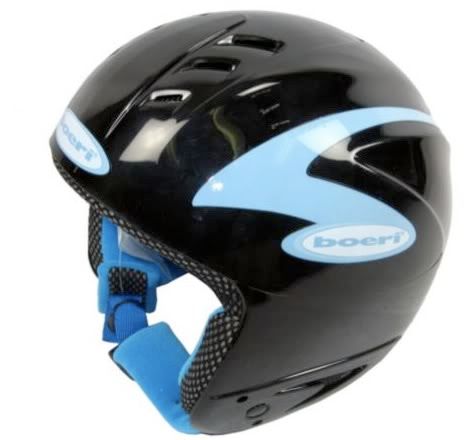 [/img]
TJ.
You're a brave soul making such specific suggestions, I had avoided it so as not to turn this into a flaming session.
Like you, I just think there could be more, and I hope there will be, for all us cyclists.
S
TJ, I curently work in the design, development and testing of Fast-Jet and Helicopter Helmets.
Not read all of this thread and i like most here would choose to wear a helmet and have thanked my lucky stars on a few occasions that i had one on,,,,however i read in a mag or on tinternet a couple of years back a debate about the merrits of a helmet in certain crashes, the incident in question was where a guy crashed and did a forward roll, and subsiquently brock his neck and was paralized as a result. the theory was it was the shape and size of the helmet that put extra force on his neck causing the damage!! Like I say I always wear one if only for the extra mental confidence it gives me but these stories of helmets causing injury also exist.
I don't know about anyone else, but my own lid has bashed, clonked and scraped and been generally abused by countless overhanging branches and twigs and such like, especially in the summer months, to know without a doubt I'd have grooves in my scalp that would not look at all pleasant.
Plus I've thrown my head down several XC trails and a bit of Watford High Street over these past 4 yrs in order to test my own feelings that I would not leave home without it. Nor can you compete in any XC or downhill race that I know of without one.
I've also raced m'bikes at club level and have slung it down the tarmac four times = 4 new helmets = £!
Unfortunately donks you don't know what kind of crash you are going to have before you have it.
I do wonder though about the bit that sticks out of the back of many bike helmets. Could this be causing problems? It's notably absent from a Xen.
[i]I do wonder though[/i]
Yeah, me too...I wonder how one can accuse a person of "guessing" and then get it so completely wrong.
😉
S
molgrips - it could be - we really don't know. Certainly the added leverage of sticky out bits theoretically could increase rotational forces and injuries - which may be a particular type of injury known as a diffuse axon injury. It also is increases the size of your head thus making it easier to hit. It could also catch on obstructions thus giving rotational accelerations.
NO real good data on it that I know of - rotational accelerations being made worse by helmets is proven experimentally but what part shell shape has to play in this is not known as far as I know
Like I say I always wear one if only for the extra mental confidence it
One of the dangers with helmets - risk compensation. Feel more confident and take more risks
Solo - your last on my comment confused me - I've got no idea what you're on about. LHS knows his onions and understands compromises and user requirements and performance balanced against the art of the possible - be that human or financial limitations.
If people want the levels of protection linked to motorized sports, they are free to purchase and wear. If they want something that passes an international standard and gives a reasonable level of protection, they wear a bike helmet. Don't blame the manufacturers and don't blame the magazines for not testing to destruction. Don't pontificate that it could be better then offer no alternative - thats where people find you have no substance. Do your own risk assessment for your own life and take responsibility for your own purchases, actions and headwear.
Feel more confident and take more risks
And have more fun
Safety Tips
1) Do not Crash
2) If you must crash do not bounce on your head
3) If you must bounce on your head avoid hard and pointy objects
4) If you can't avoid hard and pointy objects protect your head
5) If you protect head avoid accidents where rotation might be a feature.
6) If you can't avoid accidents where rotation is a feature you're ****ed.
Besdies that there are two major flaws in TJ's argument.
a) The implication that it is possible to choose how and when you crash.
b) That we, the great unwashed, presume that helmet will save our sad lives in every circumstance rather than just mitigate some of them.
The research that is so frequently quoted is fundamentally flawed, in that all of those occasions when a helmet had been worn and there has been no bad outcome are ignored. It follows for example that there will be little or no investigation of the incident with the OP because the outcome is not severe enough to warrant it. Whereas a serious injury or death will. Therefore it is relatively easy to arrive at the conclusion that having a fall when wearing a helmet often results in death or serious injury. Whereas the fact is that all of the incidents where that has not been the case and in fact the helmet has prevented that outcome by that very token go unreported and uninvestigated.
At first glance it thought this was titled "weigh your helmet kids"
[i]"Helicopter Helmets." [/i]
They sound ace, whats their range like and how much weight can they carry? 😉
As solo says - its rather hard to see why differing sports with similar requirements end up with such different designs of helmets - unfortunately fashion and consumer acceptance plays a large part.
No, I don't think so. Nothing stop you to wear a motorcycle crash helmet TJ. It will offer you much more protection. So why don't you wear one?
Cycling is a very specific sport. Different from running, skiing, Mxing, ****ing-horse riding and so and so. Therefore helmets have a different design to all the other sport. Where I don't agree with TJ is when he says that there is some data about rotational injuries. You have fail to provide with a peer review study of clinical cases about rotational injuries resulting of the presence of an helmet. Another point is that most of the studies are fairly old and still crash test some even older (cheaper) helmet design. The fact that we even have different helmet for on road and off road means at least one thing. Helmet manufacturers start to see that both sport are different and therefore the conundrum is that helmet design should be different.
Motor sport generally doesn't require pedaling, so the heat generated is much less. Even on a cool day a cycling helmet can get very hot, so it seems impracticable to me that 'piss-pot' or ice hockey style helmets could be used on a bike without compromising the experience from a comfort and safety perspective. Cooking your head in an enclosed design is going to be dangerously distracting. It's similarly clear to me that many road helmets successfully take this compromise into consideration.
One of the dangers with helmets - risk compensation. Feel more confident and take more risks
The accidents I've had with my helmet on happened in a blink of an eye with zero warning.

