UPDATE: CLASSIFIEDS section refreshed, redesigned, searchable: Go take a look
piha - indeed - I don't deny it saved a minor injury - I think that is almost certain. What I doubt is it saved major injury.
Helmets are very good at preventing minor injuries - lacerations and so on.
Flatboy Follow the links I gave to real evidence about helmets. I have read widely on this including reading the various research papers. Cyclehelmets.org is a good source of links to real evidence but do take your pinch of salt with you when you visit it
http://www.cyclehelmets.org/1052.html
TJ, do you actually wear a helmet, and if so, what is it?
The rest of the class: this is not an excuse to post up numerous hilarious pictures of inappropriate headwear...
Isn't fact free trolling fun (for some - but rather tedious for many others) . . .
The images of the helmet are clearly insufficient to determine whether it did or did not crush, being fixated on the crack and the opportunity to troll has blinded the troll to the possibility that the helmet may well have done the job it was designed to and the ultimate failure may be inconsequential or may be a result of it's deformation.
Without a detailed and informed inspection it's not possible to state "that helmet has failed - it provided little protection" . . .
troll on . . .
TJ, I know that "discussing" with you is often pointless but what you are stating is complete tosh.
I have worked in the design of helmets for years and have covered a lot of work in impact protection both simulation and testing.
Helmets are designed to collapse in more than one failure mode. One of those failure modes is to break up upon impact to further disperse the energy. From impact testing on various polystyrenes it is evident that the compression of the polystyrene foam is not solely suffcient to reduce the acceleration in an impact to an acceptable level.
Does this rotational stuff apply to other sports then? - what about something like motocross? helmets can weigh loads there. Don't see many of those guys riding without them?
That's because they're wearing them to prevent grazing or minor bruising. If there was no chance of that they'd do it nude.
Its a pointless argument as unless you test real people whilst crashing in a laboratory environment (I would guess this would be illegal 😉 ) then you'll never know 🙂
Edit: The problem is you cannot reenact a real crash in exactly the same way i.e. Ive crashed and I'm OK lets crash again without my helmet 😉
The crucial things are fit, smooth outer shell and plenty of EPS
Fit - Yes
Smooth outer shell - Yes
Plenty of EPS - not necessarily, only up to a certain thickness depending on density.
Its a pointless argument as unless you test real people whilst crashing in a laboratory environment
Instrumented dummies work fine.
Well your problem TJ and you absolutely refuses to listen to me on that, is your LR is biased. All the article comes from a source that is against wearing a helmet.
What you need to do is forget about everything you've read. Go on ISI web of knowledge and start from scratch.
You need 10-15 article to start with, using appropriate keyword and then do some upstream and downstream research from these papers.
Plus a helmet that split still do his job. Where do you thing the energy responsible from the split came from.
First glad to hear you ok and not seriously hurt.
As for TJ, he is simply saying don't put too much faith in them they may not always stop a serious injury. They are not the the be all and end all just another safety margin in case something does go wrong.
Rotational injures happen in all forms, it's a the same as deceleration injury in theory it could happen by simply running flat out and then stopping suddenly. Of course this is a silly extreme but it's simple physics, stopping a container suddenly means the contents will continue to try to move until the hit something or loose their energy.
foxyrider - MemberIts a pointless argument as unless you test real people whilst crashing in a laboratory environment (I wold guess this would be illegal )
nah, not illegal, you just need them to sign some forms...
(i heard about a phd that involved studying how old people fall over, to study this old people were harnessed up, told to walk across a room, and then someone pushed them over without warning - the harness stopped them hitting the floor, and high-speed cameras recorded the body postition as they fell, i'm a bad person and i thought this was hilarious, wish i'd been there)
Fergusd sums it up for me, we're all "fixated on the crack" - as he so nicely puts it! 😆
Helmets have saved me at least two trips to hospital, thereby saving the NHS money and saving inconvienience to myself and my riding buddies. What's not to like?
TJ, if you could see into the future and knew you were about to have a similar accident to the OP, would you have worn the helmet or gone with no protection?
If it was proven that it only saved the OP from minor injury, would you have worn the helmet?
TJ, if you could see into the future and knew you were about to have a similar accident to the OP, would you have worn the helmet or gone with no protection?
I'd not ride that day. 😆
Ahwiles - Interesting post, to be able to collect all the data required to answer your questions accurately would be very difficult. You would have to replicate an identical crash many times to accurately measure all the different forces, speeds, impacts and all the other "how much" & "whats". I doubt that could/would be done. It stopped an injury to the head and that is the important thing.
TandemJeremy - I agree that helmets are very good at preventing [i]lacerations and so on[/i] but how can you be sure the helmet didn't prevent a major injury in Simwits off?
I doubt that could/would be done.
Believe me it is done.
ahwiles, I can't supply answers to all your data requests but the surface I landed on was greenstone bedrock with a covering of leaves, twigs, loose sand/gravel and most importantly loose rocks up to golf ball size maybe a bit bigger. Initial contact with the ground was on my head going forwards and over so that I ended up on my back (it all happened a bit quick & I wasn't taking notes so vital info may be missing-sorry) The head impact was enough to knock my vision out of kilter for at least 10 mins so I have no doubt that it would have been hard enough to have caused me quite an injury.
The head impact was enough to knock my vision out of kilter for at least 10 mins
Woah. You went to A&E to get checked out right?
Yep sure did, Piha^^ marched me there! Ended up having an ultrasound to check I hadn't damaged my kidneys or summit because of where the impact on my back was.
Your visual cortex is at the back of your head, hence the problems, mangatank does have a point!
And if helmets are such a devil's spunk, why are they worn by Peaty, Hill, Rossi, Cavendish and many other useless 2-wheel riders?
TJ basing his argument on the irrelevant data, what a surprise 🙄
And if helmets are such a devil's spunk, why are they worn by Peaty, Hill, Rossi, Cavendish and many other useless 2-wheel riders?
a. sponsorship deals
b. lessens air resistance
🙄
T666Dom - Yes thats correct and would be a coup injury/trauma (allthough mild) but don't forget the contracoup injury 🙂
[img] 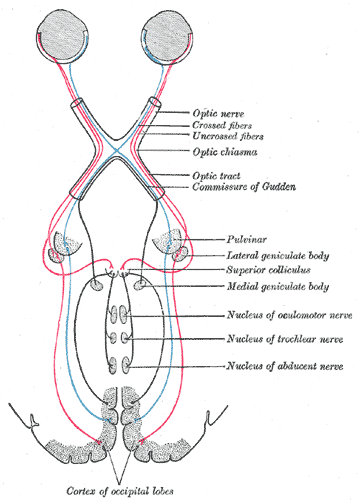 [/img]
[img] 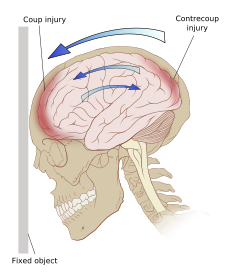 [/img]
Hhmmm. Helmets...
The cracking of the helmet indicates energy dissapation, energy that would have otherwise had to of been dealt with, by natures protection...
However, upto the point the helmet failed, most of the energy was being passed to the head, imo.
My experience leads me to think that current popular helmet deisgn does not absorb much energy. The polystyrene, as dense as it is, seems to transmit energy to my head quite well.
I was reminded of this recently when for the first time in a long time, my helmet clipped a low branch.
It was still quite an abrupt shock to my head, very little energy had been absorbed by the helmet, there wasn't much [i]cushioning[/i] of the blow and I attribute this to the dense polystyrene and the absence of a more compliant, cushioning, layer of material.
However, the skin had not contacted the branch so I wasn't left with any cuts, etc.
Current helmet design seems to be a compromise to meet several criteria, not all of which may be safety/crash centric.
How many helmet group-tests have we read where the journos refer to "cooling", "airflow", and even asthetic featrues ?
Throw into the mix, manuf costs and its not difficult to see how current helmet design has arrived at where it is now.
I don't think current designs are the best mankind could come up with for the primary purpose of preventing significant head/brain injury.
I think we only need look at helmets from other sports to get an idea of the solution other companies have come up with to try to prevent serious head injury.
Personally I fail to see the difference between a motorcyclist hitting their head against a lamp post at 25mph, and a mountain biker hitting their head against a tree at 25mph.
Yet, the helmet design solutions for each are very different...
But then again, who's going to wear a motorcycle helmet for a quick bit of XC riding ?..... 😉
I'm glad the OP is Ok, and if they think that their helmet prevented a more serious injury, then thats fine.
However, I tend to think that it shouldn't be a question of whether or not to wear a helmet, there is definately a need for head protection.
But rather, which design solution should we be wearing ?.
Cheers.
Solo
On couple of occasions I witnessed that a helmet comes useful. Riding with my mate in the Pentlands, his wheel got jammed and went OTB, Giro E2 cracked and after further inspection there was also a 1" deep dent in the helmet that would be in his head otherwise.
Mate was riding round a tree while i was setting my bike up. Somehow he lost the balance and hit his head on the tree, helmet shell had a small dent after. His face would probably be worse off without a helmet.
Riding with my mate on road, he has flat pedals and a pisspot helmet. Somehow his leg slipped off the pedal and he landed on the road, his head just bounced on the road, he said he could feel the impact and it would probably end really bad if he was riding without his helmet.
Again in the Pentlands. My mate fell into a stream at low speed. Straight on his face, Spesh Propero saved his forehead as the helmet took most of the impact and he only had a black eye after that.
However my GF's brother was riding along and didn't duck under a branch that caught on his peak and ripped it off the helmet slightly suffocating him for a second or two with the helmet straps 😉
TJ Your helmet cracked when You were on Your way to a TBC evening ride 🙂
Whatever the evidence is out there I just prefer to wear my helmet, it's light, well ventilated and look ok. It's not obligatory to wear a helmet and I choose to wear it. Simple as.
Glad the OP is ok. If anyone prefers not wear it than it's their choice and I won't be trying to convince them.
TandemJeremyPeople have the is evangelical belief in helmets - and a broken helmet is taken as proof of it preventing injury. They simply are not that good. If the helemt is cracked without being crushed then it has failed and not absorbed much energy
I read your link. The 'Ten Principles' is quite a splendid piece of academic suggestion ie it works, in a vacuum. If someone presented those points as the 10 Key User Requirements and asked someone to build it, they wouldn't get very far. In the real world, most things are a compromise (insert Bontrager quote here) as the desired item is unattainable.
Materials are designed to work to parameters so they can be used in the real world. The 'failure' as you see it is just the point at which compression is no longer possible. A crack still dissipates energy - this is normal and designed in to many things like vehicle armour etc. You are using science to argue your point - it may not be bad science, but it isn't always the most suitable, accurate or 'real world'.
Solo - compromise - you can't have everything as it just won't work in the real world. See the 10 points in the link above.
[i]And if helmets are such a devil's spunk, why are they worn by Peaty, Hill, Rossi, Cavendish and many other useless 2-wheel riders?[/i]
Because they have to?
Check out the TDF just a few years back before they weren't compelled to 🙂
Look at the way the head impacts the ground in this video. Classic MTB spill:
@ Mieszko.
I'm sorry but I couldn't help but laugh at the incident where rider was basically clothes lined with his own helmet!!
Another classic here
[url]
And if helmets are such a devil's spunk, why are they worn by Peaty, Hill, Rossi, Cavendish and many other useless 2-wheel riders?
Well for one the reason your question poses. If they didn't sheep would follow them and say shit like 'well peaty doesn't wear one'.
[i]A crack still dissipates energy - this is normal and designed in to many things like vehicle armour etc[/i]
Yes, to crack the Mat'l, energy has been "used", but once the crack occurs, all protection is gone. So I wouldn't describe this as a great feature.
What about secondary impacts ?...
As for vehicles. Vehicles crush, commonly referred to as "crumple zones".
But thats just the body.
For the soft squishy occupants ?, they get belts and bags. Modern belts tension, but still have a release point if forces become too high, and the bags are designed to deflate, they are "vented" to provide a cushioning effect, to decellerate the head rather than bring it to an abrupt stop.
In other words, forces are controlled and decelleration beneath a certain threshold, is the goal.
Current helmets I've seen/I own, are dense polystyrene, and something as round and blunt as my head isn't going to compress it enough to enjoy any cushioning effect during an impact.
When my head hits the imoveable object, decelleration rises rapidly, forces increase then at a certain point the helmet mat'l fails in an instant.
In that situation, its been my head Vs the polystyrene, until the polystyrene gives up.
However, if you're going to sell helmets for £8, then I suppose the current design is all one could reasonably expect. And its at that point that one then considers whether a poor design of helmet is better than no helmet at all.
FWIW, I wear one most of the time, but could they be better ?, I think so.
Are the current designs better than no helmet at all ?.....well, thats a difficult question for me to answer.
So, anyone up for £250 cycle helmets ?.
S
But rather, which design solution should we be wearing?
I think Solo has it right. Most helmets are tweaked road or actual road designs. This make sense because of the physical effort involved in cycling, and if anything overheating is more of an issue in MTBing, making Road helmets an even more attractive proposition. Their ability to prevent cuts and laserations is excellent. Their ability to absorb impacts is clearly limited.
It's hard to see a good alternative solution that wouldn't be unbearable to wear. Much like almost all forms of bike armour in fact.
It is my completely unscientific view that anyone who doesnt wear a helmet whilst riding off road is a ****.
Theres lots of cool things about helmets.
[i]It's hard to see a good alternative solution that wouldn't be unbearable to wear.[/i]
Exactly !. Now add manuf/retail costs into the mix and suddenly we're transported to a place where helmet design is very different to what we're wearing today.
S
Current helmets I've seen/I own, are dense polystyrene, and something as round and blunt as my head isn't going to compress it enough to enjoy any cushioning effect during an impact.
The density of polystyrene is carefully controlled and calculated to provide the best impact protection. The compression of the polystyrene provides a large deceleration during an impact event. When it approaches the maximum compression allowable by the density of the foam, the failure mechanism changes to that of fracture to further dissipate energy. Once fracture has occured the helmet has then dissipated as much energy as it can by design.
I haven't read all of this, as the usual suspects were present and correct early on and it's never very fruitful.
The crash occurred "[i][u]on a double step down [/u][/i]". Now I'm not sure [i]exactly[/i] what that is, but I'm confident that it is RAD to the power of sick. I'd be wearing a helmet if I was doing a "double step down", as I think 99% of us would be.
I'll still potentially not bother when I'm bimbling to the shops or doing other purely ambient and in no way gnarl things. 🙂
Just another anecdote, but I watched the occupant of this...
[IMG]  [/IMG]
... piledriving head first into the ground after spectacularly misjudging a steep roll-in to a fire road. And he walked away from it (slightly unsteadily).
BigDummy, it was where one deep step followed directly after another one so the rear wheel went light as the front dropped down the first step then carried on going lighter (i.e skywards) as the front wheel dropped down the second step. I think it was one of those cases where if I'd been going a touch slower I could have saved it or a bit faster & I could have cleared it although my talent would also have run out on the second option I suspect!
I kinda knew that. 😉
Point is, [i]even TJ[/i] usually admits that he wears a helmet when he's doing anything seriously fast or technical with any risk of falling off the bike that's greater than the risk of tripping over while walking. As with others, I wear a good, well-fitting helmet when I'm riding hard off road, but quite often a good, well-fitting trilby when I'm riding gently around town.
When it approaches the maximum compression allowable by the density of the foam, the failure mechanism changes to that of fracture to further dissipate energy.
After all this, that's what I was going to say 🙂 The foam probably flexed a bit, storing the energy and then the snap dissipated it. Have any of the posters measured the density of the foam through the helmet to see if it did in fact compress? Or are you just looking at a photo of the outside?
So let me get this straight. Are people (TJ) seriously advocating NOT wearing anything at all to protect your head in the case of an accident? I mean, if you have to headbut the ground, would you rather your head be completely naked, or wrapped in polystyrene?
Words fail me, they really do.
As for following the science Mr Jeremy, why don't you try it yourself? No scientist will want to stake his life on his 'theories', so wear a helmet just in case.
LHS.
Yes, I should have written "enjoy [b]much[/b] cushioning..." rather than "enjoy any cushioning".
However, the polystyrene still isn't compressing very much, esp when forces are spread over the contact area of my head against the inner surfaces/contact points of the helmet. My skin is softer than the polystyrene in the helmet.
More often than not the crack originates from stress raisers and point loads play their part in propagating a failure, and as before, once failure occurs, the helmet ceases to protect although the accident being experienced could still be happening...
However, none of this appears to play much of a constructive role in controlling head decelleration, imo.
Do we have a "Pulse" for head impact, wearing a conventional cycle helmet.
Bet it spikes significantly just before the polystyrene fails...
Consider motorsport helmets, theres a bit more going on there, including cost and not forgetting the question/issue of comfort...
Then consider that we've all been shown the Sainsbury's/Tesco £8 specials, and there probably isn't a market for the £250 cycle helmet.
So, we pays our money.....But what is the choice ?.
🙂
S
Oh yay my post has resulted in a pic of naked women, who'd a thunk it 😆
[i]So let me get this straight. Are people (TJ) seriously advocating NOT wearing anything at all to protect your head in the case of an accident?[/i]
As in my earlier post. I wear a current design of helmet.
However, I'm wondering whether it couldn't be done better, from a safety/protection performance prospective ?.
🙂
S

