UPDATE: Reviews section refreshed, redesigned, searchable: Go take a look
Disappointed at no rationale given for the shark fins. I guess 'cos they look cool' doesn't tick the box for performance enhancement 😀
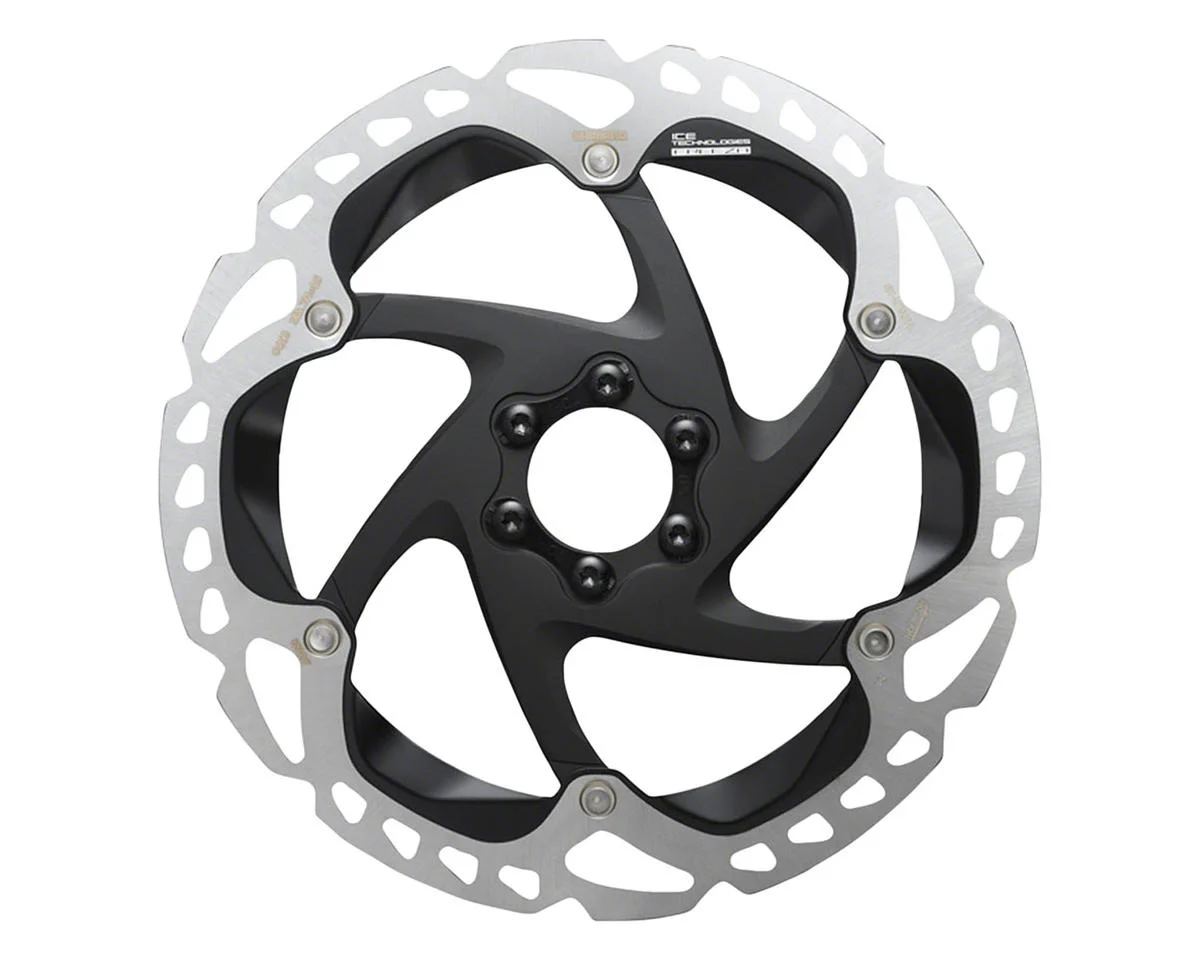
But I suspect it's similar to the extra sections of metal on the XTR rotors for heat dissipation:
Just to say that rotor thickness does change lever feel. It shouldn't. But it does.
For those saying it does, anyone care to theorise on the mechanism for that?
The thicker rotor is stiffer laterally so at the first moments of contact or light braking before it’s clamped between both pads it’ll respond more sharply.
The greater mass and thickness means the braking surface changes more slowly in temperature (both up and down) so the feel is more consistent.
The pistons aren’t extended as far (on average, depending on pad wear) so they’ll move more concentrically within the bore so less friction and more accurate feedback to the lever.
And as you’re pulling a lever, not just pushing a piston, there’ll be a change in where the braking action happens vs the shape of the leverage curve, which will be much more obvious in brakes like Shimanos.
It’s not all good though because even when a thicker rotor should fit, the reduced clearance means the pads can end up rubbing more and the greater stiffness of the rotor means that any rubbing where the disc isn’t totally flat is more annoying. Which is why I changed back to 1.8mm rotors on my E4 brakes. 2.3mm work significantly better on my V4 brakes - and cost much less in the long run because you can sacrifice more metal before they’re too thin to be good/safe.
There's probably lots of little factors too, like the pistons not extending as far our of the caliper making a slight difference to feel because the seal is extended less.
There's probably lots of little factors too, like the pistons not extending as far our of the caliper making a slight difference to feel because the seal is extended less.
With a solid brake track you don't have as much surface area or as much turbulent flow around the metal to remove the heat. This is an advertorial but I think there's some truth in the marketing:
Golf balls and the Dunning Kruger effect have a lot to answer for when it comes to understanding turbulent flow. IIRC what the the holes are actually there to achieve on push bikes is surface area.
When you introduce fluid flow to a parallel surface you get laminar flow, drag from that surface creates a slower moving boundary layer, the thickness of that layer increases until it exceeds the size of a turbulent eddy, at which point those eddies can form and the thickness of the boundary layer decreases again. For heat transfer you need the boundary layer to decrease otherwise you're relying on conduction rather than convection. There will be effects due to the incoming air already being churned up by the disk in front of it, but ultimately the boundary layer of on the leading edge of each of those holes is a bit of a dead spot in terms of heat transfer.
www.researchgate.net/profile/Michael-Eckert-5/publication/328630453/figure/fig2/AS:687712579375117@1540974864913/The-transition-from-laminar-to-turbulent-flow-in-the-boundary-layer-depends-on-the.png
This does make me wonder if a front rotor should be more solid and and rear rotor more full of holes?
That's sort-of where my thought process is leaning, do you want heat absorption or dissipation?
With the caveat that braking from 20m/s to 10m/s a 100kg bike+rider puts only about 100C into ~300g of useful rotor mass. In a single braking event it's kinda hard to envisage the rotors reaching the 400C+ where pad compounds might start to fade.
The thicker rotor is stiffer laterally so at the first moments of contact or light braking before it’s clamped between both pads it’ll respond more sharply.
The braking effect of one pad touching the rotor will be absolutely miniscule, the coefficient of friction in brake pads is actually quite low and even thick rotors bend that 1mm or so with even the worst aligned calipers with what mis probably barely a newton's force.
And as you’re pulling a lever, not just pushing a piston, there’ll be a change in where the braking action happens vs the shape of the leverage curve, which will be much more obvious in brakes like Shimanos.
I thought we'd at least debated this to the point where everyone agreed it can't be the case in a well maintained system? If there's a reduction in free throw there's a reason for it, and it's not just because the rotor is thicker pushing the pistons back. There's plenty of reasons why a thick rotor would have less free stroke, it's likely straighter, it's likely 'new' and therefore less concave, it's likely installed accompanied by fresh pads and a bleed.
Otherwise we'd be discussing these beasts.
store.pedalrevolution.co.uk/images/hope_mv2_disc-203mm_4_bolt_rohloff_vent_rotor.jpg
And as you’re pulling a lever, not just pushing a piston, there’ll be a change in where the braking action happens vs the shape of the leverage curve, which will be much more obvious in brakes like Shimanos.
Only if you have sticky pistons. If your pistons are self-adjusting properly, they will adjust to the same clearance and you will have the same lever travel.
The pistons aren’t extended as far (on average, depending on pad wear) so they’ll move more concentrically within the bore so less friction and more accurate feedback to the lever.
This is nonsense too. The pressure from the brake fluid is parallel to the piston bore. The pads are retained laterally by the caliper so they don't exert any lateral force on the pistons. The pistons will move concentrically within the bore regardless of the rotor and pad thickness because the force acting on them is exactly parallel to the piston bore. Sticky pistons may misbehave, of course, but this isn't because of the rotor thickness, it's because of lack of maintenance.
There's probably lots of little factors too, like the pistons not extending as far our of the caliper making a slight difference to feel because the seal is extended less.
The pistons in hydro brakes self-adjust so the seals will be extended the same, regardless of rotor thickness.
My guess here is that people are comparing an old worn rotor and pads with a new rotor and pads and are confusing the effect with rotor thickness. It is quite remarkable the difference a new rotor makes compared to an old one that doesn't look badly worn.
My guess here is that people are comparing an old worn rotor and pads with a new rotor and pads and are confusing the effect with rotor thickness. It is quite remarkable the difference a new rotor makes compared to an old one that doesn't look badly worn.
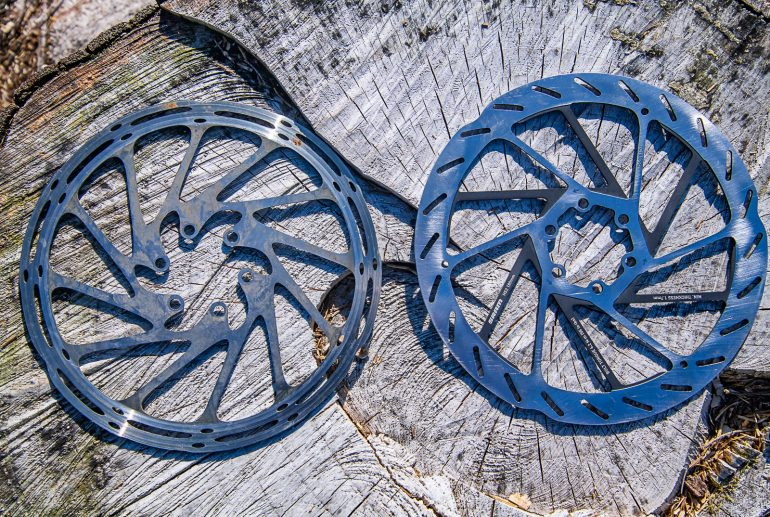
100% agree with this. However to add some further personal experiences, not many people have mentioned SRAM.
I've done direct back to backs with the regular Centrelines and the 2 piece Centreline X's, on two different sets of SRAM brakes and I can confidently say that moving the SRAM HS2 rotors is a very, very worthwhile and noticeable upgrade.
Cons - they weigh a fraction more.
Pros - literally everything else. They bit harder, brake better, dont heat up, stay true longer, the lever feels better, it is 100% a change that I reccomend for everyone other than the absolute weeniest of weight weenies.
I put a set straight onto my XC bike after having done the bigger heavier bike first!
https://www.wideopenmountainbike.com/2021/09/tested-petes-sram-hs2-rotor-review
The pistons in hydro brakes self-adjust so the seals will be extended the same, regardless of rotor thickness.
Relative to a thinner rotor, the pistons will be extended further when they contact the rotor. Whether that's piston sticking out of the seal further, or the seal extended further, or a bit of both, it's still that slightly longer lever
Relative to a thinner rotor, the pistons will be extended further when they contact the rotor. Whether that's piston sticking out of the seal further, or the seal extended further, or a bit of both, it's still that slightly longer lever
That's not how hydro brakes work. They self adjust so that the pad clearance should be consistent regardless of rotor thickness or pad wear. If you get different lever travel with a different rotor thickness, it means that your pistons are sticking in the seals and you need to do some maintenance.
That's not how hydro brakes work. They self adjust so that the pad clearance should be consistent regardless of rotor thickness or pad wear. If you get different lever travel with a different rotor thickness, it means that your pistons are sticking in the seals and you need to do some maintenance.
I didn't mention lever travel or pad clearance.
I didn't mention lever travel or pad clearance.
The only lever in the system is the one your fingers pull on. The pads do not exert any leverage over the pistons, if that's what you're thinking. There is no leverage applied at the caliper end.
ǰJust picked my bike up from the mechanic after having the brakes bled and we got chatting about removing the dead zone for XTs by fitting thicker rotors. I'm currently running 203mm fancy Ice Tech rotors (the triple layered ones) which have served me well but I like having a very on/off feel for my brakes so thinking about thicker rotors.
Got told about Galfer ones but they're about £80 an end.
A) is there a more cost effective option?
B) will thicker rotors retain braking performance for big Alpine descents etc?
C) anyone made the switch and any good?
I'm running the 2.5mm thick magura rotors off the gustav on the new xtr 4 pot m9220 and it's amazing .I pushed pistons all the way back and fitted new metal genuine pads and there's still quite a bitmof clearance and the power is great the bite is very short and the servo wave works just nicely.
My maguras feel better with thinner SLX floating (not ice tech) rotors than they do with the magura storm rotors. That's because the storm (and storm SL) seem to suffer from juddering under heavy brake application. Bite feel is the same once the pistons have adjusted.
I wonder if the improved feel is 1. The thicker rotor is less likely to deflect sideways leading to improved centering when fitting and to the pistons adjusting more evenly. 2. Reduced gap with new pads (as mentioned above). Both would result in a better lever feel.
As an aside I have learnt that the 6 bolt hole tolerance on SRAM rotors is shite. When used on a decent centre lock adapter the rotor will move forward and back relative to the hub! The maguras fit with no movement, as do Shimanos.
Running 2.0 Magura storm rotors with m6120s and tektro 2.3mm on my tech4E4s
love it!
I'm running the 2.5mm thick magura rotors off the gustav on the new xtr 4 pot m9220 and it's amazing .I pushed pistons all the way back and fitted new metal genuine pads and there's still quite a bitmof clearance and the power is great the bite is very short and the servo wave works just nicely.
Think I'll definitely try some. The reason I got into the chat with the mechanic was that I mentioned I like my brakes pretty grabby and having a short lever throw and instant grab without the floaty dead-point of Shimano brakes is what I want. Maybe I should just buy new brakes 😀
I like my brakes pretty grabby and having a short lever throw and instant grab without the floaty dead-point of Shimano brakes is what I want. Maybe I should just buy new brakes
The lever throw and bite point are determined by the lever design, not the rotor thickness. Shimano brakes need to be very carefully bled and you need to make sure the reservoir is full.
I have these rather nice TRP rotors on my HT that are 2.3mm. Whether they improve performance or not, I have no idea
It's quite clear that in the theoretical world of idealised brakes that are always in perfect working order (and ignore thermodynamics) that thicker rotors make no difference, so those of use who've tried them or are curious about them should not be posting here...
The lever throw and bite point are determined by the lever design, not the rotor thickness.
So long as the piston is able to completely retract. The thicker rotor reduces the actual throw available at the caliper between the resting and contact points (when new pads are installed at least). The lever doesn't much care, it just pushes fluid but if it pushes less fluid between the resting point and contact points then the lever throw will be less also. It will only be 0.15-0.25mm/side at the caliper but that's obviously enough for people to have felt a meaningful difference.
Seems worthy of a Viz top tip to me this one.
'Remove the dead zone for XTs without buying thicker rotors by advancing your pistons a bit.
So long as the piston is able to completely retract. The thicker rotor reduces the actual throw available at the caliper between the resting and contact points (when new pads are installed at least). The lever doesn't much care, it just pushes fluid but if it pushes less fluid between the resting point and contact points then the lever throw will be less also. It will only be 0.15-0.25mm/side at the caliper but that's obviously enough for people to have felt a meaningful difference.
You really do not understand how the self adjustment on hydro brakes works. The pistons self-adjust to the same clearance regardless of the rotor thickness. That clearance is determined by how much the seal can flex without the piston slipping through. Sticky pistons will affect this, but otherwise you can't change the pad clearance without changing the design of the seals.
Fitting a new rotor and pads will improve the lever feel regardless of the rotor thickness. Changing the pad compound will also change how the brakes feel. People saying that their brakes felt better after fitting new rotors and pads is not evidence that thicker rotors made any difference to lever feel.
This is why forums die…
I fitted thicker rotors and then found a £10 note in an old coat pocket.
That much is irrefutable.
You really do not understand how the self adjustment on hydro brakes works. The pistons self-adjust to the same clearance regardless of the rotor thickness. That clearance is determined by how much the seal can flex without the piston slipping through. Sticky pistons will affect this, but otherwise you can't change the pad clearance without changing the design of the seals.
This.
All thicker rotors do is remove a few mils of fluid from the system; everything works the same.
Thicker rotors have other advantages by virtue of their thickness
People saying that their brakes felt better after fitting new rotors and pads is not evidence that thicker rotors made any difference to lever feel.
My fingers say differently. MDR-P fitted to SRAM calipers and the feel is definitely different, specifically at the wear limit of the pad. The lever feel used to soften previously and now it is more uniform right through to when the pads need changing. Much more betterer.
Seems worthy of a Viz top tip to me this one.
'Remove the dead zone for XTs without buying thicker rotors by advancing your pistons a bit.
To be fair, when 29ers first came out I remember one of the magazines (90% sure it was Dirt) claiming they were faster because they increased the gearing so as long as you pedaled the same and stayed int he same gear you'd ride faster.
With that level of expert guidance and opinion forming it's no wonder consumers fall for marketing guff / misunderstand how things works.
It's quite clear that in the theoretical world of idealised brakes that are always in perfect working order (and ignore thermodynamics) that thicker rotors make no difference, so those of use who've tried them or are curious about them should not be posting here...
No one is saying your thick rotors aren't better, for various reasons.
The people telling you that you're wrong probably have tried them, and different thin rotors, and ice-tech rotors. Different rotors absolutely do change the way brakes feel, even when swapping rotors of the same thickness.
But claiming things like "The thicker rotor is stiffer laterally so at the first moments of contact or light braking before it’s clamped between both pads it’ll respond more sharply." just completely fails to understand how brakes work.
What we / I / they are saying is that some of the benefits cited are clearly just the result of new pads and/or rotor, or can also be observed just by changing rotor design.
I could tell you my Berlingo was heavier than an Aston Martin, and therefore faster. Because both those facts are true my Berlingo was heavier than an Aston Martin, and Lance Stroll regularly crashed his Aston Martin into just about anything so most of the time it was doing 0mph. My Berlingo being faster than an Aston Martin had nothing to do with the fact it was heavier*, and everything to do with the condition it was in.
*unless we nit pick and say the lightness was as the result of the Astons missing wheels / bodywork.
The pistons self-adjust to the same clearance regardless of the rotor thickness.
Not if they don't have enough room to back all the way off from the rotor because they bottom out in the calliper. I haven't measured it to test the theory but I can see how it would happen if everything was fresh.
“But claiming things like "The thicker rotor is stiffer laterally so at the first moments of contact or light braking before it’s clamped between both pads it’ll respond more sharply." just completely fails to understand how brakes work.”
Why? A 2.3mm rotor is fairly stiff. Pistons rarely move in perfect synchrony if you ride your bike in all conditions and service it as little as many do. When it’s slippery we feather the brakes very lightly so as not not lose control. The decelerative force from only one pad pressing against a disc is not zero, and to a rider with a degree of sensitivity can be felt. That 2.3mm rotor is twice as stiff as a 1.8mm rotor.
Also, regarding the bite point - with thicker rotors the bite point can happen so soon that the seals never reach full flexion, so the whole system works with less pad to disc clearance, quicker bite and in a different part of the system’s leverage curve.
I used Hope E4 with 1.8mm, then 2.3mm and then 1.8mm rotors. The 2.3 make contact a lot sooner whatever you do, grab harder, run with less clearance, and rub more. I went from old 1.8 to new 2.3 and changed form the new 2.3 to new 1.8 within a few weeks due to the rubbing so I was comparing new with new, same pads on both.
Now tell me why all of this is wrong because brakes are so simple…
Also, regarding the bite point - with thicker rotors the bite point can happen so soon that the seals never reach full flexion, so the whole system works with less pad to disc clearance, quicker bite and in a different part of the system’s leverage curve.
My thoughts exactly.
Does anyone know what the free throw is supposed to be on a Shimano brake (for instance)?
Also, regarding the bite point - with thicker rotors the bite point can happen so soon that the seals never reach full flexion, so the whole system works with less pad to disc clearance, quicker bite and in a different part of the system’s leverage curve.
This will only happen if the thicker rotor is precisely the right thickness to be thin enough to not drag, but also thick enough that, when the pads are fully pushed back into the caliper, the clearance is so small that the pistons don't reset themselves when you apply the brakes. That will only last a few good descents, then the pads will wear and you'll have exactly the same clearance as with a thinner rotor because the pistons will reset in exactly the same way.
Why? A 2.3mm rotor is fairly stiff. Pistons rarely move in perfect synchrony if you ride your bike in all conditions and service it as little as many do. When it’s slippery we feather the brakes very lightly so as not not lose control. The decelerative force from only one pad pressing against a disc is not zero, and to a rider with a degree of sensitivity can be felt. That 2.3mm rotor is twice as stiff as a 1.8mm rotor.
The laws of physics are far more quantitative than that, you can actually put numbers to it.
Sick in the beam dimensions, I assumed 2.3mm thick, 6mm wide and 100mm long to mimic one of the spokes on the disk, there's a contribution from all the spokes but I CBA to calculate the torsional bending components as well so let's just say it's 6 spokes, young's modulus applies and and therefore 1/6 of the result.
Cantilever Beam Calculator | calcresource
Moment of Inertia of a Rectangle | calcresource
Deflection comes out as 1N=0.23mm, so 0.04mm for 6.
Being overly generous let's say the pads are asymmetric by 0.5mm, that's 12.5N
Coefficient of friction for brake pads is ~0.4, so that's 5N of drag.
Multiply that by the ratio of the disk diameter to the wheel 8/29 = 1.3N of drag.
At 20mph, that's ~13W
To put that in context, it's about what the guys at Ceramic speed will tell you their wheel bearings will save you. Bearing in mind that the work being done by gravity while descending is in the order of 1-2kW.
Or in braking terms, the typical braking force enduromag used to test brakes was 40N, and the leverage ratio was measured at 40:1, so that's 1600N, which equates to about 177N of braking force (1800W at ~20mph)).
So to summarize, even with some (I think) really pessimistic assumptions, and some poorly set up brakes, it's about 0.7% of actual braking. And that's in total, not just the incremental braking gain over a standard disk. I don't imagine anyone is such a riding god they can perceive those sorts of figures.
You don’t have to be a riding god to notice tiny differences, you just have to be a human. And that’s the whole point I’m getting at with all of this. Certain sorts of engineers like to boil things down to a load of numbers and then state that because they’ve decided that a certain value makes things negligible that you can’t feel a difference. But who is checking what anyone can actually feel?
Thicker rotors feel different due to numerous effects, some of which I suggested above.
Coming back to your point about “0.7% of braking” - in the winter on off camber rooty wet trails I use so little of the max power of my brakes. If much of my braking is at a fraction, let’s say a tenth of my max braking power, then why it is so strange to suggest I can feel that change in initial bite? Particularly when traction is at a premium and one is constantly on the edge of losing a tyre. The stiffer rotor is going to have a different lever : retardation force curve for numerous reasons. If that keeps a tyre rotating rather than skidding and going totally sideways over a wet off camber root then that’s something that matters.
In professional sport marginal gains are constantly sought - but they’re measurable. Good luck measuring feel unless you’ve figured out how to read minds. But the thermodynamics of thick rotors are better and you can measure that.
I see Shimano are introducing 2.2mm rotors but even their marketing doesn't appear to make some of the claims above. (Also looks like the beginning of the end for 203mm)
Does that mean the Saint brake is nearly here?
Does that mean the Saint brake is nearly here?
At 57 years old I fear I may not live long enough to see new Saint released 🤣
if it ain't broke . . . etc
This will only happen if the thicker rotor is precisely the right thickness to be thin enough to not drag, but also thick enough that, when the pads are fully pushed back into the caliper, the clearance is so small that the pistons don't reset themselves when you apply the brakes. That will only last a few good descents, then the pads will wear and you'll have exactly the same clearance as with a thinner rotor because the pistons will reset in exactly the same way.
And?
that's exactly the phenomenon that people are describing. A new rotor will be straight and you're most likely to change the pads when fitting new rotors. Just because it can go off imperceptibly over time as the pads wear down, doesn't mean it doesn't happen on first installation or every time you change the pads.
Also looks like the beginning of the end for 203mm
that'll be a shame - I quite like the ridiculousness of a metricised imperial standard (and all my rotors/mounts are 203mm)
(and all my rotors/mounts are 203mm)
Most of mine too but it's a pill I'm prepared to swallow as my recent frame and fork purchases have been 200mm native and one less 'standard' is fine by me
I managed to standardise myself on 203 fronts and 200 rears.across 3 bikes. Same as @Speeder, embracing the daftness
They are structurally stronger so less likely to warp or be bend. More material means better hear sink so lower operating temperature.
However, they are not going to chance lever feel. Your brakes are a self adjusting open system. It doesn't know the difference between thick rotors with thin pads or thin rotors with thick pads. The pistons adjust to offer the same clearance. (Until you start getting to the point if really worn pads and rotors)
Came to post basically this. Not sure how big a difference it will make to warping (if you whack a rock, I think the major difference will be that the thicker rotor is harder to straighten), but having more material will mean they take longer to heat up. Shouldn't make any difference to lever feel.
any change in feel is either placebo or that your pistons were stuck and have now unstuck, different materials or other setup issues such as bedding in
folk on here have a fundamental misunderstanding of how disc brakes work
The Shimano thickies are available... but only in centrelock it seems - Swinnertons - doesn't even mention that they are the 2.3mm - just that they're new and they have the RT-750 number.
folk on here have a fundamental misunderstanding of how disc brakes work
I think some people are just a bit more open minded about the possibilities . . .
I for one am well aware of how they work in general, but we're talking about a very specific set of circumstances which may occur and there's anecdotal evidence to support this.

