UPDATE: CLASSIFIEDS section refreshed, redesigned, searchable: Go take a look
CharlieMungus - Member
It's clear that repack and co. invented [s]moutainbiking and[/s] its image. The only argument is who invented VTT?
T.FIFY
[url= http://i419.photobucket.com/albums/pp271/repackrider/avatar235.jp g" target="_blank">http://i419.photobucket.com/albums/pp271/repackrider/avatar235.jp g"/> [/IMG][/url]
[url= http://sonic.net/~ckelly/Seekay/mtbwelcome.htm ][b]2retro4u[/b][/url]
Marin County, Cali
What happened in 1984? What bike was it that didn't look like the 'original' mountain bike?
The date is arbitrary. By then a couple of years had passed since two manufacturers (Specialized and Univega) sent Ritchey MountainBikes to factories in Japan and said, "Make a lot of these." As of 1984 just about every major manufacturer offered a bike suspiciously identical to the MountainBike, but that is not where the innovation was taking place.
By 1984 a number of other American frame builders had taken up the craft (Potts, Nicol, Schafer, Chance, Bontrager, Cunningham, Parker, etc.) and had begun to expand on the original concept by adding their own ideas and tailoring their bikes for local conditions. It was the small frame shops, universally inspired by Ritchey and MountainBikes, that began the series of innovations that took us from that time to this.
Now the small shops have all been run over by major companies, and the small manufacturers such as Yeti, Ibis, Salsa, Fat Chance, Gary Fisher, Bontrager and so on have all been sold. Mountain bikes have become such complex systems that the frames are not easily built in a garage, and the innovation has gone to the level of manufacture where expensive engineering facilities and test sites are necessary for incremental adaptations.
What else would you like to know about these events?
There have been several posts referring to the Cleland Aventura as part of mountain bike history.
The Cleland concept really is a separate strand and does not compare with mountain bikes, an Aventura is designed for a different style of riding, the design philosophy is fundamentally at odds with the general thrust of mountain bike development.
It is convenient to say that the Cleland design is a form of mountain bike when talking to people who can't tell the difference, but it's more like trying to compare a MotoX motorbike with a Trials motorbike ~ there really is no comparison.
This is not to say either is superior to the other; each is designed for a particular purpose. In the case of the mountain bike and the Aventura, one is designed for speed and lightness, the other for no-compromise endurance.
In terms of acceptance of the design, very little progress has been made since 1979; very few people even begin to understand what it's for.
[url= http://i419.photobucket.com/albums/pp271/repackrider/avatar235.jp g" target="_blank">http://i419.photobucket.com/albums/pp271/repackrider/avatar235.jp g"/> [/IMG][/url]
[url= http://sonic.net/~ckelly/Seekay/mtbwelcome.htm ][b]2retro4u[/b][/url]
Marin County, Cali
In the United States we were well aware of Geoff Apps, and we carried on a spirited correspondence. Geoff supplied us with Finnish Haaka tyres with studs for snow use, something we couldn't get here, and he took advertising space in my magazine, the [url= http://sonic.net/~ckelly/Seekay/ftf_welcome.htm ]Fat Tire Flyer[/url], which was the first publication for mountain bikers.
Geoff favored several design elements that we did not, and the reason is that his bikes were not born from downhill racing, but from Rough-Stuff Fellowship style rides in the country. Highlighting these differences shows why the sport and the machinery that eventually emerged worldwide stemmed from the California concept of off-road riding.
Geoff used drum brakes, for the obvious reason that they work better in wet conditions than rim brakes. We didn't use them because they were not made for descending 500'/minute for extended periods, and wet weather is not nearly the constant in California that it is in England.
The upright position of the Cleland style of bicycle is an aerodynamic disaster for downhill. These bikes were not made for riding FAST. We used a traditional diamond frame because it is an efficient design honed from a hundred years of experience. Geoff used an offset top tube to maximize his stepover height.
No self respecting Cleland owner rode without mudguards, a deerstalker cap, plus-fours and argyle socks. The obvious cultural difference between California and England made such accessories a bit quaint to sell the concept to the teenage and twenty-something BMX/skateboard set. Because we were part of the very demographic that was going to buy and ride our bikes, no translation was necessary.
Beyond cyclocross, there was no off-road competition anywhere but California in the '70s and early '80s. In California we RACED our bikes, and the racing spurred design development as well as attracting new riders. The kids had probably never heard of the Tour de France or the Rough Stuff Fellowship, but they understood competition. Gary Fisher, Joe Breeze and Tom Ritchey were all very good road racers, and when California BMX riders like John Tomac and Tinker Juarez moved easily into mountain biking, they brought all their fans with them.
By 1980 there were mountain bike races taking place all over California, about four years before the first one would take place in England.
Yeah yeah, but we invented football, so there! 😀
I must admit I had never heard of Cleland until recently and this is even though I have had a long term interest in offroad riding, but I wasn't in the UK at that time.
I was in Oz from the 70s onward and the ownership and use of a bike was regarded as for the poor or the mad/eccentrics until mountainbikes made them respectable again.
About 1977 I did a 7 day tour through the bush on the bike and the best tyres I could get for offroad were 32mm tubulars - there were no fat tyres available by then.
I think the first thing like a modern mountainbike I saw was in 1981 - it looked like a 1930s singlespeed with fat 26" tyres (still in Oz).
Charlie Kelly, the original bikes you and your peers rode downhill were mostly (but prehaps not exclusively) converted cruiser bikes, right?. So, out of interest, why did the first frames you commercially produced look more like road frames with added fat tyres and flat bars?. Nowerdays, with all the Hydroforming and low top tubes, the modern mountain bike frame designs seem to more resemble the original Cruiser bike styling, with bendy tubes etc. I always wondered why, when the MountainBike started, the distinct cruiser bike styling almost immediately had disappeared?
My thinking over the years, it might have been one of two reasons, fashion (at that time, ie cruisers were for kids) or design/materials issues ie weight/strength?
It should also be remembered that Charlie and Gary are not only 'responsible' for the worldwide mountain bike phenomonen, their actions have led directly to an unprecedented resurgence of interest in cycling; the design and technology that was spawned by the original mountainbikes has now filtered through to every aspect of cycling today.
I would guess that Cruiser styling was not use because it is...styling.
AV2010 does that mean we can blame them for Isis?
Probably, indirectly...
So, out of interest, why did the first frames you commercially produced look more like road frames with added fat tyres and flat bars?.
That's what i wondered. Even looking at my late 80's bikes, it is difficult to differentiate them from a road frame. Ok, maybe stronger and that, but only maybe. The early commercial mountain bikes weren't as well engineered as the road bike of the time.
Repack Rider wrote:
The upright position of the Cleland style of bicycle is an aerodynamic disaster for downhill. These bikes were not made for riding FAST. We used a traditional diamond frame because it is an efficient design honed from a hundred years of experience. Geoff used an offset top tube to maximize his stepover height.
Whilst it's true to say that speed was not considered when the Clelands were designed, the reality is that BITD, in most off-road situations they were no slower than mountain bikes of a similar weight. In fact on soft or rough terrain I would say that their low pressure tyres gave them a speed advantage. My experience of riding alongside mountain bikes is not that of struggling to keep up but of being able to lead and overtake. Yes, headwinds can be a problem but you can lean forwards and rest your elbows on the bars in order to reduce the drag. For downhills you can use the high riding position as an adjustable air brake, with standing bolt upright for maximum air braking, and leaning forward and bent over for least air resistance. The Clelands riding position, with their high handlebars and weight over the back wheel are not that dissimilar to modern downhill bikes. And the heavy duty low pressure helped increase the speed at which vibration would result in a loss of control but did not pinch puncture.
Today I often ride my old Clelands along side modern bikes and apart from hill climbs, where the Cleland's weight is a handicap, I can keep up, though I overtake less these days. The Cleland's Nokia tyres were slow on smooth surfaces an roads, but low rolling reistance modern tyres are fine. Riding a Cleland was, and is, a very different experience to riding a mountain bike. The riding techniques are unusual and it even feels as if different parts of the leg muscles are involved. They offer a real alternative experience to that of riding a mountain bike. Personally I love riding both styles of bike, though modern mountain bikes feel very different when compared to the early Ritchey inspired machines.
When most people ride a Cleland for the first time they ride it like a mountain bike. It usually takes tuition and practice before people get the hang of these bikes and their many quirks. Interestingly though, motorbike trials,and BMX riders seem to know these techniques already.
Contentious, but some claim Scotland is the home of mountain biking:
😀
[i]I was in Oz from the 70s onward and the ownership and use of a bike was regarded as for the poor or the mad/eccentrics [/i]
If you live in the UK, nothing has changed.
[url= http://i419.photobucket.com/albums/pp271/repackrider/avatar235.jp g" target="_blank">http://i419.photobucket.com/albums/pp271/repackrider/avatar235.jp g"/> [/IMG][/url]
[url= http://sonic.net/~ckelly/Seekay/mtbwelcome.htm ][b]2retro4u[/b][/url]
Marin County, Cali
the original bikes you and your peers rode downhill were mostly (but perhaps not exclusively) converted cruiser bikes, right?. So, out of interest, why did the first frames you commercially produced look more like road frames with added fat tyres and flat bars?
...
I always wondered why, when the MountainBike started, the distinct cruiser bike styling almost immediately had disappeared?
We used "cruiser" frames because that was all that was available. At first it was just good fun with cheap, virtually disposable bikes. You could buy one of those junk frames for peanuts, at least until we had used up the local supply.
Then we started racing, and performance became important. Those cheap old frame were made out of tubing best suited for plumbing your house. The "cruiser" styling used far more of this heavy tubing than necessary to connect the dots.
Cruiser bike frames did not last very long under me. I had to get a new frame every six months or so, and as the supply dried up, prices rose on what were considered the most desirable old frames. It made economic sense to spend money and get something that lasted longer.
To my knowledge, the first frame built for fat-tyre off-road was one built for me by Craig Mitchell in 1976, It was a diamond frame also. The only design we ever considered was a traditional diamond frame. If you set a converted cruiser next to an Italian racing bike, it was obvious what you had to do to improve the bike. Build something like the Italian frame, but with dimensions suitable for the off-road components.
Finally, a diamond frame is a traditional design that can be built in a garage, using methods a century old, and straight tubing direct from the foundry. Building a "cruiser" style frame is a lot more difficult.
Our first frames were hand built, using untested designs, because that was the only way to get the bikes we wanted. Nobody sold them in stores. Until we did.
"air braking" best for some time! 😀
At the beginning of this curious little video
there's a brief shot of Cleland 'profiling' as we used to call it. It gave us the edge on mountain bikes in downhill sections in the early days.
From this position, you could rise up and stand on the pedals and slow down quite a lot, without using the brakes, the brakes could give you additional stopping power as needed. That's what mudrider means by air-braking.
Charlie: have I got this right? On that video posted earlier, do you say that Gary's time down the Repack hasn't been bettered yet? I think you describe the bike he used on that occasion as a 'sled'. I'm wondering what exactly a 'sled' is, and may it be an interesting experiment to create a replica 'modern' sled, and see how it does?
What a great thread.
It seems to confirm my view that riding off road has been a constant for along time, as long as we have had bikes.
What happened in California was commercial and crucial. It led to products in shops that people like me could buy and use. A friend of mine had a muddy fox in the early 80's and I road "off road" with him on my ordinnary bike. I broke a chain stay on a touring bike in the lakes. Some times we rented bikes in Elterwater. I'm sure they were copies of those first Californian bikes. Long on the chain stays, one piece bar and stem. I bought my first MTB, a muddy Fox courier in 1986 I think. Is that the right year for the first Courier?
Charlie, to hear this all first hand from you is an honour. At the time how did you feel when your designs came back from the far East with other companies stickers on.
[url= http://i419.photobucket.com/albums/pp271/repackrider/avatar235.jp g" target="_blank">http://i419.photobucket.com/albums/pp271/repackrider/avatar235.jp g"/> [/IMG][/url]
[url= http://sonic.net/~ckelly/Seekay/mtbwelcome.htm ][b]2retro4u[/b][/url]
Marin County, Cali
At the time how did you feel when your designs came back from the far East with other companies stickers on.
How I feel about it now is a lot different from how I felt about it then.
Who gets to affect their passion in life to any extent, much less take part in the most important change in cycling of the 20th Century?
Getting rich at the same time would have been nice, but if you only get one of the two, I'll settle for what I got.
1932 and earlier
[img] 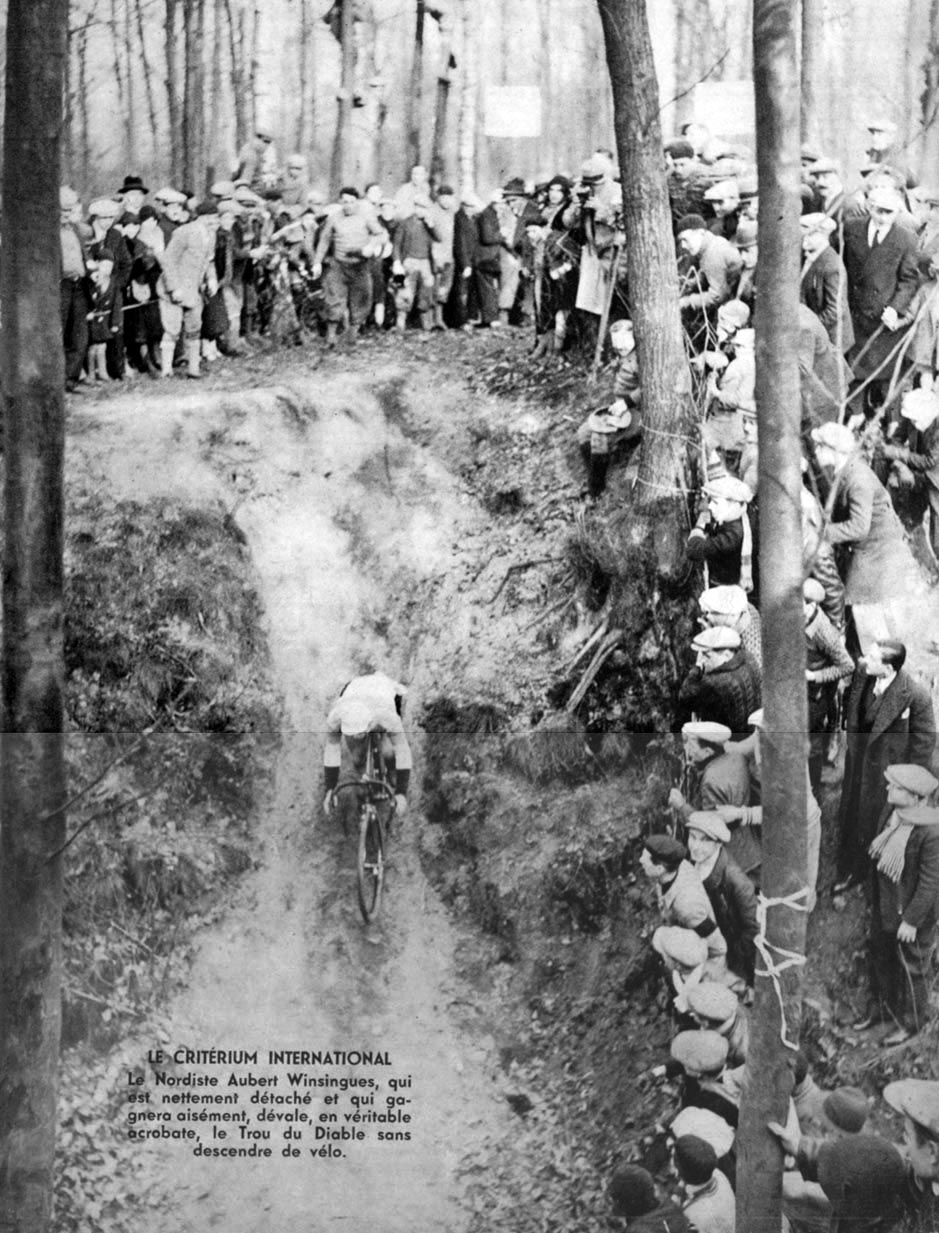 [/img]
[img] 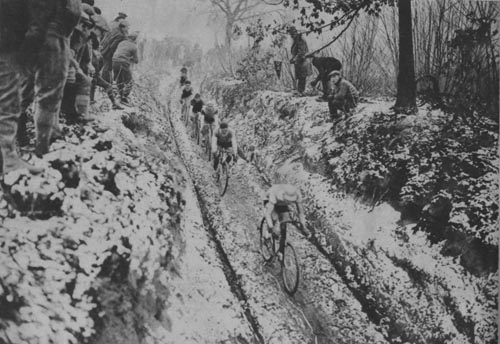 [/img]
[img] 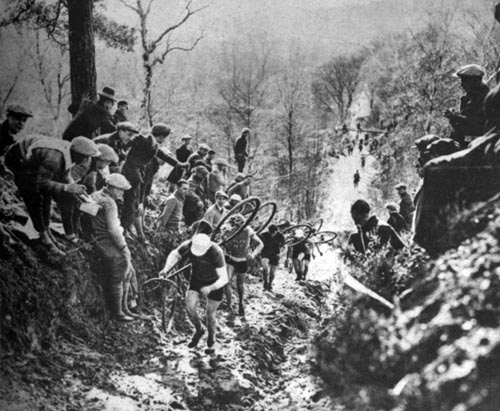 [/img]
[url= http://www.blackbirdsf.org/cx/ ]from this site[/url]
The only bit of that lot I could ride is the middle photo 🙂
Cheers Charlie, glad your not bitter
Better to be there and done it
There was early off road racing going on in NZ as well. From the comments I think this is from 1957 or so. Looks like quite fun terrain for the old bikes!
Bimbler - Member"I'd never heard of Geoff Apps before and I was an earlyish acolyte of (1986/1987) mountain biking
Interesting stuff on Geoff Apps and Cleland bikes
I have no doubt that mountain biking as we understand it, especially the gnarr rad-dude wing is an American invention. They merchandised it, industrialised it and through the power of marketing proselytized it".
[b]"Lets face it if it wasn't for American can-do-ism there'd be a few hundred mountain bikers in the UK paying £2000 for a 30lb bridleway blasters built by Geoff Apps and his ilk".[/b]
This last statement is probably pretty close to the mark. Though Cleland Cycles Ltd. stopped trading in late 1984, this wasn't directly due to competition from American style mountain bikes. Geoff Apps had been promoting his designs for years but conservative British manufactures did not see the point of cycling off-road and so were not eager to make his designs. So he set up his own business making them. However the timing was not good as Britain was in the middle of an industrial recession, suppliers were jumpy and pulled the plug on credit facilities, and that caused a cash flow crisis. By then Apps had spent all his money and was not prepared to go into debt in order to keep the Cleland Cycles trading.
However, Cleland customer David Wrath-Sharman, both loved the way the Clelands rode, and had the engineering skills to improve the design and build Cleland style bikes to order under his Highpath Engineering Brand. Meanwhile Geoff Apps' frame builder, Jeremy Torr, carried on making Cleland style bikes under his own English Cycles brand. Both these ventures did well at first and I believe if the American mountain bikes had not been invented they would have carried on making expensive bespoke bicycles for a steadily increasing band of enthusiasts. But the high quality and relatively inexpensive mass produced mountain bikes, made the Cleland style bikes look increasingly overpriced, and Apps's vision of affordable mass produced Clelands never came to pass.
However Cleland style bikes did not disappear completely. Many owners still used their Cleland, English Cycles and Highpath bikes, often in preference to mountain bikes. Some like myself still do, and Geoff, D.W.S.and others enthusiasts continued to design, built and ride a wide range of developed variants. However it is only now with the backing of Brant Richards that the the dream of a mass produced and affordable Cleland is looking likely.
If the mountain bike not been invented in the US would the Clelands have been more successful?
I believe they would. As both the design, and the idea of cycling off-road for fun, are sound.
There would certainly be"...be a few hundred mountain bikers in the UK paying £2000 for a 30lb bridleway blasters built by Geoff Apps and his ilk." Things could have grown and evolved and got more sporty, sexy and less practical. There were UK based entrepreneurs who promoted mountain biking like Errol Drew of Ridgeback, or Drew Lawson and Ari Hadjipetrou of MuddyFox etc, who could have equally seen the potential in Apps' ideas.
Had the mountain bike not been invented, could Cleland derived bikes may have eventually gone on to be sold and adapted globally?
We will never know, as mountain bikes were invented, and we can only speculate.
[url= http://i419.photobucket.com/albums/pp271/repackrider/avatar235.jp g" target="_blank">http://i419.photobucket.com/albums/pp271/repackrider/avatar235.jp g"/> [/IMG][/url]
[url= http://sonic.net/~ckelly/Seekay/mtbwelcome.htm ][b]2retro4u[/b][/url]
Marin County, Cali
I am leery of the word "invent." The mountain bike was not so much "invented," since it used elements already on the market, as it was "designed" to accomplish something no one had yet marketed a bike for.
In no respect did any of the Northern California people expect fat tyre bikes to dominate the industry. We thought that "MountainBikes" would appeal to the same people who bought cyclcross bikes, perhaps a few hundred or a thousand a year, not enough for the big companies to bother with but a big enough number to keep our tiny shop in a rented garage busy.
We were wrong about more stuff than we were right about.
Gary Fisher invented the mountain bike. Him and only him. He's told use over a million times, and at least twice on his own site here:
http://fisherbikes.com/support/glossary
It is the total dominance of the mountain bike that is so amazing. It truns on its heads so ideas people had about what a bike should be. You still here recumbent enthusiasts who seem to believe that we just need bike to be a bit more effecient. Style and user friendlness are what people want. I was a teenager when I got my first mounatin bike. I was fit and use to ride a drop bar bike regularly. But the mountain bike just made so much more sense in traffic. I suppose that road bikes have caught up but my mountain bike gave me for the first time gears I could reach with out letting go of the bars, easy to reach brakes that worked and a more upright position that meant I could look around. Rigid mountain bikes (and hard tails) are mega flexible. I toured, commuted, mountain biked and even time trialed on mine
That's a terrific film from NZ in '57!
Yes, Charlie, you're right to feel a bit uneasy with the word 'invent'. It makes it sound like someone sat down and thought it all out, whereas it was more like 'evolution'.
I was told the same thing; my bike would only appeal to a few cyclo-crossers, and thus would be a niche within a niche, from a marketing point of view.
I believe that, at that time, (mid-late 70s) there were only two machines being built where the ethos was to use the highest quality and most efficient components for an off-road bike, potentially for commercial exploitation. Everyone I spoke to about the idea, both cyclists and motorcyclists felt that a bicycle intended for off-road use [i]should[/i] be of the lowest quality and fitted with low-grade cheap components. This was on the principle that you would bust it anyway, so you may as well not pay too much for it in the first place.
There must have been a few venture capitalists who turned me down who were kicking themselves a few years later!
[url= http://i419.photobucket.com/albums/pp271/repackrider/avatar235.jp g" target="_blank">http://i419.photobucket.com/albums/pp271/repackrider/avatar235.jp g"/> [/IMG][/url]
[url= http://sonic.net/~ckelly/Seekay/mtbwelcome.htm ][b]2retro4u[/b][/url]
Marin County, Cali
Gary Fisher invented the mountain bike. Him and only him. He's told use over a million times, and at least twice on his own site here:
I agree that the rhetoric got a little heated for a while, which is what happens when you have public relations people enhance your legend. A lot of people contributed to the "invention" (design, really) of the mountain bike. Even though Gary didn't "invent the mountain bike," his contributions to the sport were and are immense, and I'm guessing that they are ahead of your own.
Regarding the US v. UK simultaneous progress. The first MTBs reflected their birthplace in California, which is relatively dry compared to UK riding conditions, and the biggest influence on the design was racing. The bikes by Geoff Apps, Cleland, Highpath etc. were far more reflective of the conditions where they were used and the purpose for which they were used.
The difference turned out to be the demographic of the afficianados. Mountain bikers were originally young Californians with a BMX. skateboard, motorcycle or road bike background. The English rider was more like a Rough-Stuff Fellowship member who never elevated his heart rate. The California/BMX/skateboard lifestyle of the '70s was being sold worldwide and eventually morphed into the X-Games, but RSF rides were not quite as marketable.

