The modern mountain bike as we know it was first developed on a large(ish) scale by some folk in the USA.
End of.
Do you not remember MTBs suddenly turning up in all the shops and on roads one year?
I present to you the Range Rider developed by a bloke called Geoff Apps. It was even a 29er so niche enough for this forum.not titanium - FAIL
Fail? Oh I don't know. It had what would be regarded as alt bars today and the later models even had hub gears. It also appears to have more than one top tube. Like all true modern 29ers Geoff Apps also had trouble getting hold of suitable tyres.
A man truly ahead of his time. Possibly even the first STWer 😉
The USA invented racing down fireroads....RePack, Mammoth etc.
Much like the invention of VTOL and Supersonic passenger travel, its not the invention that really matters it is the commercialisation. the yanks are better at that than we are. The end.......
We have better ideas though... 😉
But Geoff ran the Wendover Bash - at least as early as 1983 - which had a downhill race in it (as well as trials). He was making proper offroad bikes before then, the Range Rider, the Cleland and, now, the Aventura. He still rides off road by the way. He was doing this before the Americans, the difference IMO was that the Americans caught the imagination of the masses and so the bikes went into mass production. Geoff was a one-man band with little or no resources.
David W-S started making the Highpath a little later. I rode part of the SDW on his wife's Highpath. A different riding position from the arse-up/head down favoured by the mainstream. I didn't particularly like that position (of the Highpath/Cleland), although I absolutely do see the point of it, and its advantages. They had hub brakes, some had derailleur gears and some hub gears, some with egg rings (but with the ellipse orientated 45 deg (I think) past Shimano's biopace).
Berm Bandit - Member
Much like the invention of VTOL and Supersonic passenger travel, its not the invention that really matters it is the commercialisation. the yanks are better at that than we are. The end.......We have better ideas though...
Completely different economic situation in the USA at the time so mass production and marketing is going to take off better over there
I think there's an important distinction here that's being missed by the majority of posters.
Mountain biking wasn't invented. It's taken place all over the world since the invention of the bike. Some people even adapted or made bikes to suit this style of riding.
THE mountain bike was invented by some Americans in Marin county. They coined the name for their brand of bike, and due to location and time it was picked up by the masses, spreading round the world. All those people who were already "mountain biking" suddenly had access to bikes pre made suitable for the job.
It was kind of what I was getting at with my original post. I don't mountain bike because of the repack riders, I was doing it before I heard of them, but I ride a mountain bike that is decended from what they produced as it's the tool for the job.
In short, the mountain bike was invented in America. Mountain biking and off road cycling was not.
Tree - nor was the mountainbike "invented in one place at one time" it was a process of development in many places by many people
Nope. The name "Mountain bike" was initialy applied to one product. I forget who it was now, I think Ritchey.
I'd never heard of Geoff Apps before and I was an earlyish acolyte of (1986/1987) mountain biking
[url= http://clelandcycles.wordpress.com/history/ ]Interesting stuff on Geoff Apps and Cleland bikes[/url]
I have no doubt that mountain biking as we understand it, especially the gnarr rad-dude wing is an American invention. They merchandised it, industrialised it and through the power of marketing proselytized it. Lets face it if it wasn't for American can-do-ism there'd be a few hundred mountain bikers in the UK paying £2000 for a 30lb bridleway blasters built by Geoff Apps and his ilk.
No - I invented them back in 1977 in my garage in Formby, Merseyside when I was 11.
Took a 24" wheeled 5 Speed racer - fitted all black tyres, big wide cowhorn handlebars (must have been 800mm), took front the brake off, swapped the forks for some off a 26" wheeled bike. We called them scramblers - good fun riding on the dirt tracks in the Formby Pinewoods.
[url= http://i419.photobucket.com/albums/pp271/repackrider/avatar235.jp g" target="_blank">http://i419.photobucket.com/albums/pp271/repackrider/avatar235.jp g"/> [/IMG][/url]
[url= http://sonic.net/~ckelly/Seekay/mtbwelcome.htm ][b]2retro4u[/b][/url]
Marin County, Cali
The events being discussed here in the abstract are real events that I took part in.
First, the name of the sport comes from the company that Gary Fisher and I started in 1979, MountainBikes, to sell bikes we put together in a rented garage on frames made by Tom Ritchey. It was such a good name, and so descriptive, that it became the generic name for multiple gear bikes with large tyres used for riding on rough surfaces.
About downhill. The Repack series was to my knowledge the first downhill offroad time trials, so we in Marin certainly "invented" that. But before we started racing down hills, we had ridden to the tops of a lot of them also, and we were already riding multiple gear bikes cobbled together from piles of unrelated parts. The beating our bikes took racing downhill helped us design them for the toughness that mountain bikes need in all situations. Cyclocross bikes would have folded like paper clips under that kind of abuse.
While perhaps millions of others rode offroad before Gary Fisher and I did, no one else seems to have had the passion and ability to stake their future on such bikes by starting a company that made only one thing: fat tyre multiple gear bikes like none other then being offered for sale on the planet. Gary and I did, and it seems to have been a good idea. Every mountain bike built before 1984 was copied directly from the one we introduced.
Click my photo above to see my website.
tree-magnet
Nope. The name "Mountain bike" was initialy applied to one product. I forget who it was now, I think Ritchey.
Oops, I meant Charlie Kelly and Gary Fisher then! 😛
I wondered when Charlie would find this thread?
[img]  [/img]
"Every mountain bike built before 1984 was copied directly from the one we introduced".
This depends on the exact definition of mountain bike. I can think of a number of pre 1984 bikes, specifically designed for the enjoyment of riding off-road, that have no evolutionary connection to the bikes designed by Joe breeze, Charlie Kelly, Gary fisher et al.
*The bikes of the Velo Cross Club Parisien (VCCP)1951-56
*The 1953 "Woodsie" bike built by John Finley Scott.
*Rodney Rom's 1966 bike built in Cincinnati, Ohio ("The City of Seven Hills"), in the spring of 1966 by widening the rear of a new 10-speed Schwinn Varsity Tourist frame.
*Geoff Apps of England and his first off-road bike of 1966, based on a Raleigh Explorer frame.
*Russ Mahon bike of 1973 Cupertino, California
*Bob Crispin's bike Built in Spokane, Washington in the spring of 1974, for riding in the snow.
British Frame builders Jack Taylor built to order specialist "RoughStuff bikes" in the mid to late 1970's.
*Britain's Geoff Apps and his late 1970's Range-Rider and early 80's Cleland Aventura bikes.(from 1982-84 he formed Cleland Cycles, the first manufacturer of off-road bikes in Europe).
However it was not these bikes that started the global phenomenon we call mountain biking, but those designed by Joe breeze, Charlie Kelly, Gary fisher, Tom Ritchey and Mert Lawwill.
For those interested in the British connection, here's a 1979 article on Geoff Apps' Range-Rider bikes.
[img] 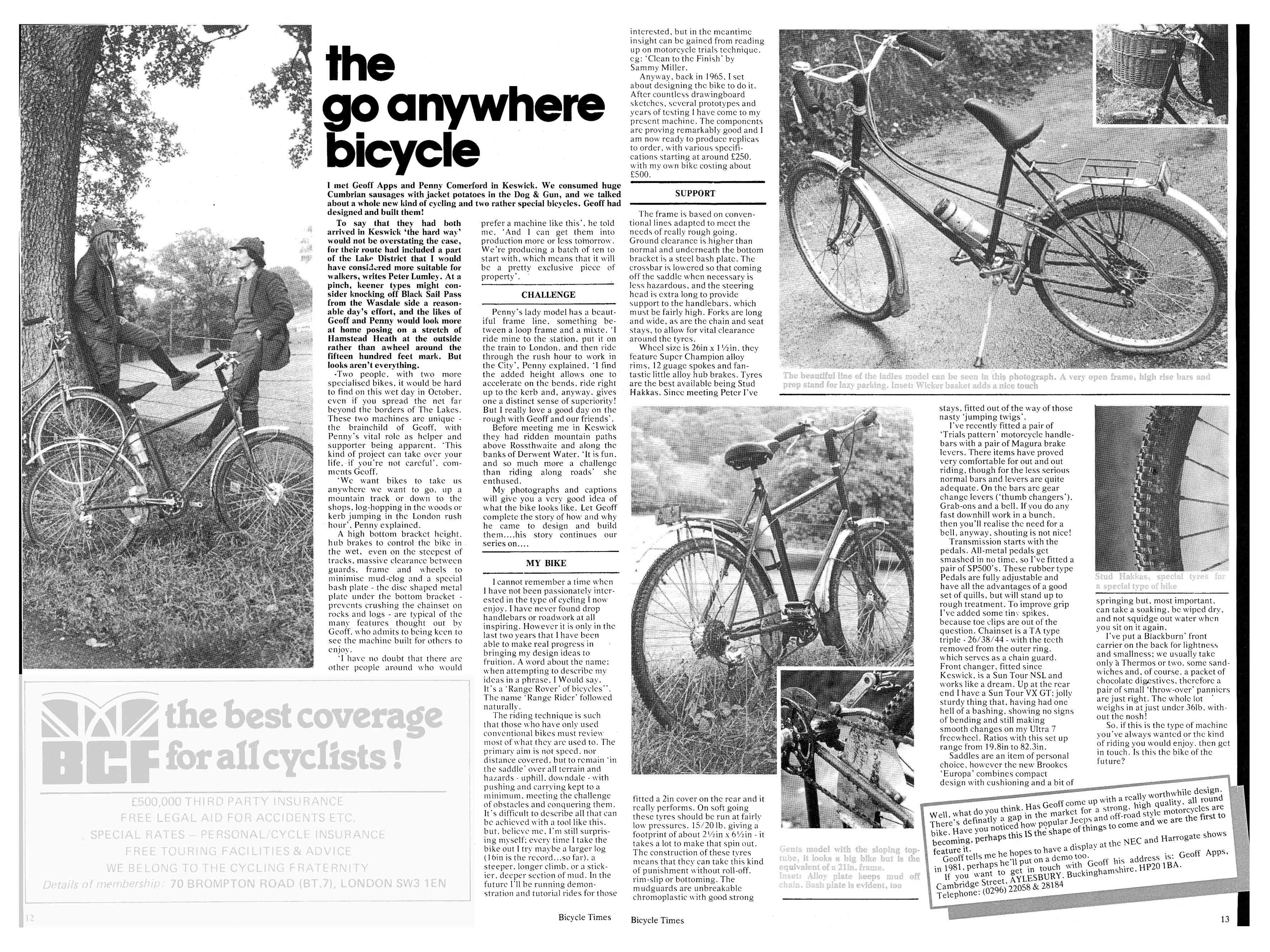 [/img]
[url= http://clelandcycles.wordpress.com/press/ ]Bicycle Times 1979, larger version.[/url]
[url= http://i419.photobucket.com/albums/pp271/repackrider/avatar235.jp g" target="_blank">http://i419.photobucket.com/albums/pp271/repackrider/avatar235.jp g"/> [/IMG][/url]
[url= http://sonic.net/~ckelly/Seekay/mtbwelcome.htm ][b]2retro4u[/b][/url]
Marin County, Cali
I am aware of all those previous off-road designs. Somehow none of them took over the world. Our bikes did.
None of the examples you gave was described as a "mountain bike," the common name that came into use in the '80s to describe a fat-tyre, multiple gear, diamond frame bike. The name itself came from the bike Gary and I sold, which was called simply, the "MountainBike." When the design was copied the name went with it.
Following Specialized and Univega, who introduced copies of the Ritchey MountainBike in 1982, every major manufacturer used the design elements we introduced for their first off-road products.
This is not something I read about somewhere. This is something I took part in.
The start of mountain biking...not in the USA?
[b]Here's my take on this question.[/b]
Riding off-road is as old as the bicycle itself as when it was first invented their were very few roads to be ridden. When roads became more common, riding off-road was generally regarded as a necessary evil as it was slow and relatively uncomfortable.
Riding off-road as a pass-time is probably a British idea that started when town dwellers cycled out to explore the surrounding countryside. They rode their everyday road bikes as far as they could and then got off, pushed or carried their bikes in order to make it through the the hills and mountains to their destination. This activity became known as "pass storming" and extreme examples of such activities were sometimes reported in Victorian and early 20th Century newspapers. In 1955 the Rough Stuff Fellowship was formed, though rough-stuff riding had been a popular occasional activity for some road-riders for many years previous to this. The attitude amongst most rough-stuff riders was that riding off-road was a challenge and a difficulty to be overcome. It was not seen as something to be enjoyed and reveled in, and so it didn't matter whether they rode or walked the terrain, so bikes largely remained unmodified. Very few specialist bikes were designed and made for rough-stuffing.
Riding off-road for sport starts with Cyclo-cross with the first Championships being held in France in 1902. Though this shares the rough-stuff concept of dismounting to tackle difficult terrain and again the bikes were largely unchanged from road bikes. The French VCCP in 1951 developed a sport similar to mountain biking that involved custom made bikes and components, but it died out around 1955. Several other individuals and groups also developed and built bicycles intended specifically for enjoying off-road riding during the 50's, 60's and 70's. However these machines never developed beyond their immediate spheres of influence. The machines produced in late 1970's Marin County California in connection with the "Repack" down hill races, were in the right place at the right time and led directly to the global activity known as mountain biking.
The earlier designs of off-road bicycle that I mentioned in my previous post, mostly died out. Though John Finlay Scott was influential and supported the Marin pioneers financialy, the evidence suggests that the pioneers developed their own independent ideas, and did not copy his design. [url= http://triplecrankset.blogspot.com/2008/09/late-professor-jf-scott-to-be-inducted.html ]John Finlay Scott link[/url]
The only non-Marin lineage of off-road bike that has just about survived is the type invented in Britain by Geoff Apps. When Apps' company Cleland Cycles stopped trading in late 1984, versions continued to be made by English Cycles and Highpath Engineering. Over the years, Apps and a small group of enthusiasts have continued to use and develop this style of bike. Various modern versions exist. One 29er version is currently being designed and will be going into production in the near future.
[url= http://clelandcycles.wordpress.com/pre-order/ ]Modern Cleland 29er link[/url]
Ace stuff that. SImilar thread here on UKCyclocross http://www.ukcyclocross.com/forum/topics/it-was-harder-in-the-old-days
The Cleland stuff is interesting. Has anyone on here got one?
Also interesting that Brant gets a name check re a possible limited frame production run.
This is not something I read about somewhere. This is something I took part in.
I don't think there's any doubt about that! 😀
It's certain that what you guys came up with (The bikes, the races, and IMO the attitude) is the most important and defining step on the ladder to what we now call 'mountian biking.' You'd have to be foolish to question that! 🙂
But I don't think it was the first step. People all over the world rode bikes off road before that, in one way or another, and the seed was already sown. It's like making fire: Heat, fuel and oxygen all existed before someone worked out how to combine them and tame them!
Interesting thread this, and a great film. Took me a while to realise that the "commentary" was added after- esp as he kept going on about the guy having had a kidney transplant. Interesting bit of trivia about the chap that worked on the cheese counter at the co-op as well- you wouldn't get that sort of knowledge on the BBC!
As far as the birth of mountain biking is concerned, it seems we were all doing the same sort of things with existing frames in order to have some fun on them off road before the "mountain bike" was invented.
Our preferred customization was to start with a racer frame out of a skip, slap some cow horns on and a 20" wheel off a raliegh grifter on the back. We used to cobble together some sort of mechanism to hold the caliper brake in the right place relative to the rim. The three speed sturmey archer hub would be kept in the lowest ratio permananently somehow. We would go to a local field with a WW2 bomb crater in it and do what would now be described as dirt jumping. The frames would snap near the head tube.
This was 81-82ish when I was 11 or 12.
At that time I remember BMXs appearing in the uk. I used to do schoolboy moto-x so lots of the lads that did that had BMX bikes before it became very mainstream.
I even remember seeing a BMX with a rear derailleur- that didn't catch on.
Within a couple of years you could get the raliegh bomber the rest is history.
We had no idea that these new fangled mountain bikes were "invented" by americans, we just knew they looked like the sort of bikes that we wanted to ride, and had been trying to make ourselves.
Woody
The Cleland stuff is interesting. Has anyone on here got one?
The reason why I picked up this thread is that I Googled "Geoff Apps" to find out what people are saying about his new bike design. I have known Geoff since 1984 and am currently involved in component R&D and testing for the new bikes. I own two Apps designed bikes, a 1983 Cleland Aventura and a 1988 version made by Highpath Engineering. I have also developed my own modern full suspension variants. I know, have known, and am in contact with the owners of many Apps inspired bikes.
[b]Here's an interesting RetroBike thread from someone who is restoring a Highpath made bike that was found abandoned in a stairwell.
[/b]
[url= http://www.retrobike.co.uk/forum/viewtopic.php?t=112627&highlight=cleland ]Highpath' Cleland restoration[/url]
Mudrider
Thanks for link, great thread and really interesting stuff. I'm quite embarrassed that I'd never heard of the make(s) or Mr Apps prior to this thread 😳
Riding position looks very interesting as do a lot of the other ideas, Cheers
Following Specialized and Univega
Are univega that old i always thought they were relatively new.
I'm interested to know what Charlie Kelly recalls of the Cupertino Riders. I've read a few magazine articles about them, it's said that they very briefly appeared at races with interestingly redesigned bikes and some ideas were taken onboard by the people credited with starting the sport as we know it. Or, were their bikes with alterations not any different to what you and your friends were riding and redesigning?.
[url= http://i419.photobucket.com/albums/pp271/repackrider/avatar235.jp g" target="_blank">http://i419.photobucket.com/albums/pp271/repackrider/avatar235.jp g"/> [/IMG][/url]
[url= http://sonic.net/~ckelly/Seekay/mtbwelcome.htm ][b]2retro4u[/b][/url]
Marin County, Cali
I'm interested to know what Charlie Kelly recalls of the Cupertino Riders.
I remembered seeing them in the winter of 1974 when they appeared for the only time on our radar screen. These guys were just like us, hippies modifying bikes for off-road, and they were ahead of us technologically because we hadn't yet figured out how to get derailleur gears onto our old Schwinns.
The answer was a drum brake, then made primarily for tandems and not something you saw very often. The Cupertino boyz had Atom drums and derailleur gears, and we paid attention. A few months later, Gary spotted a disassembled tandem at a flea market, and he bought it for 20 bucks or so. He threw away everything but the five pound rear drum brake hub, which he laced into a 26" wheel.
It was superior immediately. As soon as we figured out how to get them, we started ordering Atom hubs through either the Mill Valley Schwinn shop or The Cove, where the Koski brothers worked. The distributor noticed that so many of these obscure tandem parts were going to a tiny area, and wanted to know why.
After Gary and I had the MountainBikes business rolling, someone from the Cupertino gang wrote and mentioned that they had been into this offroad stuff some time earlier. I sent Russ Mahon a letter on MountainBikes company stationery, in which I freely acknowledged that they had given us an important piece of our developing technology. Russ still has that letter.
I have no problem acknowledging the many riders who went offroad before I ever rode a bicycle. But until the Ritchey MountainBike appeared on the market in 1979, you would have had to make your own. There was nothing on earth like the MountainBike for sale to the public, and a few years later, half the bikes sold worldwide were copied directly from it. Not from the Cleland or the Highpath, sorry to say.
It was our unique competition that drove our technology, and there was none of that downhill foolishness in England. I dare anyone to show me a downhill offroad time trial before Repack in October 1976. We DEFINITELY invented downhill racing.
tailsAre univega that old i always thought they were relatively new.
Yes. The Univega brand goes back to 1982. The following link gives some details.
[url= http://www.completesite.com/mbhof/page.cfm?pageid=13 ]History of US all-terrain cycling - Mountain Bike Hall of Fame[/url]
Repoack rider
We DEFINITELY invented downhill racing.
Certainly did. In the UK was a parallel cross county non competitive cycling.
I still maintain mountainbiking was a series of developments - after all the repack bikes of the late 70 s were not that close to what we ride today
after all the
repack bikes of the late 70 s were not that close to what we ride today
eh? There's 33 years of evolution between them. It's not even a valid comparison...please don't tell me you think modern bikes evolved from something else?
Nothing else at that time was closer - able to go up and down equally well.
exactly al - it s a process of development That was one significant point on the way.
Not as you claimed
cynic-al - MemberI'd say mountainbikes as we know them were invented in the USA in the late 70s.
I love this thread. Really enjoying the debate.
I love the fact that throughout time there have been people who take what is there and adapt it to suit their new purpose. There are always a lot of contributing factors required to transform that personal adaptation into something that has long-term, worldwide impact. That's what happened in Marin in the late 70s: the people, the hills, the economy, the industry, the old bikes, the vibe, the weather... etc.
I'm bloody glad it did too. Otherwise I would be a roadie.
I am enjoying the thread too. I'm glad that there are so many different materials, colours, configurations, styles and components and that you get to mix and match these into bike that you love and which suits your riding. It's interesting and fun.
All bikes are good bikes <HEART/>
(Wow, I AM in a good mood this morning! lol)
I have a mountain bike.
TJ that was THE significant point along the way-from which the bikes we ride developed.
I don't really know what you are trying to say any more as its completely inconsistent. What I have said is the same throughout.
Stop making it personal.
Repack Rider - MemberNone of the examples you gave was described as a "mountain bike," the common name that came into use in the '80s to describe a fat-tyre, multiple gear, diamond frame bike. The name itself came from the bike Gary and I sold, which was called simply, the "MountainBike." When the design was copied the name went with it.
Ah - the Anglophile argument. Since most other countries use a different language, none of them could have "invented" the mountain bike.
Ah - the Anglophile argument. Since most other countries use a different language, none of them could have "invented" the mountain bike.
You can say it is an anglophone argument, but apart from the france, mtb is common parlance to describe a type of bike.
What I find interesting is that my 29er with drop bars looks very similar to the path racer ridden by one of my family in 1910 right down to the single gear. His tyres look like 2" on 28" rims. The geometry is similar, but they used bigger frame sizes then. His was fixed though 🙂
I know it was ridden up mountain paths - he supposedly went up Ben Wyvis - and he wasn't the only one doing it locally.
However I think it's fair to say that USA marketing has given us the "classic" 26" fat tyred geared bike with suspension that is called a mountainbike - an abomination for frail and feeble people who cannot ride a proper bike or for fat boys to roll downhill on.
There is no doubt of the superiority of a proper bike - a rigid 29er with drop bars (where's that Hitler youtube clip when you need it)
.
.
.
.
OK now I'll duck back under the bridge 🙂
thing is none of us would be riding mountainbikes with singlespeeds without the mountainbikes of the 70s.
Right - info please. In the 60s my mum used to go out on a Raleigh hub 3 spd, with sarnies, flask, fags, rods and up the riverside and all over Forestry Commission and farm land on a regular basis. Is it the fact that she rode a shopper or that she's never been on the internet that means she wasn't a mountain biker..................
I also can't help feeling that modern mountain bikes owe more to motorcycle design and development than any form of rigid bike and the derailleur is older than anybody on here........
*Riding offroad is what people did when they worked in the countryside before cars were commonly available.
"We DEFINITELY invented downhill racing. ", so until you invented it what was two people trying to beat each other down hill called ?
Ps I think you should all be jumping up and down for joy, during 'our' (well some of us) lifetimes we've had a gifted 'leisure existence'
- dirt motorcycling - from heavy with poxy drum brakes and twin shock, to mega power, lightweight, mega travel and discs.
- windsurfing - lumps with baggy sails and rope tie on booms to carbon, lightweight, battens and clamps.
- mountain biking - already covered
- kites - my first one was bamboo and canvas
- jetskis
- ............
Kirkpatrick MacMillan invented the off road bike. Simply because he invented the bike and around that time the roads were pretty gash.
So, to summarise; Repack and his mates coined a marketing concept in the name 'mountain bikes', Mike Sinyard then commercialised it effectively by mass-producing off-road 'mountain' bikes, and Shimano etc made loads of bits to make off-road cycling easier and more efficient.
My mum told me about a conversation she'd had, in the early 60's, with an Italian bloke who explained how he and some friends had adapted standard bikes by using fatter tyres and upright handlebars, which they then rode 'off-road'. So of course others were doing what Repack and his mates were, and doing it earlier. What Repack etc have given us is the lifestyle concept. The put a name to an activity which others had been doing anyway, and one which fitted perfectly in terms of producing a marketable concept.
Good stuff, nice one, but Repack no more 'invented' mountain biking than Clive Sinclair 'invented' the computer...
Dozy forum...
Kirkpatrick MacMillan invented the off road bike.
Indeed, roads were no more than bridleways.
However, I have no doubts as to whom my MTB bikes Grandaddy is:
[IMG]  [/IMG]
My 1979 Huffy Good Vibrations cruiser, with pefectly fitting trails rims, Kenda Nevegals 2.1 Stick-E and Gusset bar.
druidh...
"Ah - the Anglophile argument. Since most other countries use a different language, none of them could have "invented" the mountain bike".mrmo...
"You can say it is an anglophone argument, but apart from the france, mtb is common parlance to describe a type of bike".
When first introduced into Britain many manufacturers used the acronym ATB (All Terrain Bicycle) to describe their bikes. For instance the first British made mass produced bikes, the Ritchey copies produced by Saracen, were marketed as The Saracen ATB. However, the American aspirational term mountain bike, caught the public imagination to become the preferred title for off-road oriented bikes.
Alternatively the logical French the adopted the equivalent of ATB, Velo Tout Terrain, VTT. This is a description that covers any bicycle designed to be used on all terrain, and so could readily be applied to the bike of Kirkpatrick MacMillan. Only when roads improved were bikes designed that were intended for road use only.
Even though others claim to have used the term "mountain bike" earlier, it was the title that Fisher and Kelly attached to their bikes and in the main, went with the bikes when they went global. So the term "mountain bike" is connected with Marin and the repack style down-mountain racing against the clock. The French VCCP took a more motor cross approach whilst in both France and Britain there developed the Cyclo-cross tradition. Britain also had the two different off-road touring approaches of the RoughStuff fellowship, who were happy to get off and walk, and Geoff Apps who thought of having to walk as being beaten by the terrain.
These activities all differ and each had developed their own style of bicycle. Their was no single invention. After the Marin mountain bikes went global, owners and manufacturers started modifying them for their own uses. Long may the invention continue!
This process continues but is mainly sport led. This has resulted in a sporting bias in off-road bike design and fashion. One result of this is that many riders prefer to get wet than use mudguards when riding in the rain. I personally believe that there is scope for a more practical approach to off-road bicycle design. But even after all the years of bike development, this remains an area that has not been explored commercially.
This process continues but is mainly sport led. This has resulted in a sporting bias in off-road bike design and fashion. One result of this is that many riders prefer to get wet than use mudguards when riding in the rain. I personally believe that there is scope for a more practical approach to off-road bicycle design. But even after all the years of bike development, this remains an area that has not been explored commercially.
Yes the current crop of "all mountain" or "trail" bikes are quite clearly race led. 6 inch travel all day bikes and baggy shorts quite clearly fit the criteria for most that you have laid down.
Oh, and as above, DH racing and the term "mountain biking" were invented by the repackers. Off roading wasn't, but then that's like arguing who invented walking.
but then that's like arguing who invented walking.
I think you'll find that was Edward Whymper and friends, in the 1860s.
[url= http://i419.photobucket.com/albums/pp271/repackrider/avatar235.jp g" target="_blank">http://i419.photobucket.com/albums/pp271/repackrider/avatar235.jp g"/> [/IMG][/url]
[url= http://sonic.net/~ckelly/Seekay/mtbwelcome.htm ][b]2retro4u[/b][/url]
Marin County, Cali
"We DEFINITELY invented downhill racing. ", so until you invented it what was two people trying to beat each other down hill called ?
Where are the records, and who was the champion? We did all that, and we found that on a narrow and steep road where the good line is a foot wide, it's impossible or dangerous to pass another rider.
So we figured out how to run downhill races as time trials, which is the way most of them are run today, and we wrote down the results. Repack was a series, with records kept and winners awarded prizes. I still have the records of all but the first race. Two people racing each other down a hill does not leave a record or decide a champion.
Have another straw to clutch at...
[img]  [/img]
Well, when out with mum (*Raleigh 3 speed shopper, previous post)) and me on a tricycle (*therefore about 1963) whilst not racing and going up hill next to a river (*river was going downhill but as it was on it's own it couldn't possible be racing) I'm proud to say that seeing a large salmon in a pool my mum whipped her tights off and stuffed it down one of the legs. I therefore wish to claim that my mum invented fish net tights.
[url= http://i419.photobucket.com/albums/pp271/repackrider/avatar235.jp g" target="_blank">http://i419.photobucket.com/albums/pp271/repackrider/avatar235.jp g"/> [/IMG][/url]
[url= http://sonic.net/~ckelly/Seekay/mtbwelcome.htm ][b]2retro4u[/b][/url]
Marin County, Cali
Sure, lots of people put together bikes for off-road before we started in California, and many used similar elements. But you couldn't go to a bike shop and buy one, and the participants might have numbered in the dozens.
There was nothing on the market like the Ritchey MountainBike before Gary and I introduced it. A few years later most of the bikes being sold looked just like it, and an entire competitive sport had grown from some crazy downhill races. As much as the others who rode similar bikes shared our passion, how many quit their jobs and staked their future on such bikes by opening a company to produce them?
In 1983 a few of us got together and wrote some racing rules and bought insurance so we could compete openly. We called our organization the National Off-Road Bicycle Association, or NORBA. The rules we wrote became the international rules later on.
1983.
I've had a bit of fun stirring in this thread but I think we should separate the concept of riding bikes in the mountains from "mountainbiking".
It's fair to say that the term "Mountainbike" should be credited to the USA (Mr Repack & associates), and I remember how pleased I was that I was able to finally be able to buy a bike that I wanted without having to modify it. It certainly was USA style merchandising which popularised it.
Unfortunately the emphasis on road sports was leading European biking up an evolutionary dead end as far as offroad bikes were concerned - blame the dead hand of the UCI which kills every technological advance. An offroad bike was a cyclocross bike with 32mm tyres.
What I always wanted was a lightweight bike with decent sized wheels and tyres. 26" was too small, but at least they came with 2" tyres which had all but disappeared from sale for larger wheels by then. The use intended for my bikes was always mountain. Often on my shoulder and straight up the hill if there was no track visible, so lightness was important, hence singlespeed. Thanks to the mountainbike concept the path racer has been re-invented (only now we call it a 29er) so I am grateful to Mr Repack for that.
But why oh why are mountainbikes fitted with a gearchange system which is guaranteed to be ripped off or bent if you ride it off track? (eg through heather) Just one more step to go...
(Yes I am a member of the RSF)
Here's Joe Breeze talking about the origins of the mountain bike and mountain biking. He made Breezer No1 in 1977, which is widely regarded as the first mountain bike built around a purpose built frame. He talks about the importance of "critical mass" in developing the popularity of the new sport.
[url=
Breeze on the origins of mountainbiking[/url]
Given enough time Geoff Apps' ideas could have also developed "critical mass". However in comparison to Americans, the British cycling establishment was extremely conservative. The letter at the end of this link gives a flavor of the many setbacks that Apps encountered whilst promoting his ideas in Britain.
[url= http://www.retrobike.co.uk/forum/viewtopic.php?t=42540&start=165 ]Letter from Dawes to Geoff Apps at end of link[/url]
Great clip.
It's clear that repack and co. invented moutainbiking and its image. The only argument is who invented VTT?
Every mountain bike built before 1984 was copied directly from the one we introduced.
What happened in 1984? What bike was it that didn't look like the 'original' mountain bike?
CharlieMungus - Member
It's clear that repack and co. invented [s]moutainbiking and[/s] its image. The only argument is who invented VTT?
T.FIFY
[url= http://i419.photobucket.com/albums/pp271/repackrider/avatar235.jp g" target="_blank">http://i419.photobucket.com/albums/pp271/repackrider/avatar235.jp g"/> [/IMG][/url]
[url= http://sonic.net/~ckelly/Seekay/mtbwelcome.htm ][b]2retro4u[/b][/url]
Marin County, Cali
What happened in 1984? What bike was it that didn't look like the 'original' mountain bike?
The date is arbitrary. By then a couple of years had passed since two manufacturers (Specialized and Univega) sent Ritchey MountainBikes to factories in Japan and said, "Make a lot of these." As of 1984 just about every major manufacturer offered a bike suspiciously identical to the MountainBike, but that is not where the innovation was taking place.
By 1984 a number of other American frame builders had taken up the craft (Potts, Nicol, Schafer, Chance, Bontrager, Cunningham, Parker, etc.) and had begun to expand on the original concept by adding their own ideas and tailoring their bikes for local conditions. It was the small frame shops, universally inspired by Ritchey and MountainBikes, that began the series of innovations that took us from that time to this.
Now the small shops have all been run over by major companies, and the small manufacturers such as Yeti, Ibis, Salsa, Fat Chance, Gary Fisher, Bontrager and so on have all been sold. Mountain bikes have become such complex systems that the frames are not easily built in a garage, and the innovation has gone to the level of manufacture where expensive engineering facilities and test sites are necessary for incremental adaptations.
What else would you like to know about these events?
There have been several posts referring to the Cleland Aventura as part of mountain bike history.
The Cleland concept really is a separate strand and does not compare with mountain bikes, an Aventura is designed for a different style of riding, the design philosophy is fundamentally at odds with the general thrust of mountain bike development.
It is convenient to say that the Cleland design is a form of mountain bike when talking to people who can't tell the difference, but it's more like trying to compare a MotoX motorbike with a Trials motorbike ~ there really is no comparison.
This is not to say either is superior to the other; each is designed for a particular purpose. In the case of the mountain bike and the Aventura, one is designed for speed and lightness, the other for no-compromise endurance.
In terms of acceptance of the design, very little progress has been made since 1979; very few people even begin to understand what it's for.
[url= http://i419.photobucket.com/albums/pp271/repackrider/avatar235.jp g" target="_blank">http://i419.photobucket.com/albums/pp271/repackrider/avatar235.jp g"/> [/IMG][/url]
[url= http://sonic.net/~ckelly/Seekay/mtbwelcome.htm ][b]2retro4u[/b][/url]
Marin County, Cali
In the United States we were well aware of Geoff Apps, and we carried on a spirited correspondence. Geoff supplied us with Finnish Haaka tyres with studs for snow use, something we couldn't get here, and he took advertising space in my magazine, the [url= http://sonic.net/~ckelly/Seekay/ftf_welcome.htm ]Fat Tire Flyer[/url], which was the first publication for mountain bikers.
Geoff favored several design elements that we did not, and the reason is that his bikes were not born from downhill racing, but from Rough-Stuff Fellowship style rides in the country. Highlighting these differences shows why the sport and the machinery that eventually emerged worldwide stemmed from the California concept of off-road riding.
Geoff used drum brakes, for the obvious reason that they work better in wet conditions than rim brakes. We didn't use them because they were not made for descending 500'/minute for extended periods, and wet weather is not nearly the constant in California that it is in England.
The upright position of the Cleland style of bicycle is an aerodynamic disaster for downhill. These bikes were not made for riding FAST. We used a traditional diamond frame because it is an efficient design honed from a hundred years of experience. Geoff used an offset top tube to maximize his stepover height.
No self respecting Cleland owner rode without mudguards, a deerstalker cap, plus-fours and argyle socks. The obvious cultural difference between California and England made such accessories a bit quaint to sell the concept to the teenage and twenty-something BMX/skateboard set. Because we were part of the very demographic that was going to buy and ride our bikes, no translation was necessary.
Beyond cyclocross, there was no off-road competition anywhere but California in the '70s and early '80s. In California we RACED our bikes, and the racing spurred design development as well as attracting new riders. The kids had probably never heard of the Tour de France or the Rough Stuff Fellowship, but they understood competition. Gary Fisher, Joe Breeze and Tom Ritchey were all very good road racers, and when California BMX riders like John Tomac and Tinker Juarez moved easily into mountain biking, they brought all their fans with them.
By 1980 there were mountain bike races taking place all over California, about four years before the first one would take place in England.
Yeah yeah, but we invented football, so there! 😀
I must admit I had never heard of Cleland until recently and this is even though I have had a long term interest in offroad riding, but I wasn't in the UK at that time.
I was in Oz from the 70s onward and the ownership and use of a bike was regarded as for the poor or the mad/eccentrics until mountainbikes made them respectable again.
About 1977 I did a 7 day tour through the bush on the bike and the best tyres I could get for offroad were 32mm tubulars - there were no fat tyres available by then.
I think the first thing like a modern mountainbike I saw was in 1981 - it looked like a 1930s singlespeed with fat 26" tyres (still in Oz).
Charlie Kelly, the original bikes you and your peers rode downhill were mostly (but prehaps not exclusively) converted cruiser bikes, right?. So, out of interest, why did the first frames you commercially produced look more like road frames with added fat tyres and flat bars?. Nowerdays, with all the Hydroforming and low top tubes, the modern mountain bike frame designs seem to more resemble the original Cruiser bike styling, with bendy tubes etc. I always wondered why, when the MountainBike started, the distinct cruiser bike styling almost immediately had disappeared?
My thinking over the years, it might have been one of two reasons, fashion (at that time, ie cruisers were for kids) or design/materials issues ie weight/strength?
It should also be remembered that Charlie and Gary are not only 'responsible' for the worldwide mountain bike phenomonen, their actions have led directly to an unprecedented resurgence of interest in cycling; the design and technology that was spawned by the original mountainbikes has now filtered through to every aspect of cycling today.
I would guess that Cruiser styling was not use because it is...styling.
AV2010 does that mean we can blame them for Isis?
Probably, indirectly...
So, out of interest, why did the first frames you commercially produced look more like road frames with added fat tyres and flat bars?.
That's what i wondered. Even looking at my late 80's bikes, it is difficult to differentiate them from a road frame. Ok, maybe stronger and that, but only maybe. The early commercial mountain bikes weren't as well engineered as the road bike of the time.
Repack Rider wrote:
The upright position of the Cleland style of bicycle is an aerodynamic disaster for downhill. These bikes were not made for riding FAST. We used a traditional diamond frame because it is an efficient design honed from a hundred years of experience. Geoff used an offset top tube to maximize his stepover height.
Whilst it's true to say that speed was not considered when the Clelands were designed, the reality is that BITD, in most off-road situations they were no slower than mountain bikes of a similar weight. In fact on soft or rough terrain I would say that their low pressure tyres gave them a speed advantage. My experience of riding alongside mountain bikes is not that of struggling to keep up but of being able to lead and overtake. Yes, headwinds can be a problem but you can lean forwards and rest your elbows on the bars in order to reduce the drag. For downhills you can use the high riding position as an adjustable air brake, with standing bolt upright for maximum air braking, and leaning forward and bent over for least air resistance. The Clelands riding position, with their high handlebars and weight over the back wheel are not that dissimilar to modern downhill bikes. And the heavy duty low pressure helped increase the speed at which vibration would result in a loss of control but did not pinch puncture.
Today I often ride my old Clelands along side modern bikes and apart from hill climbs, where the Cleland's weight is a handicap, I can keep up, though I overtake less these days. The Cleland's Nokia tyres were slow on smooth surfaces an roads, but low rolling reistance modern tyres are fine. Riding a Cleland was, and is, a very different experience to riding a mountain bike. The riding techniques are unusual and it even feels as if different parts of the leg muscles are involved. They offer a real alternative experience to that of riding a mountain bike. Personally I love riding both styles of bike, though modern mountain bikes feel very different when compared to the early Ritchey inspired machines.
When most people ride a Cleland for the first time they ride it like a mountain bike. It usually takes tuition and practice before people get the hang of these bikes and their many quirks. Interestingly though, motorbike trials,and BMX riders seem to know these techniques already.
Contentious, but some claim Scotland is the home of mountain biking:
😀
[i]I was in Oz from the 70s onward and the ownership and use of a bike was regarded as for the poor or the mad/eccentrics [/i]
If you live in the UK, nothing has changed.
[url= http://i419.photobucket.com/albums/pp271/repackrider/avatar235.jp g" target="_blank">http://i419.photobucket.com/albums/pp271/repackrider/avatar235.jp g"/> [/IMG][/url]
[url= http://sonic.net/~ckelly/Seekay/mtbwelcome.htm ][b]2retro4u[/b][/url]
Marin County, Cali
the original bikes you and your peers rode downhill were mostly (but perhaps not exclusively) converted cruiser bikes, right?. So, out of interest, why did the first frames you commercially produced look more like road frames with added fat tyres and flat bars?
...
I always wondered why, when the MountainBike started, the distinct cruiser bike styling almost immediately had disappeared?
We used "cruiser" frames because that was all that was available. At first it was just good fun with cheap, virtually disposable bikes. You could buy one of those junk frames for peanuts, at least until we had used up the local supply.
Then we started racing, and performance became important. Those cheap old frame were made out of tubing best suited for plumbing your house. The "cruiser" styling used far more of this heavy tubing than necessary to connect the dots.
Cruiser bike frames did not last very long under me. I had to get a new frame every six months or so, and as the supply dried up, prices rose on what were considered the most desirable old frames. It made economic sense to spend money and get something that lasted longer.
To my knowledge, the first frame built for fat-tyre off-road was one built for me by Craig Mitchell in 1976, It was a diamond frame also. The only design we ever considered was a traditional diamond frame. If you set a converted cruiser next to an Italian racing bike, it was obvious what you had to do to improve the bike. Build something like the Italian frame, but with dimensions suitable for the off-road components.
Finally, a diamond frame is a traditional design that can be built in a garage, using methods a century old, and straight tubing direct from the foundry. Building a "cruiser" style frame is a lot more difficult.
Our first frames were hand built, using untested designs, because that was the only way to get the bikes we wanted. Nobody sold them in stores. Until we did.
"air braking" best for some time! 😀
At the beginning of this curious little video
there's a brief shot of Cleland 'profiling' as we used to call it. It gave us the edge on mountain bikes in downhill sections in the early days.
From this position, you could rise up and stand on the pedals and slow down quite a lot, without using the brakes, the brakes could give you additional stopping power as needed. That's what mudrider means by air-braking.
Charlie: have I got this right? On that video posted earlier, do you say that Gary's time down the Repack hasn't been bettered yet? I think you describe the bike he used on that occasion as a 'sled'. I'm wondering what exactly a 'sled' is, and may it be an interesting experiment to create a replica 'modern' sled, and see how it does?
What a great thread.
It seems to confirm my view that riding off road has been a constant for along time, as long as we have had bikes.
What happened in California was commercial and crucial. It led to products in shops that people like me could buy and use. A friend of mine had a muddy fox in the early 80's and I road "off road" with him on my ordinnary bike. I broke a chain stay on a touring bike in the lakes. Some times we rented bikes in Elterwater. I'm sure they were copies of those first Californian bikes. Long on the chain stays, one piece bar and stem. I bought my first MTB, a muddy Fox courier in 1986 I think. Is that the right year for the first Courier?
Charlie, to hear this all first hand from you is an honour. At the time how did you feel when your designs came back from the far East with other companies stickers on.
[url= http://i419.photobucket.com/albums/pp271/repackrider/avatar235.jp g" target="_blank">http://i419.photobucket.com/albums/pp271/repackrider/avatar235.jp g"/> [/IMG][/url]
[url= http://sonic.net/~ckelly/Seekay/mtbwelcome.htm ][b]2retro4u[/b][/url]
Marin County, Cali
At the time how did you feel when your designs came back from the far East with other companies stickers on.
How I feel about it now is a lot different from how I felt about it then.
Who gets to affect their passion in life to any extent, much less take part in the most important change in cycling of the 20th Century?
Getting rich at the same time would have been nice, but if you only get one of the two, I'll settle for what I got.
1932 and earlier
[img] 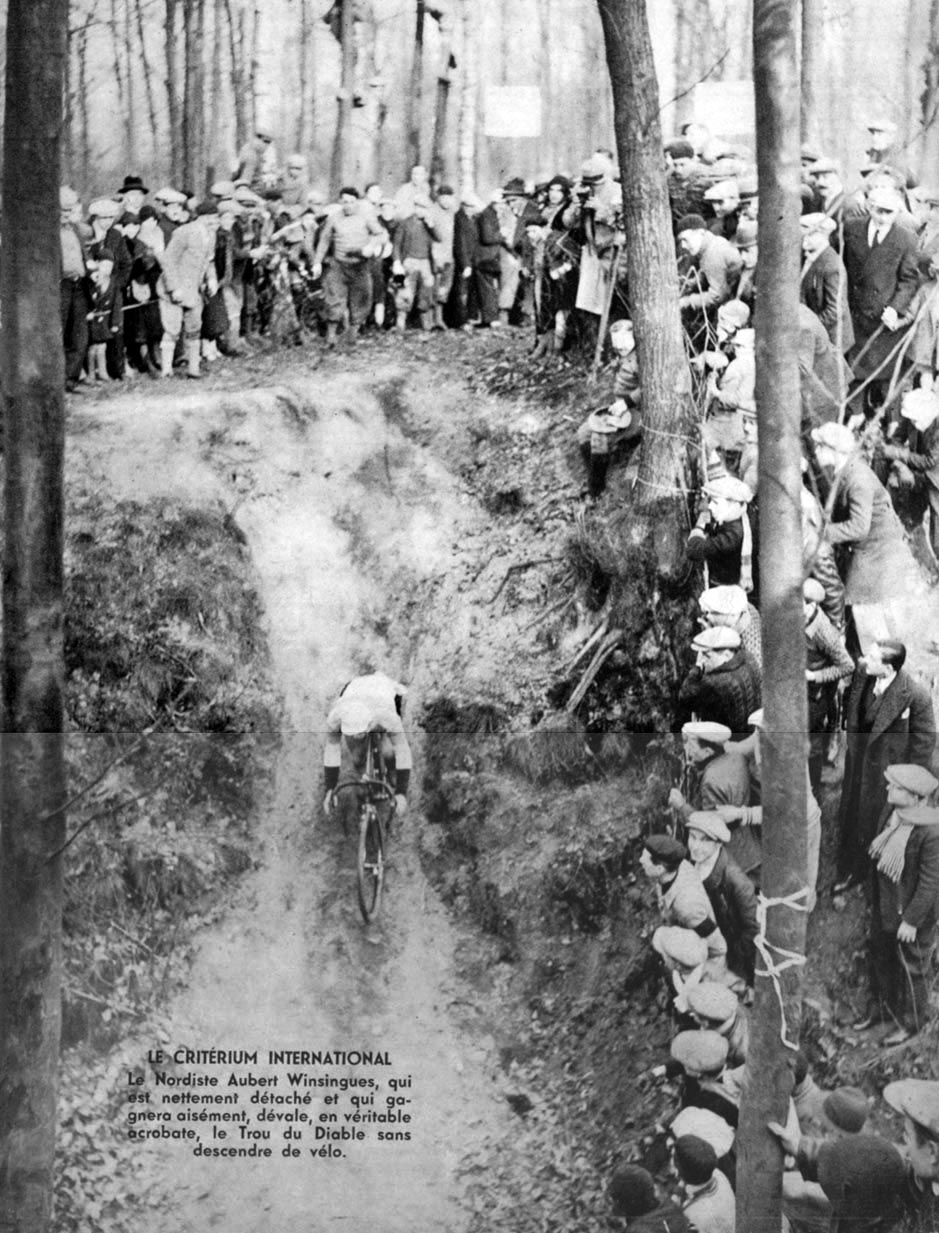 [/img]
[img] 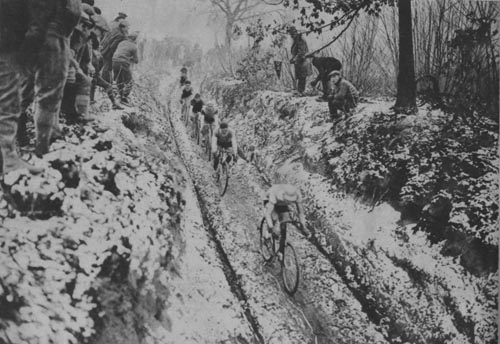 [/img]
[img] 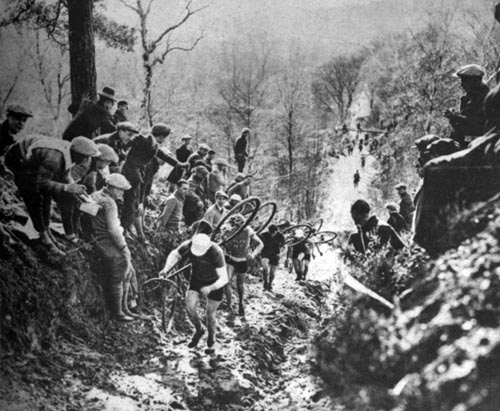 [/img]
[url= http://www.blackbirdsf.org/cx/ ]from this site[/url]
The only bit of that lot I could ride is the middle photo 🙂
Cheers Charlie, glad your not bitter
Better to be there and done it
There was early off road racing going on in NZ as well. From the comments I think this is from 1957 or so. Looks like quite fun terrain for the old bikes!
Bimbler - Member"I'd never heard of Geoff Apps before and I was an earlyish acolyte of (1986/1987) mountain biking
Interesting stuff on Geoff Apps and Cleland bikes
I have no doubt that mountain biking as we understand it, especially the gnarr rad-dude wing is an American invention. They merchandised it, industrialised it and through the power of marketing proselytized it".
[b]"Lets face it if it wasn't for American can-do-ism there'd be a few hundred mountain bikers in the UK paying £2000 for a 30lb bridleway blasters built by Geoff Apps and his ilk".[/b]
This last statement is probably pretty close to the mark. Though Cleland Cycles Ltd. stopped trading in late 1984, this wasn't directly due to competition from American style mountain bikes. Geoff Apps had been promoting his designs for years but conservative British manufactures did not see the point of cycling off-road and so were not eager to make his designs. So he set up his own business making them. However the timing was not good as Britain was in the middle of an industrial recession, suppliers were jumpy and pulled the plug on credit facilities, and that caused a cash flow crisis. By then Apps had spent all his money and was not prepared to go into debt in order to keep the Cleland Cycles trading.
However, Cleland customer David Wrath-Sharman, both loved the way the Clelands rode, and had the engineering skills to improve the design and build Cleland style bikes to order under his Highpath Engineering Brand. Meanwhile Geoff Apps' frame builder, Jeremy Torr, carried on making Cleland style bikes under his own English Cycles brand. Both these ventures did well at first and I believe if the American mountain bikes had not been invented they would have carried on making expensive bespoke bicycles for a steadily increasing band of enthusiasts. But the high quality and relatively inexpensive mass produced mountain bikes, made the Cleland style bikes look increasingly overpriced, and Apps's vision of affordable mass produced Clelands never came to pass.
However Cleland style bikes did not disappear completely. Many owners still used their Cleland, English Cycles and Highpath bikes, often in preference to mountain bikes. Some like myself still do, and Geoff, D.W.S.and others enthusiasts continued to design, built and ride a wide range of developed variants. However it is only now with the backing of Brant Richards that the the dream of a mass produced and affordable Cleland is looking likely.
If the mountain bike not been invented in the US would the Clelands have been more successful?
I believe they would. As both the design, and the idea of cycling off-road for fun, are sound.
There would certainly be"...be a few hundred mountain bikers in the UK paying £2000 for a 30lb bridleway blasters built by Geoff Apps and his ilk." Things could have grown and evolved and got more sporty, sexy and less practical. There were UK based entrepreneurs who promoted mountain biking like Errol Drew of Ridgeback, or Drew Lawson and Ari Hadjipetrou of MuddyFox etc, who could have equally seen the potential in Apps' ideas.
Had the mountain bike not been invented, could Cleland derived bikes may have eventually gone on to be sold and adapted globally?
We will never know, as mountain bikes were invented, and we can only speculate.
[url= http://i419.photobucket.com/albums/pp271/repackrider/avatar235.jp g" target="_blank">http://i419.photobucket.com/albums/pp271/repackrider/avatar235.jp g"/> [/IMG][/url]
[url= http://sonic.net/~ckelly/Seekay/mtbwelcome.htm ][b]2retro4u[/b][/url]
Marin County, Cali
I am leery of the word "invent." The mountain bike was not so much "invented," since it used elements already on the market, as it was "designed" to accomplish something no one had yet marketed a bike for.
In no respect did any of the Northern California people expect fat tyre bikes to dominate the industry. We thought that "MountainBikes" would appeal to the same people who bought cyclcross bikes, perhaps a few hundred or a thousand a year, not enough for the big companies to bother with but a big enough number to keep our tiny shop in a rented garage busy.
We were wrong about more stuff than we were right about.