I think I know what I want to do to my Marzocchi Z2 to decrease low speed compression damping and make it more supple on small bumps e.g. armoured trail centre trails etc, but where on earth do you get shims?
Silverfish. Should have searched better.
you going to change the stack yourself???
I've GRIP2 fox 36ers and cos i'm light, i'm riding with the LSC fully open... Would like to readjust it to have a bit more range...
DrP
Makes sense to have a go yourself if you've got the shim stack info and know what you're doing, seeing as service places like jtech want an extra £50 for shuffling a few shims around. Ludicrous price.
I figure that you pay the money for having your shims shuffled by someone who knows what they're up to. If you already know or fancy finding out by trial and error then happy days.
Reasons for doing myself:
- The damper is at the top of my fork at comes out on its own so no full rebuild required
- Once done I can put it back myself or make further adjustments if I decide I don't like it, without sending it off.
- It's not rocket science
- The full rebuild instructions from Marzocchi cover removing and replacing the shim stack, and give part numbers and dimensions.
- I've watched this excellent video which is about motorcoss but it applies. I have a single stage shim stack, my plan is to add another small washer over the biggest one to give it some room to move more freely at first as a two-stage stack, which I hope will achieve my aim. If not, I'll put it back the way it was.
@DrP if you just want to change the overall range of damping adjustment, replace the oil for lighter then you will be able to turn the knobs up. In my case, I want to change the force only for certain ranges of force. It's really good in heavy chop, just not on lots of small bumps.
There's plenty info out there already, for example Rockshox have all their shock tunes explained with diagrams dimensions and even silhouettes of the shims laid out, hard to go wrong, therefore £50 extra tuning charges are a bit of a urine extraction imho.
This vid which is MTB specific reckons a split stack is a niche application, so perhaps it's more of a MX thing. I've ordered a selection of shims so we'll see.
Do it! I've been tuning my forks and shocks for years, its a great way of getting what you want from what you have.
I agree about the 'tuning services' from service providers - I reckon most of the time they're taking a punt with a bit of a shim shuffle (probably not even placing new shims in the stack - simply changing the order of what is already there!) Don't get me started on the whole Smashpot/GRIP XYZ/etc etc 'upgrades' - personally I think they're the MTB equivalent of directional HiFi speak cable or £6k 'low noise 3amp fuse'.
I like an active suspension (no point in having it if you don't use it) so automatically reach for the 5wt fork oil (the thinnest my local MX-shop sells) and work from there. Always struggled to find shim sellers, so have gone with MX-Tech.com previously, but they are States based so long postage times. Although if you're looking to build a 'library' of shim sizes and stack builds then they're pretty cheap.
@molgrips - let us know how you get on, what stack did you start with, what did you change it to and what's the difference? Would be interesting to see.
For those who like their information in paper form, I found this book to be excellent for those thinking of diving into their dampers in a bit more detail:
https://www.amazon.com/Techs-Motorcycle-Suspension-Motorbooks-Workshop/dp/0760331405
This is what it looks like now:
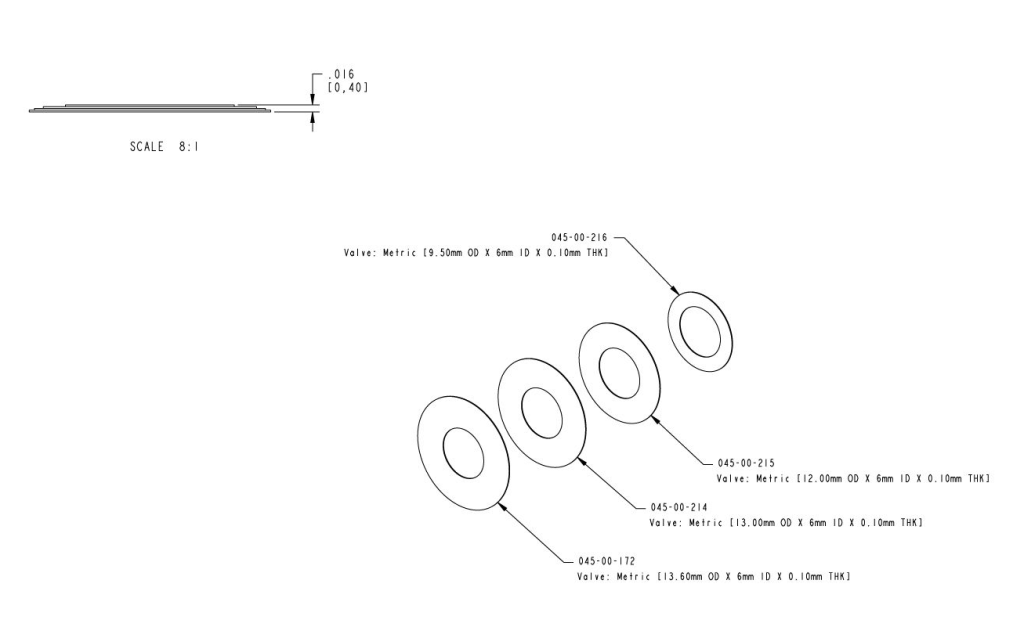
And I think there's too much low speed compression. I can only get the smallest three shims from Silverfish. So one option is to fit another one of the small ones between the two larger to create a split stack. That might be too much, so the other option is to replace the 13mm one with another 12mm one which would be about as subtle a change as I think I could do. If the split-stack idea is too much I could pair that with tokens. I'm currently using none, and I can go up to four.
It's a pretty stable pedalling platform as it is, and doesn't dive much which I think makes the bike nice and manoevrable on technical ups and downs.
Looking at the weather I don't think I am riding today, so perhaps I'll try swapping the middle two around today and see what happens.
Cool. If it were me, I'd probably start with sticking the 9.5mm shim between the 13.6mm and the 13mm shims to see what that does. Might be too much, but you get the feel of what it does and how much of a difference it makes pretty quickly, meaning you can work from there - especially if its dead easy to pull apart and shuffle it all back if it's a disaster!
Edit: Be careful about the total shim stack height: Many shocks have a hollow bolt which holds the stack onto the piston head. This provides a by-pass allowing oil to flow through the bolt, into the shaft and through into the other side, the rebound pin often adjusts up to this bolt to regulate the flow. If you place additional shims into the stack, the bolt doesn't tighten down to the same location and the rebound adjustment is affected (hope I've explained this properly....)
I had a go at "tunnig" my Lyrik, but tbh it didn't help. The issues were caused by some misalignment of the bushings not the damping causing it to feel really harsh. I think the damper and shims are quite finely tuned and it's easy to mess it all up. They often aren't designed to run anything than the stock shim setup unlike the rear shock (which what Rockshox's published shim stacks are for) or an mx fork.
Often the problem with mtb shocks seems to be the flow ports through the piston. Seems to be cheaper to use a restricted prison and a couple of shims and limit tuning rather than I high flow prison with lots of shims which can then be turned accordingly.
In the past, I've found little useful change paying for shim shufflers but when a tuner starts talking about swapping or modifying the piston, they're usually serious about actually changing the performance
Sure, I could mess up the damping, but it's a non-destructive change so I can easily un-mess it.
On this fork the rebound assembly is completely different and at the other end of the damper, and it does not appear to have a shim stack. Nothing is mentioned in the docs.
I will keep an eye out for bypass ports, but if I am understanding this right the only oil passage through the fixed piston is pushed through by the displacement from the damper shaft, so the volumes must be really low and hence the restriction would be high. This suggests there's no port. That said, the compression knob can all but lock it out, so that suggests there's a port that it can occlude.
In the past, I’ve found little useful change paying for shim shufflers but when a tuner starts talking about swapping or modifying the piston, they’re usually serious about actually changing the performance
Noted, I'll bear that in mind. I won't bother modifying a piston unless it's obvious, and I doubt anyone will provide a high end service for a low end fork.
You can buy the tools to rebore your bushings. Tool and a couple adding 0.07 or 0.10.
I wonder if most of the time suppleness is found not by adjusting shim stacks, but rather a rebore.
An expensive tool, but if an LBS bought a set and started offering the service it's become "affordable" during a shop service?
You mean to widen the bushings?
I did this after having them changed with a brake cylinder reaming tool from Halfords. They were too tight IMO. It worked pretty well. I removed the seals from the lowers and put the steerer tube in my bike stand upright. I'd read that the lowers should just slide straight off the uppers, so I gently reamed the bushings til they did. Big improvement in suppleness.
I will keep an eye out for bypass ports, but if I am understanding this right the only oil passage through the fixed piston is pushed through by the displacement from the damper shaft, so the volumes must be really low and hence the restriction would be high. This suggests there’s no port. That said, the compression knob can all but lock it out, so that suggests there’s a port that it can occlude.
That's how the old Bomber 55 TST2 damper operated - displaced oil from the shaft was controlled to provide compression damping. Very effective but in the TST2 damper Marz had completely blocked the ports with 3 x 1mm steel washers to enable the TST lever to diver through a port or not (lock out). It's the set-up that got me into tuning in the first place.
Be aware that if there's a bypass port then the 'near lockout' setting means that the movement you get in this mode is achieved by all the oil flowing through the shim stack. It shows how much the valve shims are restricting the flow. In this case, if you mess with the stack then you'll reduce this effect (i.e. not be able to 'lock out' the forks with the compression knob. (I'm sure you realise this but you never know who's reading this and planning their own attempt).
Of course, if the compression is done via a spring that winds pressure onto the shim stack to provide more resistance to the flex of the shims then the result could be similar in that you lose the heavier compression settings.
You can buy the tools to rebore your bushings. Tool and a couple adding 0.07 or 0.10.
I wonder if most of the time suppleness is found not by adjusting shim stacks, but rather a rebore.
An expensive tool, but if an LBS bought a set and started offering the service it’s become “affordable” during a shop service?
Reaming the bushings is always my first step to tuning a new fork. Often the bushings are either too tight or not round enough.
I have the blue liquid lab tool with fittings for 34 and 35mm stanchions.
I think Fox have subcontracted their strip down and rebuild manual to Haynes. "Undo the nut from the shaft.." er.. no.. the entire shaft has undone from something else now I can't do anything. That was not supposed to unscrew at all according to the pictures.
I have the blue liquid lab tool with fittings for 34 and 35mm stanchions.
Is that for sale anywhere?
Reaming the bushings is always my first step to tuning a new fork. Often the bushings are either too tight or not round enough.
.. goes off to read about tight bushings on new forks ..
Great, now I have another job to do 🙂
Is that for sale anywhere?
They're not conventional "click to buy" for sale but I just contacted Oliver and ordered direct.
http://blueliquidlabs.com/suspension/fork-bushing-tools/
https://www.mtbr.com/threads/tight-bushings-harshness.1129699/
If you fancy a trip down the rabbit hole!
Burnish or hone? I am considering removing the abrasive bits from my brake cylinder tool so the bushings will just get rubbed with metal (one has fallen off anyway). That might have a similar effect to burnishing.
Managed to get the nut off the end. Funny, there's only three shims here not four. Swapped two round, reassemble, lockout doesn't work. Ok fair enough, put back the way it was - lockout still doesn't work. Balls!
Maybe there were originally four after all...
You really don't want to be removing any material from the bushings. The heads on the tools are smooth and leave no marks.
The tool I have has three pieces of very fine grit stone on it. It's meant to be smooth enough for the inside of brake cylinders. Also worked very well on my 66s. But yeah.
Well I had a go at my bushings and posted in the other thread:
https://singletrackworld.com/forum/topic/marzocchi-z2s-dry-from-factory/#post-12883314
I just went for a ride and they are way more plush, what forks should feel like, although they are at what I would consider the slack end of normal so I hope I haven't removed too much material...
Anyway, regarding the shim stack it's not quite as shown in that MX video. When you turn the knob, you aren't preloading the shims with a spring, you're actually opening a gap between the shim stack and the thing that clamps them in place, so they are free to move. The more you 'open' the damper, the larger the gap which means the more the shims can move without having to flex. The spring effect of the shim only comes in when the flow is fast enough to create enough pressure through the gap to bend the shims. So it's already a sort of two-stage effect. The size of the gap you can open (by turning the knob) affects low speed compression, and the flexibility of the shims affects high speed.
There's a few of things to try if you want less compression damping. The compression damper adjustment is on a screw thread. It's simply the handle on the knob butting up against the crown that limits the travel. The top of the damper control shaft it attaches to is a hex head so it is possible to remove the knob, turn it through 60 degrees and refit. This occurred to me on the ride home so I can't say what it's like on trails. However, examining the mechanism shows that only half or three quarters of a turn of the shaft has any effect so this is limited.
Another option is to go to 2.5wt oil from the specified 5wt, and increase the stiffness of the shim stack so you don't loose too much high speed and start diving on big hits. But you can't add more shims because this will close the gap and reduce low speed which is the opposite of what you want. You'd have to add larger ones, but there's only 4 so you don't have that many options.
You could remove the smallest shim thereby creating a larger gap, but you'd have to hope that turning the knob would still tighten the thingy enough to clamp the stack down, otherwise you'd lose lockout. I'm not sure I'd care, since my rear shock doesn't have a lockout and riding a FS bike with only the front locked out is a bit odd.
The part of the static 'piston' with ports in it is actually pretty small, so if you had access to a lathe and a supply of shims in various sizes you could easily make a bigger one, with more holes, and cover them with bigger shims.
On either Pace or early DT forks you could reset the adjuster position to give access to a great damping range.
Ok so resetting the knob seems to have helped. If anyone else feels like they need a more active Z2 here's what I did:
I put the adjuster in the extreme clockwise position and then removed the knob via the little bolt in the top. I then wound it back in so it was not fully locked out but as stiff as I'm ever likely to want it, then put the knob back on in the same clockwise extremity.
Hi @benpinnick
We use these – https://sicd.co.uk/product/suspension-fork-bushing-sizing-tool/
/blockquote>
do you check bushes on forks supplied on customers builds or as extra customer service?
I still wasn't happy on rough fast ground so I put in 2.5wt oil. Definitely the right weight to go for, but you will also want more tokens.
@Rootes1 sorry I never did reply - we don't have time to do every one. I hope one day we do but that would (ironically) need far more forks going through the workshop in order that strip and rebuild becomes a thing. We are starting to offer custom tuned Fast dampers and shocks though, and trutune will appear soon for lighter riders too.
Right now we do bush sizing on the obviously stiff ones, plus its a free service for anyone thats not happy with their fork (if bought from us).