I am notorious amongst my ride-buddies for hanging off the back of my bike them moment the gradient gets more than a gentle downhill roll.
It's a fair cop.
How do I stop? (Don't just say 'don't do it', I already tried that).
Tips and tricks please.
Thanks
160mm stem? You won't be able to.
keep your arms bent, elbows out. Google 'attack position'
Go on a skills course?
I went on one of Ed Oxley's: first thing he noted about all of us was that we were too far back on the bikes when descending (he followed each of us down part of a blue trail so nothing extreme), explained why it was bad for handling and showed what we should aim for.
A couple of things could be happening:
- You're getting scared, so back off the bike
- Your bike is accelerating away from you, so you end up behind it
You want your weight centred above the BB on the bike, so you need to pay attention to when you know you're not centred, and rectify it.
If you find the bike in front of you, try to slow it down before entering the section, that way you've got time to think and adjust.
The reason why you don't want to be off the back of the bike is that you'll lose front end grip, which will make the bike feel skittish, which will make you scared and the whole loop repeats itself.
For me, the answer is practice and sessioning. Get your mates to film you, and shout when you're off the back.
****ing skills course is always the answer, are people that incompetent they don't know how to ride a bike?
400mm seatpost at max elevation, you won't be able to
Get some shorts with a baggy crotch that catches on the nose of your saddle.
Shorter legs.
Go on a skills course?
+1
my post of :
was one of the first things I got from a session with Rab Wardell at Dirtschool.keep your arms bent, elbows out.
many posts. some helpful (thx). this is obviously a common problem!
[i]**** skills course is always the answer, are people that incompetent they don't know how to ride a bike?[/i]
never hurts to get better does it? Once you got past the "big circle in the woods" type of riding, and you're getting to grips with technical aspects, why wouldn't you learn some basic techniques?
rickonThe reason why you don't want to be off the back of the bike is that you'll lose front end grip
Not to mention the fact that if you're hanging off the back, your arms will be stretched out forwards at full reach. Hence, every time your front wheel drops into a hole, it will cause the handlebars to yank on your arms, pulling your body mass forwards. And, as you weight at least 5x what your bike weighs, this generally leads to a short, sharp and often painfull trip over the bars!
There are two ways of bringing "stability" to a bike and rider, but although there are times when you do need to be kissin the rear tyre with your ass, they are actually pretty few and far between. Much better to get low, with bent arms/legs to keep your mass decoupled
never hurts to get better does it? Once you got past the "big circle in the woods" type of riding, and you're getting to grips with technical aspects, why wouldn't you learn some basic techniques?
agreed, the best athletes in the world still have coaches.
Alternatively - not better, but cheaper - download, read and practice Lee McCormack's book.
agreed, the best athletes in the world still have coaches.
who coaches these "coaches"
The results of their coaching re-enforces their ideals and so a spiral of improvement for rider and coach is created.
When improvements stop - time for a new coach and a new spiral.
[i]Go on a skills course?[/i]
We did one with Andy at Ridelines (Glentress), stopped me doing it and I'm now far happier going down steep stuff - and tbh mtbing in general.
Perhaps if you had a dropper post you wouldn't feel the need to hang off the back.
If you can read and your mates help by shouting at you, you wont need a skills course.
Its not rocket surgery, its riding a bike 🙂
agreed, the best athletes in the world still have coaches.
who coaches these "coaches"
it's usually an awful lot easier to see what someone else is doing wrong than to notice it yourself. Not to mention that some people are better than others at analysing things (the most naturally skilful riders sometimes struggle when "just doing it" isn't enough)
Given that the OP knows he's getting something wrong then a skills course seems a reasonable suggestion.
Obviously riding gods have no need of such things... 🙄
Are you any slower than your mates?
Who cares where your arse is al long as you're having fun.
The point about top athletes having coaches is that the coach acts as a sounding board for the athlete, they are rarely anywhere near as good as the athlete they are coaching - Andy Murray having Ivan Lendl is one exception I can think of but it's actually quite rare.They look at the athlete dispassionately and offer suggestions for improvement.
The OP is in a classic negative feedback loop. A similar scenario happens in skiing: to control the skis you need to push forward through the front of the boots so that the tips of the skis bite rather than flap about (this is the origin of the "Bend ze nees" phrase) but the natural reaction when you pick up speed is to push back from the danger. So yes, you do "bend ze nees" but that is as a result of pushing your bodyweight forward whilst still keeping your centre of gravity above the centre of the skis so from the side your body is a sort of Z shape. In mountain biking speak, this is the attack position.
The OP needs someone to assess his riding and offer reasoned suggestions for improvement, let's see - a skills course!
I was guilty of this particular sin too
OP do you ride with SPD's or Flats?
keep your arms bent, elbows out. Google 'attack position'
This is good advice IMO.
You want your weight centred above the BB on the bike, so you need to pay attention to when you know you're not centred, and rectify it.
And this.
Practice riding some steep bits with your mates, feather the brakes don't lock them and keep looking ahead.
> Are you any slower than your mates?
Yes.
> Who cares where your arse is al long as you're having fun.
I don't particularly care about being slower then them, partly because they are very fast.
But I do care being dumped on said a**e due to crappy technique.
I love my riding and regard trying to do my best part of the craft of that.
To everyone else: any personal tips apart from 'do a skills course' (which I will).
> OP do you ride with SPD's or Flats?
SPDs.
> keep your arms bent, elbows out. Google 'attack position'
Thx, this looks handy:

My thoughts ... ensure you can feel some downwards pressure on your hands (bent arms above is a good suggestion) if you can feel that your weight is too far back. You might like to find a not too steep slope and practice some mild pumping / weight-unweighting as you roll down, can can't really do that if your weight is too far back.
Get low, not back. Bend your arms and your knees and get your heels down. Look beyond the bottom of the drop to where you're going next. Commit and 'drive' the bike rather than just hanging on. Relax and remember to breathe.
> OP do you ride with SPD's or Flats?SPDs.
Yep me too. I was relying on the spuds to keep me on the pedals even with my body in the wrong position.
Consider switching to flats for a while. You'll have to get more centred on the bike or you keep slipping off the pedals.
But to be fair you've identified the problem and that's half the battle. I was oblivious and it was only going on skills course that it was spotted.
are people that incompetent they don't know how to ride a bike?
Ride a bike, or ride a bike well given the conditions found? Mountain biking is a sport that seems to have bred the 'I can ride a bike, don't need nobody telling me what to do' mentality. Most sports have an acceptance that a level of coaching is a part of improving. It's pretty arrogant to think someone else can't help you be a better rider.
I have found that if I am riding well then I am pushing the front tyre in to the ground and tracking the terrain, then I have to be forwards.
bent elbows, low over the saddle and relaxed, then you can push the tyre in to the terrain where you want most grip.
Its good to go to a pump track as the riding position on a pump track equates well to the attack position.
this also gets you to use your legs a lot more.
It's a good thing to sort you will get so much more confidence on the descents and in corners if you can get a more centered or even forward position. Fabien Barel did a good video on this and about people running their rear sus too firm and their front sus too soft because they are too far back on the bike.
+1 for a skills day
+1 for playing on a pump track
-1 for making rude comments about your desire to be a better rider 🙂
Can i make a suggestion? Can those who went on a skills course to solve this particular problem post up how to do it? It'll save the OP a lot of money (cue lots of 'best upgrade you can buy...blah blah blah..riding gods blah blah blah...')
Fabien is not only fast he really understands good technique.
Can i make a suggestion? Can those who went on a skills course to solve this particular problem post up how to do it? It'll save the OP a lot of money (cue lots of 'best upgrade you can buy...blah blah blah..riding gods blah blah blah...')
I switched to flats for most of my riding, it forced me to think more about my body position.
I also try and remember "Chin over stem Hips over BB" whenever I feel I'm slipping into old habits
Are you any slower than your mates?
Who cares where your arse is al long as you're having fun.
But the OP isn't having fun is he...
A skills course will definitely help. I've just been on one, and it has made me much more confident on the bike again, to the point it is almost like rediscovering riding an MTB again.
I sort of hinted at it with my skiing analogy: but think of the bike pivoting around you whilst you try to keep your CofG above the bottom bracket - think of a plumbline dropping from just behind your belly button going through the BB. So on a descent, as the front wheel becomes lower you move back [i]slightly[/i] to compensate and keep the plumbline through the BB. Obviously at some point the slope will become steep enough that you [b]will[/b] be behind the saddle but that would be pretty steep.
probably not very useful to the OP but the tip that helped me recently was lasercock©
i'd do a bit of research on the ideal position, then just practise on some less steep stuff and get steeper as you get more confident. It'll come fairly quickly i reckon. Like others have mentioned it happens with sking and boarding.
Can i make a suggestion? Can those who went on a skills course to solve this particular problem post up how to do it? It'll save the OP a lot of money (cue lots of 'best upgrade you can buy...blah blah blah..riding gods blah blah blah...')
The point of a skills course, in fact, any kind of coaching whether for sport or other things, is that the mistakes people make and the reasons why they make them, are individual... and therefore a personalised solution is required. Being watched by an experienced coach is far more effective than a bunch of strangers on the internet telling you what worked for them.
IMO those of us raving about skills courses are doing it because a good one is really, really effective, and can transform your riding. For me, there's no glory or fun in mincing down stuff I can do at speed and with style for the sake of a skills day and a bit of practice. Helped to stop me breaking bones too 🙂
the 'attack position', bent elbows, as per my previous post, and the jpeg that anotherposter linked are/were the biggest changer for me. I do find that I have to tell myself on most rides to get the weight forward and think of my arms as big springs to soak up holes under the front wheel.
It's interesting as I've been drumming this into my kids and the 8 yr old cleared all of Cathkin yesterday for the first time (except the water splash climb) 🙂
The course I went on was all focused around the principle of centre of mass over the bb and your position neutral ie if you let go of the bars you would fall neither backwards nor forwards. Obviously there are occasions when you need to otherwise, but this is your base position. Join that with knees and elbows bent in attack position heels down etc.
Seems to have served me well over the years, I've not been thrown over the bars since the course.
I personally haven't found the skills courses I've done quite so revelatory, just to provide a differing point of view. Not a waste of time, indeed quite a good use of money (a small fraction of what I spend on my bikes) but not really "transformative". Maybe I'll try another.
Some thoughts on the OPs question
1. This is a bit of a boring video but it did get me thinking about position on the bike (but not training in a gym as the presenter recommends!):
2. Go riding your hardtail on local trails in lots of filthy winter mud. Put a good mud tyre on the front (maxxis beaver) and keep something more normal on the back. Should teach you to get your weight forward as you will get instant feedback when it isn't, i.e. you will slide out of every corner 😀
thx all for the good tips, plenty here to work on.
"get low not back" feels like 4 valuable words, a good place to start.
nobody need worry that I don't enjoy my riding
lol @ sideshow's no 2, creative.
Repetition.
Retraining yourself by picking an easy gentle slope that feels safe. Riding and re-riding it, modifying position to find one that keeps front wheel traction without the risk of tipping over the bars.
If you're feeling heroic find out how far back or forward you can get before you lose the bike whilst there's nothing nasty to land on
whitestone - MemberI sort of hinted at it with my skiing analogy: but think of the bike pivoting around you whilst you try to keep your CofG above the bottom bracket - think of a plumbline dropping from just behind your belly button going through the BB. So on a descent, as the front wheel becomes lower you move back slightly to compensate and keep the plumbline through the BB. Obviously at some point the slope will become steep enough that you will be behind the saddle but that would be pretty steep.
I like this. I also liked, I think it was maybe Andy Weir at Ridelines, who suggested imagining the bike hanging under you on strings rather than you being plonked on top, we tend to describe ourselves as moving around on the bike but for this I think it's maybe better to think about moving the bike. It's essentially the same thing o'course but in my head at least feels more mobile.
The trouble is, everyone visualises and interprets things differently, what works for one person won't necessarily make any sense for the next. This is one of the things that makes a good coach/trainer good, they're not just parroting lines, they're both working on the problem and working on how to get you to understand it and what to do.
The course I went on was all focused around the principle of centre of mass over the bb and your position neutral ie if you let go of the bars you would fall neither backwards nor forwards. Obviously there are occasions when you need to otherwise, but this is your base position. Join that with knees and elbows bent in attack position heels down etc.
Thats very interesting, just from that one paragraph, I know that you must have gone to a different skills coach to me, yet we live in a similar area.
I am not saying either is wrong, just different approaches to teaching I guess, and I bet both have similar outcomes.
[url= http://singletrackworld.com/reviews/mucky-nutz-butt-fender/ ]Mudguard with a design flaw[/url]
Thats very interesting, just from that one paragraph, I know that you must have gone to a different skills coach to me, yet we live in a similar area.
It's probably more likely me not explaining it very well. The plumb line thru your bb analogy above is probably a better description of the same thing I was getting at.
Change your saddle
[img]  [/img]
...if you let go of the bars you would fall neither backwards nor forwards
'Heavy feet, light hands'
I found these videos very useful (parts two and three are probably most relevant to the question - bear with it):
(Fabien Barell's videos, also)
I'm glad someone has said heavy feet, light hands... while in a neutral descending position, you should feel as though you could let go of the bars and wouldn't fall backwards. Most of your weight will be through your pedals ergo bottom bracket.
I'm glad someone has said heavy feet, light hands... while in a neutral descending position, you should feel as though you could let go of the bars and wouldn't fall backwards. Most of your weight will be through your pedals ergo bottom bracket.
In fact, think about your heels too. If you can't drop them then you are probably too far back.
Yesterday I could feel the rear tyre buzzing my ass on a popular cheeky trail in the Peaks.
So Im doing it wrong then?
hora
So Im doing it wrong then?
I think that's pretty much a given don't you?? 😆
Well I went on a skills course and one of the take-home lessons I learned was to get my weight back when it gets steep. Clearly there is a difference between getting your weight back a few inches as is necessary and hanging it all the way out there so your Nobby Nick is parting your butt cheeks. Practice will get you understanding how far to put your weight back for a given gradient/feature. In anycase you're better off having your weight too far back than not far enough, a guy who's been joining us for the last couple of rides, a roadie having a go at mountain biking, went over the bars this weekend and bust his collar bone - he now wishes he'd got his backside further back. He did refuse to lower his saddle as we advised when we were coming upto the steep stuff, but he didn't seem to want to move his saddle for some reason.
wobbliscott - MemberIn anycase you're better off having your weight too far back than not far enough
Mmm. But having your weight too far back reduces grip on the front wheel and can also cause crashes.
The overriding consideration when road cycling is efficiency so getting the saddle height correct for maximum power is of prime importance. A mate who's a roadie and now does a bit of mountain biking recently fitted a dropper post as he'd come to a steep bit where his mates had promptly put their droppers down and he'd struggled. His comment was "Why? .... Oh f***ing hell!" and at the bottom "I need to get me one of those"
I liked the mcCormic book as well and reckon it's worth a read..got some good pointers in it.
droppers are absolutely fing fabulous 🙂
I am moider for this also, have suffered a couple of heavy crashes due to losing the front end because of this.
Surely Lasercock™ is the ONLY riding tip for all ills 😉
(actually, might work, since you probably can't successfully point your nob if you're right back)
hora - Member
Yesterday I could feel the rear tyre buzzing my ass on a popular cheeky trail in the Peaks.
So Im doing it wrong then?
POSTED 32 MINUTES AGO #
Not necessarily, google images will bring up plenty of photos of the worlds best DH riders hanging so far off the bike they're almost touching the tyre with their shorts...as always it depends on how steep the descent is.
First time I rode at Rogate-DH I experienced loads of front end wash outs, being new to gravity type riding I assumed it was tyres so spend loads chopping and changing in an effort to find one that would bite into the ground there....it never worked and it was only when I became more confident and read up on DH techniques that I was able to move my weight from hanging off the back in a terrified novice manner to being lower but more central on the bike....hey presto the front tyre suddenly had grip where previously it had none and my lesson was learned.
There are courses with sections where you will need to drag your arse on the rear tyre, I just haven't control across any yet in my relatively short and recent obsession with gravity orientated riding.
I'm not sure lasercock has any application here. Or darcy turenne's t'n'a for that matter.
This is a good example of what a lot of people on this thread are talking about. still a pretty perfect plumb line down his centre of mass thru the bb, despite a steep slab and saddle in the way.
[img] 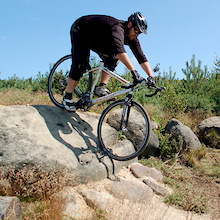 [/img]
Perfect B.A. Nana!
so it seems that 'get low not back' and the head down attack position work quite well.
who'd have thought?