Strap in this is going to get geeky quickly.
Looking at the switchback MK3 frame geo on Stanton website ( https://www.stantonbikes.com/product/switchback-gen-3/) and comparing it to the mk2 that I currently have (geo here - https://geometrygeeks.bike/bike/stanton-switchback-631-mk2-2017-1/) there doesn't seem to be a big enough difference between the seat angles to make up for the increase in reach (e.g. looking at 16.5" long frame reach increases by 20mm but seat angle by 0.3 degrees). I've compared it on the bike geometry calcs website and that agrees with my suspicions, a seat angle of 74.8 would be the only way to achieve those numbers of reach and virtual top tube length. Now this doesn't seem unreasonable, but why wouldn't Stanton publish those figures if that was the case? Am I missing something?
I've contacted Stanton to query as I'm interested in buying a mk3 in Ti but not heard back (yet). I like how Stantons ride but I want to be confident in the numbers before I put any money down.
Just a guess, but is one set of figures at sag and the other not?
Nope, fork a-c very similar on both - 509mm / 510mm
The new bike's much longer going by those figures- the reach difference isn't just going to be from the seat tube angle, the front triangle is longer.
(though I'd be cautious of comparing the 2 sets of figures in general, geometrygeek is a great resource but it's not always correct. And is it sagged vs unsagged, same length fork?)
Overall it says chainstays same length, chainstay angle'll be reasonably close, wheelbase is 93mm different, reach 45.5 different... so it doesn't really feel like we're comparing like with like, that's too much of a wheelbase difference to come entirely from small angle changes.
yep you're right NW, and that's another thing I noticed but wondered if the slighyly slacker head angle would account for it - 65 vs 65.5?
I'm too far gone to stop now...
This is the geo of the mk2 mapped out in bikegeocalc -
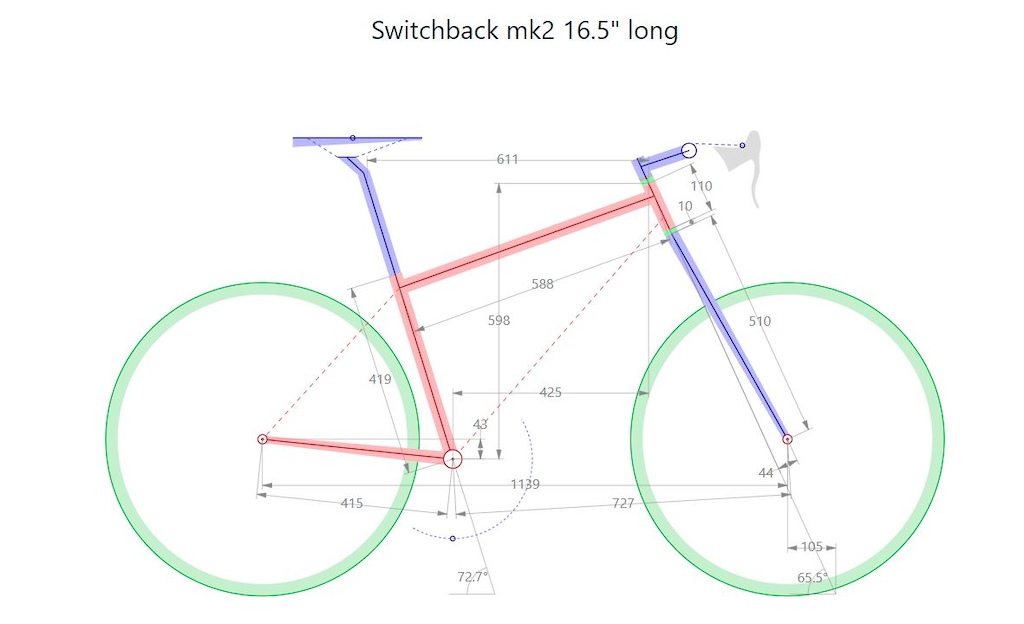
You can see the geo is pretty close to the stated geo apart from the wheelbase.
And this is the MK3 using the geo from Stantons site-
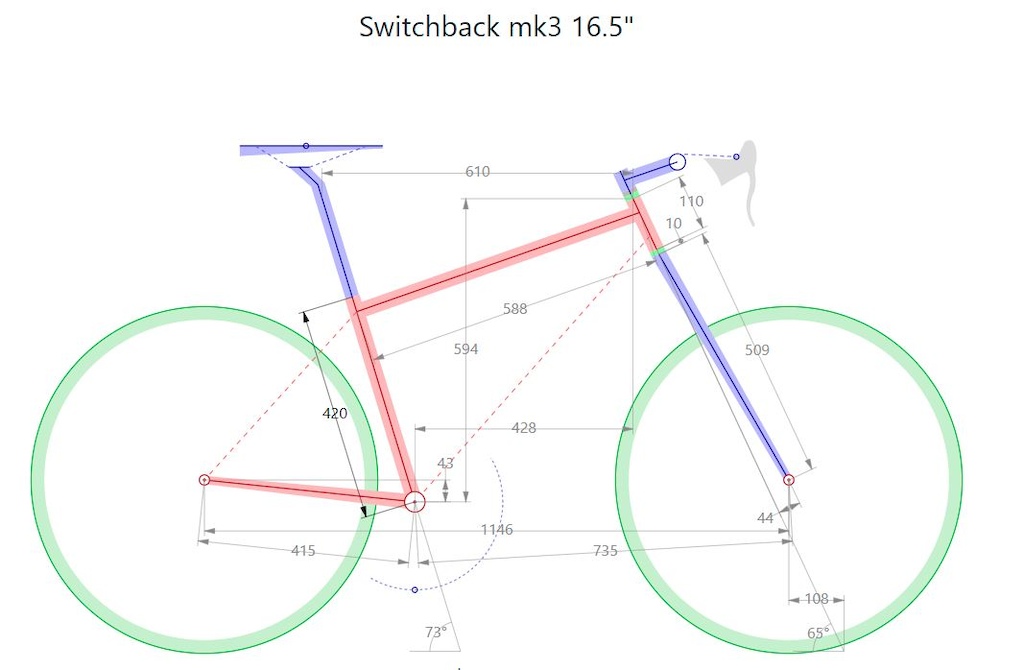
The reach and wheelbase are way off the manufacturers stated numbers (should be 448mm and 1161mm)
Changing the seat angle results in something a lot closer -
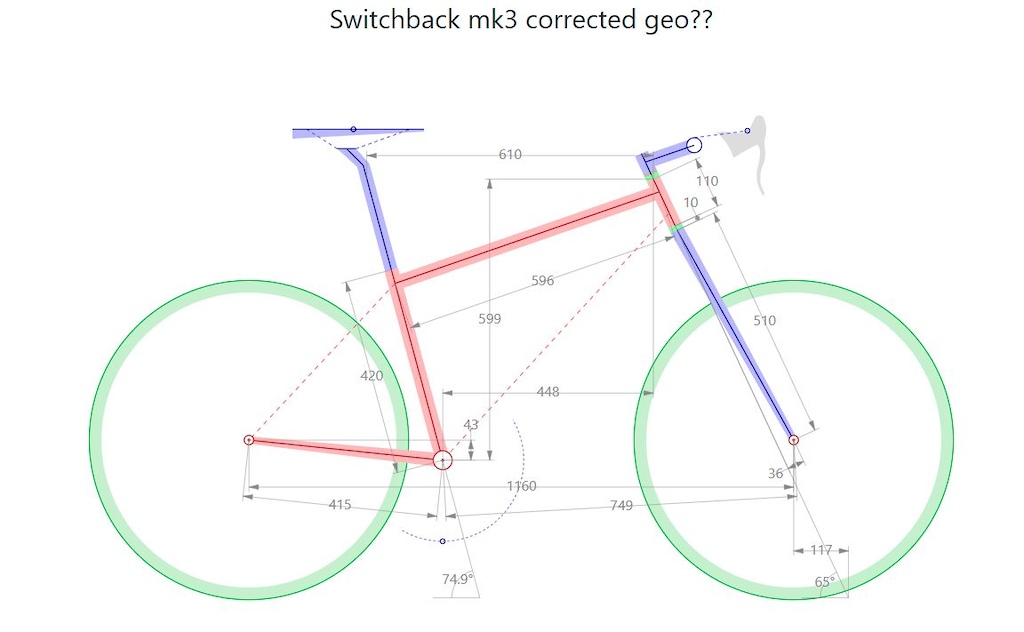
So I think that Stanton have just put the wrong seat angle on their charts, either that or the reach or effective top tube are way off. Still trying to get an answer from Stanton to confirm.
I’m sure I’ve previously found similar discrepancies in Stanton’s geo tables.
However, do bear in mind that the seat tubes on these bikes aren’t straight.
Published geo charts are notoriously wrong.
However, do bear in mind that the seat tubes on these bikes aren’t straight.
You're right and I did wonder about that, but it doesn't explain the comparison between the mk3 and the mk2 which have the same seat tube arrangement.
Published geo charts are notoriously wrong
Well that sucks, surely they can do better than that, I know some companies do.
Stevet1
Free MemberNope, fork a-c very similar on both – 509mm / 510mm
Axle to crown doesn't tell you whether the rest of the geo figures are sagged or unsagged, it's always quoted unsagged.
“ Axle to crown doesn’t tell you whether the rest of the geo figures are sagged or unsagged, it’s always quoted unsagged.”
Cotic quote it sagged. Ragley used to. And I think Stanton have done and possibly still do - or do a mix!
Axle to crown doesn’t tell you whether the rest of the geo figures are sagged or unsagged, it’s always quoted unsagged.
From the stanton site -
Measurements based on 2018 140mm 27.5" Pike RCT3 25% in to the Sag
Axle to crown is literally the length of the fork fully extended from its axle to its crown, you can't measure it any other way. It's the equivalent of eye-to-eye for shocks. Quoting it in geometry gives a reference but it doesn't tell you if the rest of the numbers are sagged or unsagged.
Cotic quote geometry sagged, and they give a definition of how they measure the overall geometry, just like Stanton in stevet1's example- but that's not the same thing as a2c. Stil important, since you need to know how long a fork and how much sag, to make a sagged figure useful for comparison- sagged is always the best way to measure but it needs that extra info.
(Probably why for years the industry quoted unsagged, we've always had a bit of a thing for "simple but not very useful" compared with "useful but it needs more words".)
“Axle to crown is literally the length of the fork fully extended from its axle to its crown, you can’t measure it any other way. It’s the equivalent of eye-to-eye for shocks.”
In the past the Stanton charts definitely just said “axle to crown length” and quoted a length which was actually the A2C of the recommended fork minus 25% of the travel. I remember because I was very confused as I was trying to compare the geometries of various bikes when choosing a new hardtail and I thought their numbers were static not sagged - until the A2C thing clicked.
I’m liking how Bird are now quoting both sagged and static. Static is better for comparing to other hardtails but sagged better for comparing to full-sus bikes.
Has anyone ridden both?
Is the STA angle quoted a virtual STA where its actually measured at seat height for the median rider?
Every bike should have a (correct) data plate
https://www.peterverdone.com/data-plates/
Even compared to bang up to date geometry, the mark 2 is still looking quite slack with a 65.5 degree head angle, sagged at 140 travel. I wonder what the static head angle is on mine, with 160 forks?