UPDATE: CLASSIFIEDS section refreshed, redesigned, searchable: Go take a look
Couple of Twitter posts from Lance last night which I thought were interesting. Remembered a thread on here where people debated the pro's and con's of discs on roadbikes. An idea that's time is coming??
"Random thought - how long til we're all riding w/ disc brakes on our ROAD bikes?"
"The UCI weight limit is 6.8 kilos. We are well below that now and have to ADD weights 2 the bike. Why not disc brakes and power meter?"
Someone who's never tried it will be along shortly to tell you you don't need disc brakes on a road bike.
I want some discs for my dads road bike, he wears through rims like there is no tomorrow.
You don't need disk brakes on a road bike.
😉
I'd look at it the opposite way. If you'd consider putting disks on a race bike as there's no weight disadvantage because of the weight limit, then how stupid is 6.8kg? Notwithstanding of course that if you're doing an event where you're worried about 6.8, then you're not allowed disks anyway.
Whos this Lance Tweets bloke then ?
Rod brakes will come back. Soon.
The problem isn't the weight of the brakes, I reckon it's the strength of the frame and fork. I imagine disc brakes generate a lot of force through the frame; perhaps you would have to add more weight to the frame?
Better off just ditching the weight limit rubbish or at least making it fairly meaningful rather than the arbitary figure the UCI plucked out of thin air a few years ago.
There's probably no real difficulty from a technical standpoint, you could easily build a frame capable of dealing with disc brakes. Might come along, who knows?
Safety is the issue here. The UCI don't want people getting bits chopped off by high-speed rotors (that's one excuse I've heard anyway).
And before you say anything, yes I know mountain bikers aren't exactly all missing fingers or noses or nipples (except Tim K). It's just UCI stupidness again, as if anyone needed to ask.
disc brakes and QR levers at 50mph? thats going to seriously hurt
Depends which way the dropout faces
I would like a road bike with discs. On a side note with regard the drop outs the ones on my focus hard tail both (ie forks and frame) face forward diagonally, it actually makes getting the rear wheel in eaiser.
I already have a road bike with disks. What's the fuss about?
And before you say anything, yes I know mountain bikers aren't exactly all missing fingers or noses or nipples
Mountain bikers don't ride in packs of 180 riders.
nothing really radical with discs on bikes as druidh says, there are loads of those poncy flat bar mtb look alike 700c things with 'em on. They would just have to have foo foo small pads and rotors or they would be way too powerful for ultra narrow HP tyres and the spindly frames, that would of course lead to brake fade on long descents. .as said there might be issues with quick releases and the force being transmitted through the forks with breaking on sealed surfaces which mtb's dont suffer with large volume tyres and suspension to neutralise the forces.
To be fair Lance spouts masses of shite on his twit, not least his renunciation of the heretic Contador which was only eclipsed by the dross of Bruyneels twits. You dont have to look far to find other twits, including Boardman, who from a point of knowledge rather than conjecture are having a right go at Lance over the nonsense, The UCI issue is that the limit is intended to make for a fairer equal platform that most companies building bikes have a potential to build winning bikes. If the weight limit went the rather dull cycle companies like the one lance rides would end up carving a ferrari style monopoly at world cup grand tour level.
The UCI issue is that the limit is intended to make for a fairer equal platform that most companies building bikes have a potential to build winning bikes. If the weight limit went the rather dull cycle companies like the one lance rides would end up carving a ferrari style monopoly at world cup grand tour level.
Well even if that were true, they could just lower it a bit. The original argument was something to do with cost, but given you can build a medium sized road bike for <£2k which is under the weight limit, it's really a bit silly now. Not to mention that Emma Pooley has to ride a bike which weighs as much as the one Magnus Backstedt was on.
I was under the impression that discs were not a viable solution because the place where you most need them like mountain descents also will generate the most heat. Ok you could start running a bigger rotor however that would incur more weight and start to affect the handling of the bike. Even if the heat issue was somehow addressed I am guessing the head tube and forks would need a serious beef up to withstand the extra stress a regular disk break assembly would apply.
EDIT: hmmm, seemed to have just repeated what Max said earlier. must read more before posting 🙂
could they aracer.. .did you just read the tattle here or did you check out boardmens twits.... if you have an issue about the dimensions or size of bikes they make Pro's race on here is Pat McQuaids phone number +41 24 468 58 11 He'd probably love to hear your views. My own road bike is a Gios ex tour team bike made in steel and still alive unlike much of that carbon composite crap they ride these days...
lance talks out of his ass.. it would be a mistake to go lapping his words up with your own tongue
i've used them discs on a road bike. Theres a definite advantage for bikes that get used for touring, commuting and throughout the winter, but i can't see any real advantage on a pure racing bike. Once the forks beefed up it becomes quite uncomfortable too.
two further points:
Someone always claims that it'll be too much power for 23mm slicks, but thats rubbish.
Theres not actually any hydraulic road brake levers out there yet.
aracer - spokes couldn't cause similar injuries?
LOL at the "too much power for narrow tyres", sorry I can't take you seriously now...
I'm sure bladed spokes would cause as much damage, if not more than a small rotor.
And don't forget all those self-propelled, heart-seeking carbon shards....
grahamt1980 - Member
disc brakes and QR levers at 50mph? thats going to seriously hurt
Rim brakes and hitting a wall at 40mph because you cant stop will seriously hurt.
The too much power for 23mm tyres thing is feasible. I can lock front and rear quite easily with my caliper brakes on my roadie.
disc brakes and QR levers at 50mph? thats going to seriously hurt
you'll be needing some 20mm maxle dropouts, then.
there's a weight limit for pro road bikes? what is this, Royal Ascot?
[i]Someone always claims that it'll be too much power for 23mm slicks, but thats rubbish.
[/i]
+1
Discs are better brakes, in every way except (currently) price and weight. It also frees the rim up, so you can run carbon without poor braking issues, and alternative profiles (tubeless?)
What I thought was interesting was the TT bikes at the tour. All the effort that went into hiding the front brake inside the fork crown on the Trek bikes - why not just fit a disc and teeny caliper, and run the hose internally? TT bikes hardly use the brakes anyway, so it could be[i]tiny[/i]
[img]  [/img]
Trolling Zoo Fighter - Member
The too much power for 23mm tyres thing is feasible. I can lock front and rear quite easily with my caliper brakes on my roadie.
Heh. The second stw'er who can lock their front wheel 😉
All the effort that went into hiding the front brake inside the fork crown on the Trek bikes - why not just fit a disc and teeny caliper, and run the hose internally? TT bikes hardly use the brakes anyway, so it could betiny
The road fraternity is not ready and it's more about looking trick than real benefits.
Apart from the fact it's rather harder to get something in the way of the spokes than it is to hit an exposed disc.
[i]The original argument was something to do with cost, but given you can build a medium sized road bike for <£2k which is under the weight limit, it's really a bit silly now[/i]
The original argument re the weight limit thing was that, right up to the mid-nineties or so, pro's were routinely drilling out components and even frames in an attempt to reduce weight.
This can have fairly catastrophic consequences if a part fails at high speed so the UCI came up with a 15lb (6.8kg) weight limit with no real reaosn as to why they'd chosen that. With advances in material now, it's easily possible to build a functioning road bike down to 12lb and, as mentioned, there's lots of off the peg bikes which are <15lb.
All the effort that went into hiding the front brake inside the fork crown on the Trek bikes - why not just fit a disc and teeny caliper, and run the hose internally? TT bikes hardly use the brakes anyway, so it could betiny
Because however tiny it was it would still be more drag than even a normal caliper, let alone a hidden one.
The original argument re the weight limit thing was that, right up to the mid-nineties or so, pro's were routinely drilling out components and even frames in an attempt to reduce weight.
Are you sure? I certainly can't say I saw many continental pro bikes with drillium that late on. It might have been popular with British time triallists and amateurs, but the pros have always been pretty conservative and known the value of reliability. In any case the UCI line was certainly a cost one.
Someone always claims that it'll be too much power for 23mm slicks, but thats rubbish.
I'm sorry but the trouble with my rim brakes (campag centaur) and 23c tyres is actually converting that stopping power into traction and actual braking in an emergency stop.
I moved to disc brakes in a heart beat the second they were mainstream and viable on MTBs but proper road bikes? I can see it on loaded up tourers and even cross bikes but 23c tyres on a racing bike really can't cope with any more braking power than a quality calliper already offers. It's easy enough to lock the brakes as it is!
tandemjeremy to the witness box please
Does everybody use really rubbish tyres that skid rather than put them over the bars?
Not a case of quality of the tyres. The mechanism at work is simply friction. One way of envisaging it is to think of a tyre as having a 'capacity'. I.e. a maximum force it can exert on the road surface before 'failing' i.e. losing traction, skidding.
To pitch you over the bars the capacity of the tyre needs to be sufficient to exert the appropriate force otherwise it will simply skid. One factor determining capacity will be the material of the tyre (hence different compounds of varying wear rates and expense). A primary factor however is contact area, quite simply how much tyre is on the road surface and how much of a purchase it is able to make. Reduce this and no matter what you do the capacity decreases. High tyre pressures decrease this contact area furthermore. Obviously on a road bike a small contact area does wonders for rolling resistance, useful in a 200km+ stage.
It follows then that it doesn't matter how strong your brakes are, if the capacity of the tyres is insufficient, then the brake will never be able to apply it's full stopping power before the tyre skids. Similar situation to speccing a too powerful engine in a small car. Try and accelerate and the wheels will just skid.
This doesn't mean I don't think disc brakes aren't a good idea. I'd be petrified going down the big alpine stages knowing that each application of the brakes brings my tube closer to explosion point.
That's my 5.5 p's worth anyhow.
Si C
While I'm in the camp of 'no real need for discs on road bikes', many of the comments above forget that the issue of power is moot - you just size the discs correctly so that they're not too powerful. You wouldn't be running 160mm rotors but more realistically something like 100mm or potentially even less for some of the skinny pro runts 🙂
Yes very interesting explanation of how tyres work, but have you ever actually tried skidding the front tyre on a road bike? Hint: if you are going to try this I recommend doing it in front of something soft.
i have discs on my road bike.........awesome too..... 😉
[IMG]  [/IMG]
I'm in favour of road discs not for more stopping power but more consistency in the wet, no more rim wear, no worries about over-heating rims (more of a concern with tubs), better performance for carbon rims and better modulation.
In dry conditions more power isn't needed but in the wet it would be nice to have nearly as good braking as in the dry (it's a long way short with rim brakes). I'm not sure over-heating of discs would be an issue either, speeds are much higher to help with cooling but also most road braking is done in short bursts rather than dragging the brake as can often be the case on MTBs. If cable disc brakes can be done with enough power and modulation then there would be no need to worry about over-heating the oil in the calipers either.
I think the main barrier is just all the changes and testing it would need (new hubs/rims, seat stays beefing up, forks beefing up, new caliper/rotors etc.) it just isn't worth the industry investment for the relatively small advantages it would bring.
moved to disc brakes in a heart beat the second they were mainstream and viable on MTBs but proper road bikes? I can see it on loaded up tourers and even cross bikes but 23c tyres on a racing bike really can't cope with any more braking power than a quality calliper already offers. It's easy enough to lock the brakes as it is!
Why do people make categoris statements like this with no datqa whatsoever to back it up?
...and what aracer said re locking front wheels, I'd love to see it.
cynic-al,
Isn't what you're saying here that the force required to knock you over the bars on a road bike is much lower than on tourer/tandem/mtb?
Must admit, didn't really get aracer's point, but what I think you're talking about is that you think it's nigh on impossible to lock a road bikes front tyre.
I think this is probably much more a result of the rider's centre of mass being high up. As a result the resultant moment from braking forces is amplified, making it much more likely to pitch you over the bars before the capacity of the tyre is reached.
Like I've said before, not against discs on a road bike in any way, but to defend what other's have said about 23c tyres not being able to 'take' disc brakes. They do have a good point with regards to tyres skidding etc. especially at high speeds when the forces required to pitch you over are much higher.
Si C
All your hypothesising is great Si C (SimonC?) but I've never seen anyone lock their front wheel on a road bike (and my point is I don't think it's possible or useful) - and I'm scared to try.
I think this is probably much more a result of the rider's centre of mass being high up.
You have seen a road bike haven't you - lower BB, lower front end, lower position?
In any case becuase a stronger brake not only allows greater braking forces (subject to traction as you correctly point out) but allows better control of braking, less fatigue etc.
Theres not actually any hydraulic road brake levers out there yet.
AFAIK Magura made a short lived version of their hydraulics with road levers, admittedly rim, not disks - called HS-66's and HS-77's. They're discontinued and consequently as rare as rocking horse poo but apparently [url= http://cgi.ebay.com/Magura-HS77-Road-Levers-with-HS33-Canti-Mount_W0QQitemZ170361689036QQcmdZViewItemQQptZCycling_Parts_Accessories?hash=item27aa5913cc&_trksid=p3286.c0.m14#ht_500wt_1107 ]they still pop up now and again on ebay...[/url]
[img] 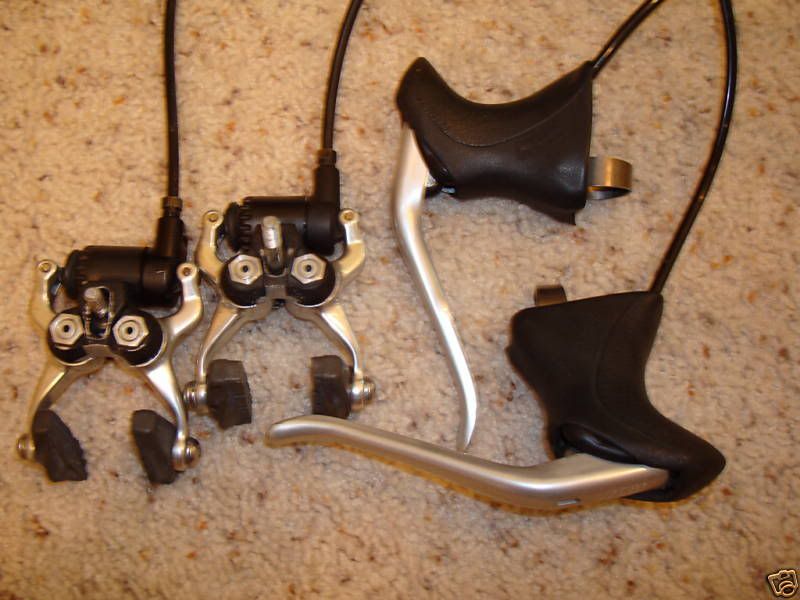 [/img]

