UPDATE: CLASSIFIEDS section refreshed, redesigned, searchable: Go take a look
Noticed a commented from JimBuchannen about the length/slackness of his Starling
I think that if you are going to go very slack all the other angles must be adjusted too or it will not work. The Starling has short chainstays and a not very steep seat angle, add to that a not short enough stem and you have problems.
Is CP running no wiper seals in his forks?
The Starling has short chainstays and a not very steep seat angle, add to that a not short enough stem and you have problems.
Jim's Starling has 455mm chainstays and the 75 deg seat angle has no bearing on the handling except when seated. And the stem is 40mm long...
Now that CP has come around to 29er, how long before he realises he's wrong on B+? 🙂
Hurry up...get a wider yoke organised!
Don't hold your breath/not a hope in hell on that one bedmaker. He was straight off the 29 full version, didn't ride it for long at all. The front is a different matter.
Like me it's a good bike if you like that feeling, but he doesn't like the way it steers.
I think it steers much better with these angles, similarly a G13 with -2, than at mid 64's. The flop, offset and trail just do seem a nice balance.
Much as I adore the 40's the offset of 51 at such a slack HA made the steering 'almost' too responsive. I became used to it and stability didn't suffer but it was more sensitive than in this set up. That's not a surprise but I did like the feeling on this one.
Rick, now that is some eagle eyes!! He isn't...they are an experimental special. And very amazing they feel too. If ugly as sin presently. I shall be trying the same mod shortly I think. So little stiction.amazing when compared back to back with one with wiper seals. Of course it still has to be sealed!
Have to see how the 27.5 rear fares.
I do t advocate by one doing it but I suspect a b+ tyre would fit in the rear there is that much room even with a 29er. Something like.2.8, possibly a 3.0 but they are horrible things. I preferred 29+. B+ seems so sensitive to tyre pressure and of course the punctures and the weight in the wrong place...
Chainline - what difference does the -2 make on the stack height? I assume lower but is the difference diddlysquat. And are your G13 forks still set at 140mm or do you account for the lower stack by jacking them up to 150mm?
I love the way my G13 rides and I seem to be continually setting faster times on it but also curious about the slacker head angle. That said I do like the fact that it feels like I have to muscle it into corners at higher speeds as, to me, it adds to the feeling of stability which in turn gives me confidence. I'm also 6ft 4 and 100kg so the effort required for me to tip the bike in is probably far less noticeable.
I am also still coil curious for the rear. Having to pump the shock to around 300psi to get the required sag gives me a nagging feeling that I'm missing out on some of the benefits as a result of running it at the extreme of its operating range.
What are the options for running 29" wheels on the geometron? Is it just the G13 or could the G16 run 29" wheels front and rear?
Ideally I'd like a long travel 29er geometron.
Ganic... see pictures and write up. That is a G16 29er GeoMeteon I was/am talking about.
Gotama, that was one of my points and heavier rider may prefer that feeling, likewise an aggressive one.
If you use a superstar or works the change in stack height depends on if you had the steerer slammed or not.
The offset is st the top and the bb change is minimal so if you have 10-15mm spacers, no change. It can also be reset with bar/negative rise stem e.g Syntace -6deg 30mm.
Ok, thanks, food for thought.
I run 15mm of spacers and a 35mm rise bar so plenty of scope to mess around there.
Yep. Sounds like a no lose eat apart from the cost of the headset.
Just ordered myself a G13. And now begins a 6 week wait!
BIGMAN...and a -2 headset 😀
Chainline, is it possible to test the 29 G16 set up anywhere?
It's abit of a departure from my 2017 Enduro 29 in terms of HA, reach and chainstay length.
Toby has a setup, Chris does and I do. Essentially yes. Mojo would set a demo bike up for you in the preferred size.
You could try mine depending on what size you are and where you are?
I'd recommend you test a 29/27.5 too since it is so easy to swop between them.
Jim's Starling has 455mm chainstays and the 75 deg seat angle has no bearing on the handling except when seated. And the stem is 40mm long...
I stand corrected, that sounds great and should ride really well!
@Chainline - I live in Kent so not sure the - 2 degree is needed. Would it add performance values even on flatter trails?
BIGMAN, yes. in my opinion of course. just because it's flatter doesn't mean you aren't travelling, it's more related to a combination of turn in and grip. You should find you can weight the front more into a corner and that it will hold a carve better, it will also speed up turn in. What offset fork are you running as that does have a bearing.
"Jim's Starling has 455mm chainstays and the 75 deg seat angle has no bearing on the handling except when seated. And the stem is 40mm long..."
That's not quite true as it has a bearing on the overall geometry. with a steeper ST, the whole front of the bike is pushed forward relative to a given ETT and CS length, making it longer and changing the weight distribution, although I agree mostly in seated riding.
It is compensated for here by a longer chainstay, but the Geo is straight of a Mojo apart from the SA, so very flattering...I think it might not take on the steepest of slopes with that HA and SA as well without more rider adjustment on the saddle. I find the G13 as standard more difficult (tho not difficult) than the G16 on very steep climbs even though it's only a degree or so slacker in the SA.
Chainline: In reality then how much difference is there between the G13 and the newer G16? Im looking at XL G13 with a customization off fitting in an X2 shock, and a 62 degree head tube in the high setting. Then I wonder is that just the G16 with 29er wheels fitted?
Paul j That would indeed be a G16 with 29 wheels fitted when in the low setting. Although they may tweak the linkage ratio if you want a 135mm rear end if you just allow the X2 you get approx 150mm.
The G16, to get an ideal BB (although that is a matter of personal taste), ends up a little slacker at around 61deg but at that point is basically a slacker G13 with 150mm travel and the option to make the most amazing 27.5/29 hybrid 😉
IF you were still minded to go custom to eliminate the slight compromise on the SA (I can confirm that it is un noticeable on the trail (and at 76.5 is still steep compared to most other bikes) and climbs brilliantly,
I'd suggest a G16 but 'reset' to work perfectly with your preferred wheel size without any shock offset adjustments (it is however only one offset bush which allows massive flexibility in the bike with little or no compromise) what you lose is the ability to use 170mm with a 29 rear wheel as it makes the BB too high
If your wheelsize of preference is 29 then it's just a matter of specifying that the BB is 335 - 340mm with the 740mm dia rear wheel.
I'd suggest you get a demo on a 29er'd Mojo G16 XL and a -2 headset G13 you'll know for certain then.
If you did do the G13 custom, I'd adjust the BB and the SA too to 335mm and 77.5deg as well as the HA to 62.
Don't forget the G16 has an 83mm BB if you were thinking of moving cranks.
Legend you are chain line.
Is there much difference in weight between the two frames, it will be used for a lot of alpine singletrack, with a fair bit of pedaling, and trail riding.
occasionally used for an uplift etc.
As you say i think testing the G13 with a -2 against the 29er xl geo.
much appreciated chainline.
Possible to get the longer swing arm on my 2016 mojo G16, and fitting 29er front and back?
hmmm, not sure anyone has tried to fit a 29 in the rear of the 2016. Its great with a 160mm 29er front and longer swingarm with 27.5 rear. Angles and bb are spot on with no adjustment.
The new swingarm yoke is what allowed the change to use a 29 wheel it has more clearance. There isn't any reason to not be able to use the new swingarm I don't think but its £400. Would need to check as it replaces the rear bush with a bearing so its possible it may need seatstays too but could still be cheaper than a new frame.
You would have to ask CP if its actually possible, or I can if you want.
I would highly recommend, if you're current frame is the right size, trying it with a 160mm 29 front fork.
Thats easy to facilitate. Where are you. If it was a preferred option it is just a case of swopping fork lowers.
Do you have an xl already.
Sorry there are so many possibilities...
I have the longest, G16. I need to the 180 36 and x2. Serviced so may drop it in, see if I can ride the G13 with angle set and then have a chat.
Chainline, what rear shock length are you recommending with the 29r 27.5 hybrid?
either works well enzocycling. 216x63 or the 222x70 on a 2017 model. Depends on your preference.
I personally like the 170mm 222 just because it gives my knees less grief in the really rough stuff I sometimes ride. The 216 155mm feels livelier if you want it to as you can deliver a smaller air chamber.
They both work perfectly with the hybrid in terms of geo. It's only when you want to run the 29 rear wheel I'd recommend the 216mm only due to BB height.
That's not quite true as it has a bearing on the overall geometry. with a steeper ST, the whole front of the bike is pushed forward relative to a given ETT and CS length, making it longer and changing the weight distribution,
I'm not convinced that's really the case. When you're standing the position of the front of the bike is determined by the fork length and offset, the head angle, the head tube length and the reach, with the rear of the bike determined by the chainstay length, and the stack and BB drop dealing with the vertical aspects.
I don't think I've ever noticed the non-seated handling (i.e. downhill) being at all affected by the saddle position on the rails (I believe there's about 2 degrees of effective seat tube angle available) but it does have a big effect on seated pedalling, both on the flat and when climbing.
I may have missed this earlier in the thread but whats the weight of the g16/geometron frame with the x2 shock?
Nicolai website states 3500g for frame without shock, so guessing about 4000g for frame and shock?
@Chainline I never stated an offset I wanted. Mojo are putting together a 36 with a 20mm axle. Would you recommend ordering a certain take?
[img] 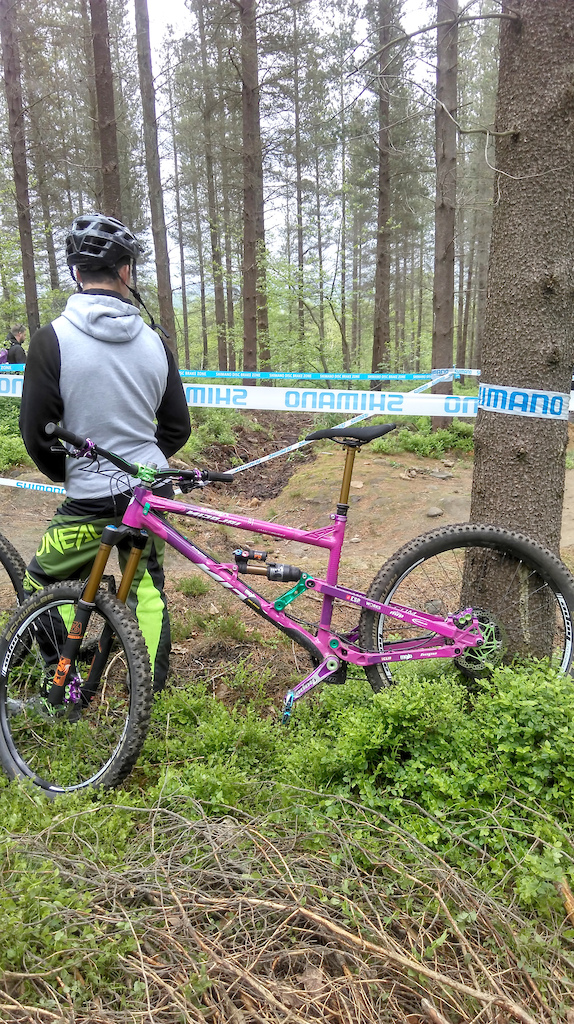 [/img]
I was perving on this yesterday at the Steel City race. It looked mint so I thought I'd share the picture.
I still love the look (and the theory) of these bikes but to be honest you've all blown my mind with information.
I just want someone else to design the bike so I can ride it without thinking about it. I honestly can't be bothered to get the rulers and protractors out and start adding and subtracting millimetres from everything. I just like big jumps and massive skids.
I'm not convinced that's really the case. When you're standing the position of the front of the bike is determined by the fork length and offset, the head angle, the head tube length and the reach, with the rear of the bike determined by the chainstay length, and the stack and BB drop dealing with the vertical aspects.
+1
Tom, Chiefgrooveguru, but you can't separate the ETT/Reach relative to seat angle.
The front of the bike is indeed fork length and offset, the head angle, the head tube length (kind of as stem and spacers can compensate for HT) and the reach but the reach is typically a function of the ETT and bike size hence why I said relative to the same ETT. Two bikes with the same ETT (typically the bike size indicator along with ST length not necessarily the best indicators) but different ST angles will have quite different reach and balance.
Reach can be described by basic Euclidean geometry. It's a function of the stack height and a straight line from the BB that intersects a horizontal line drawn from the centre of the head tube.
Now I'm not entirely sure, but I'm fairly sure it has nothing whatsoever to do with ST angle. I'm 95 percent sure that whoever told you that ST angle did have an effect on reach, was off their ****ing rockers on shrooms.
[img]  [/img]
Moving the ST forwards or backwards, won't do shit to the geometry of that triangle.
If however, you mean that the weight distribution of the bike when statically sagged as opposed to sagged with a rider on it changes - then yes, ST angle will change the weight distribution of the bike - but it will be utterly negligible with the rider on top of the bike.
Also, this kind of misinformation puts me off listening to bike shops and even Mojo - I'd rather go the full custom route - or even knock out my own design on some CAD software and get someone to weld it up in steel. I've slowly come round to the crazy long is better philosophy - but some of the stuff in this thread is just plain odd.
That's not quite true as it has a bearing on the overall geometry. with a steeper ST, the whole front of the bike is pushed forward relative to a given ETT and CS length, making it longer and changing the weight distribution,
This is absolutely true, I think maybe you guys have misunderstood. Chainline specifically said "relative to a given ETT and CS length". If you change the seat angle but not the ETT then it does change reach. As Tom says, basic geometry.
I think Chainline's taken a weird way to look at it frankly but he's not wrong.
Yeah, I think I get the way he's trying to describe it - I think we all actually agree in a very roundabout and contrived way. If you're keeping the ETT the same but pushing the ST angle orward that is going to increase the reach.
I feel I need to draw a diagram to clarify this for everyone. The way I see it is we have three separate groups of parameters.
The fundamental group which affects a bike's handling is the chassis. The numbers that matter for this are wheel size, BB drop, chainstay length, reach, head tube length, axle-crown length, fork offset and head angle. You don't need any more than that to determine the exact static relationship between contact patches, axles, bottom bracket height, wheelbase, front centre, trail, etc.
The next group which affects steering feel is the bar width, rise and backsweep, the stem length and rise and steerer spacers.
The final group which affects seated weight distribution and seated reach (effective top tube length) and pedalling position is the seat tube angle, seat height and seat post offset / saddle position on the rails.
It could be that the final group affects your standing behaviour but it really shouldn't - when you drop your saddle and descend where the saddle was shouldn't affect the position of your hips.
The steering group also affects weight distribution but much less than the rider's own behaviour does.
I don't look at effective top tube lengths when sizing bikes, I look at reach, stack and seat angle.
But that was my point. The ETT, which is a function of SA on most bikes unless the horizontal intersects the top of the ST, if unchanged on two equivalent bikes but one bike has a steeer SA it impacts the reach. If the reach is different, the weight distributionof the rider is different.
Tom, Feel free to design, or go, or listen to whomever you wish it's a free country. We all see and explain things differently which is why they teach my daughter 5 ways to divide stuff these days.
One thing missing there Chiefgrooveguro is that the bar width etc has an effect on the riders position which in conjunction with reach has an effect on how those contact patches work depending on terrain and particularly how a bike initiates turns and changes direction, it's not just steering feel. You can change weight distribution and CofG with a bar width change markedly.
Actual (not virtual) seat tube angle and ETT affect where the end of the saddle is in relation to your tender body parts when the saddle is dropped. A measurement that might be felt in certain situations.
Edited to be gender-neutral, apologies to any lady cyclists who read the original.
Chainline - MemberBut that was my point. The ETT, which is a function of SA on most bikes unless the horizontal intersects the top of the ST, if unchanged on two equivalent bikes but one bike has a steeer SA it impacts the reach. If the reach is different, the weight distributionof the rider is different.
I think it's mostly a matter of reference points tbh. I think some people think of the frame geometry as being a load of tubes connected together at certain angles, which fits how you describe these changes- changing the seat tube angle pushing the headtube forward.
Whereas others think of it as a collection of points, connected together with tubes of the appropriate length- so steepening the seat tube would shorten the top tube rather than pushing it forward
I can make both work in my head but the latter seems more intuitive- you don't start out with a top tube X length then decide what angle to make things so that it fits, you start out deciding where you want the key points and that determines how long the top tube is.
. But maybe it also depends on how you work with these things? I suppose my thinking's like redrawing a single line on a sheet of paper where everything is static, yours is a bit like dragging a point on a screen and having other points move in relation.
What Northwind said - I didn't get the way you were describing it Chainline. You're describing the same thing as us but in a different way.
I apologise for being rude.
But that was my point. The ETT, which is a function of SA on most bikes unless the horizontal intersects the top of the ST, if unchanged on two equivalent bikes but one bike has a steeer SA it impacts the reach. If the reach is different, the weight distributionof the rider is different.
I think the point I'm trying to make is that ETT and SA are a distraction when thinking about designing a bike to handle well when cornering or descending. Lay the chassis out correctly, then apply the appropriate seat angle to get a comfortable seated fit and good climbing performance. Seat angle does not affect standing weight distribution and if you're saying ETT does then it's only because reach does.
One thing missing there Chiefgrooveguro is that the bar width etc has an effect on the riders position which in conjunction with reach has an effect on how those contact patches work depending on terrain and particularly how a bike initiates turns and changes direction, it's not just steering feel. You can change weight distribution and CofG with a bar width change markedly.
No, I did mention that in my penultimate paragraph:
"The steering group also affects weight distribution but much less than the rider's own behaviour does."
If you're still convinced that ETT and seat angle affect standing handling (assuming reach is constant), then you can test the theory by sliding your saddle backwards or forwards on the rails. I'm very fussy about where my saddle is and very sensitive to the minutiae of set-up (it's very annoying because I'm actually not that keen on bike fettling!) and I've never noticed a difference from moving my saddle when it comes to descending or cornering. Yet when climbing or pedalling on the flat even a 5mm change in saddle position is obvious.
arghhh

