We print very little these days, post-process everything and view at few demanding resolutions.
Is it *really* worth shelling out loads on the optics?
What's "loads"?
That's really for you to answer.
Expensive lenses might be expensive not just because they offer better optics, but perhaps because they let in way more light (so better for low light shooting and action shots), or because they are built to last.
If you can't see a problem then no? Better lenses tend to give sharper pictures and better contrast and colour, but if you're going to PP it and are not looking for soft edges at high resolution, why bother? Personally I can't stand an image that gets spoilt by a soft focusing lens, but I will be zoomed RIGHT in and do sell images that get blown up to ~A3. As tucker says, the only other reason is that expensive lenses tend to give less distortion and larger apertures so allow operation in more circumstances. If you don't currently feel limited, maybe there's no need.
For some applications the 'pro' lenses are a necessity, but in most cases a mid range lens will perform well enough.
Years ago, on another forum, a poster was asking whether he should buy a Nikon D80 consumer body, or the 'semi-pro' Nikon D200. One reply was 'if you have to ask, get the D80'. It's a good answer. You'll know if you need the lenses. I know I do, I just can't afford them so make do for now.
Depends.
Image quality is as important as you feel it is.
However - more money also gets you wider apertures on the whole. Which might mean the difference between shot or no shot.
Personally I'm going for lots of different kinds of 'standard' quality lenses ie big zoom for £300, fast prime for £250 and so on rather than one expensive general lens. I like the Oly 12-60 for my camera but it's £800 and hence off the list.
Don't forget that (depending on which system you are with), you can sometimes pick up older superseded top of the range pro lenses that are optically perfect but rough looking for reasonable money.
As grips says, expensive lenses get you more that just slightly higher quality glass.
If you want to shoot at a shallow depth-of-field; shoot in low-light; or freeze the action with a fast shutter speed then you can't really achieve that with post-processing and you will need a lens capable of a nice wide aperture, which tends (not always) to mean they are expensive.
If you want to shoot at a shallow depth-of-field; shoot in low-light; or freeze the action with a fast shutter speed
Mmmm.. careful here. You can quite easily do all those things with a kit lens. An expensive lens just makes it a bit easier still.
My kit lens is 14-42mm f3.5-f4.5. The fancy option alternative is 12-60mm f2.8-f4.0, which is basically a stop difference. Really not that much for a lens costing 8 times as much...! It has other advantages of course.
Photoshop can't fix everything...you can't polish a turd.
Photoshop can't fix everything...you can't polish a turd.
but if assume composition is fine. and the image is viewed on a screen...
i've seen some pretty good stuff with old lenses mounted onto DSLR bodies.
Errr
Hi-res printing and such aside, shooting at a higher resolution gives you more scope for tight crops.
Mmmm.. careful here. You can quite easily do all those things with a kit lens. An expensive lens just makes it a bit easier still.
Okay, perhaps I should say "[i]shallower[/i] depth-of-field; shoot in [i]lower[/i]-light; or freeze the action with a [i]faster[/i] shutter speed" 🙂
Photoshop can't fix everything...you can't polish a turd.
You can roll it in glitter though. 😉
I print quite a bit, and often very large. So it matters to me.
But for video I'm more than happy with crappy lenses, as video is such low resolution (as long as they're fast).
My kit lens is 14-42mm f3.5-f4.5. The fancy option alternative is 12-60mm f2.8-f4.0, which is basically a stop difference.
Yep, two-thirds of a stop - not much difference. But still means a shutter speed of say 1/100s versus 1/60s at f3.5
Really not that much for a lens costing 8 times as much...! It has other advantages of course.
Yeah as well as the faster aperture your also paying for the 2mm wider, 18mm longer, possibly a better/faster AF motor, and of course, the better quality glass.
Absolutely, but I was making a point about diminishing returns and only very moderate extra light capability. Next higher up is a 12-35mm f2.0 at £1,600! So one more stop.
The point is that by the time you've shelled out for a DSLR of any kind, you're already at the level where returns start to diminish rapidly, as discussed on my lens thread from yesterday.
So shoot what you got, and enjoy it 🙂
Perversely all of the large prints I have are with my second-tier lenses. Good lenses for sure, but not my best ones. I don't have a single print from my best lenses. They're so big or inflexible that I hardly use them.
One stop is a pretty big difference - twice the light - twice the shutter speed - and don't forget that lens f2 throughout, so it is one stop faster than the f2.8-4.0 at 12mm, but at 35mm it is probably closer to two stops faster.
But yeah I agree there are definitely diminishing returns - and definitely a point where the capability of the equipment outreaches the capability of the photographer (which is why basic prosumer lenses do me just fine too 😳 )
Even then I do have a nice wide angle (Sigma 10-20mm) and a nice fast prime (f1.8 50mm) for my Nikon, because they can't be replicated in PP (and they are fun to use).
and definitely a point where the capability of the equipment outreaches the capability of the photographer
More importantly there's uses that don't require the kit.
If you're stopping down to f16 for landscapes the fact that you have a £4000 f2 zoom lens or a more modest lens is irrelevant. You won't be able to tell the difference.
Extreme lenses only matter if you're doing something extreme.
If you're stopping down to f16, you will be in the territory where diffraction is reducing your image quality 🙂
Also - there are other characteristics of good lenses - low chromatic aberration, nice bokeh, to name but a couple. My favourite lens is my 85/1.4. I never use it at 1.4, but whatever aperture I use there is always something about the photos that sets it apart. Is it worth the money? to me, yes, to others, no.
If you're stopping down to f16, you will be in the territory where diffraction is reducing your image quality
Exactly. But if you want the DOF...
Exactly. But if you want the DOF...
How much DOF do you need??
At f16 on a 35mm lens Hyperfocal Distance is around 167cm.
Everything from 141cm to infinity will be in acceptable focus!
On my camera with a 35mm lens that would be hyperfocal from 1.4m (with a 3m point of focus). Ideal for foreground interest.
Choose f11 if you like. Doesn't really matter. A good lens vs a great lens will give the same results at either aperture. Which is all I am suggesting.
Choose f11 if you like. Doesn't really matter. A good lens vs a great lens will give the same results at either aperture. Which is all I am suggesting.
Not really true. Not related to Ken Rockwell are you?
In a low light scenario, the very expensive fast lens will probably still be able to AF accurately, the slow kit lens may well struggle.
I absolutely agree that fanstaic results can be achieved with good lenses, and many cheap 'kit' lenses are very good by any normal standards (esp, so in Nikon's case). But to try and play down the usefulness of expensive lenses is just denial.
But to try and play down the usefulness of expensive lenses is just denial
I'm not denying they are wonderful things, but the message to the beginner is do not think for a minute that you NEED one to get good pictures.
To answer the OP's question directly, it's absolutely NOT worth it unless you frequently come up against a situation where your lens does not perform and an expensive one would. AND you think it's worth spending the extra.
To compare with MTBs, you do pretty much need to spend over say £3-400 to have a fun time doing what we'd consider proper mtbing. You definitely do not NEED a Yeti ASR Carbon to have fun unless you know you're going to benefit from it, or have deep enough pockets not to care.
In a low light scenario,
Now, I wasn't talking about low light scenarios was I.
Try reading my post before suggesting I'm the long lost cousin of Nikon's very own village idiot. 😆 As you're obvioously struggling with this reading business, here it is again:
Extreme lenses only matter if you're doing something extreme.
Low light is an extreme condition. That's where extreme lenses come into their own rather than "a point where the capability of the equipment outreaches the capability of the photographer" which I was responding to.
Would you not feel embarrassed churning out naff photos with top end kit?
Not that any of you necessarily do.. I'm talking hypothetically 🙂 I know I feel embarrassed enough about my photos without having to admit I spent thousands on kit 🙂
I guess you wouldn't wonder if it was the kit at fault. 😀
The kit doesn't tell me what to point the camera at, that's my point 🙂
Would you not feel embarrassed churning out naff photos with top end kit?
You get used to it.
Genuine chuckle at Don 🙂
There are other advantages to larger f stops, at least in the Canon world. Obviously viewfinder is much brighter, but also focus speed and accuracy. I find a marked difference between an f4 and an f2.8 (both L series) on a 1dsiii. Several cross hair sensors become active at the 2.8.
And cost doesn't necessarily equate to sharpness. Several lower priced lens out resolve much more expensive examples. The 50 f1.8 is a goods example with upwards of 50 LP/mm. Edge sharpness may suffer slightly.
Guess its the weight / cost argument for blingy stuff. Initial gains are easy, but ramp up sharply as you get near the peak.
I thought that when using the viewfinder (i.e. when not acutally taking a photo) the camera uses a large aperture, and the aperture only actually closes when you take the photo? Non?
poppa: yep* that's why mightmarmite said the viewfinder image is brighter with faster lenses.
* (on modernish lenses anyway. Ancient lenses may have an aperture ring which you set before the shot)
Ok, I get it now, being stupid.
Graham, even my old 80s Chinon left the aperture open whilst you twiddled the ring and looked through the VF, and there was a lever it flicked to actually close it when you took the shot.
Some cameras have extra AF sensors which need f2.8 or faster to come into play, but even cameras without those will focus better if they have more light (below a certain level of light).
Graham, even my old 80s Chinon left the aperture open whilst you twiddled the ring and looked through the VF, and there was a lever it flicked to actually close it when you took the shot.
Well my [url= http://www.europe-nikon.com/en_GB/product/nikkor-lenses/auto-focus-lenses/fx/single-focal-length/50mm-f-1-8d-af-nikkor ]50mm f/1.8D AF NIKKOR[/url] is still available new and has a manual aperture ring on it:
[img] 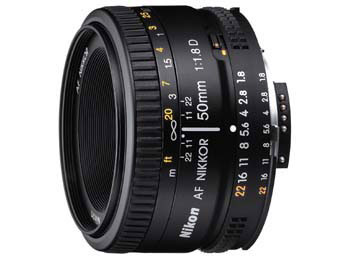 [/img]
Does that support camera control too or do you have to use the ring?
Yer I am saying it had a manual aperture ring, but the camera left it open until you pressed the shutter like my DSLR does. Or flicked the preview lever.
Yer I am saying it had a manual aperture ring, but the camera left it open until you pressed the shutter like my DSLR does. Or flicked the preview lever.
That was pretty standard, wasn't it? I could do that on my old Praktica!
Yer I am saying it had a manual aperture ring, but the camera left it open until you pressed the shutter like my DSLR does. Or flicked the preview lever
Sorry, should have used quote. I was replying to GrahamS.
I've used old auto-stopdown lenses so I know what you mean.
I think this depends largely on what kind of shot you're trying to get.
If you quite like highly processed looking shots and you tend to shoot abstract or detail shots where composition and subject are the most important things, then I think you can get away with virtually any lens.
See the huge growth of iPhone photography for eg.
However, I've found that the majority of my shots are as wide an aperture as possible - it's just what I prefer.
I also prefer my processing to look natural - no surreal HDR photos for me.
You don't have to spend huge amounts though. I get by with just 2 fast lenses:
Tamron 17-50mm F2.8 (cost £250)
Canon 50mm F1.8 (cost £60)