Its obvious to even the most argumentative fool that some music systems sound substantially better than some others.
This is true, but does not answer my question.
What do you want to know? How to measure "better"?
What do you want to know? How to measure "better"?
I'm just pointing out that the OP is starting from a false premise. If you've already decided that it will sound better, then it will.
Hmmmm, stands a chance chiefgrooveGuru.A high-output, linear 15-inch cone driver
As for not wanting big speakers around. Now I've put cushions on them so they can be used as occasional seating Madame is quite happy with guitar cabs in the living room.
I'm just pointing out that the OP is starting from a false premise. If you've already decided that it will sound better, then it will.
I thought he was asking what is it about better systems that make them sound better. It is not difficult to find two systems where one is better than the other so what are the sort of differences between them?
At the high end it's not really about better it's what gets you closer to what you want so that really is subjective.
I thought he was asking what is it about better systems that make them sound better.
Again, you're starting out with the premise that they're better. Evidence from blind listening tests is mixed...
Find two where one is better! Not hard.
Find two where one is better! Not hard.
You'd think so, yet people don't seem to be able to reliably distinguish between different kit.
Blimey - The op was only asking for some critera by which 'better' can be measured.Again, you're starting out with the premise that they're better. Evidence from blind listening tests is mixed...
Unless you're saying that there is no difference between a boom box and a typical audiophile system, then there must be measurable differences.
Geetee had a good stab at an answer.
I'll add 'time-coherence' - particularly important between speaker drivers.
The op was only asking for some critera by which 'better' can be measured.
Well, if you're looking to determine an audible difference, then I would suggest an ABX test.
That's not a criteria!
That's not a criteria!
I would say it's the only one that really matters.
Have you ever taken part in one?
Have you ever taken part in one?
No, why do you ask?
"'time-coherence'". I had to Google that.
Better for me is closer to the original. If it's a trumpet I want to close my eyes and the trumpeter is right in front of me and when he hits a high note I wince. An over-driven guitar, I'm cowering behind the sofa rummaging in my pockets for my -20dbs. When the drummer stands on the right pedal I want to feel it in my chest. Yet in the HiFi shop the systems sound so smooth and warm and so HiFi.
Plug some good IEM or open-back headphones into a decent source of music - note the clarity, decent sound balance.
The goal is now to reproduce that clarity and balance, and possibly improve the 'imagery' with your hifi.
This proves somewhat difficult - a lot of components, like pre-amplifiers, add varying levels of distortion, speakers interact with your room, etc. Speakers themsleves have pretty high levels of distortion.
But cost doesn't necessarily equate to less 'things in the way'.
Edu, you have to understand, there are limitations. Get a set of giant horns and you'll cower behind the sofa, but nothing else will fit in the room.
A 2x12" cab measures 65 x 55 x 25cm, about the size of doll's house, or do you live in a doll's house? 😉
Back in the seventies a mates's dad had a good HiFi so we went to his house to listen to music. Dad also had an electric organ which had some big Celestions in the back. When the organ speakers were added to the amp it made Rumours "come to life". Until a speaker coil melted, the volume returned to normal levels and dad got a bit upset.
Thanks all - interesting debate. I think I at least now have some type of response when asked...
Get a 10" sub for punch and a 15" sub for seriously low but less defined frequency! Best of both worlds! Lol!
The 2x12 is only designed to reproduce one instrument....
I'm with matty on this...
less noise, more dynamic
re what sol said, there's IME v little bass near to 20hz or 50 in much music.
The expense of making good LF drivers is making them sound good at the high end of their range - below that they are just pistons, like HF units.
Crossovers are difficult to get right, exp when the lF cone is breaking up.
Mid band is where all the info is, not bass.
re what sol said, there's IME v little bass near to 20hz or 50 in much music.The expense of making good LF drivers is making them sound good at the high end of their range - below that they are just pistons, like HF units.
Crossovers are difficult to get right, exp when the lF cone is breaking up.
Mid band is where all the info is, not bass.
I agree but if you look at the actual costs to produce a typical £2k floorstander, the costs of midrange and high range drivers is very low compared to the cost of the cabinet to maintain acceptable aesthetics and bass performance. Once you start heading into £4k+, it starts to flip the other way as with that much money to play with, the differentiator is more often the midrange and quality of the crossover points.
You have to spend alot of money on speakers for the cabinet material, shipping and design costs to be lower than a driver used in it. The cabinet design is primarily there for the lower frequencies.
Even the very best crossovers represent a very low percentage of the overall costs as the components are cheap and they are no longer cutting edge.
AlexSimon - MemberBlimey - The op was only asking for some critera by which 'better' can be measured. Unless you're saying that there is no difference between a boom box and a typical audiophile system, then there must be measurable differences.
depends on your definition of "better". Logically you'd say accurate, lacking in distortion, balance, sound fill, that sort of thing. But that doesn't translate into "listening pleasure", which is immeasurable.
The listener tests keep on coming up with the same 2 issues... People's tastes in sound vary, so there's no one "better". And many people can't reliably distinguish between different systems anyway. It's why they spend so much time making lovely sounding kit, then stick an eq or the dreaded LOUDNESS button on it so you can ruin it.
Human perception and taste is incredibly subjective and pretty unreliable. This is a total digression but it's a nice example of how we work. I went to my motorbike tuning guys, and they had a customer raging because they'd "ruined" his GSXR, it had no power. They showed him graphs- it used to be that it had no midrange so when it climbed out of the power hole, it gained a lot of power in about 500rpm. They'd fixed that, and also given it a bunch of extra power up top- but the owner thought it was weak, because it no longer had that mighty increase in power when it got out of the hole. The new tune was "better" but he hated it so they reversed it.
My point was that it's annoying that every hi-fi thread descends into a 'directional £1000 cable/ABX' thread of people sticking their oar in, regardless of the OP's actual question.depends on your definition of "better". Logically you'd say accurate, lacking in distortion, balance, sound fill, that sort of thing. But that doesn't translate into "listening pleasure", which is immeasurable.The listener tests keep on coming up with the same 2 issues... People's tastes in sound vary, so there's no one "better". And many people can't reliably distinguish between different systems anyway. It's why they spend so much time making lovely sounding kit, then stick an eq or the dreaded LOUDNESS button on it so you can ruin it.
Human perception and taste is incredibly subjective and pretty unreliable. This is a total digression but it's a nice example of how we work. I went to my motorbike tuning guys, and they had a customer raging because they'd "ruined" his GSXR, it had no power. They showed him graphs- it used to be that it had no midrange so when it climbed out of the power hole, it gained a lot of power in about 500rpm. They'd fixed that, and also given it a bunch of extra power up top- but the owner thought it was weak, because it no longer had that mighty increase in power when it got out of the hole. The new tune was "better" but he hated it so they reversed it.
But I understand your point, there are subjective elements in audio mainly due to everything being compromised, so you are forced to choose your own balance. It doesn't mean that those compromises can't be described, measured and theoretically eliminated.
Sonos is well-liked because as well as being very convenient and user-friendly, they've chosen a good set of compromises which distracts/annoys the least amount of people. But you can bet that they know what measurements they are aiming for (from geetee's list and others) whenever they design a new item.
I know a 2x12 is usually just for one instrument, I was simply using the size for the cab to say that space in the room is really a non-problem. HiFi manufactuers could use 10, 12 or 15" drivers but most seem to want to offer small packages even if making the cab 5" wider and 3" deeper wouldn't really be space problem in most rooms.
When you are used to hearing guitars through cabs recordings of guitars played through HiFi never sound right and playing with one of my guitar cabs I think I've worked out why:
HiFi speakers are mounted in closed, sometimes ported cabinets. This means that the speaker cones are always air damped to some degree (a lot in the case of fully closed cabs). This stops the speakers destroying themselves at high volumes but damps the movement and hence the sound signal - rubber-suspended hifi speaker cones are rather fragile things compared with relatively stiff paper-coned guitar speakers.
I tried one of my guitar speakers, a Celestion Vinatage 30, in a semi-open back cab, a closed cab and finally a classic open-back Fender cab. Open back it's got real growl in the mid range and bass, closed it sounded softer, smoother and more "HiFi".
Of course generally there's no replacement for displacement, but I challenge you to convince MissStripes to let me have such a thing in the living room!
It also matters what you play. Here's two songs, both with drums and bass guitar as a song intro.
Imagine Dragons, Radioactive:
[IMG]  [/IMG]
RX Bandits, Will You Be Tomorrow
[IMG]  [/IMG]
OK, the RXB Intro is "quieter", but my gosh they're not mangling the signal!
RXB Recorded their album, from a PledgeMusic funded campaign in a few weeks.
I 'scoped these myself, straight off the back of my amp because I had been wondering why Radioactive sounded so weird.
So - maybe Hi-End won't make your shitty recordings bearable.
Generally you pay for better materials, design and production techniques. So birch ply speaker cabinets instead of MDF (which has better resonance as it reflects the sound instead of absorbing it) and hand soldered components rather than a solder bath, for example. Having said this, I can't see the value in paying £200 for a mains lead. Anything over £1000 and the difference is minimal IMO.
Edukator, not all speakers have enclosures. This is one of the most accurate sounding examples:
http://www.linkwitzlab.com/LX521/Description.htm
It will not sound "hi-fi" in that cliched warm and smooth and flattering way which is nothing like high fidelity in the true sense. It will sound more real than anything you've ever heard with recorded music.
[img] 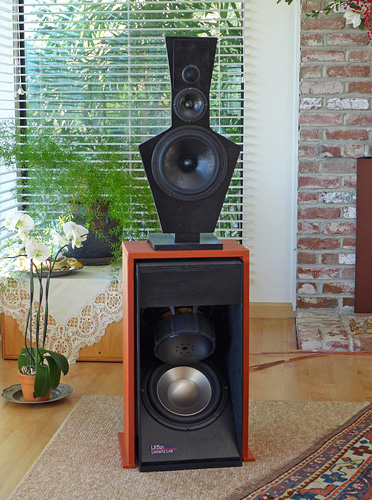 [/img]
Look no box! Open baffle 4-way active dipole.
[img] 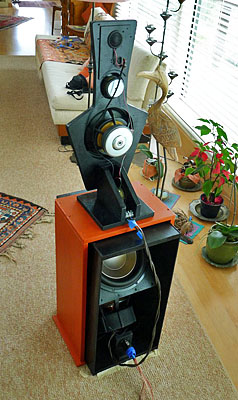 [/img]
Or for a smaller room:
[img] 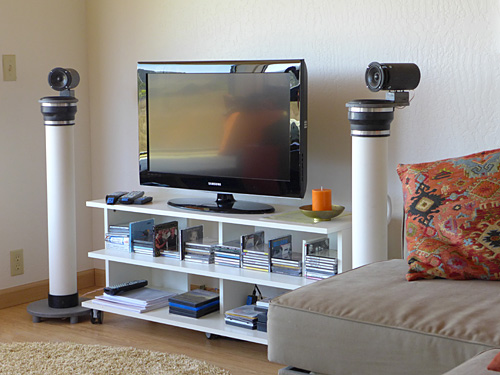 [/img]
[img] 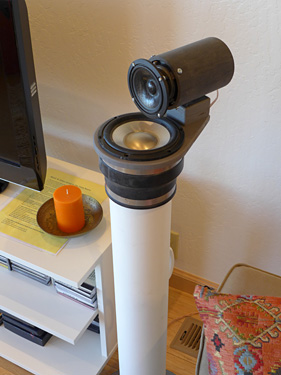 [/img]
The figure 8 response of the bigger dipole speaker needs more space to prevent early reflections messing with the sound. This LXmini has an open baffle full range speaker whose rearwards output is acoustically filtered to give cardioid response and a transmission line woofer with omnidirectional response.
I thought so.
I haven't heard any of those linkwitz designs. How do they sound compared to a "normal" IF or ported design?
Of course the classic dipole designs were Quad electrostatics and fabulous things they were. Need a fair bit of space behind though.
Once again I need Google for the text but the idea's there. Something that might get me in to a shop to listen to and expect to hear something that breaks the stereotype.
Edit: if it's like opening up a guitar cab then on first listening it'll sound a bit harsh and aggressive then you'll realise that it sounds just as harsh and aggressive as the original voice/instrument.
No, you need to read properly - the link is there! 😛
I know a 2x12 is usually just for one instrument, I was simply using the size for the cab to say that space in the room is really a non-problem. HiFi manufactuers could use 10, 12 or 15" drivers but most seem to want to offer small packages even if making the cab 5" wider and 3" deeper wouldn't really be space problem in most rooms.
No, using a bigger driver means the volume has to increase MASSIVELY to get the same response (I think relative to cone area), all other things being equal. And the trend is to smaller enclosures.
HiFi speakers are mounted in closed, sometimes ported cabinets. This means that the speaker cones are always air damped to some degree (a lot in the case of fully closed cabs). This stops the speakers destroying themselves at high volumes but damps the movement and hence the sound signal - rubber-suspended hifi speaker cones are rather fragile things compared with relatively stiff paper-coned guitar speakers.
"air damping" only comes into effect near the resonance, and it's higher for ported designs (at and above the resonance) than in IBs.
HiFi manufactuers could use 10, 12 or 15" drivers
[img]
 [/img]
...some do 😛 ... though whether you'd call the result "Hi-Fi" I doubt.
Not your typical livingroom setup.
For something a little more hi-fi.
[img] 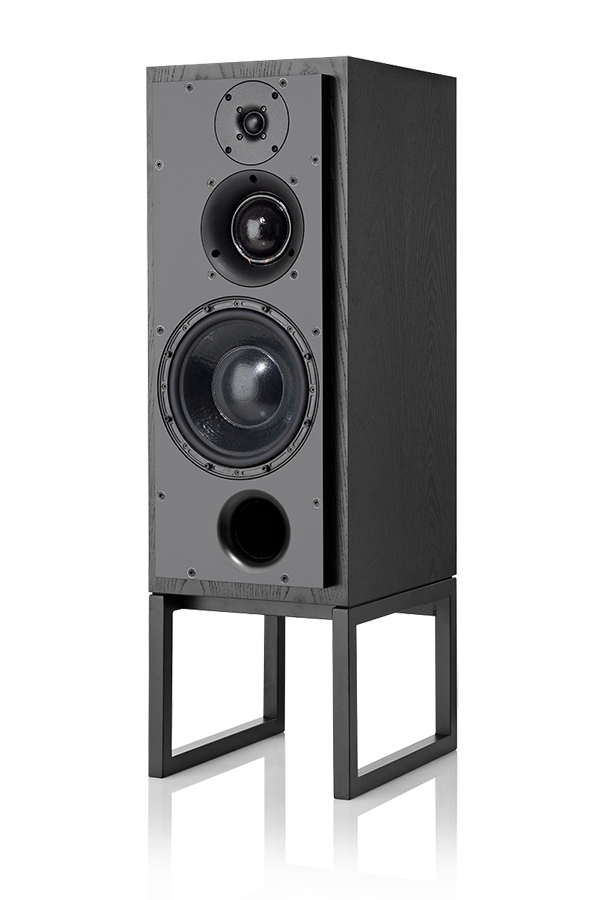 [/img]
Or if sir has a larger room
[img] [/img]
A ballroom
[img] 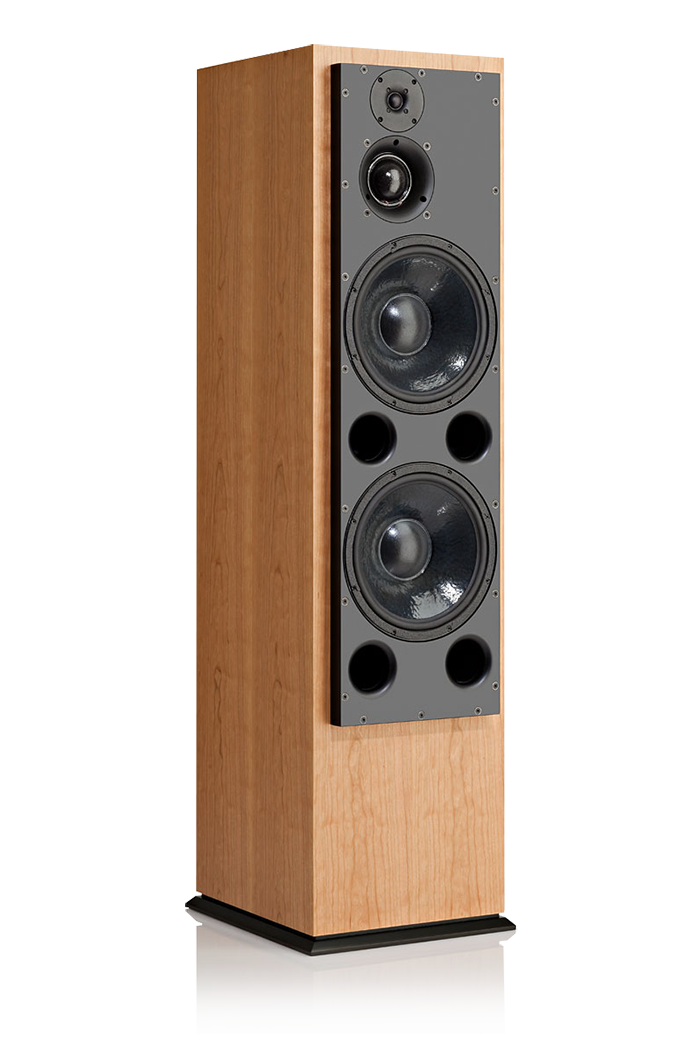 [/img]
A castle
[img] 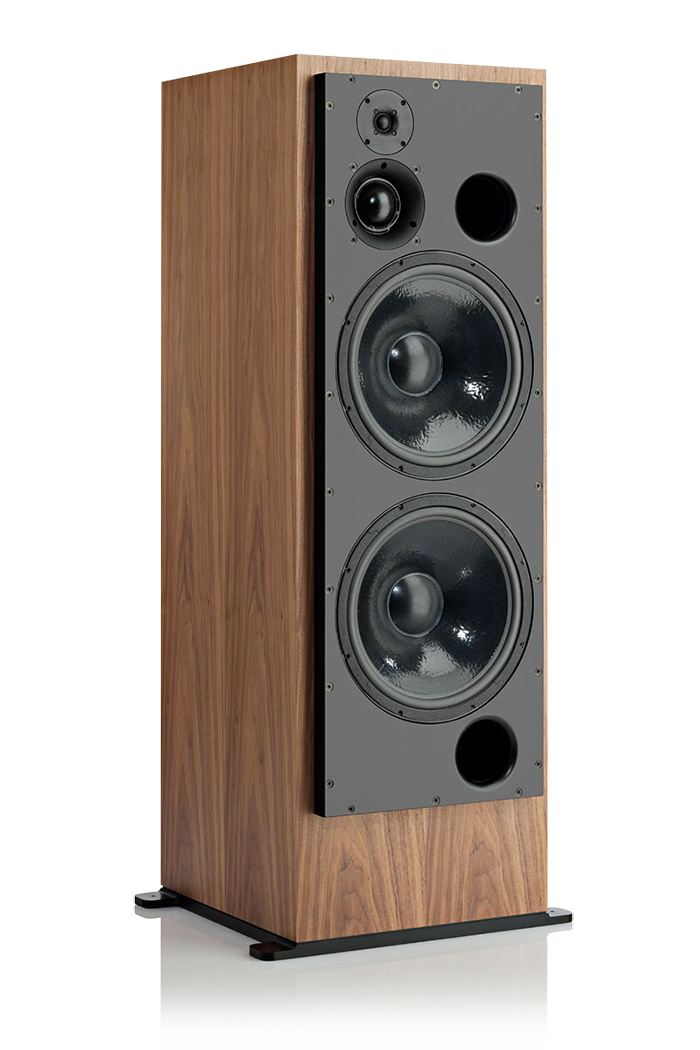 [/img]
Some quite serious LF drive units there along with the best mid range driver on the planet.
AFAIK that's about as top-end as it gets!
Where do I sign for the free, no-obligation 29 day* trial period?
*Pretty sure noise complaints need to run across two months for an eviction notice...

