I suspect (and I’m happy to be proven wrong) that if you added all the cars in that motortrend post together they would account for less than 1% of all cars in the UK. Making it not relevent to much.
I didnt say anything about sales volumes, you asked how the 'crude' pushrod v8 compares in terms of fuel economy to its more sophisticated peers, and the answer seems to be 'quite favourably'.
Dont get me wrong , I have no dog in this fight, but to just dismiss that particular pushrod v8 as crude, low performance, poor fuel efficiency or any other stereotype that used to be laid at the door of the 70's pushrod v8's seems to be laazy stereotyping to me.
I'm not sure GM's use of rods to waggle the valves counts much of either way in engineering terms here. It worked for them on that engine in that market.
Well I did actually mean non 2v non V8...as per the almost immediate edit.
As in normal cars.
And for completeness. Nothing mentioned of emissions either just economy.
As you say it's not 1970any more that sort of info is important today.
This is an interesting read on pushrod engines in new motorbikes - concentrates on the new BMW cruiser but lots of tech info too https://www.bennetts.co.uk/bikesocial/news-and-views/features/bikes/air-cooling-and-pushrods-bright-future-for-old-tech
We need pushrod v8s like a hole in the head.
Oh I agree, but same could be said for any high-performance engine. Just so happens there's something deemed even more anti-social about a large capacity V8 compared to smaller engines that provide similar power/economy. But it lets me live out my Days of Thunder / Mad Max fantasies...
On economy, relative to the performance a pushrod V8 petrol isn't all that bad (all for similar driving under my heavy right foot, much with bikes on the roof):
330i 6-cyl 260ps, 24mpg
MINI Cooper S 1.6 4cyl 185ps, 32mpg
6.0 LS2 V8 400ps, 20.5mpg
Push rods give good low end but lack at high end /lack revs also
Why would a push rod engine give better low end? you could have any cam profile you could have with a push rod engine in an over head cam engine. I would agree you might not be able to rev a pushrod engine as high as an OHC engine without some very expensive parts and mitigation's. but I can't see why a push rod engine would have more bottom end by being a push rod engine.
the answer seems to be ‘quite favourably’.
Far far more data is needed to make a call about the relative merits of these particular engineering solutions. If only we had someone well qualified to make call. Oh wait we do, and you ignored them.
Just because Top Gear like a car overall, doesn't mean the valve actuation mechanism is empirically better than the other solution. Car might've been even better if it had DOHC.
Dont get me wrong , I have no dog in this fight, but to just dismiss that particular pushrod v8 as crude, low performance, poor fuel efficiency or any other stereotype that used to be laid at the door of the 70’s pushrod v8’s seems to be laazy stereotyping to me.
This is exactly the point. Just dismissing pushrods as "crude" is silly. Obviously, DOHC has become the standard layout because it works better for most applications, but pushrod engines aren't as agricultural as you might assume.
If you're interested, I drive a Toyota with a 1500 cc DOHC petrol engine. I am astonished at how well it performs for a cheap shopping car, plus how little fuel it uses.
Why would a push rod engine give better low end?
I think that's inherently associated with 2-valve heads rather than pushrods. You have good swirl from the larger valves but you can't do much timing overlap as you can with 4 valve. That leans toward lower rpm operation. Any power difference could be fixed with a bit more displacement.
4 valves on pushrods has been done. Not sure its the 'simple' route to making 4 valve heads work. Hasn't been done much AFAIK.
My 2v pushrod 80hp Guzzi is good for 45mpg even in 'not particularly hanging about' mode - much better than the DOHC 4v 90hp triple in the Triumph which struggles to 40mpg unless ridden in a nun-like fashion.
The Guzzi engine is a damn site cheaper and easier to service too - no water cooling, less valve clearances to check, no cam-chain or tensioners to check/replace
Thanks, interesting article
That GM piece is interesting - I wasn't aware of this and it's counter-intuitive, but as all designs are compromises it looks like this compromise worked for GM in this market.
A very quick skim read of the literature suggests that the package size part of this is a big deal which makes sense for large automotive V8s, hence power density in terms of bhp/kg is high.
It's impressive that they have got reasonable efficiency and I assume have passed emissions regs with this. It looks like they're supercharged and direct injection which will help.
I'll be taking a read around this this evening.
https://www.holley.com/blog/post/everything_you_want_to_know_about_the_gm_gen_v_lt_engine/
Do bear in mind that this is a specific market, and GM are using OHC for their smaller engines. I highly doubt that this is economically transferrable to smaller engines such as those used in the UK.
pushrod engines aren’t as agricultural as you might assume.
True that. This is what we make at my work. This one is a 95 Litre 5,000+BHP V16. Pushrod of couse.
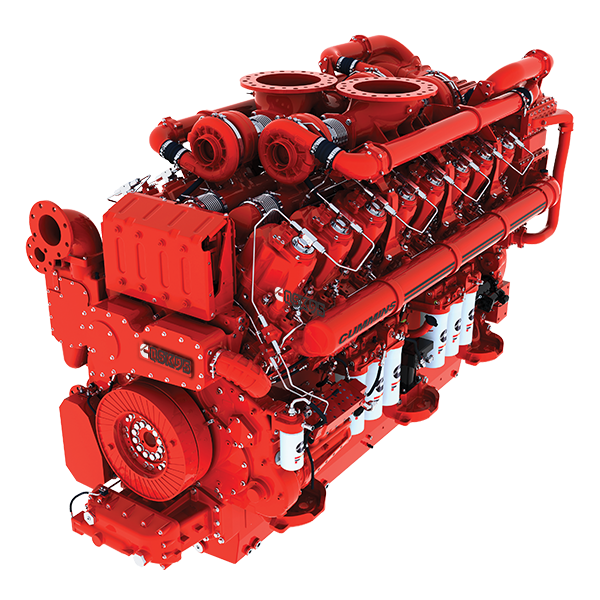
Push rods give good low end but lack at high end /lack revs also
Ultimately, an OHC will rev higher because the valve gear is lighter and more rigid, so you can run more aggressive cam profiles. Performance engines have run DOHC for a century for exactly that reason. That doesn't mean that you can't make an OHC engine that gives good low end torque. If you run the same cam profiles, valve sizes, etc. you'll get exactly the same torque curve out of a pushrod and OHC engine. Nascar V8s are built to run at high revs and full throttle for hours on superspeedway, but they change cams for better low end torque on road courses. Nothing to do with with pushrods versus OHC, just the cam profiles you can run.
And further we still have not found out why a new push rod diesel would be an improvement over dohc diesels
I wasn't saying it was significantly better, or even that it would pass Euro5/6/7. Just on an "if it's not broke, why fix it" basis, why was it dropped? Long before DOHC's might have made it complicated, and long before the idea of a sporty diesel was thought up (and pushrod petrols are still 'sportier').
The only argument that really rings true is the one around using common castings for petrol and diesel engines. Rover did it with the pushrod B series, which became the O series then the T series, but they didn't convert it to diesel until the O became the L by which point it had already gained an OHC.
And I suppose prior to that there was no real interest in diesel cars? The exception that proves the rule being Landrover (not a car and used pushrods in a Diesel).
sure if you throw enough money at something you can make it do what ever you want it to do... It neither makes it the best option nor the right option.
For the majority of folks needs a push rod anything is not the answer
As for cam profile you can't profile your way out of a lack of revs - although we have 9 speed gearboxes these days to counter that to a point
In the same way you can't profile your self out of a lack of displacement (although you can charge your way through it to an extent)
“if it’s not broke, why fix it” basis, why was it dropped?
That is really easy to answer. See my first post for the main points. But... specifically relating to the valves and cams it goes like this.
For maximum efficiency and optimum emissions you want the valves to open as close to instantaneously as possible. When they open and close slowly they can't hit the "optimum" position for breathing and maximizing the work extracted from the combustion gases on the power stroke as the event is "spread out".
To get as close as possible to "instantaneous" opening and closing you need to open and close the valves quickly which involved accelerating the valve at a higher speeds.
Higher opening speeds mean higher stresses in the valvetrain system (valve stem, tip, the valvertrain itself including pushrods if any and the cam lobe, including all interfaces in this arranegemnt.). THere is a finite limit as to how high these stresses can be before you encounter issues - fatigue, surface wear, galling, breakdown of the lubricating oil film etc. The higher the mass of the system the higher these forces are for a given opening acceleration and speed, hence you need to either limit speed (RPM) or ramp rate, i.e. a slow opening valve (bad for efficiency and economy)
Higher closing speeds need higher acceleration to accelerate the valve fast enough to close on time and to avoid valve "float". This limits the maximum speed of the engine and also demands a stronger valvespring. Stronger valve springs increase the loadings described above for the opening loads, hence there is a limit. Pushrod engines have a higher mass in the system so these limits come into play earlier, meaning either lower max speeds or a slower closing rate is needed, hence bad for efficiency and economy.
The above factors mean that pushrod engine are more limited and are harder to engineer to achieve performance and efficiency. It's possible to engineer around these limitations, but why make it harder?
TL:DR - pushrods really are "old tech" for automotive size engines and whilst you can engineer them to work they have inherent limitations which have seen them superseded in the vast majority of cases.
The only argument that really rings true is the one around using common castings for petrol and diesel engines.
I'm sorry this is not the case. The benefits of OHC are clear for everyday automotive and it's hard to develop a competitive engine that meets emission standards with using it, which is why virtually all modern engines use it.
The above factors mean that pushrod engine are more limited and are harder to engineer to achieve performance and efficiency. It’s possible to engineer around these limitations, but why make it harder?
TL:DR – pushrods really are “old tech” for automotive size engines and whilst you can engineer them to work they hav
With vee engines, the valvetrain is much less complex with a single camshaft and pushrods. You can use a single gear drive to drive the camshaft. With DOHC, you need a much more complex system to drive two camshafts per cylinder bank. Most engines run DOHC, but that doesn't mean it's the best thing for every engine.
4 valves on pushrods has been done. Not sure its the ‘simple’ route to making 4 valve heads work. Hasn’t been done much AFAIK.
This is very common on larger industrial engines. The rocker gear is more complex as one pushrod has to operate two valves.
True, the cam drive arrangement can be simpler with a pushrod Vee.
The trade-off though is the valvetrain dynamics compromise which is generally more important.
Nascar engines crank out 800 HP and rev to 8500 to 9000 RPM, so pushrod 2V engines aren’t as terrible as people imagine.
Well yes but that doesn't help the case for pushrods though. The only reason they still have pushrods are because they have to. They also have to have carburettors too. Much in the same way F1 cars are limited to 13" wheels with high profile tyres. It doesn't mean or prove they are the best solution. Just because you CAN make these things chuck out good performance doesn't mean they are the optimal or best solution. If the restrictions were removed the pushrods, carburettors and low profile tyres would disappear overnight. They're just doing the best they can with what they're allowed to run. Also NASCAR engines sit at constant revs for basically all their time chucking out constant power so the inertia of moving parts due to changes in engine revs is not such an important aspect so they can really be optimised and tuned for a very narrow band of revs and power outputs. the benefit of variable valve timing and all the other tech in modern engines is to deliver optimal efficiency across the whole rev range.
Anyway cams are so old fashioned. The future is camless and pneumatically actuated. Actually simpler than cams. A chap on YouTube converted his MX5 to carless in his garage. Imagine him trying to manufacture his own OHV variable timing and lift cylinder head!
Guessing they wanted the bonnet on that Stingray to be low, and they still wanted a V8.
they still wanted a V8.
You only have to look at the hatred for the ecoboost Mustang to understand how important nostalgia is int he American market.
Guessing they wanted the bonnet on that Stingray to be low, and they still wanted a V8.
Current corvette is not front engined, it is the first mid engined corvette.
Looks nice, and priced well.
Oh yeah it even says that in the article. Still, could be packaging related just the same.
The future is camless and pneumatically actuated.
Why pneumatic specifically? Is it a speed thing? I'm just thinking back to marine engines, they were hydraulic on an air spring but only ran at 104rpm.
I thought the Fiat one (twin air?) was electronic rather than pneumatic. This is the only alternative valve technology I heard about.
The higher the mass of the system the higher these forces are for a given opening acceleration and speed, hence you need to either limit speed (RPM) or ramp rate, i.e. a slow opening valve (bad for efficiency and economy)
<pedant alert>Speed doesn't come into it, F=ma.</pedant alert>
🙂
Pedantry aside, are there any decent YouTube (or whatever) channels that explain the trade offs involved in this kind of thing?
<pedant alert>Speed doesn’t come into it, F=ma.</pedant alert>
Shirley a is governed by RPM.
More rpm means more reciprocations between open and closed. And to do more it has to me accelerated and decelerated quicker to fit more cycles in.
Infact speed is the only parameter the designer fully has control over everything else in that system is nigh on a closed loop derived from the other factors the system must also address at the same time.
M<pedant alert>Speed doesn’t come into it, F=ma.</pedant alert>
Speed is everything to do with it.
Force = mass x acceleration
Acceleration = speed / time
Re YouTube etc. If you google valvetrain dynamics you’ll find some stuff.
There’s the hobbyist / entertainment type stuff which is simplified, and the academic which is what you’ll need for a better grasp, but is rather dry.
One of the challenges with this type of engineering is that whilst each individual aspect is pretty simple the trade-offs and interactions involve multiple systems and factors which you have to understand to a certain level.
If you take as a starting point that the ideal airflow behaviour of a valve is to both fully open and close instantly, but also has to be durable it’s not a bad place to start.
As a really basic analogy to human scale interactions, imagine opening and closing a normal household door. Do it at “normal” speed. Nice and easy right? Now do it repetitively very fast for 2 minutes. Hard work right? Now do the same on a really heavy ok door. If you can achieve the same speed then it will be a massive amount harder. That very roughly analogous to a heavy or lightweight valvetrain.
The Fiat one, by the way, doesn't have a throttle - it controls the air mass intake by early closing the inlet valve. Pretty damn cool.
If you've ever driven a Sierra 2.3 diesel you'll realise why there's very few pushrod diesel engines around.
Our Xtrail accellerates faster with the caravan on the back than my Sierra did without.
There’s the hobbyist / entertainment type stuff which is simplified, and the academic which is what you’ll need for a better grasp, but is rather dry.
I've got a degree in Aeronautical Engineering, I'll survive.
Speed is everything to do with it.
Force = mass x acceleration
Acceleration = speed / time
That's splitting hairs. Once up to speed the force is zero.
As a really basic analogy to human scale interactions, imagine opening and closing a normal household door. Do it at “normal” speed. Nice and easy right? Now do it repetitively very fast for 2 minutes. Hard work right? Now do the same on a really heavy ok door. If you can achieve the same speed then it will be a massive amount harder. That very roughly analogous to a heavy or lightweight valvetrain.
So you're saying mass has a direct influence on the force needed for a given accelaration?
I’ve got a degree in Aeronautical Engineering, I’ll survive.
Perfect a then dive straight into the more “university lecture” stuff.
Once up to speed the force is zero.
Apart from the camshaft the valve train is rarely at constant speed - is is continually accelerating in one direction and then the other to drive the valve from its static “closed” position to moving quickly toward “open” and then decelerating to achieve its “open” position, then the reverse to close.
So you’re saying mass has a direct influence on the force needed for a given accelaration?
Yes. Apologies for the overly simple explanation earlier. Basically F=m.a
Well yes but that doesn’t help the case for pushrods though. The only reason they still have pushrods are because they have to. They also have to have carburettors too.
Nascar engines use electronic fuel injection.
The point about Nascar engines is that pushrod engines can rev much harder than people assume and can generate pretty decent horsepower.
The point about NASCAR engines is they have been developed within a prescribed et of parameters.
Push rods are shit and belong in the dark ages outside of industrial applications. It's operationally advantageous to be able to pull a cylinder head at sea with nothing more than a windy gun and a chain block, you pay for that in energy losses. Only medium speed engines use push rods last I checked since slow speed are entirely electronic and high speed use camshafts and belts.
high speed use camshafts and belts.
I think you'll find proper race engines use gear drives, not timing belts or chains. Timing belts are cheap and quiet, but aren't up to the demands of proper high-performance engines.
The 1994 Indy 500 was won by a car with a pushrod engine, build buy Ilmor and funded by Mercedes-Benz.
Exploiting a loophole that allowed 3.4 litre pushrod engines to run higher boost than their 2.6 litre competitors, right?
Exploiting a loophole that allowed 3.4 litre pushrod engines to run higher boost than their 2.6 litre competitors, right?
Yes. It happened because they allowed stock-block engines with pushrods as a cheaper alternative to custom built race engines. Buick V6s were pretty common back in the 80s, but weren't reliable because of the requirement to use stock parts. The stock parts requirement was lifted to help the Buick based engines. When Ilmor realized that the requirement for stock part had been removed, they built a custom engine to take advantage.
My point isn't that pushrods perform as well as DOHC for racing engines, it's that the idea that pushrod engines are "shit" isn't quite right. They can rev a lot harder and put out more power than people often assume and the Chevy small-block engines seem to go pretty well. In the Australian V8 touring cars, the quad-cam engines struggled against the Nascar based pushrod engines because they were all rev limited to 7500 RPM and had limitations on camshafts to prevent an expensive engine development arms race. There was no power advantage to quad-cam engines under those regulations, but they used more fuel. The rules were relaxed a few years ago to allow turbo V6 engines in. GM built a quad-cam V6 turbo, but never raced it.
This really is peak STW. Some dude who clearly knows about this stuff shows up and answers the OP's question, then a bunch of other people show up and try and pick holes in the explanation.
Love it.
I think you’ll find proper race engines use gear drives,
If you put your part quote back. In context SK is clearly talking about industrial/boat applications as is his vocation.
Main reason that we don't use gear drives and pushrods outside of the racing world is that over the years we have grown to enjoy not driving with ear defenders on.
The point about Nascar engines is that pushrod engines can rev much harder than people assume and can generate pretty decent horsepower.
Yes I acknowledged that but the point was it’s not a valid example because it’s not the optimal solution. Free from the restriction of the rules of the game the engine designers would ditch pushrods and have a more technically optimal design.
NASCAR is steeped in history and nostalgia which is hampering the innovation in the sport and channeling it into a single technical solution which they’re doing their best to ring the next out of.
The future is camless and pneumatically actuated.
Why pneumatic specifically? Is it a speed thing?
Don’t know. It’s what F1 engines use and the Kenisegg that has a cam less valve train. I guess hydraulics would be too heavy and I think the compressibility of air might be a factor.

