Not quite – it said “Boris Johnson’s return to work ‘a boost for the country’ ”
No the BBC did not give the opinion that Johnson's return to work was a boost for the country.
The BBC simply reported a quote from his deputy. A perfectly legitimate thing for a news provider to do.
This is what the BBC actually reported :
Boris Johnson's return to work on Monday after more than three weeks out of action will be a "boost for the country", his deputy has said.
New Zealand gets something around 3.9 million visitors per year compared to 37 million for the UK.
So per capita visitor numbers are very similar?
This is what the BBC actually reported :
Boris Johnson’s return to work on Monday after more than three weeks out of action will be a “boost for the country”, his deputy has said.
With a headline that read,"Boris Johnsons return a "boost for the country". Most people dont read beyond that.
“Raab welcomes return of PM”, or similar, should have been the headline, shouldn’t it.
If they are using quotation marks then it's clear that they are quoting someone.
I don't think that they are responsible for people not reading beyond the headlines.
I would certainly expect to read an article before expressing my outrage towards it.
If they are using quotation marks then it’s clear that they are quoting someone.
But pointless if they dont say who they are quoting.
No the BBC did not give the opinion that Johnson’s return to work was a boost for the country.
The BBC simply reported a quote from his deputy. A perfectly legitimate thing for a news provider to do.
Why did they even choose to report that? Why is the most important thing to report what some flunky thinks about "Johnson" ? News is biased in what they choose to report as important, as well as the words they use to describe it.
Meanwhile, what Boris appears to be actually be saying
BBC News - Coronavirus: Boris Johnson says this is moment of maximum risk
https://www.bbc.co.uk/news/uk-52439348
Apart from the mugger nonsense, it was the kind of speech he’s great at giving, and he delivered it well… lots of upbeat tub thumping… just don’t expect any details in follow up questioning.
Yes it was a bit like a Pathe News broadcast. Though "I ask you to contain your impatience" was quite sensible.
just don’t expect any details in follow up questioning.
Fear not Kelvin, Keir has sent him a letter in a stunning example of effective, holding the government to account, credible opposition. If only his predecessor had thought of that!
You’ll enjoy Frankie Boyle’s latest rant Dazh.
The original calculations were that we'd have around 500000 deaths, based on a 1% CFR and about 80% of the population getting infected. I can't see that anything that has happened so far has significantly changed that arithmetic, all we've done is spread it out a bit, so those deaths will occur over a few years instead of a few months. We have kept the death rate to around 1% by not overwhelming the NHS, which has certainly saved a lot of lives as the evidence suggests that the CFR increases significantly when health services are overwhelmed. Then we will have added a huge amount of suffering and death due to the economic hit, the cancers not diagnosed, the stroke and cardiac arrests not going to hospital in time... The only thing that can make a real difference to my calculation is an effective, widely available vaccine.
This is a bit grim, so please someone, tell my why I'm wrong.
OWG no not of we continue social distancing. Why pressure from economic fronts whilst not unexpected needs to be held against the above worst case scenario.
not saying you're wrong but you have to factor in that those 500K deaths were the outcome when we couldn't treat the majority of them. By spreading them out the chances of survival are higher if you can be treated as opposed to be told you aren't priority and left in an aircraft hanger or exhibition hall waiting to die.
Second - a vaccine and/or effective treatment may be a year away but it will come. Scientists will sort this out in the end, given enough time and resource. We need to buy time for now.
Of course, the other issue (and people have said this since the start) is that the effect of continued lockdown on the economy and thence on people's lives because of the recession that awaits us all......how big is that against the deaths due directly to CV19. It's like a cross channel fader, increase lockdown restrictions for longer and CV19 can be heavily restricted but general deaths will spiral. Where to put the slider is the tricky bit, and there's no 'good' answer, just incrementally less shit ones.
not saying you’re wrong but you have to factor in that those 500K deaths were the outcome when we couldn’t treat the majority of them. By spreading them out the chances of survival are higher if you can be treated as opposed to be told you aren’t priority and left in an aircraft hanger or exhibition hall waiting to die.
I didn't think that was correct - I thought the 500k was specifically if no significant social changes were made, and there was a hypothetical infinite supply of hospital resource. The authors made it fairly clear that in reality the amount of ICU resource would be swamped pretty quickly and that would then increase the case fatality rate.
not saying you’re wrong but you have to factor in that those 500K deaths were the outcome when we couldn’t treat the majority of them.
I think 1% is what you get as long as you don't overload the health service. It's more like 4% (2 million) if you do. So without physical distancing 500000 is a best case, not a worst case scenario. This is why Valance's 20k was obvious nonsense as soon as he's said it, and I can't really understand why he did say it. We're at well over double that already.
There are no obviously best courses of action. I'm so glad it isn't me that has to make the choice between loosening the lockdown (which will cause loss of life) and continuing to damage the economy (which will cause loss of life).
Of course, there is the option of abandoning our current economic system altogether, but I suspect that would also cause loss of life.
We could offset some of that economic shock by putting off the economic shock of leaving the SM & CU for 2 years, as the SNP have proposed. If we can’t make that small “sacrifice”, why should we be asking more people to die prematurely to reduce the economic damage of this health crisis?
you may be right, the 500K was quoting OWG's number* rather than any calculation of mine, and indeed as you change the model you can change how you reach it but still reach the same number.
* although I've seen that number used several times as well....Ferguson for one.
500K was the upper limit for predictions on an absolute worst-case scenario (highly transmissible and highly pathogenic). A more reasonable figure is half this. Even simple sums with (now better) established numbers (1/2 - 2/3 infected and case fatality rate of 0.1 - 0.3%) gives 33-132,000 deaths (and we're well above the lower bound). That's still a big number. I think that we will have conservatively saved 100k deaths, mostly in the 65+ age group. If you cost this with quality-adjusted life years#, the cost effectiveness fails massively. But that was not the point. It will be the point to unlock though.
#Suppose we save 100,000 lives, with a mean of 10 years extra life, that's £35k/yr x 10ys x 100,000 = £35bn. I can confidently predict that the lockdown will fail NICE recommendations, by about 2-3 orders of magnitude!
Thanks @TiRed. The only quibble I'd have with that is that a CFR of 0.1% would imply that 40 million of us have already had it, given 40k deaths so far - even 0.3% would imply that 13 million had been infected. Is there any evidence that infection has been that widespread?
theotherjonv - I don't share your confidence that a vaccine will be developed; an effective treatment is, I think, more likely but in either case the key question is how long will it take.
You refer to buying time - yes, that's a given but at what human and economic cost?
I watched this yesterday and it a different and interesting viewpoint,it is a long interview but one that I think is worth watching
Is there any evidence that infection has been that widespread?
Actually the argument is really reversed - if there is evidence that the proportion who have seen the infection is say 1-3%, We have 66 million people and about 100K cases reported and, say 30k deaths, so the case fatality rate is perhaps 30k/(66mn x 0.01-0.03) = 0.045 - 0.015. We know that it is also at least 10x lower in the younger and more healthy (0.005 - 0.001). The truth is, we don't and have never known the denominator. The reason for this lack of knowledge is that PHE don't approve of the antibody tests. But I have shown that these would provide a (moderately) biased but useful estimate with which we could have had an estimate a few weeks ago.
Also I was not clear in that last comment - the CFR in elderly is probably 1-3%, in healthy young it is much lower - (at least 10x lower hence the 0.1-0.3%).
When done, I'd be impressed at 10% prevalence of past infection in the general population.
I don't understand. In your first paragraph you show that the case fatality rate overall is between 1.5% and 4.5%. then in your second paragraph you state the rate for the elderly is between 1% and 3%. These estimates cannot both be correct.
Sorry I was mistaken in the first paragraph - the working estimate is the 1-3% overall, but in healthy it is at least 10x lower. The best guess prevalence from multiple (non UK) surveys appears to be <10%.
A new one for me. The headline daily England and Wales hospital deaths figures include deaths going back for weeks. The Oxford Centre for Evidence-Based Medicine has plotted deaths against the actual date of death as against the date of release. Deaths peaked on 8th April and have been going down ever since. There is the caveat that recent dates will have total revised up as deaths on these dates are released as part of future daily updates.
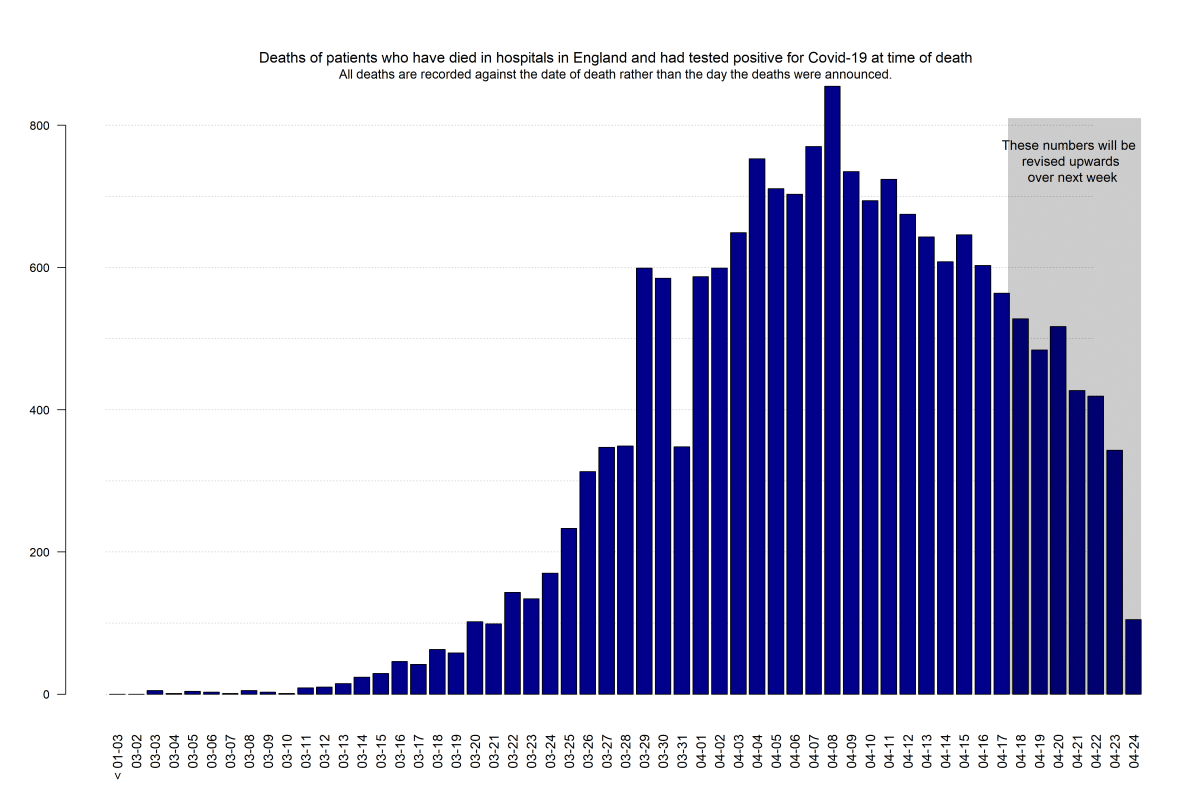
https://www.cebm.net/covid-19/covid-19-death-data-in-england-update-25th-april/
If the time from infection to death averages 3 weeks then did the infections peaked in mid March before the lockdown started? In which case the voluntary social isolation measures as per Sweden may have been sufficient.
With regard to the question of should we have locked down earlier.
I have a simple answer, YES we should have locked down earlier.
When we delayed the lock down we were doubling the number of cases every 3 days.
Post peak, I believe we are now halving the number of cases every 12 days.
That means for every 3 day delay to lock down, one has to then remain locked down for an extra 12 days. So a week delay to lock down equals an extra 4 weeks of lock down. And so on.
The experts should have known this, and this should have been the argument for early lock down at government level. This should have been the end of the argument, sadly it was not 🙁
From both a health and economic perspective an earlier lock down would have been better.
Neil
True but you have to factor in the ignorance and selfishness of many of the population. If we had locked down earlier, there would have been fewer cases but would the lockdown have crumbled quickly as people 'couldn't see the point'.
It feels like the current lockdown is beginning to crumble despite the fact 20 thousand gave died. An earlier lockdown may have generated more lockdown fatigue resulting in more deaths due to a second wave. Trying to implement a second lockdown will be difficult, people accepted it once, twice might be a different issue.
Nice summary - I like that, and completely agree. Doubling time up is not the same as halving time down. One was unrestricted transmission, the other is not.
If the time from infection to death averages 3 weeks
Globally, case numbers are only about 5 days ahead of deaths. I pretty much discount any death data that is less than a week old in my analyses. Most up to date mortality comes out tomorrow for Week 16.
@frankconway - I didn't say we'd find a vaccine specifically; I said a vaccine and/or a treatment. Either will do TBH, but as a scientist I trust my colleagues in the medical and pharmaceutical sciences to deliver something.
And as you say, (indeed as I said) buying time but at what cost...I'm glad I don't have to make that decision but at the same time I'm not exactly confident in the ability of those that do either.
Nicely put neiloxford.
I also see your point stumpyjohn, calling for a lock down earlier might well have led to fatigue and disobedience from the public but this would have been proportional. The whole population wouldn't have abandoned lockdown, only a proportion of it.
So taking neiloxfords model as an example but factoring in your observations, an earlier lockdown would have seen us going into the lockdown with lower numbers. Lockdown would have held the peak at a much lower figure. Public fatigue/disobedience would have led to a slower reduction post peak but from a much less high peak.
The curve would have had a shallower rise, lower peak but potentially longer tail. Less deaths overall, less damage to the economy and keeping numbers within the capacity of the health service.
The experts should have known this, and this should have been the argument for early lock down at government level.
The experts did know this. They were ignored for too long, as the government took the advice from Sage as gospel, even though at odds with the wider scientific community, and secret, and members not named (to protect the “impartiality” or their advice). Secret “science” that can not be reviewed, and is from unknown sources, is not science. We know the government has to make political decisions, but Sage advice should feed into that rather than be formed by it… Cummings and Warner’s role in it should he called out at every opportunity.
Nicely put Neiloxford.
It’s a real pity the journalists asking the same old questions to the government at the daily briefing lack any kind of maths/science understanding to be able to raise a point similar to what Neil has made. I’d like to see Valance/Hancock justify our delay when presented with that fact.
Inkster, you're probably right, despite a number of high profile bellends flouting lockdown most people have adhered to it, more than enough to have a significant effect.
I'd also be very surprised if the government were having adult conversations waying up pros and cons of when to lock down. They were just very much rabbits in the headlights without a clue hoping it would go away.
Someone asked a few pages back whether Boris would change his tune after getting it himself. I think he has as he's really trying to not get up hopes that the restrictions could be lifting anytime soon.
Anyone else notice this or am I just imagining it?
No he hasn't.
He talked this morning of great successes.
That is just crazy. Sounds like Trump.
How big are we expecting 2nd/3rd waves to be? Can track/trace completely squash this thing until vaccine/treatment options appear?
How big are we expecting 2nd/3rd waves to be?
Have a look at 2009 swine flu 😉
https://en.wikipedia.org/wiki/2009_swine_flu_pandemic_in_the_United_Kingdom
We know what unbridled transmission can do - doubles in three days. We know what lock-down can do - half-life of decay of two weeks. Somewhere in between those two is the second wave. That's what's not being modelled. How much contact do you want? The growth rate is exp((R-1)*TIME/5d), where R is about 2.5 going up and about 0.66 going down. That's a reduction in contacts of about 4x, so quite impressive.
Back of the envelope - even after lockdown is removed, we'll all be very cautious for a few months, so in reality, I would be surprised at a secondary epidemic a 10th of the size, with most likely outbreaks still going through the occasional nursing home.
Don't hold your breath for a vaccine. But do expect therapeutic agents to come. After SARS-COV1, there was no vaccine, but worse, there were no drugs either. That won't be allowed to happen this time. MERS doesn't really count because it was not human-to-human transmissible to any degree (Camels are the reservoir, so don't lick one, they still have it).
What caused the gap between waves of swine flu? I don’t recall any measures?
Summer. Influenza is very seasonal due to temperature, virus breakdown and mixing patterns. Impressive though. The second phase coincided with normal flu season.
Ah. I was reading an interesting article about whether it was the sun/heat or vit D levels that causes flu to drop in the summer. Is there any Vit D link with CV19?
Also a layman’s question about antibodies/immunity.
It’s been said many times one of the issues with CV19 is that it’s new, so our bodies immune system doesn’t recognise it.
Is it possible that even if having the disease doesn’t convey immunity, it does mean your body recognises it, so avoiding a lot of the complicated secondary issues we are seeing?
We have two arms to the immune system, innate and adaptive. Innate is just pattern recognition and is much older - something looks odd, attack! COVID19 works on both, but it is your adaptive that primes some cells (called memory B cells) to remember what it saw last time. When presented with the same foreign protein again, those B cells are called into action, expand and produce antibody. Whether that is enough for immunity is not known. Whether COVID20 comes back with the same proteins, we also don't know (except the previous SARS-COV-1 is very similar and does cross react).
I'm betting on adaptive immunity and cross-reactivity at least conveying some immunity to severe infection. It's why influenza hits children badly.
As for Vitamin D - who knows? We've had three weeks of sunshine and cases are going down 😉
TiRed - I rarely post on here, or indeed anywhere on t’web, just wanted to say that I’ve really appreciated reading your posts as an intelligent insight into what is going on. Thanks.