MegaSack DRAW - 6pm Christmas Eve - LIVE on our YouTube Channel
for a terranova 1man tent, sleep mat, sleeping bag, possible small tarp...then all the usual light weight stove, torch, ti pot etc etc
basically got everything but the backpack.
Depends on how well your gear packs down, and the season.
I can fit my standard, not ultra-lightweight bivvy gear (bivvy bag, mat, tarp, sleeping bag, clothes, food, water, etc.) in my 35-45l (expandable bag). Fine for a night or two, spring-autumn, might struggle in winter, but it's got loops and stuff to attach stuff to the outside so would probably be ok.
Ymmv but in summer I get on with a 25l (BCB daysack) with small tent strapped externally with the, er, straps!
Prob go 35l if I wanted everything stowed inside the bag but I like to utilise the straps as once tent is pitched I have a daysack
as small as possible - get weight on the bike if you can.
I started with an osprey 22L. slowly moved kit onto the bike. use the same pack but lots less weight in it. much more comfortable & better handling too.
Why a tent [b]and[/b] a tarp?
a little 'porch style' tarp
not bike packing.
I like the idea of hanging some equipment off the sac (in a dry bag)?
I'd go 40L-ish on the basis it would be more flexible. It would also depend on how much food and drink I'd need to carry.
And I hate things strapped to/hanging off rucksacks.
I'd avoid sticking stuff on the outside of the pack - it can fall off, snag, move around, and even be dangerous if it shunts you forwards scrambling down steep rocky terrain (eg Lake District). Far better IMO to get a slightly bigger pack (won't weigh much more) and get everything inside, where it's dry, safe and can't swing around. Bigger packs are more versatile too - you can use it in autumn and winter when you'll need more gear. It also means you can pack more booze and/or luxuries. Personally, I don't get this current obsession with minimising size and weight if you're not competing in some kind of race. For an insignificant bit of extra pack weight you get a far more versatile set-up and the chance to carry some bits & bobs that can make a trip safer and more enjoyable.
makes sense...cheers...what pack size then?
oh and what brand? any recommendations? I like the idea of a tall / narrow pack as it would lie nicely in the porch area (zephyros)
36 to 45ltr is perfect size for summer backpacking and doubles up as winter pack. Loom at Osprey packs, IMHO they are the best.
Personally, I'd be looking at 45 litres and bigger. Be disciplined packing so you're not carrying stuff you won't use (you'll learn by experience). The air in your unused pack space really doesn't weigh much. I really like Lowe Alpine packs for wild camping. Osprey look excellent and are more fashionable, if that matters. They cost more though.
Having got and used many sizes of rucksack when climbing I've never seen the need, summer or winter, UK or Alps, for a big rucksack. Mostly I used a 30 - 35L sack, could get a full rack, rope, shoes, chalkbag, spare clothing, etc in there. The usual gripe about packing: you pack a rucksack twice in a day - once before heading off to the crag; once when heading home.
Using a small rucksack means you have to *think* about what you take. Sadly this seems beyond most.
You could always tell the British climbers in the Alps: they were the ones staggering around under a huge rucksack.
Sorry - rant over 😉
Make?
Go for niche and UK (this is STW)
www.aiguillealpine.co.uk/products/rucksacks-bags/
Er...tent, sleeping bag, stove, sleeping mat, grub, booze, raincoat/trousers, hat, water, camera, warm tops. I'd struggle with a 35 litre, for sure, and that's what I take on every camp, never mind in winter. To be fair though, I have a two-man tent which could be a bit smaller, and I tend to camp high up in the UK where it's a bit cooler, even in summer. I could save a small amount of space ditching things like waterproof trousers, but why bother, especially in the Lake District.
If you are doing the Jennride this weekend then Aiguille Alpine are in the same building as the cafe and Hawkshead Brewery.
I like the look of that Aiguille stuff - looks like it would last a lifetime.
Aiguille stuff is really good - but if you;re going to be riding off-road put as much of it on the bike if possible. I either use a Carradice Camper Longflap or apidura/ revelate bags depending upon the level of beard and tattoo company.
all my wild camping kit goes in a 70 l rucksack with a seat and closed cell foam footprint on the outside - seems a lot but weighs only 13 kg without food.
This however is for scotland so includes sunscreen and woolly hats etc and is used for mutiday trips where I don't see another person let alone a town
Most recent trip was 4 days without restocking. 17 kg weight as we set off. Temps ranged from 20c to 2 c. There was nothing in the bag that was not used. I was carrying slightly more than my share tho as it was shared with my missus and she needs to carry a little less 55l rucksac for her 14 kg at the start
It all depends on what point on the comfort / safety / weight scale you want to go on.
Leightwave rucksacs are what we use. Waterproof and light. However this is for walking - for cycling get the weight on the bike and distributed well.
If you are doing the Jennride this weekend then Aiguille Alpine are in the same building as the cafe and Hawkshead Brewery.
jenn ride this weekend?
Using a small rucksack means you have to *think* about what you take. Sadly this seems beyond most.You could always tell the British climbers in the Alps: they were the ones staggering around under a huge rucksack.
+ 1 ... a bigger sac means you'll end up carrying more
Jenn ride in lakes this weekend, http://singletrackworld.com/forum/topic/jennride-southlakes100info-for-the-weekend-and-entry-on-the-day
I have a HAWG and some stuff strapped to bike, need to check weight of backpack for interest.
For a couple of nights backpacking, 35l will do and 45l is luxury. I'd be having a good look for something around the 45l/500g mark if you're buying new. You can easily end up with 1-1.5kg sac if you're not careful with a consequent impact on AUW.
I can generally fit all I need in a 20l with space to spare.
That includes all the stuff you mention (apart from tarp AND tent) plus down jacket, spare trousers, waterproofs and socks, food, small first aid kit, emergency bag etc. I think the total weight last time I bothered weighing was just under 5kg. That was only a one night away whilst racing a mountain marathon but done similar two night trips with same 20l rucksack. This is when using rucksack only, running not biking. Nothing strapped to outside as I would just lose it.
I do have some lightweight stuff that compresses well, but I have also done it a few times. Every time I come back, if I have not used something I don't take it again. Soon get to a lean pack.
Suppose it depends on if your going as light as possible or heavier and slightly more comfortable
Have you looked at the OMM rucksacks? They are not bike specific but great for running/walking and come in 20l and 25l. I have both sizes and rate them for comfort and robustness. 25l is a great compromise size and should be enough.
45L for me when wild camping or biviing in the alps back in the day.
weighs only 13 kg without food.
That's an awfully heavy bag. Getting it lighter is partly down to your approach / attitude and partly a matter of cost
Edit: with the right kit and not too many compromises about half that is quite doable
My rucksack on alpine climbs would weigh 10Kg with all my share of the climbing kit, bivy kit, rope and food. That was back in the 1980s, with modern lightweight kit it would be somewhere in the 7-8Kg range.
As ajf says: make a list of what you take, when you get back cross off everything you used. What's left (apart from emergency stuff like First Aid Kit) can be considered for leaving at home the next time. Keep doing this and without spending any money you've cut down on weight and bulk. At this point you can start looking at treating yourself to lighter kit.
Get a copy of "Smarter Backpacking" by Jorgen Johansson for ideas.
Spin - Member
weighs only 13 kg without food.That's an awfully heavy bag. Getting it lighter is partly down to your approach / attitude and partly a matter of cost
Edit: with the right kit and not too many compromises about half that is quite doable
Nope - I have been doing this for 40 years and its very refined kit. the only thing that is excess in that pack is a sub 200g seat and a 300g closed cell foam footprint for the tent rather than a 200g plain one.
Remember this was for a 4 day trek with no resupply possible, no mobile phone signal at times and at points a walk out would have been well over ten miles. This was not a kip in the woods above a town where you can bail if it rains / blows a gale / you get cold
We were expecting night time frosts
Tent is a two person lightweight 4 season tent - 2.6 kg ( £400). ( Mrs TJ had the jetboil stove) I want a tent that will stand up to a full on gale / storm as no escape was possible without calling the big yellow bird. Frinds of mine have had lighter decent quality tents collapes in gales in the highlands. I am not prepared to risk this hence a full on geodesic 3 season mountaineering tent
A full change of clothes incase of getting soaked ( several big river crossings) plus a fleece to wear and one for warmth at the campsite. Clean shirt, underpants and socks for each day. Long johns for evening and sleeping. 3 season sleeping bag - 1kg plus a silk liner. Small first aid kit, kindle, reading glasses. big thick wooly hat, winter mountaineering gloves, full set of robust waterproofs, shit shovel and bog roll, 400g sleep mat ( I'm 56 - I need this)
total cost of replacing the kit would be well over a grand - strong light cheap pick two - I pick strong and light
Its horses for courses but even removing the luxuries would save less than a kilo and make the camping less pleasant. I am looking to buy na down jacket tho to replace one of the fleeces which will save a bit
Going on the principle of not taking next time anything not used would not reduce it at all - [b]everything was used.[/b]
Taking any less in the situation we were in would be compromising cvomfort and safety too much.
rucksac weighs under a kilo - very light for a 70l
I have worked hard to get the kit down to that weight without compromising comfort and safety. No way on earth could i half the weight without doing so. Even compromising a bit on the comfort would save under a kilo
Even tarp and bivvy bags for two would not save much weight - expecially as warmer sleeping bags would be needed
We actually weighed the bags as we set off and on treturn once we had eaten all the food - I think like bike weights people often totally underestimate the weight of stuff they take
[quote=tjagain ]I think like bike weights people often totally underestimate the weight of stuff they take
Nah. Folk that are serious about cutting weight tend to be quite anal about weighing stuff and knowing what can be cut/bettered. My last overnighter, I weighed my complete kit (including bike) for the first time - not something I'd done before. Total weight was 23kg. That was food, water (1.5L), spare clothes plus all sleeping/cooking kit, tools, camera, phone, batteries etc. Hell, I even had a pair of binoculars with me 🙂 Of course, I'd have wanted more food for another couple of nights out but that's about it.
some of the weights folk claim are simply not believeable ( knowing your bikes are nice and light I do believe your 23kilo inc bike tho - that will be around 10 kilo of kit?
I am serious about cutting weight down ands weigh everything
the 13 kilo included a litre of water and a 300g pair of binos and two trekking poles, small camera and a phone and a map and was weighed with most of my clothes in the bag as it was nice and warm when we set off
the tent i saw blow down was a terranova laser Stupid wire pegs didn't work
there is no way on earth I could save half that weight without making it so uncomfy I would have to reatreat into my sleeping bag early and / or compromising safety too much for the sort of trip we were doing
[quote=tjagain ]some of the weights folk claim are simply not believeable ( knowing your bikes are nice and light I do believe your 23kilo inc bike tho - that will be around 10 kilo of kit?
Less. The bike has 3" tyres and 45mm rims 🙂
I'm with scotroutes on this - like ajf I'm coming from the perspective of doing MMs and Polaris - I've finished fairly high up in both. I've done an overnight with a 25L pack, when a significant amount of the space inside was filled with bubble wrap (lighter than any normal sleeping mat, and fine for a couple of nights). I'm not quite sure now what all mine weighed, but weights being quoted certainly are believable - I think I've been under 5kg. My tent is lighter and more compact even than a tn Laser, but I have slept in it in some pretty wild weather. All sorts of ways to save lots of weight - for example people seem to feel the need to carry a lot of weight in cooking equipment, when my tin can chimney effect solid fuel stove actually works just as well.
I'm afraid to say tj that it just looks like you're old school! Fair enough, carry what you like or think you need and have fun in the hills but there are other ways. Here's my thoughts on your kit list:
200g seat and a 300g closed cell foam footprint-500g right there.
A full change of clothes incase of getting soaked- Just put wet stuff on in the morning and keep moving! Maybe save a kilo?
Clean shirt, underpants and socks for each day.- Embrace the stink. 4 days, one change of socks,save another kilo.
kindle- luxury! Print some reading material out and wipe your arse with it when finished!
full set of robust waterproofs-Maybe half a kilo to be saved here by going lighter.
silk liner-no need.
shit shovel-There are other zero weight ways to safely shit in the outdoors. Half a kilo?
300g pair of binos-Luxury.
small camera and a phone-do you need both?
big thick wooly hat-light fleece hat?
jetboil stove-Heavy!
Taking any less in the situation we were in would be compromising comfort and safety too much.
A lot of what I've mentioned above are unnecessary items and all of that stuff could be left behind or changed without compromising safety at all. And yes, I am talking about remote areas.
Just because you use it doesn't make it necessary, I often 'use' significant amounts of whisky on a camping trip but I wouldn't say it's necessary!
Clean shirt, underpants and socks for each day.
One of each for camp, it's not a fashion parade!
Two fleeces?
As Colin says, you get quite anal about weights 🙄 I've a spreadsheet with the weights of all my kit. Each item's weight is rounded up to the nearest 5g after I've made any modifications that I want.
For the JennRide this weekend I will have under 5Kg of kit, not including water (750ml bottle) or food which will be about another Kilo. There'll be kit (like a 20,000mAh power bank battery) that I won't use as it's a practice ride for next week's HT550 and I'm taking the same kit - waterproofs will wait until the day before depending on the forecast. So, yes it's "race" mode kit but even swapping out all the ultra-light stuff for more reasonably priced kit (silnylon rather than Cuben fibre tarp, Exped Synmat rather than Klymit X-Frame, etc.) will add less than a kilo. There's no cookset but even my heavy canister gas one only weighs 250g including the gas cylinder! The weight includes phone and SPOT tracking device, can't remember if it includes camera, assume not.
Food for a multi day trip with no chance of restocking will add to the weight but even using the old army calculation of 1Kg per man per day, a four day trip is still going to leave me under 10Kg
Edit: I went on a climbing expedition to the Himalaya, we had a competition to see who could wear the same underpants for the longest. I lost, after 60 days they fell apart!
Klymit X-Frame
Do they actually work ok?
They are fine for summer but there's no insulation in them so once the temperature gets close to freezing you are better off with a mat like the Exped or NeoAir. Think of them as a super light Lilo. They do pack up very small though. If I'm in touring mode rather than racing I'll take the Exped - another 150g heavier but ...
I haven't seen it linked here yet but [url= http://bearbonesbikepacking.blogspot.co.uk/2016/08/tls-revolutionary-packing-system.html ]TLS[/url]
Edit: TJ, I've had a Wild Country Super Nova tent get destroyed in a Scottish Gale (insurance paid up eventually) but also seen a Go Outdoors big frame tent stand up to a Hebridean storm for several days. I've seen two identical tents next to one another - one gets flattened but the other's fine: a gust of wind hitting a boulder 50 metres away with the wind at a particular direction and strength or some such random collision of circumstances.
I had one of the short Klymit mats. Atrocious. Unless you have the pump you can't get enough air in. If you turn at all you feel the ground through the gaps.
I forgot the sigg bottle of whisky! Best part of a kilo.
Spin - you may disagree but to me going for 4 days without being near a road means enough spare clothes so that if you get soaked then you don't get hypothermia. I have had folk on expeditions get hypothermia and its not nice. The fleeces are essential - its cold at night high up this time of year. I hate being cold and I don't want to have to retreat into my sleeping bag the moment we stop moving. We go away every year at this time and last year I was in bed with all my clothes on inc two fleeces Shit shovel - essential. Read the guidance. digging in shit is the best way unless you carry it out. anything else is antisocial
the footprint - is only 100G extra - as I am not pitching my expensive tent on heather without one and a lightweight material one weighs 200g
Yes there is around a kilo and a half of luxuries there. Even remove them and make the camp much less pleasant I am still going to be nowhere near 6 kilos
Silk liner - essential - adds warmth to the sleeping bag. cleans socks and pants each day - essential - I was walking don't forget and don't want blisters / sweat chaffing
Sorry dude - I simply disagree with you. I also as above simply do not believe the weights some folk claim. I included everything including 2 walking poles - thats 500g. Phone is for emergancies only - so in the bag turned off. Hence a camera as well
Jetboil - cooking for two remember. 2 cans of fuel incase one leaks - one 100g one 250.
You say your stove is only 250 g - Including pots big enough for two?
the hat and gloves are fleece - full on winter mountainering kit.
I thaver thought long and hard about the kit I carry and yes a kilo or more of luxuries in there but Its supposed to be fun. Everyting in there was used at some point
Ditch the whiskey, kindle, camera, chair and use a flimsy footprint would take me down to around 10 kg
Sorry dude - I simply disagree with you. I also as above simply do not believe the weights some folk claim.
No worries, I never expected? you to agree with someone else on this forum! Nevertheless, I'm not compromising on safety in the hills and the weights people are quoting are totally achievable.
Sounds like you're stuck in a bit of a 'I've always done it this way' rut?
Think of them as a super light Lilo
Didn't realise till now that they're meant to go inside your bag. Does that lead to condensation on the underside of the bag?
I use a balloon bed for MMs and they're surprisingly comfortable.
Aye - I agree acehivable but at the cost of comfort and / or safety . What are you doing with your shit if not digging it in? Carrying it out again? anything else is antisocial and against the access code and I have a 85g shovel
Next week we are going away for 12 days unsupported - whats feasible for a single night when racing with an easy route out if it all goes wrong is not for multiple nights with no easy escape route and planned camps on the tops of mountains where snow may well be on the ground and frost is possible
I am not stuck in a rut at all. Much new kit over the last few years. Much thought into weight saving. I also carry a chunk more than half the kit.
. I also carry a chunk more than half the kit.
Well that changes things a little.
I agree acehivable but at the cost of comfort and / or safety
Comfort? Perhaps a little, depends on the individual. I'm definitely not compromising on safety though.
I should qualify the 'stuck in a rut' comment by saying I was too until I did a mountain marathon which opened my eyes.
🙂
Not an angry argument - just a debate
So if you fell in a river ( as was possible on that trip we just did 3 river crossings) and get soaked to the skin without spare clothes how are you going to avoid hypothermia in freezing temps?
What do you do with your shit?
I keep reading about folks lightweight trips and adopt what ideas I can. Mrs TJ generally carrys a couple of kilo ( or more) less than me.
But I am old and I like a bit of comfort. I like to be able to sit in my chair at the campsite not having to retreat into my sleeping bag for warmth, drink a whisky, watch eagles thru my binos and take photos. I also like to be able to cook quickly and easily, drink good coffee and eat well.
You should see what we take when "comfy camping" by bike 😉
[url= https://c1.staticflickr.com/1/631/22827945147_4a3b2df633_k.jp g" target="_blank">https://c1.staticflickr.com/1/631/22827945147_4a3b2df633_k.jp g"/> [/img][/url][url= https://flic.kr/p/AMebMa ]lammermuirs selfie[/url] by [url= https://www.flickr.com/photos/25846484@N04/ ]TandemJeremy[/url], on Flickr
Edit - I shall weigh the luxuries and see how much it comes to and also the basic kit - you have got me questiuoning
I use a 55l bag (montane grand tour) for multi day trips in the highlands. Could easily manage with 40 to 45l in summer.
Generally aim for under 10kg without water, although obviously in winter this is blown out with axe and crampons.
Finding a comfortable pack with some form of compression to keep your kit stable even when not rammed full would be my starting point.
EDIT - am also from a mountain marathon background (although many years ago). Really does teach you what you really need! Would admit that comfort can be compromised, but never safety.
My kit includes a trowel 🙂
My kit includes a trowel
Do you stop to do a bit of pointing and brick laying?
Shudder to think how much the sand and cement slows you down...
That's one name for it 🙂cloudnine - Member
My kit includes a trowel
Do you stop to do a bit of pointing and brick laying?
The one mountain marathon I did also opened my eyes.
Opened my eyes to how close to the wind alot of the guys were sailing to the wind with their safety.
The kit met the mandatory kit required but some of it was one going to be banjaxed after one use.
Like tj if in venturing into new terratory or into the hills where as he puts it the only way out if you get into a hypothermic state is a yellow taxi I'm not going to play fast and loose. Even at a mountain marathon there is a safety net if you don't dib back in so I can understand these guys sailing close to the wind but when there's no safety net it's stupid.
Doesn't take much to end up in a hypothermic state I put a foot wrong and ended up In the wrong end of the feshie at 10pm with an icy wind blowing. Never been so glad to find the bothy fire glowing as even after a change of clothes and a down jacket on I was still struggling with warming up
That would have been one misrable night with the change of clothes...and might have been lethal without a change had I made confused cold choices and been less lucky with the bothy
Well I'm 58 so no spring chicken! I used to be able to get by with three sections of Karrimat shoved down the sleeve in the back of the rucksack but these days I'm soft 🙄 so have an Exped Winterlite.
A lot of my kit is quite old - I've a 20 year old fleece for example, I wore it to work today - so I don't buy kit for the sake of it, I'll cogitate* over something for ages working out how much use I'll get out of it, etc., etc.. I'll usually only buy something new when what I've got wears out or my wife says something along the lines of "chuck that in the in, it's disgusting!". I try and buy items that work together in ways that the result is more than the sum of their parts.
Cooking kit: the 250g kit is 100g gas canister; small burner; Alpkit 650 MyTiMug. If I want to go lighter then a homemade beer can alcohol/meths stove with foil windshield (10g). Cooking is mainly rehydrating stuff, trying to replicate cooking at home is pointless (IMHO), boil-in-the-bag type foods mean no washing up! The meths stove is slower than the gas but five minutes vs three minutes? What are you going to do with those two minutes? You are sat around chatting, it's just that the cooking/boiling of water takes a couple of minutes longer. And yes, this is for two.
Sleeping bag: in this country in summer (basically around now until sometime in September/October depending on year) I use either a Cumulus 150 quilt or a PHD Minim 200 bag, both are rated to around 5C. I'm a warm sleeper so they are fine for me. Once it gets cool then I'll take both and use the quilt as a wrapper, this combo is good down to -5/-6C which unless you are camping on the summit of Cairngorm in the middle of winter is going to be good enough for the UK.
River crossing: strip off as much as possible or is publicly acceptable 😳 and put it in a dry bag. When you get to the other side a micro-fibre towel will get you dry enough and you can put dry clothes back on.
@spin - coming from a climbing background we always had our sleeping mats outside the bivy bag. These days I'll put it inside, there's not much condensation and there's a bit of protection from the material of the bag. For the bag/quilt combo mentioned above then with the Exped mat I need a bigger bivy bag than standard so have an Alpkit Hunka XL.
My aim generally is to move through the mountains as lightweight as possible. I've carried big, heavy sacks and my knees are no better for it. I'm not trying to replicate living at home but balance weight and comfort and practicality.
Once you've got kit for one night then really the only extra stuff for further nights is food and fuel. It looks like you are looking at *every* worst case scenario and packing accordingly. I know what's meant by MM runners sailing close to the wind - I'm not anywhere near that.
*cogitate: (verb) to constantly prevaricate over the purchase of an item whilst muttering words to the effect of "my current model really isn't up to standard dear, I think we should get this".
depends on circumstances for me, I think I'd rather do it the TJ way for a UK long weekend away, backpacking with some mates, a few comforts, change of clothes, some alcohol and pleasant food (not arsed with the binoculars tho ta).
In other circumstances I'd be cutting down to bare bones, but more because I'd be having to deal with the addition of other paraphernalia.
most aren't doing a mountain marathon or training for one or climbing in the alps, just spending a weekend with mates enjoying the outdoors. most of the time I couldn't give a toss about gms here and there. Stick that on your spreadsheet 🙂 😉
Love the idea of the Aiguille stuff and I'm sure it would last for ever. But I like the look of some of the more 'modern' bags. especially with a front face of the bag that zips open (as opposed to one opening at the top)
haglofs
gregory
osprey
bergans
thinking 65ish would be a good idea? 1-2 night camp lake district - spring/autumn
macpac
deuters
what sleeping bag do you have?
thinking 65ish would be a good idea? 1-2 night camp lake district - spring/autumn
I used to use 50l with the carrymat strapped to the outside and that's in winter.
Long time since I did any back packing though, so stuff will be lighter and smaller now...
[url= https://c1.staticflickr.com/9/8525/8454678236_77a0f0e00f.jp g" target="_blank">https://c1.staticflickr.com/9/8525/8454678236_77a0f0e00f.jp g"/> [/img][/url][url= https://flic.kr/p/dT7rhq ]RED PIKE FROM BRANDRETH[/url] by [url= https://www.flickr.com/photos/brf/ ]Ben Freeman[/url], on Flickr
The problem with getting a rucksack that's too big is that the load can slip down to the bottom, upsetting the balance and making it uncomfortable. You can minimise this so some extent if there is a divider and/or compression straps but these then make retrieving items whilst on the go a wee bit more hassle.
[quote=B.A.Nana ]depends on circumstances for me, I think I'd rather do it the TJ way for a UK long weekend away, backpacking with some mates, a few comforts, change of clothes, some alcohol and pleasant food (not arsed with the binoculars tho ta).
In other circumstances I'd be cutting down to bare bones, but more because I'd be having to deal with the addition of other paraphernalia.
most aren't doing a mountain marathon or training for one or climbing in the alps, just spending a weekend with mates enjoying the outdoors. most of the time I couldn't give a toss about gms here and there. Stick that on your spreadsheet +1 to all of that, but I'm sure you wouldn't claim that other folks weights are unrealistic if they're specifically attacking the light/fast option. Also, race or not, a lighter pack is just more pleasant to carry.
Here's my bike from a recce of the northern loop of the HT550 on the May Day bank holiday, the shot was taken between Glen Golly and Bealach Horn. We bivvied in the woods at the foot of the descent from the bealach.
[img]  [/img]
I didn't have a rucksack. The blue bag on the front has Alpkit Rig7 tarp, Exped mat, Hunka XL bivy bag, Cumulus 150 quilt and PHD sleeping bag. Spare clothes in the seat pack, poles for tarp, powerbank battery, food (for two nights), stove and mug in the partial frame bag. Tools spares, emergency stuff in the bag beneath the downtube. Trail food in the two grey feed pouches behind the blue bag and in the Lioness on the front (hard to see because it's black). The Lioness also had stuff like water filter, cables and light. No firm idea of the total weight but it was probably about 8Kg. Just sensible packing really.
We weren't slumming it though we didn't have any whisky with us 🙁
Here's a shot of the bike in ITT mode for the Trans Cambrian Way in March.
[img] 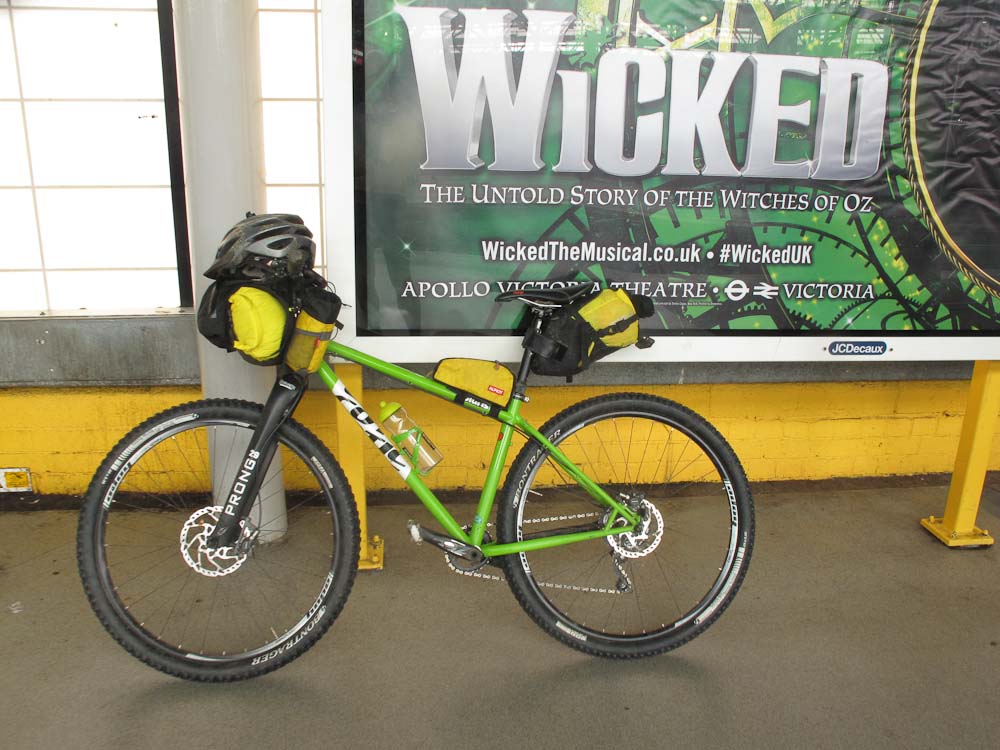 [/img]
Basically no frame bag and the spares are in the top tube bag rather than one under the downtube as I didn't have that bag back then.
PHD is cheating anyway, I bet it's no bigger than a tube of toothpaste and weighs less. Most people have to make do with a normal stuff at normal prices. 🙂
Ha, ha! I know what you mean, there's no denying it's pricey stuff. I got that bag in their spring sale a couple of years ago so not quite such a shock, £170 from memory, definitely an investment rather than a simple purchase. The Cumulus kit is decent stuff though (the bags are sold under the Criterion label in the UK), not quite as good as PHD but quite a bit cheaper. I suppose they sit somewhere between Alpkit and PHD in both price and quality.
In my case, ME Dewline and still going strong.
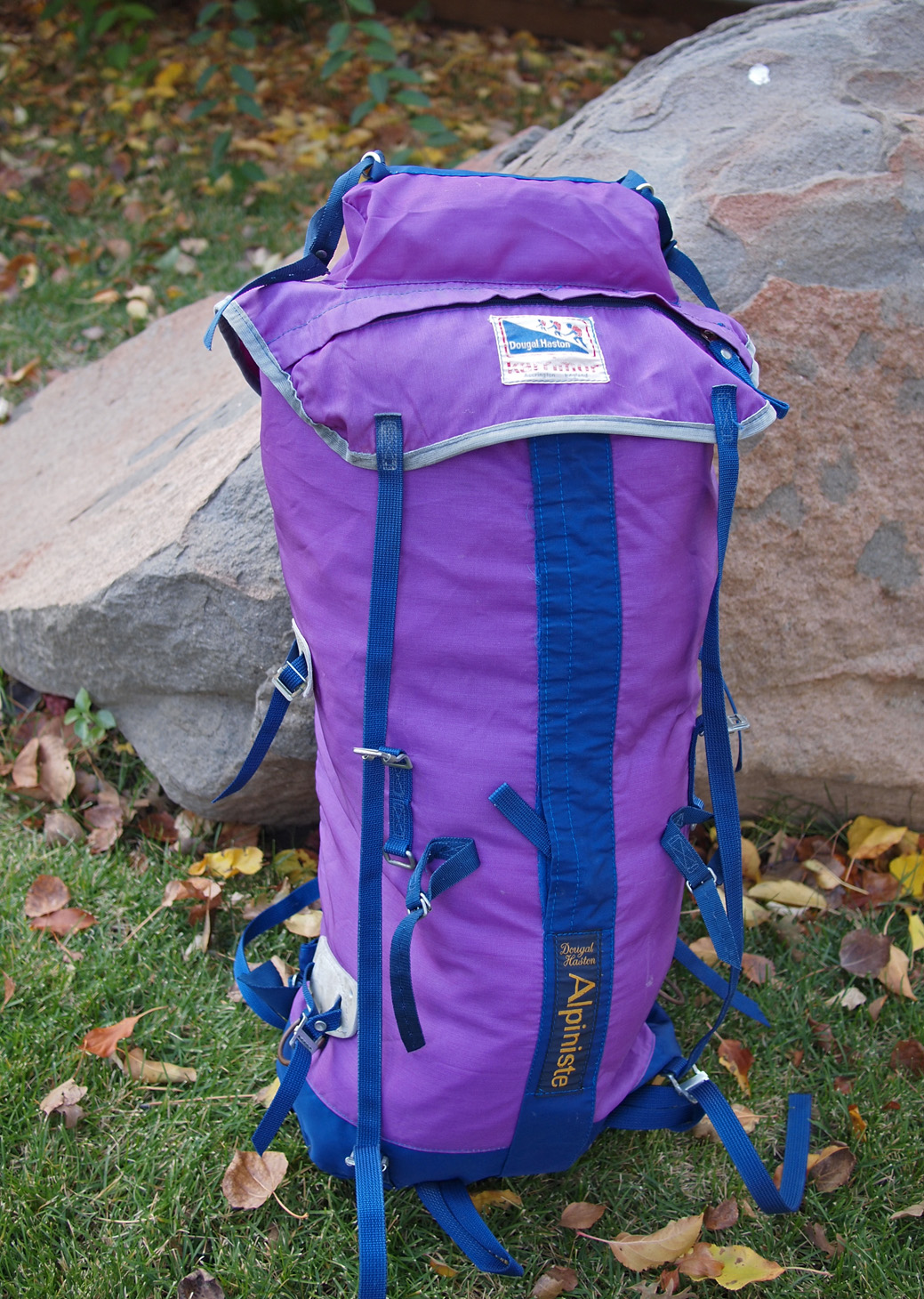
footflaps, that looks like the colour of a Karrimor Alpinist?
[quote=tjagain ]Shit shovel - essential.
Yes, but the one I carry weighs next to nowt, plastic thing with the handle cut off.
I also as above simply do not believe the weights some folk claim. I included everything including 2 walking poles - thats 500g.
Which is one reason why others think you're carrying too much - those weights are real and achieved by being obsessive about everything. I don't carry walking poles even when walking - I understand why you do, but then it's more added weight.
You say your stove is only 250 g - Including pots big enough for two?
Mine weighs way less than that - two people just requires a bigger foil takeaway container. The cooking kit is a relatively small part of it, but illustrates the level of obsession - I use solid fuel as it gets rid of wasted weight in containers. Here's my stove:
[IMG]  [/IMG]
Top bit is a steel can as I found the alu coke can used for the bottom couldn't take the heat. The same as whitestone I'm just boiling water on the stove to add to dehydrated food - menu usually starts with a pot noodle or pot pasta, which then provides the "bowl" for all other courses. Cooking/eating utensil is a plastic spork.
My suggestion of a 25L pack is the minimum for MM level of kit - could probably get it all in a 20. If I'm going longer and/or worse conditions (though bear in mind KIMM/OMM is at the end of October and I've been out in pretty rough conditions in that) then I might carry more spare clothing in which case maybe a 30L pack. Have done hut to hut ski touring in Norway with a 45L pack - no cooking equipment or tent but that doesn't make a huge difference, and was certainly carrying plenty of clothing given expected temperatures down to -20, though a down jacket is a lot lighter than fleece for the warmth rating. Also skins, snow shovel and waxes. I own a 65L pack but it hasn't been used in over a decade - I've moved on from carrying lots of stuff, it's far more fun if you're not weighing yourself down.
footflaps, that looks like the colour of a Karrimor Alpinist?
No, that photo is from before that came out. It's a Hard Rock IIRC 50litre thing. They had a set Hard Ice, etc at 30l, 40l and 50l. These were two tone with the back a different colour to the sides. The Alpiniste was all the same Karrimor purple.
Just had my new chair arrive - a 75g saving.
Looking at a down jacket to replace one of the fleeces.
I have a ti spork. Nicer / lighter than plastic
I need the walking poles - dodgy knee. I am looking at CF ones to save some weight
Aracer - could you live using that stove / cooking equipment for 12 days?
It's not a competition! TJ can take 13kg of stuff if he likes. To be honest when I've camped out on foot I take more because I can, and it doesn't bother me that much. It does on the bike though so that's where I try to cut down. I'd probably do the same as him - it's nice to be able to change clothes, and if I were walking I'd probably bring them for luxury and because I own a nice 60l pack.
So if you fell in a river ( as was possible on that trip we just did 3 river crossings) and get soaked to the skin without spare clothes how are you going to avoid hypothermia in freezing temps?
I've been wet many times, I just press on and I warm back up again in no time, because I am wearing kit that is warm when wet. Only risk is falling in and becoming too injured to press on - but then I'd be in the survival blanket or whatever and keeping warm that way.
Interesting discussion. Glad trailrat understands my point about the risks and the circumstances under which I as camping. Molgrips - where we were get wet get hypothermia without dry clothes
[quote=tjagain ]I have a ti spork. Nicer / lighter than plastic
er, nope - have just weighed my plastic one and it's 9.86g (yes I have a scale that accurate!) - though for a MM I'd probably take a disposable spoon, the sample I have here is 2.72g. Not even sure about nicer. The ti thing is a good example of where people think something is light when it isn't - a quick google suggests a ti spork is ~15g. A general theme with ti stuff which seems to have got a reputation for being ultralight - Trangia pans are lighter than typical titanium ones.
Aracer - could you live using that stove / cooking equipment for 12 days?
Possibly not, but then the OP is looking at doing a 2 nighter. On a longer trip I'd probably take a superlight gas stove, but that still weighs way less than a jetboil.
I do get where you're coming from, and would carry more for the sort of trips you're doing - though still a lot less than you are (I'd be aiming for the 45L pack). The thing is though, the sort of trips most people do when they're talking "wild camping" are just 1-3 day trips where you can get away with minimal kit.
I did post some of this when sleep deprived on night shift so not as coherent as I might have been. I am still running with a bit of a misfire 😉
the 13 kg contains a kilo or two extra as I carry a bit more than mrs TJ, it also contains a kilo or two of luxuries, and a kilo or so so that if I run into difficulties I can be safe not have to rely on the big yellow bird to rescue me. No phone signal for large parts of the walk
So take away the luxuries and the bits I am carrying for mrs TJ then down to around 10 kilos ( including rucsac and poles) Take away my safety margin then well under 10 kilos, take away my comfort and whisky down to 7-8 kilos ish
TJ - all fuel types have pros and cons, it just depends what your priorities are. I've petrol, gas, meths and paraffin stoves that I can use - fifty years of camping and I've built up a collection!
For sheer heat output and for use in very cold conditions then petrol. For absolute ease of use then gas.
For simplicity, ease of transport of fuel then meths.
(Not used the paraffin stove in years)
There was a survey done on one of the US long distance trails about stoves, the only one that was 100% reliable was the homemade soda/beer/pop can stove.
The meths stove can be a bit of a faff and it takes a little getting used to but once you know how much to use to boil say 500ml of water then you can estimate fairly accurately how much you'll need for a day/week/whatever. Since it doesn't need pressurising you don't need super strong containers as with gas and petrol. It's just a heat source at the end of the day.
Meths stoves don't work very well at low temps - you need to warm both stove and fuel up before you even begin to think about starting it up, but this is just a matter of shoving both into a pocket or inside your jacket for a few minutes. They don't like wind either so a windshield is essential.
I'd be happy to use a meths stove for a 12 day trip so long as the temperatures were above freezing.
But if you are going to cross a river where there's a risk of submersion then you are better stripping down to your underwear and keeping your clothes in a dry bag. If the weather is intemperate then just put your waterproof shell back on. You aren't going to get hypothermic in the time it takes to cross the river.
I just carry my knife. I can make everything else I need using just that and my surroundings. It's the ultimate ultrasuperlight setup.
still have my replacement Alpiniste in the garage (original got nicked).
And a Hot Ice (IIRC) 25l/30l day sack with axe straps.
bomb proof. faded / not faded pattern on lid cover from straps 🙂
No, that photo is from before that came out
You must be older than you look 🙂
[img]
 [/img]
On stoves - I have used loads of different one - the jetboil is my fave for a variety of reasons partly due to its efficiency - less fuel needed thus a weight saving - half the fuel per day compared to a pocket rocket and partly due to the fact that for an extra 8 grammes I get an french press for my coffee and partly down to the sheer convenience of the thing
Optimus petrol burner was the hottest.
Molgrips - where we were get wet get hypothermia without dry clothes
Why? You're under your windproof shell, aren't you? I've been very wet and very cold many times all over the country - I'm not new to this. I disagree that hypothermia is inevitable with the right clothing.
If you aren't adding new water to the system and you are protected from wind driven evaporation, then the water in your clothes warms up.
You must be older than you look
OK, different version, I was thinking of, which was mid 90s IIRC.
[url= https://c1.staticflickr.com/5/4223/34622550601_b5f09c09b6.jp g" target="_blank">https://c1.staticflickr.com/5/4223/34622550601_b5f09c09b6.jp g"/> [/img][/url][url= https://flic.kr/p/UKtC4B ]Alpinist 45+10[/url] by [url= https://www.flickr.com/photos/brf/ ]Ben Freeman[/url], on Flickr
I have one of the old KIMM sacks, the larger "45l" one
Ready for Buachaille Etive Mor in the morning (a mate is Compleating)
[img]  [/img]
Edit: and I've just knocked 200g off the bike by setting up the front tubeless (the rear already was)
tjagain - Member
Looking at a down jacket to replace one of the fleeces
Have a look at a Primaloft pullover instead of down. Less troubled by damp than down and nearly as light/compact. It's probably the most used, most flexible bit if kit I've got and when you compare it to the weight and bulk of fleece... Obv assuming carrying whilst on the move rather than wearing as it'd have to be seriously cold to wear whilst generating heat...
On the stove front, I've taken to using a Micro Rocket/100g gas/reactor type pot. The pot uses about 30% less gas than a normal one which is a key point particularly if resupplying is limited or you're out for a few days on the trot.
TJ, where are you going that you'll have no contact, any shops etc for 12 days? That's a pretty remote trip...
I have one of the old KIMM sacks, the larger "45l" one
I never understood why they made those as 45l is getting pretty large for a KIMM, 25-30l is all you need and the Elites are more like 15-20l (but they sleep in a bin bag and only carry one spare sock).
As I said - not firing on all cylinders due to shift lag from nights so not too clear
the 4 day trip that I just went on had no contact - that was in strathconnan
the 12 day trip next week will have two places for resupply - poolewe and torridon - neither has a lot in the way of shops. Can't carry 12 days of food. Will be sending parcels to get picked up in both places
You may see the HTR550 folk coming through- it starts on Saturday 26th so the fast folk should be in the area on Monday?
Oh - I'll have to check the route and look out for them. Better take extra jelly babies for them I guess - do HTR 550 people eat jelly babies or only hi tech stuff? 😉
No outside help allowed! Maybe. We're allowed to use any facility available to anyone who rides the route at any time not just the group start. The rules are [url= http://www.highlandtrail.net/ ]here[/url] The route doesn't go out to Poolewe any more but cuts through to Letterewe House and follows the old Postman's Path to Kinlochewe. The bit through Torridon is different as well - it doesn't go to Torridon village but cuts up by the Easan Dorcha bothy. Rich Seipp who occasionally posts on here is currently doing it with his lad, Minipips - [url= http://trackleaders.com/highland17 ]linky[/url]
Some eat gels and the like, I'm not going to bother, they don't sit well on the stomach after a while. I might have one or two in the pack just incase I need a lift towards the end 😆 Jelly babies are fine - just packed a bag - along with chocolate, flapjack and more chocolate!
Have just finished packing bags and setting up the bike for tomorrow's JennRide, total weight of bike, bags, gear *including food and water* is 18.5Kg. The bike itself is 11.5Kg. I'll probably go with something similar for the HT550. It definitely isn't comfort but it's enough to be safe. There's some extra stuff in there, not so much "just in case" but to get a feel for the weight if I need more next week.