UPDATE: Reviews section refreshed, redesigned, searchable: Go take a look
I think the mild hybrid idea sounds like a good way toe gain some significant gain at low speed / start stop driving. If you could up the motor to. 72v pm motor I think this would work even better and allow to run the ICE at a more efficient load.
For van and larger cars I can see a retrofit system with pancake motors on rear hubs to offer additional torque and low speed movement working well. It would all rest on the control system and battery / charge management.
As that Harry's garage video explains, they can be used to limit use of fossil fuels, or to limit use in built-up areas. They require a determined user to realize that, firstly by plugging it in, and secondly by switching to the correct mode at the appropriate time. They're popularity is mostly from greenwash and a favorable taxation system.
Surely it depends how the PHEV is used. If it's just used a tax dodge and someone drives it 100 miles a day using the engine then of course it's not going to be any better for lifetime emissions than a ICE car, probably even worse as you're carting the batteries around.
However someone that does 95% of their driving in sub 10 mile journeys, running entirely on the battery charge they go from plugging it in overnight then surely it's a lot better in emissions-wise, even factoring in the generation emissions.
Sure you could argue someone that does 95% of their journeys sub 10 miles should have an EV but we're still transitioning from ICE and PHEV is a transitional technology. Once attitudes and infrastructure have caught up I'm guessing a lot of people buying PHEVs now will be buying EVs next.
Anything that needs to run an onboard engine to charge a battery no matter how sporadically is not an environmentally friendly device. It a fossil fuel burning machine not an electrically powered vehicle.
Greenwash writ large.
However someone that does 95% of their driving in sub 10 mile journeys, running entirely on the battery charge they go from plugging it in overnight then surely it’s a lot better in emissions-wise, even factoring in the generation emissions.
Depends on the source of the electricity but even if its fossil fuel electricity the total emmissions are less from driving - but that is countered by the increased emmissions from manufacture and disposal of the car. You are also lugging parasitic weight about - either the electric motor if driving under ICE or the ICE if driving electric. This wastes energy.
You also get the particulates from tyre and brake wear - again increased because of the parasitic weight.
There is some quote about not throwing away the good in search of the perfect. They offer an improvement, it's a journey.
If petrol was £5+ a litre we would get far greater improvements in efficiency. after all we had 50+ mpg cars that could carry 4 adults in the 40s.
The key is to reduce the total energy usage by reducing size and weight of cars and of course reducing how much they are used. Modern cars are bloated with huge parasitic weight
Hybrids because people think they are doing their bit and because of the parasitic weight do nothing to reduce usage and energy consumption
Sure you could argue someone that does 95% of their journeys sub 10 miles should have an EV but we’re still transitioning from ICE and PHEV is a transitional technology. Once attitudes and infrastructure have caught up I’m guessing a lot of people buying PHEVs now will be buying EVs next.
and not forgetting the cost. My parents fit the model you describe - retired so spend most of their life pottering about locally, but occasionally do a 230m drive to see me or one of my siblings. They bought a plug-in hybrid - the full electric model was £20k more (xc40) and may not have been able to do the long drives in one hit - they didnt want the stress of not knowing they'd get there, which is fair enough.
You also get the particulates from tyre and brake wear – again increased because of the parasitic weight.
you generally get a lot less wear on brakes due to the regenerative braking. Most electrics offer one-pedal driving these days (as in, back off the accelerator and you end up with the car regenerating as hard as possible and slowing you down) - you can get around 0.3g of braking force that way which is as much as you want in day-to-day driving - you basically only need to use the brakes when someone's messed up.
Tyre wear will possibly be ever-so-slightly slightly increased due to extra weight but its minimal - an electric car may weigh 20% more than an ICE, which probably leads to 5% more tyre wear - lets say thats 5.25mm vs 5mm rubber over 25,000 miles - the amount being turned into particles is tiny
Thats the point. HYbrids make a miniscule reduction in overall admissions.
Numbers or stfu
Modern cars are bloated with huge parasitic weight
While there's probs. a bunch of stuff you could take out of any modern car, I'd imagine a lot is going to be safety equipment though isn't it? I mean sure, a Mk2 Escort was 875kg, and it's modern Focus equivalent is 1200kg or so. But I'd bet 50p that the newer car is a bunch more safe and less polluting and gets better MPG than it's predecessor. I know which one I'd rather have an accident in.
edit: I'd even make the claim that even if say the Sat-Nav system weighed .5kg it's still probably worth it for carrying an onboard system that directs you straight to where you want to go via the most economic route while avoiding traffic delays and using less fuel, over the lifetime of a car more than compensates for the extra weight.
Modern cars are bloated with huge parasitic weight
Unless you are talking about SUV's that weight is to make them safer. You're making a lot of sweeping statements, are you an engineer?
Look at the weight of say a golf in the 90s compared to now.
cars are 50% heavier (ish) all that extra weight requires energy to move it and to manufacture it. the new model needs to be faster. so you add a more powerful engine. But then you need bigger tyres and brakes - more weight. etc etc parasitic weight. Hybrids require two engines - parasitic weight. Batteries - parasitic weight.
Molgrips - the numbers are out there - how about you provide some for your outlandish claims.
So safety equipment, is that parasitic weight in your example? Have a rollover accident in the 90's golf, and guess what, it'll crush you, in the new model, you'll still be able to open the doors.
I live in a Victorian house, on a street of similar houses. As no one has drives then a PHEV or pure EV would not be that practical. The best we can go for is a Hybrid like a Prius.
If people want electric cars to be mass market then central and local Gov need to do something about infrastructure. I'd love a pure EV car but it's not practical. So I'll soldier on with my 6 year old diesel Octavia for the time being.
Hopefully in a few years time with autonomous vehicles we won't have this concept of owning a vehicle, we'll just hire one that fits the needs of the journey and does the driving for us. So small EV for driving in the city centre, big PHEV for towing a speedboat half way across the country.
Loads of hybrids used as taxi's/private hire for short stop-start journeys in town where the benefits of lower exhaust emissions are most noticeable, and regenerative braking means that brake wear is lower. Not much seems to go wrong with Toyota hybrids and they often rack up big mileages.
I’d imagine a lot is going to be safety equipment though isn’t it?
We don't need safety features though, right TJ? They give us a false sense of security which leads to complacency etc etc.. 😉
Molgrips – the numbers are out there – how about you provide some for your outlandish claims.
My outlandish claim is that you don't know what you are talking about. So you bring some numbers. I've said (which you'd know if you were reading properly) that we don't know if the energy cost of the battery in a mild hybrid outweighs the increased FE and/or local air quality benefits. You're saying that it does - so back that up.
cars are 50% heavier
Golf Mk3 2.0 petrol 113bhp was 1035kg and is quoted at 32.8mpg.
Golf 8 1.0 TSI petrol 116 bhp is 1264kg and combined fuel consumption on the new WTLP test of 53mpg and 49.7 'real world' mpg on Honest John
So it's 22% heavier, roughly 50% more fuel efficient, and MUCH safer.
Honestly if you're going to wade in guns blazing you REALLY need to prepare your argument better or you're just going to a) look like a nobber, b) get shot down and c) trash your own credibility.
I had a 94 Passat for a while (as a second car) after owning more modern cars. I felt very vulnerable. My nose felt like it was on the windscreen, and the tiny little A pillars were noticeably very flimsy indeed, and close to my head.
Look at the weight of say a golf in the 90s compared to now.
Look at the crash test safety videos of a golf in the 90s compared to now...
I suppose it would reduce the load on the NHS because 50% more accidents would result in a death at the scene.
Indeed. Safety matters:
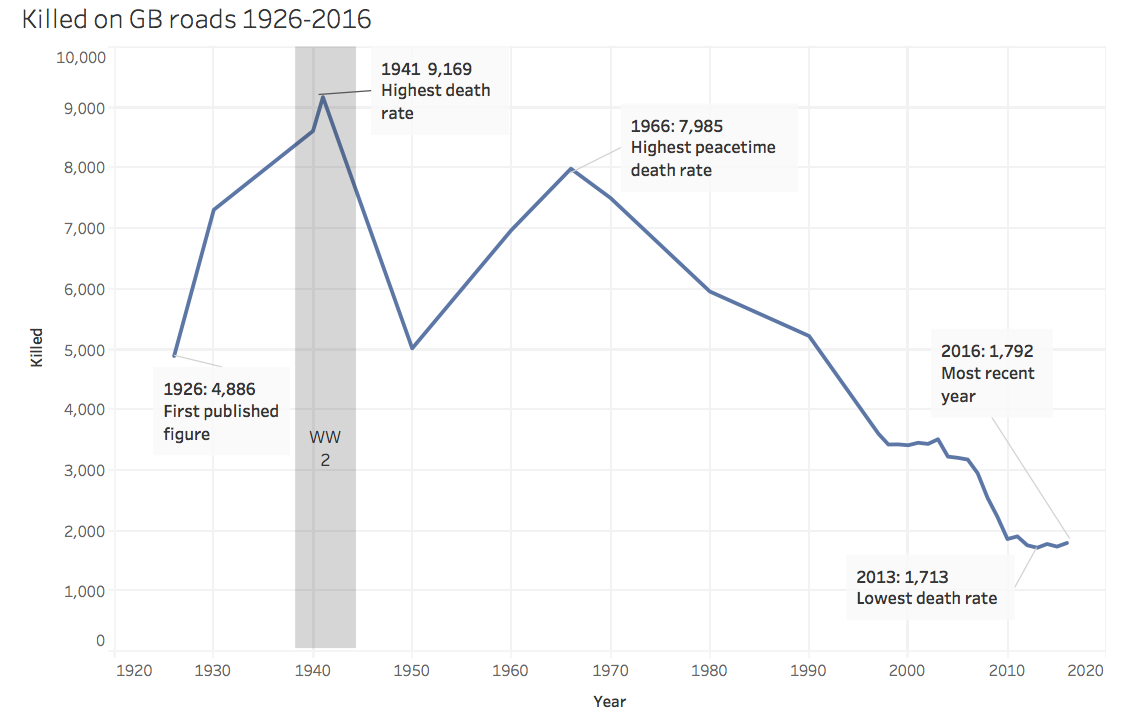
The highest peacetime death rate was in 1966, when traffic was much much lower than it is now - anyone got a graph for that?
We don’t need safety features though, right TJ? They give us a false sense of security which leads to complacency etc etc..
What we need is electric Citroen 2CVs - that will absolutely not lead to countless firey deaths from 40mph crashes at all.
2cvs are cool though so on balance...
Cool from the outside, not when inside a moving one :puke:
that we don’t know if the energy cost of the battery in a mild hybrid outweighs the increased FE and/or local air quality benefits. You’re saying that it does – so back that up.
RThat is not what I have said. its easy to demolish an argument if you mischarectarise it
what i said is any savings are insignificant because it does not alter behaviour thus energy usage is not significantly reduced.
the answer to vehicle polution is to drive less. thats the only answer. Hybrids do not help as they givbe peiople a fig leaf to cover the fact they are still using massive amounts of eneregy to move a 1.5 tonne machine around to move one person
Ok =- i am out of this. Its making me and others cross
the answer to vehicle polution is to drive less. thats the only answer.
In complete agreement but good luck with that post Covid!
You really think all that extra weight is about safety? I accept a little bit is but the rest of it is extra equipment
Imagine how much better fuel economy you would get in the modern golf was the same weight as the 90s one? Weight also increased wear and tear on infrastructure.
You really think all that extra weight is about safety? I accept a little bit is but the rest of it is extra equipment
Numbers please!
Park a Golf 3 next to a Golf 8 - the chassis and frame on the latter are far more bulky, it's clear to see that a lot of weight has gone into that.
Then there's a dozen airbags, big tyres, ABS and ESP kit, bigger brakes and so on. If we're in the business of guessing, I'd guess that most of the extra non-safety gadgets on the modern car don't weigh all that much.
Imagine how much better fuel economy you would get in the modern golf was the same weight as the 90s one?
Imagine? Why don't you have a go at calculating it?
Also, if you want a modern car that's light, get a Citroen C3 - similar size to the old Golf, and the basic 80ps version is 980kg. And fuel economy still around 50mpg.
You really think all that extra weight is about safety? I accept a little bit is but the rest of it is extra equipment
Imagine how much better fuel economy you would get in the modern golf was the same weight as the 90s one? Weight also increased wear and tear on infrastructure.
Increasing the size of the crumple zones and intrusion protection on the front, side and rear added significant amounts of weight to cars. You won't remove 300kg from a car by removing the speakers, satnav and aircon.
To drop that kind of weight and keep the safety you're talking about having carbon fibre safety cells in every family car and thinning the glass used using something like the automotive gorilla glass.
To drop that kind of weight and keep the safety you’re talking about having carbon fibre safety cells in every family car and thinning the glass used.
I dunno, as above Citroen seem to have managed it.
C3 only scored 4 stars in the crash ratings didn't it - and it was outright piss poor for pedestrian safety!
What is the point of hybrids?
I depends on the owner/user.
For the Company Car driver, like diesel before, it's taxation. It's not their 'fault' taxation is this respect is supposed to drive good behaviour and the emissions tests are supposed to drive better emissions, but the manufacturers tailor them to the tests and not the best emissions - do we really think a 2300Kgs, 440Bhp Porsche Panamera hybrid gets 99mpg?
It's no different to the last gen of 'Green' cars, the super-eco Diesels, Company Car drivers seemed to love the Passat CC Bluemotion because the tax was cheap, it was supposed to do 58mpg, but most of the ones I saw got beat to death by their drivers.
For the emissions conscious it's a tentative, baby step towards a EV, if you do plug them in and you do drive well they can be very efficient and at the same time they don't cost £50k+ and they will let you do that theoretical 1000+ mile journey people worry about. I might argue that if they really care about the environment, they'd be better of keeping the car they have in good shape for as long as possible and buying half as many cars and driving them half as often.
They're no longer a magnet for virtue signalling, people into that have migrated to Teslas.
Facts-schmacts You're all missing the point; TJ has a new phrase...and that's the important thing.
I'm going to try to shoehorn "parasitic weight" into all my conversations from now on. I expect I'll just win all internet arguments from now on with it as well.
Looking at some of the comments I also think some posters are getting mixed up with hybrid types...
A PHEV can be plugged in as well using its ICE to charge the battery. This is how I managed 1750 miles on 36L of petrol. Most of the mileage was using energy supplied by national grid.
I do have some sympathy with the greenwash comment (mine is a company car so I fully admit tax rates are a factor).
One point that hasn't been raised is that, in my case, I actually drive it differently - I actively try to drive further before the petrol engine kicks in meaning I'm tending to drive more slowly.
Maybe every other PHEV is never plugged in as the click bait stories say and I'm an outlier though.
Company Car drivers seemed to love the Passat CC Bluemotion because the tax was cheap, it was supposed to do 58mpg, but most of the ones I saw got beat to death by their drivers.
That's not the car's fault though.
That’s not the car’s fault though.
Not sure it's a fault thing.
The point of them was to reduce BIK liabilities for their drivers, if VW really wanted to make the most environmentally sound Passat they could, they could have made it less powerful, limited the top speed, fitted smaller wheels and tyres etc etc etc, but they knew that it wouldn't sell.
Many of the drivers picked them entirely on taxation.
There's a argument, or maybe a stereotype that the very people who ordered the Bluemotion version were the last people to give much of a shit about emissions and frustrated by the Bluemotion aspects actually drove them harder. I know the reps that worked across the road from me at the time certainly did.
if VW really wanted to make the most environmentally sound Passat they could, they could have made it less powerful, limited the top speed, fitted smaller wheels and tyres etc etc etc, but they knew that it wouldn’t sell.
That was what the original Bluemotion thing was. But you don't need to make a diesel less powerful to make it more economical. You just need to drive it more slowly.
the answer to vehicle polution is to drive less.
Amen.
I think TJ is completely right that the real issue re: global warming is total energy usage (notwithstanding the local impacts of pollution in cities which is obviously important too).
Does anyone know how much MPG-equivalent you can get from an electric car, if you take into account the average UK mix of 'green' electricity (wind turbines and the like) and fossil fuel burnt to power the national grid? There are presumably huge inefficiencies in electricity production / storage / transfer. I'd (genuinely) love to be wrong on this, but my sneaking suspicion is that overall electric cars won't save a lot in terms of overall energy use.
I think TJ is completely right that the real issue re: global warming is total energy usage
Everyone bar the idiots already knows this.
So the BBC article just popped up on my feed, it says this:
Transport and Environment's analysis says a key problem with plug-in hybrids is that so many owners rarely actually charge their cars, meaning they rely on the petrol or diesel engine.
So hybrids are good if people actually use them properly. The problem as usual is people not giving a shit.
Does anyone know how much MPG-equivalent you can get from an electric car, if you take into account the average UK mix of ‘green’ electricity (wind turbines and the like) and fossil fuel burnt to power the national grid?
Again this is a well researched question. Tailpipe emissions:
https://www.carbonfootprint.com/electric_vehicles.html
Lifetime newspaper article:
And the study (not read this yet)
https://www.nature.com/articles/s41893-020-0488-7.epdf
Hybrids especially (with the frequent charging) are a natural fit with personal (i.e. on the owner's house) solar panels & batteries (Powerwall etc). All the government needs to do is pump a bit of money into proper subsidies to make it actually attractive/affordable and I'd be the first in the queue! Then instead of burning petrol/diesel or indeed charging from coal-fired power stations etc you've got legitimately green/sustainable electricity for personal transportation.I’d (genuinely) love to be wrong on this, but my sneaking suspicion is that overall electric cars won’t save a lot in terms of overall energy use.
Does anyone know how much MPG-equivalent you can get from an electric car, if you take into account the average UK mix of ‘green’ electricity (wind turbines and the like) and fossil fuel burnt to power the national grid? There are presumably huge inefficiencies in electricity production / storage / transfer. I’d (genuinely) love to be wrong on this, but my sneaking suspicion is that overall electric cars won’t save a lot in terms of overall energy use.
Harry Metcalf made a video about it recently, it varies from region to region, but in South Wales (where I live) despite having wind farms in every direction as far as I can tell, for some reason we have very poor energy creation efficiency, worst in the UK probably so in terms of Co2, it's marginal at best if I'd be doing more good with say a Tesla 3, than my Superb Diesel that's got AdBlue and Stop-start and does a genuine 40mpg urban and 55mpg on a run, and that's me driving, not some lab test. That doesn't factor in the greater cost (in energy) of making an EV or the extra weight of materials needed to build it.
Of course, infrastructure is improving all the time and if we held off until the infrastructure was perfect it all becomes very chicken and egg.
As for costs, plugging in at home is very cheap especially if you get the right tariff and a smart charger, it costs about £6 to fully charge a Nissan Leaf and it will go about 120 miles real-world (I think) so that's about 5p a mile. Diesel costs 1.20 per litre, or £5.40 a gallon / 45mpg (average for my car) that's 12p per mile, but if you need to charge on the move it can be as expensive as running a fairly pokey petrol car, I seem to recall one of the big charging station providers raised their prices 5-fold recently? I did some maths a few months ago and in terms of £ per mile plugging in a EV at a Motorway services costs the same as a 25mpg car.
Of course, that should be a fairly rare occasion and doesn't include Tesla who have their own system. I certainly wouldn't plug in a PHEV at a charging station.
My car can be swapped anytime between next June and June 2023. I'll look at the Superb PHEV and the new Enyaq - I'm aware other brands exist, but I've got a mate who works at Skoda and a get a decent, if not amazing deal from him.
Any idea how efficient, over a lifetime (not yours, the panel and battery), a setup like that is? Over and above commercial generation?
I'm betting at our latitudes we might not find panels and batteries coming out that well.
Back on proper topic, I'm dictionary target market for a PHEV, short commute, the occasional long trip.
Making more commercial sense, was a diesel estate and an old runaround petrol.
so here are some actual facts 😀
100kg weigh saving in a car leads to 0.4l/100km less fuel used. Lets assume that is the same the other way around as well.
a modern car is maybe 200kg more heavy than one from 25 years ago (in canada, reading their graph, but its probably similar here) - so that's 0.8l/100km less efficient than if they'd kept the weight off.
Average lifespan of a car is approx 200,000km - lots go on further, lots die younger, so that's 1600l of fuel used over 15 years or whatever, so from a cost perspective its a small cost (£10/month?) for the additional safety etc
each litre of petrol burned apparently generates about 2.3kg of co2 so on the lifespan of the car, your emitting an extra 3,680kg of co2
Happy to be on our 2nd Hybrid. Misses hates driving but has to for work, she tried a Yaris hyrbid and loved it for the 5 years we had it, kids grew so she wanted something that worked the same so bought a Lexus NX, though I wanted the PHEV as her commute was going to be less, driving in-out of a valley twice a day might not have been on pure battery mind, but the only one that suited was the Mini Countryman PHEV which she didn't like.
Nothing "eco-warrior" about owning one, the main driver just prefers to drive a hybrid over a standard manual or auto. The NX might be better than a standard petrol of similar size/weight but my 13yr old RAV beats it's MPG on average.

