UPDATE: CLASSIFIEDS section refreshed, redesigned, searchable: Go take a look
I'm pricing up EV chargers and PV+battery right now. Anyone got a zappi or hypervolt talking to their inverter for the clever solar integration functions?
Ideally I'd get the EV charger a few months before the PV, and possibly from different companies and am wondering who normally does the integration. First PV company says they wont interface to the EV charger, that's for the charger installer. I bet the charger people are about to tell me it's the PV installer's responsibility.
Anyone know if that's right and been through this aspect, or know how much is involved? Maybe just a data cable and some settings?
Probably going for a hypervolt charger if that matters. PV system is more of an unknown at present until i get the full quotes in.
So the plan is to bury something like 2,000 litres of water in insulated IBCs in the garden, and use day time solar energy to slightly warm them up during the day
The problem with that is that even on a clear sunny day (which are both short and not that common), you're probably not going to be generating much more than a third of the power required to raise that volume of water by 10°.
Interesting idea though.
Anyone know if that’s right and been through this aspect, or know how much is involved? Maybe just a data cable and some settings?
I think they're right, the charger people should set up everything the charger needs to do. I don't think there's really any communication between the charger and the inverter; the charger just measures what's going on at the grid supply to know whether it should speed up or slow down, the inverter isn't really involved.
Where it gets complicated is hybrid inverters; then the charger doesn't know if its power is coming from the PV, which it should use, or from the house battery, which it shouldn't. Zappi gets round this with what they call "export margin", so only charging when the exported power goes over a certain amount; this means the battery is full, and by keeping a bit of export going it ensures the house battery isn't being drained. I think it does mean you can't charge the car on PV in preference to the house battery, unless you can tell the inverter not to charge the house battery at certain times.
I don't know if hypervolt does something similar. Givenergy - the manufacturer of our inverter and battery - are releasing their own charger soon so maybe that will integrate properly for a bit more control. I've been very impressed by the givenergy dashboards, controls and monitoring.
I've been looking into this as our PV and battery was finished last week, but we only have a dumb charger. I've been managing charging on solar by using the granny cable at 2kw when there's a bit spare or the main charger with the car charging speed turned down a bit to 4kw when there's lots. It's a bit tedious, so I think a more intelligent charger is on the list for next year.
Ah right gotcha, thanks, that solves my charger fitting quandary then if there's no direct interface, i can see now that makes sense.
Just need to work out how much battery capacity to get, and whether i'm better off with a 3.6kW or 5kW inverter now. And whether the kit being quoted by my local installer is as good as the Givenergy stuff that seems to be the dogs doodahs (but seems tricky to get).
I thought I'd put this on this thread but it must have been on another one so (and please forgive me if I am repeating myself).
We have gone for renewables in a big way. No mains gas and when we bought our house 10 years ago it was a coal filled multifuel stove with a backburner for heating and hot water. The house also had a solar thermal system that had been installed in 1994.
Things we have done:
1. Biomass boiler - great bit of kit but pellets are annoyingly hard at the moment and does need love in terms of servicing and clean out. Converted house from vented to unvented tank too.
2. Updated the solar thermal - new microcontrollers and regular fluid replacement. Ours are evacuated tubes with metal vanes sealed in them, but are not made anymore. 30 tubes on the roof and work brilliantly.
3. 2kw PV on the boiler shed roof 8 years ago with associated FIT tariff. Over the 8 years they have reliably produced 1500 units/year or so. No optimisers on them as they weren't a thing back then. Shed roof is dead south facing at 20 degrees. we installed a Solar iBoost with this to top up the hot water when we are producing excess electricity.
4. This summer the south roof of our house needed re-tiling so we put 5.4kw of flush fitted PV panels on it instead of tiles. Its south facing at about 40 degrees. We also added a 15KW Huawei battery. This has been 'live' for the last 2 weeks and our electricity use has plummeted to an average of <2 units from the grid/day. This is when we try to draw more amps than the battery can supply (eg induction hob on, oven on and tumble dryer running).
5. We have also fitted a Zappi in advance of an EV arriving when its built and shipped.
Company used over the last 8/9 years are Energy Zone in Cleobury Mortimer so good for whoever it was who needed a Worcestershire installer! They are good but always busy.
Things I would say from our experience:
1. The biomass now that pellets are becoming harder to source. I think I would go air source (though this was less good 8 years ago).
2. Servicing renewable tech is harder to achieve than standard heating as there are fewer trained people to use.
3. Installers and companies do frequently go bust. Loads of biomass firms have disappeared.
4. Make sure the heat calcs are done well to avoid disappointment!
5. Consider 'air to air' air source - can be reversed in the summer to give cooling.
6. Solar hot water is very good in our experience.
7. Love the battery so far.
Hope this helps.
Just need to work out how much battery capacity to get, and whether i’m better off with a 3.6kW or 5kW inverter now.
I did some maths using the PVGIS online stuff to try to work out the effect of having a 3.6kw or 5kw inverter with an 8kwp array; there's not really much in it. The vast majority of the time you'll be getting less than 3.6kw off the array anyway, and when it does go above this it'll be on a sunny day when you'll generate more than you can use anyway. Also note that if you have a hybrid inverter with a DC connected battery the 3.6kw limit is just what it can convert to AC, it can still store excess above that in the battery. The givenergy 5kw inverter for example can output 5kw AC but accept 6.5kw from the panels if the battery can take the remainder.
That said, a larger inverter does give you more headroom to run larger loads from solar on sunny days (not necessarily from the battery - the givenergy battery can only output 2.6kw whatever the inverter), so assuming it's not that much more expensive you might as well.
We’ve had our array installed for almost a month, but still can’t switch it on as SSEN haven’t got around to allowing our G99 cert to be approved. When I call, it goes straight to messaging, when I email, I get nothing. What a bunch of clowns. Almost a month of free power lost to utter ****wittery.
Best hope they allow it then as g99 is supposed to be approved prior to install not like g98.
Can take 6 months.
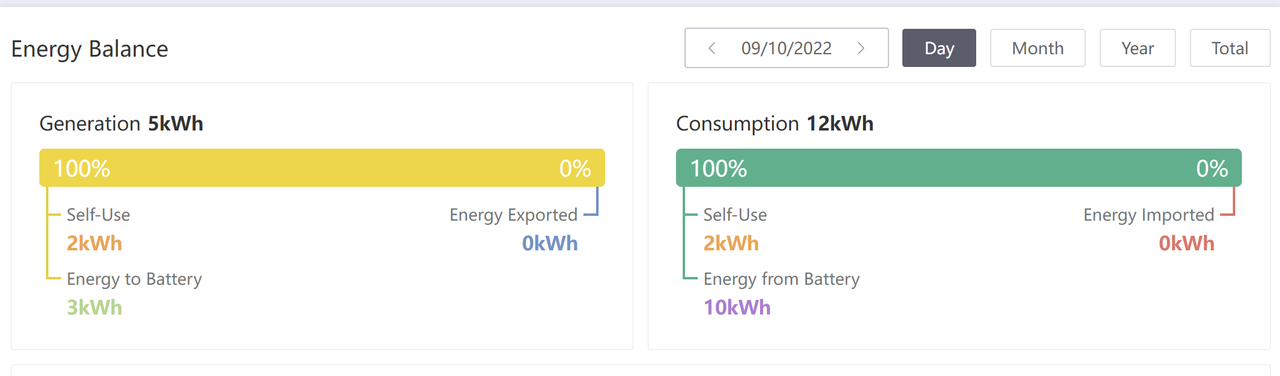
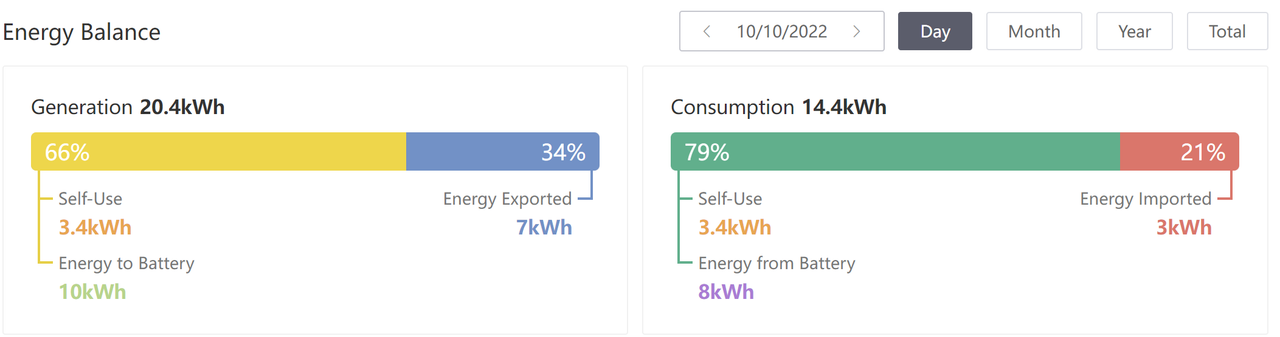
Was looking at the data from first 11 days of the month .
1-11 Oct 2020 130kw used (no solar)
1-11 Oct 2021 66kw used (4.14kw panels)
1-11 Oct 2022 25kw used (same panels plus 10kwh batteries)
Most of that has been the electric shower so that's why I'm looking at the solar thermal and tank
Best hope they allow it then as g99 is supposed to be approved prior to install
This!
G99 absolutely necessary prior approval before installation.
I wonder if you could fit a smaller inverter (maybe s/h) to get going now and then change the inverter when the approval Congress through?
I also wonder how many >4kw
systems have been fitted that don't have permission!
also wonder how many >4kw
systems have been fitted that don’t have permission!
Lots . Just have to pop on to one of the many DIY solar groups on facebook Given the red tape they are making you jump through and making you use MCs (total racket) accredited installers with no other way round it. The backfeed rate is so derisory people are not bothering with it ....
That said I did get my smart meter read a few weeks back as they had "detected erroneous usage" ..... I read into that they didn't believe my usage had cut by half ...
MCs (total racket)
Like most of these schemes they binfit the scheme providers and the larger companies to increase barriers to entry.
The vast majority of the time you’ll be getting less than 3.6kw off the array anyway, and when it does go above this it’ll be on a sunny day when you’ll generate more than you can use anyway.
Agree although its important to do all the calcs yourself they are quite unique to each household. We have a 5.6kW PV and an 8.7kW battery on order. Wife works from home and I am retired so around most of the day. Intend to use as much as we need during the day then once battery topped up send the rest to our Immersion tank via an iBoost solar diverter. Any spare after that goes to the grid until we get an EV then into our Zappi as our EV will mainly be on the drive. We are with Octopus already so intend to go to their overnight tariff and top up the battery during the cheaper hours.
Waiting for our survey and to ask questions as to how configurable all of this is and how the separate components work with each other.
Just remember the bigger the inverter the bigger the start up current required from the panels.
I went from an old gen 3.6 to a current gen hybrid and I generate at much lower light level.
I've just been going through the calculations for potentially getting solar panels for our house. It seems to me that the recommended size of system recommended for a typical 3 bed house (3-4 kW) are flawed and based on typical energy use for an entire day. However, unless you are storing excess energy with batteries (expensive) or using it to charge an EV for example, then the most efficient thing to do would be to size the system based on how much energy you typically use per hour during sunshine hours. Any excess that you generate from an oversized system gets very little back from feed in tariffs compared with what you save on actual usage (and obviously costs lots more to install).
We use approx 10-12kWh per day - so ~0.5KW per hour. It seems like a ~1kW solar array (producing 1kW energy per hour) would be more than enough to directly provide the power that I would need to run appliances during the day.
Or am I missing something?
It seems like a ~1kW solar array (producing 1kW energy per hour) would be more than enough to directly provide the power that I would need to run appliances during the day.
You are right in terms of your daily usage apportioned evenly through the day but when you use power 1kW is unlikely to be enough. Many appliance use more than that, Toaster/Dishwasher/Washing machine etc so you are likely to be using your 12kW per in day in bursts. If you go over the 1kW then at that point you will be drawing from the grid unless you have a battery that can deal with the surge.
If you size panels to your use. Your reliant on the panels producing max all day long.
Need redundancy.
I have a 4kw array and even on the dullest of days I cover my static demand and only pay for my active use.
When it's bright the batteries get charged. And allow me to run the power heavy things free. Previously the panels only ever subsidised and it was impossible to use 100% of power generated without using more electric than intended.
Good luck with that thought process, what are you going to do when sun doesn't shine or at night?
5.3 array and 2 x 5kwh batteries, even on good days spikes in demand, electric shower oven etc mean we draw from grid,.
My washing machine uses ~0.5kWh per cycle (as does the dishwasher), so if I used these only during the day, they might be mostly covered by the solar energy generation (from a ~1kW system), I understand that peak energy consumption for the washing machine might be 2000watts, so this would need to draw from the grid.
As you say, a bigger system would produce more background generation on less than ideal days, but would cost a lot more to install, and the payback would take longer. Just trying to understand what we might need - I'm not prepared to pay the extra for battery, but can see that this is the answer to the problem of excess energy production.
Cost is largely access and labour.
1 inverter costs x
Purchase of 1 panel is 200 quid . 10 panels is 2000 . But your inverter /labour and access on either system is 3 or 4 grand
As a proportion of the install adding more panels is not massive given the cost of the rest of the kit given the benifits it brings and over its lifetime
Also, most of our energy use must come in the evening (electric oven, tv, Kids xbox, lights etc) when the solar energy generation isn't optimal, so my estimate of 0.5Kw per hour during the day is probably on the high side (except when washing machine or dishwasher are on).
That’s why batteries although pricy make so much sense…
My washing machine uses ~0.5kWh per cycle (as does the dishwasher), so if I used these only during the day, they might be mostly covered by the solar energy generation (from a ~1kW system), I understand that peak energy consumption for the washing machine might be 2000watts, so this would need to draw from the grid.
As you say, a bigger system would produce more background generation on less than ideal days, but would cost a lot more to install, and the payback would take longer. Just trying to understand what we might need – I’m not prepared to pay the extra for battery, but can see that this is the answer to the problem of excess energy production
I'll not repeat what others have said, but you'll be VERY disappointed if you go ahead and have a 1kW system installed (3 panels, you're wasting your time and money). The 1kW is the theoretical maximum, it will never generate that even when conditions are perfect (best conditions are cold sunny days, efficiency drops off the warmer the weather). Peak generation is when the sun is highest and tails off either side of that.
With a 4.2kW system the best days of summer we generate 30kWh, best days of winter 6kWh, however last December we generated a measly 52kWh for the whole month, 15 days were below 500Wh.
Biggest regret with our system? We only had 4.2kW of panels fitted, in hindsight we should have covered the roof, that would have given us a theoretical max of 12kW.
Also, most of our energy use must come in the evening (electric oven, tv, Kids xbox, lights etc) when the solar energy generation isn’t optimal, so my estimate of 0.5Kw per hour during the day is probably on the high side (except when washing machine or dishwasher are on).
In that case don't have solar installed unless you're fitting a battery too to utilise the generation.
We generate 4000kWh a year and use 35% of that, but that's because Mrs f is at home all day so the dishwasher, washing machine, oven etc are used during the day to make the most of the energy we generate
I suppose I'm trying to justify to myself that a ~1kW system would be useful! The problem for us is that although we have an ideal roof aspect (south facing), it is a shared roof with our upstairs neighbour (flat). This is Edinburgh - so common to have a groundfloor flat (us) and upstairs flat. So my understanding is that we would have to draw up a legal agreement for future maintenance responsibilities and change the deeds to reflect this. Although not impossible, this would add to the expense etc. Our upstairs neighbours are elderly (80+) and don't want to install solar themselves (they also worry a lot...).
We do, however, also have a single story extension with a flat roof that could accommodate 3-4 panels (so maybe 1600 watt max with 400w panels). I was just seeing whether this is a good idea with my calculations. Access and installation costs might be lower for the flat roof I guess (although would need some kind of racking)
That said, a larger inverter does give you more headroom to run larger loads from solar on sunny days (not necessarily from the battery – the givenergy battery can only output 2.6kw whatever the inverter), so assuming it’s not that much more expensive you might as well.
Thanks @phiiiiil , £300 difference for 5k inverter, sounding like a good idea then assuming it's ok with the DNO. I'll estimate how often I'd be using more than 3.6kW + max battery discharge rate. If I can get the panels I prefer I might be able to fit 16 panels so 6.48kWp. Time for more PVGIS calcs.
Consider if you have multiple roofs - you can extend your solar day for a significant part of the year with east or west or even north (for 3 or 4 months anyway) and that longer solar day is more useful (to me anyway) than peak solar output
3.6kW was quoted £7000 including £1000 scaffolding for our house, and 7.3kW £9000 including £1000 scaffolding.
100% more capacity added 28% to the price. Though you do need a G99 export agreement.
Guess what we went for?
@sparky1uk We have a Zappi, it came with a 'Hub' which plugs into your router and a 'Harvi' which is a small collar that fits round your mains cable and a module that communicates with the Hub and thus to the Zappi. The Harvi measures the power drawn or exported back to the mains. There's a phone app that links to the Hub on which you can see how much you're exporting and decide if you want to charge the EV. Our EV requires at least 1.4kW to charge, which I think is standard for EVs. The Zappi has 3 settings, Eco+ which will only charge if there's at least 1.4kW going spare, and so cuts in and out as clouds pass over, Eco which charges at the higher of 1.4kW or the amount of spare, or Max which is a flat 7kW. I tend to use Eco, and switch off if the sun goes in. The Zappi works as designed on Eco+, but after the first few cycles of on/off, our EV (a VW) gets fed up with being messed about and stops accepting charge, so it has to be unplugged and plugged in again to reset it. It would be nice to just leave it on Eco+, and hopefully there will be software upgrades that fix the issue.
My washing machine uses ~0.5kWh per cycle
Cold wash, presumably?
I considered a Zappi but decided that the £900+ installation cost (you also need the Harvi wireless transmitter) would pay for a lot of electricity. With a battery installation and a sunny day, I just limit the car to 10A between 9am-4pm, with unrestricted charging in the cheap overnight period. If a cloud drifts over the panels then the battery picks up the difference and recharges once it brightens up again.
So far I’ve not troubled the grid during the peak hours, although with an electric hob I would say that I’ve developed a tendency to cook steaks slightly rarer than I used to because you literally watch the battery emptying itself expensively in front of you while cooking.
Thanks for the info @Greybeard. Ours will be a cupra born, based on the ID3 so maybe have the same bug. Do you have a battery on the PV? Sounds like that can add another layer of control/complexity, with export (or charging in my case) directly from solar only after the battery is full.
Do you have a battery on the PV?
No. We use about half what we generate, on average in summer, and I suspect we'll use a higher percentage in winter, and at times in summer we'd fill the battery. I calculated payback at about 23 years. I'd rather spend money on more panels, which are an overall environmental benefit. A battery is just a financial benefit to us, it doesn't do anything for the planet.
My washing machine uses ~0.5kWh per cycle
Cold wash, presumably?
No, 30C wash but speedy cycle. Measured with a power meter.
Looking at what uses power on the various graphs our system provides, our normal washing machine cycle uses just less then 0.5kwh and the dishwasher just over 1kwh, but both use most of that in a short period when they go up to 2.5kw. It would need a fairly large system to be able to provide that on anything but a super sunny day.
including £1000 scaffolding for our house
Is there a reason why scaffolding seems to vary so much? Quite a lot of houses round here have gained solar panels this year; some have had proper huge scaffolding erections put up, often for extended periods of time, but others - including ours - were done just using a mobile scaffold tower that took no time at all to build and take down and must have been an awful lot cheaper.
A battery is just a financial benefit to us, it doesn’t do anything for the planet.
Not quite true. The battery allows time shifting of demand, meaning that generation resources outside the home as well as inside the home can be better utilised.
That means that for a given energy use less aggregate nameplate capacity of generation is needed - that is a benefit to the planet, and it is particularly true with variable generation like wind and solar where you harvest the energy into a battery when you can to use when you need it. It is less true in a system with plenty of flexible (we used to call it dispatchable) generation like CCGTs. But hopefully that will change.
So is a battery an environmental a benefit in isolation? Possibly not. But in aggregate it is. Just let’s not get started on particular battery chemistries and characteristics - that’s where it gets hard.
A question about battery capacity and how much can be run from it.
I understand that Wh = Ah x V, so a 100Ah 12V battery can provide 1200Wh, but what happens when you convert your 12v DC battery power to 240v AC power with an inverter? Do you still only have 1200Wh or is it now Ah x 240v?
A battery is just a financial benefit to us, it doesn’t do anything for the planet.
Unless you dont consider the harnessing and use of electricity that would otherwise be lost a benefit to the planet.
Unless you dont consider the harnessing and use of electricity that would otherwise be lost a benefit to the planet
It's only lost if you don't have a single neighbor in you side of the transformer
It’s only lost if you don’t have a single neighbor in you side of the transformer
I dont know what that means
Do you have houses in your eyesight of your house ? If so your electricity did not vanish into thin air.
use of electricity that would otherwise be lost
It's not lost, it's exported to the grid, and I would be paid 3.95p/kWh for it. But IGM has a good point about a battery enabling time shifting, thanks.
It’s not lost, it’s exported to the grid,
I see.
I've asked two localish firms to quote for installing systems to our bungalow.
This is what they have come up with:
Firm one.
10 x 415w panels
1 x 3.6kW inverter
1 x 9.5kWH battery
£9940.75
Installed inc Vat
£11695
Firm two.
12 x 405w panels
1 x 3.6kW inverter
1 x 4.8kWH battery
£5860.00
Installed inc Vat
£9028.34
I intend to get at least one more quote but the two systems quoted aren't *that* dissimilar (on paper at least Firm two - battery size apart - seems 'better') but there's over £2600 difference in price. What am I missing?
The VAT on the 2ns quote doesnt seem correct?
The 2nd battery is double the 1st so looking at post VAT prices they appear very similar. Around £2667 for the additional 4.7kW.
I received 5 quotes (after approaching 6 companies) and other than one outlier, and considering they were all using different kit, they were broadly similar.
What am I missing?
Battery size.

