
i'm reading this at the moment, and feeling a little overawed. anyone else read it? i keep having to read a happy book in between chapters to temper it a little..
Interesting read, but historically flawed, far fetched in placed (Falklands) and economically unsound. But, apart from these small issues, well written.
just got to teh falklands bit, flawed? how so? interestingly, from other sources friedman comes across as a liberal kind of chap
My sister gave it to me for Christmas forgetting, or more likely ignoring, the small fact that I don't read books.
friedman comes across as a liberal kind of chap
You mean like a neoliberal ?
It's been a handy blueprint for Dave and chums. All we're missing is the uniforms and the death squads
i don't know? do i? i guess i mean in the anti draft, pro legalising weed, advocating same sex marriage kind of way..
if you don't like books, this is a nice one[url= http://www.theschooloflife.com/shop/how-to-change-the-world/ ]here[/url]
economically unsound
I've not read the book - but if THM finds it to be economically unsound, it has my automatic approval. 🙂
i guess i mean in the anti draft, pro legalising weed, advocating same sex marriage kind of way..
Yes that would fit comfortably into the neoliberal mindset of no government interference I would have thought. And I'm sure it's all in line with the views of STW's resident neoliberal Z-11.
i'm reading this at the moment, and feeling a little overawed.
You may also enjoy/be overawed by Adam Curtis documentaries. ([url= http://thoughtmaybe.com/by/adam-curtis/ ]link[/url])
Libertarian might be a better term for Friedman.
No teeth 😀 good to know!!!!
[url= http://www.urbandictionary.com/define.php?term=libertarian&defid=3347715 ]Libertarian[/url] seems a fair description.
I've had a flick though it, but thought it was all a bit 'Bilderberg'
By that I mean that when bad things happen, some people inevitably benefit. Sometimes they do so deliberately and maliciously, sometimes they are cynical opportunists, and sometimes it just turns out that way, the vicissitudes of fate - However conspiracy theorists often take this as proof that the people who benefited must have made it happen. It's a simple "post hoc, ergo propter hoc" fallacy.
There's an underlying paranoid belief that dark forces operating in secret are somehow manipulating events to their own devious ends. They are used to explain any event the conspiracy theorist cannot make sense of, which is practically all of them. They are usually both loosely plausible and fantastically complex at the same time, but rarely supported by any real proof. They are based on the mistaken belief that behind any significant event is equally significant planning and intent.
Essentially, whenever you hear "bad things are happening, and we've identified a shadowy cabal that is making them happen", your Occams razor alarm should indicate "Loon!".
I think you'd be better off reading Black Swan theory by Taleb!
Some brief words of advice:
George Orwell:
[i]Therefore we are some-times told that the whole thing is an astute manoeuvre by the governing class--a sort of 'bread and circuses' business--to hold the unemployed down. What I have seen of our governing class does not convince me that they have that much intelligence. The thing has happened, but by an un-conscious process--the quite natural interaction between the manufacturer's need for a market and the need of half-starved people for cheap palliatives.[/i]
Bernard Ingham:
[i]Many journalists have fallen for the conspiracy theory of government. I do assure you that they would produce more accurate work if they adhered to the cock-up theory.
[/i]
Bernard Ingham
😀
But the notion of the government being in-charge and orchestrating things begins to look less plausible in light of the awe in which they hold large commercial organisations who often do employ the best and the brightest.
If you read Friedman's "free to choose" and/or Nozick's "anarchy, state and utopia" and compare their ideals with the reality of what had happened in the world subsequently, then it is pretty obvious that the central theme of the book falls flat from the outset. Other than that, it is an jnteresting (if flawed) read.
anti draft, pro legalising weed, advocating same sex marriage kind of way..
The broad church of individualism (including neoliberals) so not really a dichotomy [img] 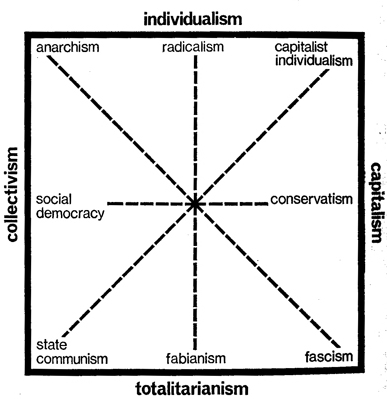 [/img]
You may also enjoy/be overawed by Adam Curtis documentaries
I thought the Power of Nightmares should be on compulsory weekly repeat to frame everything we see in the news, but found the Machines of Loving Grace a bit too high-concept/low-impact.
Might have to go back and watch the Nightmares again, cheers for the link.
Stealth edit; didnt even know he'd done one on Nixon (though not surprising!), thats this weekends not-ant-and-dec viewing sorted.
There was a good interview with him in the New Statesman recently ([url= http://www.newstatesman.com/culture/2014/02/adam-curtis-interview ]article[/url]). I like his work a lot. His endeavour to see through the media portrayal and propaganda of politics is entirely admirable and yet there always seems to be a thread of humour in his films, even if only in the form of subtle tweaks in the soundtrack.
Interesting post, ninfan. I do confess to seeing the government's sinister hand behind most bad things. I think that labels me as a "loon"! Not sure I'd trust anything that Bernard Ingham said though - he thought Thatcher was a good PM, for goodness' sakes!
ninfan - I take your point, but dismissing it as 'all a bit 'Bilderberg' is a tad disingenuous
For a start Naomi Klein is a very well respected journalist and author, who exhaustively researches her subject matter and goes to great lengths to document her sources
The central tenet of the Shock Doctrine is that a political and corporate elite will use an economic crisis (in this case South America) to roll back the state, privatise the rump that remains, to hand it over to a profit hungry globalised corporations, at the same time deregulating, and reducing the 'liabilities' for these entities
Now bare in mind that it was written a good few years before the banking crisis.
Then jump forward to this:
[img]  [/img]
The multi-millionaire beneficiary of vast inherited wealth, stands at a gold lectern to deliver a speech to the 'Masters of the Universe (their self-appointed title), who represent an industry that received the biggest taxpayer bailout in history, as a result of Friedmans Chicago school policies of allowing the market to decide everything, with minimal regulation. The people sat before him are the living representation of the abject failure of Friedmans ethos, yet they carry on in the same barely regulated manner, paying themselves obscenely vast salaries and bonuses, while soaking up the taxpayer subsidies (in the form of QE for example) that the Chicago School pretends to abhor. And of course, all this while all the large globalised corporations avoid paying any tax.
During this speech, he soothes and reassures them that its business as usual. At the same time, for the remainder of the population, he promises, with a straight face, and without even a whiff of either irony or self-awareness 'Permanent Austerity'.
Thats not really a conspiracy theory, is it?
ononeorange - I'd say that Ingham was in a privileged enough position within the inner circle that he could make the cockup observation with some experience 😀
Regards Adam Curtis:
😀
Binners - Therein lies the contradiction, its the Friedmanesque Chicago school of free market economics is fundamentally and diametrically opposed to the taxpayer subsidies and QE that the politicians use to try and control the market - failure remains inherent to the capitalist system, its the politicians (of all flavours) trying to control and buffer the people away from this reality with rabbit out of hat tricks that cause the 'moral hazard' by propping up failure. 'The market' is merely responding to this like a virus (for that is essentially how the market works), eternally adapting and taking any advantage it can get.
its not behind it, simply responding to it, and thats the problem, the 'cause and effect' of the shock theory is all the wrong way round, because 'the market' succeeds we think its caused the problem, but the problem is within the people who vote for the politicians that promise them the impossible (constant growth)
Fair point. So what we're left with is the worst of all worlds? It really is ****ed up, isn't it?
I wonder if Friedman and the Chicago School ever foresaw, or even suspected, the totally dysfunctional economic system their theories would eventually create. And if they did see it, and the fanatical idealogical (and powerful) free-market evangelists it produced, whether they'd have ploughed on regardless. I suspect they would
Very good 🙂 Suspect Curtis would like that (if that's not himself doing it).Regards Adam Curtis:www.youtube.com/watch?v=x1bX3F7uTrg
Pynchon is a great read for the military industrial complex, corporations as governments etc. Far more powerful and influential a subject as fiction, IMHO (at least in the hands of an exceptional writer - a bit like Orwell's 1984 in this regard).
Pynchon wrote the intro to a recent edition of 1984 - talk about a meeting of minds.
So what we're left with is the worst of all worlds? It really is ****ed up, isn't it?
Yes, and Yes 👿
Do you know what, I think that the real problem was that Friedman saw a puritan argument, he and the true free market capitalists invest too much faith in the people and in human nature, (That greed ultimately becomes balanced by fear of loss, leading to a self regulating system) - conversely the puritan socialists also place too little faith in the darker side of human nature (Hayek's road to serfdom argument)
Personally, I think that the problem lies in [b]representative[/b] democracy - as long as you have people with a self interest in the perpetuation of their own position within the 'system' then society can never truly succeed - probably leaves me somewhere in the bracket of Hayekian Anarchist 😀
Regards Adam Curtis:Very good Suspect Curtis would like that (if that's not himself doing it).
Brilliant film.
binners - Member
I wonder if Friedman and the Chicago School ever foresaw, or even suspected, the totally dysfunctional economic system their theories would eventually create. And if they did see it, and the fanatical idealogical (and powerful) free-market evangelists it produced, whether they'd have ploughed on regardless.
More likely they would have been bemused by your observation. Friedman's light shone brightly for a very short time but the closest anyone really got to implementing his theories here, was Lawson's failed attempt at targeting the money supply (just as structural changes meant that their choice of target proved to be the a flawed one). Thatcher and Lawson and Co relied as much on fiscal policy (if not more) than controlling the MS, so even evidence from the high altar in the UK is little more than mixed. It's hard to see how or where there has been any practical application of his theories indeed he wrote extensively about how this was a disappointment especially the ever increasing roles of the state. Economics moved on pretty quickly to a greater consensus between supposed rivals eg, Keynesian versus monetarists and a realisation that fiscal policy and monetary policy work best together. Friedman would have been similarly bemused by recent tax debates.
I am sure he was have pointed out the basic flaw the central argument of this book too ie, the idea that governments have used moments of crisis to roll back the role of the state. History tells us that exactly the opposite had happened but history doesn't make for such an interesting read! Like Thatcherism, Friedmanism is largely a myth used to sell books and create headlines among other things. And by the looks of things successfully too!!!
History tells us that exactly the opposite had happened but history doesn't make for such an interesting read
so what happened in chile, didn't? confused now