But in most cases that £3.50 charge is only possible because people are paying more to cook their dinner or do their laundry during the day. That is the true cost.
You're ignoring the cost of petrol in that part of the calculation that they would have to buy had they not switched to electric to optimise their energy costs.
Which in most cases would blow the uptick in electric costs for day usage out of the water - by a factor of around 8x versus the spend petrol. (Less in winter)
That said it can be quite tricky trying to figure out all the elements, and you have to charge at home. And it's designed that way. Market is trying to beat you.
I actually despise it but there's not much choice if you want to tackle it all.
I'm still on a very cheap fix of 6p for 7hrs use from last year - for two cars. With timed electric usage domestically at night.
It won't be such a good deal next time. The window is getting narrower.
Our domestic electricity use works out at around 8kwh daily and at the time of switch to OIG the increase in daytime unit cost was 5p a kwh. So worst case, if that was all 8kw was used in the daytime that would add 40p to the daily bill. As we now run the washing machines and dishwashers exclusively during the night, as laundry dehumidifier too that difference is hugely narrowed. We also now use the immersion heater all the hot water and have that run 0430-0530 on cheap rate saving a good chunk on LPG. I then consume 15kwh daily average on EV charging at 7p kwh.
The maths works for me.
I did a full spreadsheet of day electric use and our mileage in the old car, over 3 months.
The combined cost was still nearly £1k saved over a year fuelling EV Vs petrol. I do 12k miles a year though.
Have you looked at overall cost including buying and depreciation...or are you a leaser/PCP ?
We're moving house/country shortly, our old car has already gone so we have 2 wheels apiece for a few weeks, then we buy a new to us car. But we are old school, so save up and buy and hopefully keep it a good few years. Some absolute bargains to be had in nearly new EVs (which must mean someone has taken a bath ....personal purchase or the lease/finance company). £55k new, £18k at 18 mths old with 9k miles as an example
I had 2017 Fabia with 97k miles that was racking up bills (rusting catalytic and turbo iffy for a start...).
I've moved to a 3 year old ex-lease Polestar 2 with 35k on it. Cost was £17k, but only £3/month more loan payment than the older Fabia.
So yeah, overall depreciation will cost more. But month to month I'm driving newer, cheaper to run car and happy with the money it costs.
A new EV would be about £120-200 a month more.
Nope, but it's one of the simple ABCs of owning an EV of pretty much any description. If you're parked somewhere you can charge (especially at home where it's cheap) Always Be Charging.
But the point stands – I didn't (I wasn't expecting to be having to take that car until the last minute) and the knock-on effect was hours wasted trying to charge it.
I do have one complaint with this thread and the EV Guy type social media posts where people constantly boast about being able to charge their car overnight for £3.50.I don't have an EV tariff (and to be frank my home electricity isn't *that* cheap) but that, combined with charging at work, in a PHEV (with sufficient range for 95% of my driving). In total it's cut my fuel costs by about 35% from my previous diesel. I have a spreadsheet. Which i started filling in when prices spiked during the early days of putins invasion of Ukraine.
But the point stands – I didn't (I wasn't expecting to be having to take that car until the last minute) and the knock-on effect was hours wasted trying to charge it.You miss the point, it doesn't matter if you're planning to use it or not. If it's parked near cheap power, get in the habit of keeping it topped up to a reasonable level. Most of my colleagues are running full EV, and have been for a long while. Get home, plug in. Hell, i even plug my PHEV in when i know i'm not going to be using the car for 2 or 3 days.
Which in most cases would blow the uptick in electric costs for day usage out of the water - by a factor of around 8x versus the spend petrol. (Less in winter)
I completely agree. I am not saying that my argument offsets the saving versus petrol, very far from it. But the true cost is more than the £3.50 charge, even if only a few pennies or pounds each month.
payment via the Tesla App only
That's the only exception, I think. Everywhere else lets you use contactless.
in nearly every case it is only possible because of an EV tariff which will include a much higher day time rate for everything else your house uses
Don't think so, I pay 28p for daytime use now and in April looks like that's going down to 25p. 51p standing charge. I think that's the same as standard, but we get 7.5p overnight.
Did you fill up your car every night before you got an electric car?
No, because it didn't matter. I did however head out to get fuel the night before a big trip when the logistics demanded it. We plug in every night because it takes a few seconds; it allows the grid to balance and you never end up without charge like you did. Once it's a habit it's no more of a challenge than brushing your teeth before bed. I'm not prepared to pay a grand a year to save a few seconds each day, it makes no sense.
You miss the point
Not really – for whatever circumstance, the car didn't have enough charge and the shocking state of the charging network in the UK left me faffing around trying to charge it (further compounded by the claimed fast charger I took it to taking an age to charge it).
No, because it didn't matter.
Exactly – see my point above...
But the point stands – I didn't (I wasn't expecting to be having to take that car until the last minute) and the knock-on effect was hours wasted trying to charge it.
It's a change in mindset to be sure.
Back in the day, I had a nokia phone that I had to charge once a week. Back then, the idea of a phone that needed charging every day would have sounded daft. But the truth is my modern iphone probably does need charging every day but I never think about it. In fact, it is such a non-issue that it doesn't even show me the state of charge unless I swipe to check (which I never do). It's just become part of my routine that I stick it on the charging pad when I'm not using it and never even think about the state of charge. Charging is actually less of a hassle than it was with the nokia when I had to find the charger and consciously think about charging.
The transition from ICE to EV is similar. Yes the range is lower and it takes longer to "refuel" but once you get into the mindset of "plug it in when you are not using it" range just becomes a non-issue. I've done nearly 20,000 miles in the EV now including numerous long trips of up to 500 miles each way and never once have I had to stop to charge the car (or wait for it to charge). Just like my phone, I plug it in when I'm not using it and it never runs out of charge so the nominal "range" is meaningless. It's actually less hassle than the ICE car, which requires a special trip to a petrol station and a few minutes standing on a draughty, smelly forecourt waiting for the tank to fill up.
I think EV manufacturers don't help themselves by displaying estimated range so prominently and it just leads to lots of chatter and anxiety about a meaningless number. An old fashioned gauge that said full, plenty, half-full and think about charging would be just fine for me.
Exactly – see my point above...
Yes but it's on you to make the (very small) change. If you want things to get better you can't expect everything to stay the same.
Yes but it's on you to make the (very small) change.
I agree – but, on this occasion, I hadn't charged it and it caused us no end of hassle. Similar has happened when we have had to drive a longer distance on two consecutive days (and our slower home charger can't recharge it fully overnight). For example, after last week's debacle (driving to Manchester and back on Friday night), my wife couldn't use the car for a long trip on the following day as it hadn't recharged enough as I got home at 1.30am.
Not really – for whatever circumstance, the car didn't have enough charge and the shocking state of the charging network in the UK left me faffing around trying to charge it (further compounded by the claimed fast charger I took it to taking an age to charge it).
I think from your description of events it seems pretty clear the issue was with your car, not the chargers.
my wife couldn't use the car for a long trip on the following day as it hadn't recharged enough as I got home at 1.30am.
Why couldn't she break her journey for a rapid charge?
and our slower home charger can't recharge it fully overnight
are you trying to live with a 3 pin plug charger ? This is the main reason we didn't after living with a leaf owner doing just that last year we saw that its unmanageable for us.
Why couldn't she break her journey for a rapid charge?
Because it was time-critical.
my wife couldn't use the car for a long trip on the following day as it hadn't recharged enough as I got home at 1.30am
There is some stuff here that just isn't adding up.
Lets make some assumptions, all erring on cautious / worse case scenarios:
1. You still had 10% left in the car when you got home
2. You have a normal home charger and, with loss, it charges at 6kW
3. Your wife left at 7am
4. You disabled any EV tariff time restrictions on charging, so your car was able to charge 1.30am-7am
If all of these things were true (and I've been very cautious with each), you would have put 35kWH into your car between 1.30am - 7am. You already had 10% so if your car is 60kW battery, would would be well above 60% charge by 7am. Your wife wouldn't have had to stop for a 60%%-100% charge, only enough to get to her destination. So probably 10mins max on a rapid charger if she was going a long way.
As I say, a lot of assumptions there but your argument doesn't really make sense. Unless of course if you are relying on a 3pin granny charger. In which case, you are going to have a very difficult time!
2. You have a normal home charger and, with loss, it charges at 6kW
I believe he only has a granny charger
I believe he only has a granny charger
I went 2 months without a charger at home. It certainly took a bit more forward planning and I was lucky enough to have charging at work.
I believe he only has a granny charger
I do - it charges approx 30% in 12 hours.
EV isn't for everyone.
I have a colleague who keenly leased a Honda eny1 thing. Discovered that the short range, no home charging (terrace) and thier range paranoia just didn't work for them. They are back to a petrol car after 3 years.
On the other hand, another colleague bought a 10 year old Leaf for buttons. It rolls down the hill to his work most days (6 miles each way), occasionally to our office or a site within 50 miles, and they love it.. Saved a fortune, just plug in on the drive to a proper charger and keep running till it's dead.
Each to their own.
That said, we do need to reduce carbon and pollution, and we will need ever stronger 'carrot and stick' to achieve change. Not everyone will need comfortable with this.
I do - it charges approx 30% in 12 hours.
yeah I'm not surprised your facing challenges. Be like trying to fill your diesel tank with a syringe
Because it was time-critical.
So she couldn't set off 20 minutes earlier? Or you get home 20 minutes later? I agree that there are occasions where an EV is less convenient than an ICE car, and need more careful planning as a result.
So she couldn't set off 20 minutes earlier? Or you get home 20 minutes later?
Yes, we could, or go back to ICE and not have to do either. But, my wider point is that the UK network of chargers isn't great – we've been compromised more than once, either having to crawl home, find a charger (that works and takes the payment method we want), hope that it is super fast as claimed and not have to sit around for an hour waiting. More widely, my biggest frustration is that my vehicle (like many others) doesn't get anywhere close to the claimed range, and range plummets at motorway speeds.
For example – my drive last Friday night was 140 miles in total, my car has a claimed range of "up to" 250 miles – I didn't go over 70mph – an average of 37mph (with an 85% "efficiency rating according to the app), drove in Eco mode with max regen. I set off with 98% charge, and I had 8% left when I got home.
Yes, we could, or go back to ICE get a home charger and not have to do either.
FIFY
I think for most people, having a home charger is the key to an easy EV life. It is possible without, it is just a faff.
Its a real shame for people who are not fortunate enough to have that option.
edit* I don't know what is going on with your car John. Your numbers just don't make sense. I agree with you though, I don't think EV's are right for you.
Yes, we could, or go back to ICE and not have to do either.
My point is that things you describe as impossible would be easily possible with a small amount of planning. If that's not for you then I agree you're better off with an ICE car. My annual efficiency is 4 miles/ kWh which gives 256 miles range against the official 283 miles range. I'm quite happy with that.
Think these threads should have an AI summary as the title, this one would read something like "Plan ahead, so your battery isnt dead".
It sounds like the wrong car for your situation though that has been highlighted in the past IIRC. That and lack of proper home charging it's kind of inevitable you've arrived where you are.
We are on our second MG4. This is the LR Trophy version which my wife really wanted (after having the std range one) even tho she rarely needs to charge away from home. Less than 25% and she gets range anxiety. I don't think we ever publicly charged the first one as we always took my ICE car if that was going to be necessary (and I didn't find that one very comfy for longer journeys), now we are pretty sanguine about range especially as we've ended up with £2000 ish of "Free electricity" on our Octo card.
I know everyones experience is different but we've not had one issue public charging. Generally < 30 mins to get to 80%, no issues using the Octo card and a combo of the in built sat-nav (which isn't great) and ABRP (which is) means we've always got options if we do run into an issue.
It's taken a while for my better half to feel comfortable with having to charge away from home, but now we're planning a european road trip this summer.
One thing we would change is we have an ICS home charger. Not a well known make and we're on our second unit. Means we can't use the intelligent Octo tariff. It does talk to Home Assistant tho which means I never have to use the hateful UI!
Random question - has anyone any experience of driving the Irish "Wild Atlantic Way" in an EV? Just looking at ABRP it seems it might be challenging unless you assume that all of the mapped charge points are available and in order.
as we've ended up with £2000 ish of "Free electricity" on our Octo card.
How do you earn that?
I second having a charger from an established common brand. We have an eo charger and they effectively washed their hands of all owners of our model when the outsourced smart platform made changes. The charger is essentially dumb now which only works for us as octopus can control the ID7 directly and the Zoe we can cope with the charge timer (ignoring the fact it's currently fallen out with the charger).
@nixie - I went and checked with the financial controller and, as ever, I'd over estimated the amount 😉 We had £600, £300 was MG offer, £300 was from Octopus because they spent about a year not fixing our smart meter. I think the 2000 came from me working out how many miles we could eek out of that.
The MG App is far better than it used to be (a low bar) so we use that to drive the charger. All the charger functions (like lock, etc) and stats are loaded onto an "EV Page" in Home Assistant.
Random question - has anyone any experience of driving the Irish "Wild Atlantic Way" in an EV? Just looking at ABRP it seems it might be challenging unless you assume that all of the mapped charge points are available and in order.
not to sure, charging should be ok though, might just take a bit of planning or the odd detour as fast chargers look a bit limited (plenty on the motorway networks though) All the major towns will have chargers, ESB are at lots of train stations, lots of Lidl have EZO chargers etc. you may need to download the various apps as not all chargers are contactless. My main go to is ESB as they have good coverage for the routes I use most (Dublin-Cork). I find public charging here in Ireland to be cheaper than UK @50-60cent kWh.
Thanks. I have the EZO key fob thing already because they are taking over some ChargePlace Scotland locations so I will look into ESB as well.
That and lack of proper home charging it's kind of inevitable you've arrived where you are.
I really disagree – yes, the most recent issue was bad planning, but overall, our experience has been of incorrect information on Zapmap, broken chargers, chargers not charging as fast as claimed, overall slow charging (this isn't always an issue – some "fast" chargers do work as expected so I assume it's not my car), stations not taking the preferred payment method etc.
I'm glad that some people think it works, but I don't agree – the network is shockingly bad. Going back the the earlier "trying to fill your diesel tank with a syringe" metaphor, that's what it can be like when you get to a station and find its super fast chargers aren't working, or have queues, then have to use a slower charger. If *all* locations had super fast chargers, and they all worked, then maybe we'd be getting somewhere.
Regarding the home charging – that isn't normally a hugely big deal – it's the fact that any 100 mile+ journey needs planning and, even when you do plan, you are let down by the infrastructure. Maybe I have just had bad luck.
Do UK houses have an (easy) way to get a 3 phase 415v socket installed these days?
That's what i did as per earlier posts on here. Got my out of date, non-compliant 3 phase socket fixed and charge from that. Costs about 25% of what it would cost for a wall box, and i get a cable i can take away with me and charge from shuko/3 phase.
Can fill an 80kWh battery overnight. Even though i have to limit the power into the car somewhat if i want to heat the house at the same time...
So the maths just changed. Email from octopus this morning. From 1st April our overnight rate will be 3.5p down from 7p kWh! Day rate has a similar 3.5p reduction.
So the maths just changed. Email from octopus this morning. From 1st April our overnight rate will be 3.5p down from 7p kWh! Day rate has a similar 3.5p reduction.
Is that on IOG or their standard Go?
IOG but the reduction is due to policy changes so if invasive the same reduction will apply to OG
That'll recoup the 3p a mile tax charge nicely
Yes, an effective halving of the cost of charging my car for the moment is good news (esp with my wife being made redundant yesterday). Can't imagine how long it'll last like that and obviously there is the new road tax equivalent to come. But short term, I'll take the small bonus.
This disparity between those of us able to charge at home and those having to use commercial charging gets larger...
I thought IOG was due to go to 7.5p from April - not heard any confirmation from Octopus yet though.
So I have an old type 1 charger at the house and have used a good quality Type 1 to type 2 adapter for a few years without issue. Seem to have got some moisture in one of the pins on the connectors now and light rust which is making it hard to pull apart (we keep the adapter indoors).
I've ordered some contact cleaner spray but any suggestions on the best way to approach this i.e. clean up the male-female elements?
I'm on a fixed deal till September so might be different to the current rate. Cost changes as it's giving policy not pricing.
From 1st April our overnight rate will be 3.5p down from 7p kWh! Day rate has a similar 3.5p reduction.
I'm not seeing that. Do you mind sharing your postcode - or at least a postcode in your general area?
We are IV12. We have two houses next to each other (one is a commercial holiday let) and there was a 7 days gap between the emails to the two properties notifying the change in price. Both were on fixed rate and both have still had a price reduction. So maybe they are rolling out the emails over time.
Any SO postcode should do it.
Thanks. I don't see even the current 7p tariff on their website. I'm obviously failing the intelligence test just now, so I'll wait and see what happens!
https://octopus.energy/smart/intelligent-octopus-go/
Looks like current non fixed rate is 9p and will go to 5.5p so same 3.5p reduction.
Just doing a bit of forward planning and wondering if anybody is running a two-EV household and if so, how they handle charging. Is it just a case of one car one night and the other the next or is there a smarter way of keeping them both topped up? I also see that some tariffs specifically mention a single EV but not sure if that is really an issue in practice.
My wife's little petrol AWD car is getting on a bit and is reaching the stage where we'd normally think of replacing it (before hitting any big bills). Might just keep it (or even replace with a newer version of the same ICE car) as there are some advantages to having access to both EV and ICE. Plus the fact that it's quite efficient (nearing 60mpg if driven carefully) and an absolute beast when it snows. That's obviously becoming less of an issue as the planet warms (at least until the AMOC shuts down 😀) but there were a few days this January were the EV stayed on the drive and we used the old ICE car to get in and out of the village to fetch supplies.
On the flip side we are tending to put as many of our miles as possible on the EV and a second EV would save fighting over who gets left with the old technology 😀
standard go is down to 4.99p offpeak and 27.51 peak for me with a 58p standing charge.
Just doing a bit of forward planning and wondering if anybody is running a two-EV household and if so, how they handle charging
We do. One gets used longer trips and the other more short trips. Longer trip car goes straight on charge when we get home so it's generally ready for the next trip. Short trip car goes on as and when it needs it (normally before it gets too low). Not had a contention issue yet but normally we know what we are planning so can get them both charged in advance if both needed for longer runs at the same time.
Do these Octopus prices vary much by postcode? I may well be convinced to switch now but I cannot get EV tariff prices until I am already a customer, so the only quote I can see is for standard, non EV tariff. So it looks like I need to lock into Octopus via a switch before I can confirm what my EV tariff will be.
Second question, with the price cap changing, am I better switching before or after April 1st?
I'm happy to take the Octopus IOG reduction - I only signed up a couple of weeks ago so am locked at this new reduced price for a year.
Same day I have email confirming that Octopus are starting process to be able to sell my solar back at 12p...
Now, I wonder when I can get a 'clever' battery system installed for a reasonable sum... 🤔
@roverpig we have 2 and operate same as @nixie
Not been an issue although did briefly consider having one on the charger and one of the granny cable overnight a few weeks ago, when there was a chance both would be needed to be relatively full the next day. I didn't do it in the end though.
Edit - we are not on the Intelligent tariff, but if we move onto it, I'll set it up through the charger and not connect the individual cars.
Just doing a bit of forward planning and wondering if anybody is running a two-EV household and if so, how they handle charging. Is it just a case of one car one night and the other the next or is there a smarter way of keeping them both topped up? I also see that some tariffs specifically mention a single EV but not sure if that is really an issue in practice.
we have 2 and an OMHE charger with 3 hrs a night of EV rates (8cent). With our mileage (under 10k per year each) we just have one on charge most nights and tend to sit between 40-80%. We use our days off, when cars not used as much to top it right up to 80-90%. Not had any issues thus far, on the odd occasion it has led to us charging outside the 3hr window to ensure we had enough in a car for a long journey, but even then we were charging at our night rate (20cent?) which is about a third of what public charging is so no big deal really. It is odd though that I now moan if I do need to charge at the night rate given it is still 3 or 4 times cheaper than petrol/diesel, guess I am spoiled with the 8cent EV rate.
Also got the Octopus email this morning. Slightly confused as had just signed on for another 12 months fixed deal, assumed therefore prices would be errr fixed, but I'll take it!
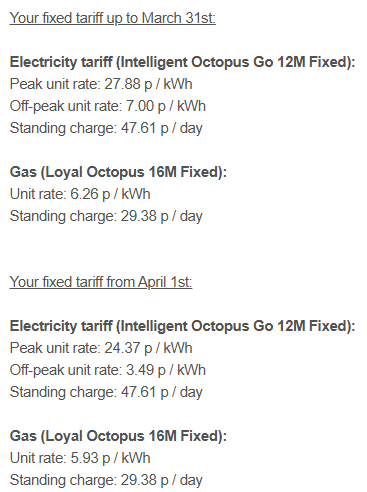
Also got the Octopus email this morning. Slightly confused as had just signed on for another 12 months fixed deal, assumed therefore prices would be errr fixed, but I'll take it!
Me too, but my new fixed doesn't start until mid April so I assume the quoted figures are before then.
We've got two "dumb" EVs and a fairly dumb charger - you can program it to charge at certain times etc to make use of the low rate electric but beyond that it's pretty much plug and play.
In terms of keeping them both charged we just ad-hoc it. We don't charge them alternately every night or whatever, just as and when but generally we're operating a day ahead.
Ie - If I've got enough for tomorrow but not the day after but the Mrs is in the same boat one of us will charge a day early.
In nearly 3 years of having 2 EVs it's never once been an issue but seeing how some people approach charging I dread to think of the absolute cluster it would become when they overthink it.
Thanks @nixie, @oldtennisshoes, @andy4d and @IvanDobski
As suspected, it sounds as though you basically just need to decide which car to charge each night (unless you want to get up in the middle of the night to change them over). Although the idea of putting one on a granny charger while the whole house is on the cheap rate could work too I guess.
Not has an email from Octopus yet (I'm on IOG too) but maybe my time will come.
Prompted by some of the conversations above, I did try a back of the envelope calculation on whether my switch from OVO to Octopus when that latter doubled the EV rate to 14p/kwh had actually resulted in lower overall bills. Simple answer seems to be no.
October 28th 2024 - January 27th 2025 on OVO (pre-EV): total cost £443
October 27th 2025 - January 24th 2026 on Octopus (with EV): total cost £678
The Octopus bill includes £128 of 7p/kwh (so basically EV charging as we haven't done any load shifting) but take that off the Octopus bill and it's still over £100 more for that three month period (presumably due to a higher daytime rate). Of course, if I work out what I would have spent on petrol to cover the same miles I'm sure I'm still quids in and if I'd stayed with OVO I would have paid twice as much for the EV charging (14p/kwh vs 7p/kwh), making the "equivalent OVO cost £699". So, I guess I'm still ahead, but only just.
We also have 2 EVs - an ID3 and a Zoe. The ID3 we just plug in and the charger just does its stuff when the cheap electricity rate kicks in at 11:30pm (Zappi charger & Intelligent Octopus Go). The Zoe doesn’t play so well so I just plug that in at 11:30 and hit Boost on the charger and it charges.
We don’t do high miles so we never have to charge both cars for longs journeys - but if we’re going somewhere far we’ll use the VW and charge to 100% over night. The Renault is now mainly my son’s going to school/football/gym car so just gets charged when needed, which is about once a week. (It was originally bought as our runaround and for him to learn to drive in, as he didn’t get along with the manual ICE car we had before).
Thanks @tomtomthepipersson
It's all a bit of a moveable feast as by the time I actually get round to buying anything the tariffs and what cars they can talk to will no doubt have changed again anyway. But good to hear that people are making it work.
Are the reductions due to the removal of the green levy? Firms mainly committed to the reductions even for those on fixed rates, so Oct, EOn etc all are passing on
https://www.moneysavingexpert.com/news/2025/11/energy-bill-cut-renewables-eco-martin-lewis/
Yes exactly that.
they will be back to the old prices - possibly more come the next round with the current situation. Government trying to spin it as a positive but really its going to be a net negative.
Here is a fun one:
My wife was doing a trip into the wilds of Scotland. She's never charged the EV on a public charger. Partly because she has her own ICE car and partly because, when we take the EV on long trips together, I do the charging. But she's obviously seen how easy it is so decided she wanted to take the EV this time "to save the planet". She was planning to stop in Inverness for a break anyway, so for a bit of fun, I told her to head to the Tesla chargers, plug in and text me the number of the charger. I then started the charge on the Tesla app remotely from home while she went for a coffee and stopped it when she was ready to go.
OK, not a particularly useful feature. She'd have coped just fine with charging at any of the Inverness locations I'm sure, but I thought it was interesting that you could do that.
Looks like instavolt have ditched their discounted off-peak charging. I can’t see anyone using them at 89p surely? That’s gridserve prices for not particularly fast off-motorway chargers.
they will be back to the old prices - possibly more come the next round with the current situation. Government trying to spin it as a positive but really its going to be a net negative.
Yeah this is the tiniest of crumbs to get them off the hook for a short while.
Besides this is a political move -so Labour can quash the 'green levy' argument on people's bills which they take a lot of stick for.
Effectively the government is now funding this directly. As it should do.
Each to their own.
Well, no, not really. I was thinking about this the other day. You know when you see a carload of youths and they are throwing their fast food wrappers out of the window and you think 'look at those buggers throwing their rubbish everywhere' - when you drive an ICE you are doing the same thing. You are spreading waste behind you everywhere you go. It's invisible, but it's still there and it's still a problem. We've just been doing it so long people don't think about it.
Maybe I have just had bad luck.
I think your car either has a fault or it's crap. My car has WTLP range of 193 miles. Mine says on the dash 180 in winter and 205 in summer, and you actually get that. Actually a little more because the range starts to drop more slowly in the last 10%. Some cars are better than others in this respect, but it's not universal. Driving style also plays a part - some people mash both pedals like lunatics, this is very wasteful.
As for charging issues, only once have I ever found a non working set of rapid chargers. I've never had one charge super slowly like you said - so it's quite possible your car is faulty.
so it's quite possible your car is faulty.
I'm also going to suggest a setting somewhere. I've had to become a proper EV geek the last few weeks. Now it is all set up, it Just Works.
But, like a mobile phone, setting up properly can really make a huge difference.
@jondoh what car is it, and does it have some form of charging settings / battery protection ?
But, like a mobile phone, setting up properly can really make a huge difference
Really? Is there a setting for 'bad efficiency'? On my car the settings make little difference. The regen setting is immaterial as far as efficiency is concerned, what matters is how fast you choose to slow down. It matters not if it's done by lifting off or by pressing the pedal. There is an 'eco' setting but all that does is remap the pedal and make the aircon less powerful. But if you press the pedal less in normal mode and the car's up to temperature it doesn't matter, the same power is consumed.
Tell you what, useful slow EV chargers are hard to find aren't they? I need a 100% charge to get home from climbing, so I thought it'd be perfect to save some money and use a slow one. However almost all of them are at businesses where you're either blocking their parking all day or it's got cameras and you can only stay for 2-3hrs e.g. Tesco. There are slow chargers at the rapid chargers, but I don't fancy blocking a rapid for 6hrs. Interestingly some of the rapids don't have the slows on them, presumably for this reason.
First experience today of properly needing rapid charger to continue long journey. Drove down from central Border to Ambleside on Wednesday, then to Langdale yesterday and to Keswick area today for glorious sunny stroll strong Blencathra begore heading up to Carlisle. Got to Ionity chargers with 10% left. 30 mins later I’m up to 80%. Cost me £20 and a flat white in Starbucks. Everything worked first time. I thought that was pretty decent.
Not only that Molgrips but a lot of cars with rapid charge ability cannot fast charge on AC so you'll only get 7kW-10kW on an AC charger capable of 22kW
Really? Is there a setting for 'bad efficiency'? On my car the settings make little difference
More on the charging side.
I've four apps. Polestar for the app. Polestar Energy for setting up Polestar app speaking to Octopus and charging limits, and telling the charger (SyncEnergy App) to play nicely with my preferences.
Hidden in SyncEnergy was a really,verbally slow charging speed set as default.
Hidden in Polestar Energy was a similar setting.
Polestar energy needed to be told when I wanted charging complete by.
Sync and Octopus needed to both be told 'yeah, fill her up with freebie energy whenever you want'.
I've had to work out schedules, hunt around Reddit and forums to work out some things - like SyncEnergy charger doesn't work on a 5ghz WiFi was worked out by a neighbour, but isn't in the manual....
@molgrips another analogy could be “bagging all your rubbish up, taking it home to be burned in an incinerator”! Pollution from electric vehicles is just displaced?
Pollution from electric vehicles is just displaced?
Partly but it depends on the generation mix in play at the time - over the past year it's been just under 30% from fossil fuels with the rest coming from renewables, nuclear or biomass. An ICE car is 90 or 95% fossil fuels with a bit of bio ethanol thrown in, so roughly 3 times more fossil fuels consumed. As the grid gets greener that number changes more and more in favour of the EV. Oh and power stations are way more efficient at getting energy from gas than your car is at extracting it from fuel.
Plus of course that power stations tend not to pump out their pollution right next to where pedestrians are breathing it in.
Pollution from electric vehicles is just displaced?Displaced and reduced. Quite a bit. Even if they make your leccy from coal.
Pollution from electric vehicles is just displaced?
No - there's much less of it to begin with. Even if you powered an EV exclusively from coal fired power stations it'd still be 3x lower carbon emissions, because of the way the motor works vs an ICE. However, overall only about 1/3 of our energy in the UK comes from fossil fuels in the form of gas, and none from coal.
And on top of that, there is the question of distribution. Displacing it to remote locations where it can be managed is much better than spewing it around towns and cities right outside people's houses.
Lastly, 1/3 of our energy comes from fossil fuels *on average*. However the energy that goes into your EV can be much less. For example, whilst we lose solar generation at night, demand is so low that sometimes wind and nuclear meet it all. We mostly charge our cars overnight so we can take advantage of that.
I think thats a bit disingenuous about the pollution. Additional load only can come from fossil fuels as renewables run pretty much maxed out. so an increase in electricity consumption means an increase in fossil fuel useage. If you were not charging that car tyhen therre would be less fossil fuel used by the amount it takes to charge that car
Sure we can build more renewables but the answer is to use less energy not switch from one form to another. There is also evidence that with the low cost per mile of EVS they are used more
Efficiency is greater for sure as is less pollution in cities