UPDATE: Reviews section refreshed, redesigned, searchable: Go take a look
What, er, is it exactly?
Fluffy things in the sky? I know little.
Or outsourced computing? I know little, but think of hotmail or flickr - these are cloud services.
I've just started using [url= https://www.dropbox.com/ ]Dropbox[/url], let me know if you want an invite. 😉
Basically it's storage in the sky that you can access from any device that's connected to the internet.
You have an account.
You sign in.
You access what you want.
My understanding is that your files anre split and stored at different locations making it difficult for hackers to access all your info, but I still wouldn't store sensitive stuff.
Main benefit is file size that can be stored.
I can, for example, upload my product catalogue and give access to all my clients to read and I guess download. something that would require 100 emails...
Or upload the files on a PC and show the catalogue to customers using my phone or a tablet.
First impressions are good.
Its a sales term. Basically its for outsourcing a 'service' rather than computing however all the models seem to be wrong, as they just seem to end up as hosting companies.
All part of the cycle, of centralisation/decentralisation.
Don't worry give it a year, and the next big thing will be along. Although the cloud idea has been about for around 10 years, look at Utility Data Centers, so its just a spin on a very very old idea.
Rather than have to worry about buying servers, installing the software you want on it, maintaining it, upgrading it, replacing it when your service contract expires etc etc...
You buy cloud services where someone else does all that crap for you and it just works.
Much like utilities. You buy electricity from a cloud. You don't have to build your own power station and run a cable to your house.
[img] 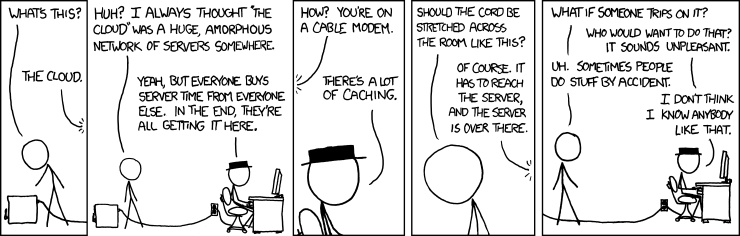 [/img]
Cloud - lots of computers providing a service on the internet for you.
GMail, Hotmail, Yahoo Mail are examples of 'email' in the cloud.
We (as a company) are migrating from email in-house (MS Exchange) to Google Mail. I don't have to worry about licensing, hardware costs or downtime (relatively speaking) 🙂
Another example of the cloud - YouTube video encoding. At home, you have ONE computer, encoding a HD video.... it might take 5hrs to finish?
Upload it to YouTube, and it will use multiple computers together.... and finish in about 1 minute.
Loads and loads of different examples, depending on how technical you are for understanding them.
Cloud.
Plus points: Distributed, so easy to carry on if something bad happens in a single location.
Minus points: Where does your data go if the cloud provider goes bust? e.g. what happens to my Flickr photos if they go titsup?
or downtime
Read the gmail cloud service agreements - SLAs aren't brilliant. This is a potential failing of current cloud offerings: the one size fits all approach doens't always translate to the level of service you might expect from a dedicated outsourcer.
We (as a company) are migrating from email in-house (MS Exchange) to Google Mail
Just done this as well - I can't actually see any downside at the moment....
e.g. what happens to my Flickr photos if they go titsup?
You have them backed up, right?
I think the cloud is an easy way to access info from anywhere in the world providing you have an internet connection and not a substitute for storage space.
Rather than have to worry about buying servers, installing the software you want on it, maintaining it, upgrading it, replacing it when your service contract expires etc etc...
That's what it *should* be however when you come to actually deploying servers, that's not what you get, especially if you want CPU intensive jobs which run for 1 month then nothing for 3 months, as you end up having to buy enough servers for the 1 month job for your entire contract.
I looked into this for work and basically they offer a network link, air con and power and you have to do the rest, and you can only change your requirements up, not down. So you might as well buy the kit yourself if you have enough aircon and power spare in your computer room.
We (as a company) are migrating from email in-house (MS Exchange) to Google MailJust done this as well - I can't actually see any downside at the moment....
Works well until it pops and you have to wait for google to fix it, and if you aren't worried about IP.
I know about the SLA's and have taken these into account.
Currently Google Mail have an average of 7 minutes per month... that's only 2 reboots of our mail server..... and the average is taken from a second here, a second there, not 7 minutes continuous.
We're also looking at the cloud for SQL 2008 number crunching. One task currently takes 8hrs (every night) on our current hardware. Same task took 10mins in the cloud! That could be run on demand when a client clicks the button..... food for thought.
TBH - even if gmail are a shower of sh!te, it will still be a glowing beacon of reliability compared to our existing 'IT support'! 😉
I looked into this for work and basically they offer a network link, air con and power and you have to do the rest
Well, no you didn't.
What you did was look at the building blocks that cloud companies use to provide cloud services.
If you'd wanted cloud services you'd have talked to a cloud service provider and would have been discussing applications not hardware.
richc - it appears you don't understand what the cloud is!
Give Rackspace a call - they've got some cloud experts in house, and have found them *very* helpful.
"The Cloud" is the latest IT buzzword, beloved of Chief Execs and FD's everywhere, as it is code for outsourcing, hence the laying off of internal IT staff.
So, the "Cloud" is just - outsourced stuff you can do using the internet, then...
Richc - surely that is NOT cloud computing, just locating?
The cloud means virtual servers or services accessible from anywhere, to me. I've got a load of work documents in 'the cloud' (actually Live Mesh) and I can access them from anywhere. I could use apps in 'the cloud' too if I was using google apps for editing docs etc.
Different clouds though, which is a tad annoying.
I thought we were going to start referring to The Cloud by it's real name: Hard drives in India.
"The Cloud" is the latest IT buzzword, beloved of Chief Execs and FD's everywhere, as it is code for outsourcing, hence the laying off of internal IT staff.
It's more than that. Part of it is economies of scale. A cloud company can offer services that IT teams simply can not.
Minus points: Where does your data go if the cloud provider goes bust? e.g. what happens to my Flickr photos if they go titsup?
They'll end up with my Fotopic ones.
(yes - I did have copies)
I thought we were going to start referring to The Cloud by it's real name: Hard drives in India.
Unless you're using one for massive computational power instead of storage 😉
We (as a company) are migrating from email in-house (MS Exchange) to Google Mail.
Does that mean you have @gmail.com mail addresses? If it does I think the downside may be in customer perception.
I looked into this for work and basically they offer a network link, air con and power and you have to do the rest
Er, you looked at co-location in a data centre, not cloud services..!
Blimey - I'm a lawyer and I seem to understand more about IT services that an IT man. Worrying..! 😯
Blimey - I'm a lawyer and I seem to understand more about IT services that an IT man. Worrying..!
I wouldn't worry, most IT bods and care givers probably know more about the law than you. 😉
Mr Woppit - MemberSo, the "Cloud" is just - outsourced stuff you can do using the internet, then...
Pretty much, the main reason for it's rise seems to be purely that simpletons get to use a new bullshit bingo buzz word since the concept has been in heavy use for a few years.
It was Rackspace (and BT and Amazon) we spoke to, and once you get down to the nitty gritty (not the marketing, but rather what access, performance and availability speeds can you guarantee) unless you are talking about generic services, all you just get network, power air con and a network link.
I also spoke to HP (and Dell) technical marketing and sales, and they had to admit unless you are talking about simple mail or data storage you won't fit into the cloud.
Might be different in the future, but if you want to deploy now, that's the reality.
You're not talking about cloud services. The cloud is an application layer, not a hardware layer.
What 5e said.
I feel that this is relevant
[url= http://www.zdnet.com/blog/microsoft/is-apple-really-using-windows-azure-to-power-icloud/9687 ]http://www.zdnet.com/blog/microsoft/is-apple-really-using-windows-azure-to-power-icloud/9687[/url]
That's my point, all the cloud applications out there at the moment are data storage and mail based, if you want somewhere to put pictures/documents and read email the 'cloud' can do this, However I could access my mail (and data) from anywhere 10 years ago and I am fairly sure that wasn't a cloud service, rather just a firewall port forward to a pop/imap server authenticating against LDAP.
If you want to use the cloud for processing data (like render farms for for FEA) you drop out the the cloud model, and they offer you hosting rather than services.
If you think the cloud can do this you ought to let Rackspace know.
A cloud company can offer services that IT teams simply can not.
Can you name some?
For some companies externally hosted services are appropriate for others not. There is a loss of flexibility and if your company tends to add and remove services/servers as mine does then offsite contracts can be restrictive.
They are efficient due to the concept of "virtualisation" however if you have sufficient internal resources its straightforward to use this technology internally and that gives a huge amount of flexibility and actually is far more cost effective.
Having internal skills and the requirement to make fast changes would largely determine if this is usefull for you.
Although the cloud idea has been about for around 10 years, look at Utility Data Centers, so its just a spin on a very very old idea
Goes back a lot further than that, basic concepts are the same as the computer bureaux of the 1960s and 1970s.
The cloud is an application layer, not a hardware layer
Depends what "cloud" service you're talking about. It can be application but equally OS or even basic iron - SaaS, IaaS etc to throw in a few more buzzwords (buzz-acronyms?) designed to impress your CEO.
That's my point, all the cloud applications out there at the moment are data storage and mail based, if you want somewhere to put pictures/documents and read email the 'cloud' can do this, However I could access my mail (and data) from anywhere 10 years ago and I am fairly sure that wasn't a cloud service, rather just a firewall port forward to a pop/imap server authenticating against LDAP.If you want to use the cloud for processing data (like render farms for for FEA) you drop out the the cloud model, and they offer you hosting rather than services.
If you think the cloud can do this you ought to let Rackspace know.
They're anything and everything. Epos, accountancy, labour management... the list is endless.
You need to talk to cloud application providers who provide the service(s) you want.
If you want bespoke services then you can pay a cloud company to write them.
You seem to be talking about providing cloud services for yourself which is contradictory.
Cloud computing seems to have a different term depending on who you speak to. RichC your description is not what i would describe as cloud computing. Basically the cloud is a generic term for offering applications, processing power and/or storage and be billed per usage. e.g. Imagine the 'traditional' scenario of providing a database server for a certain task with a intense month end routine. You would identify the specification, purchase the hardware, install it, maintain it, patch it, (finance) depreciate it and have the capacity to do x number of tasks in y time. Cloud computing would mean you identify the role of the machine, i.e. database server (with usage estimates as well), and then run your tasks on it. If your usage spikes (month end processing) then you have the option of adding additional resources (memory, processor, bandwidth, more servers) to decrease processing time or expand capacity for a period of time. Your cloud provider should be constantly monitoring and providing stats on the services you've taken. This can apply to any services. Gmail, youtube, flickr are all good example of cloud computing for dedicated tasks, however the new wave of cloud computing for business is the scenario described above. The cloud computing for consumer is focussed on music and storage i.e. iCloud from Apple and whatever the Google and Amazon services are called. HTH
Bill by usage is how we define - it also usually allows for a greater variation in SLA to suit budgets. It can be by CPU time, IOPs, storage used what ever metric you care to use and can be accurately measured and reported.
Much of what I do day to day is sold internally as 'private cloud' as it seems to keep middle managers happy .. we have connectors to utilise external resource but for a number of reasons, mainly non technical, we just use in house compute power at the moment.
5e our spec was, we need to run computation jobs (using industry standard software) which will use about 2TB of storage 3 times as year. Our current jobs take 28 days to complete so they must take this amount of time or less. After which we need access to the 2TB of data(via network or tape) and will not require the service for another 2 months.
Sound like a service suitable for a cloud? Did to me, didn't to any of the cloud services companies.
The cloud is a buzzword, that at best doesn't mean anything, or at worst means completely differently things to different companies, hence the confusion.
I have to admit I am biased towards finding out exactly how they are hosting the cloud services as I've worked in Datacenters for 13 years (and on 'cloud' service for at least 6 of those) as I know how to spot the difference between what marketing say, and what actually happens.
richc Amazon disagree with you
[url= http://aws.amazon.com/ec2/ ]Amazon Cloud Compute Platform[/url]
You seem to be talking about providing cloud services for yourself which is contradictory.
Not if you're a big enough company - often service units like IT are distinct from the business, and are required to compete with external providers - in this area a 'private cloud' can offer an alternative to the business with comparable pricing models.
I wish we were closer intwined wit the business though. I'd have a really nice car by now 🙂
edit double post
I wouldn't worry, most IT bods and care givers probably know more about the law than you.
Excellent. Got an issue at the moment on the difference between "profit" and "anticpated profit" when trying to determine what is in or out of a direct loss category for limitation of liability.
Anyone?
Not if you're a big enough company - often service units like IT are distinct from the business, and are required to compete with external providers - in this area a 'private cloud' can offer an alternative to the business with comparable pricing models.
Yeah, granted.

