UPDATE: CLASSIFIEDS section refreshed, redesigned, searchable: Go take a look
There's a one buzzing round London at the moment. Don't see one of those every day!
[img]  [/img]
There are rumours going around that 'THEM' (the SAS etc) are looking to aquire some, and a number of US aircraft may or may not be currently operating out of an RAF station in Hampshire, giving the UK experience using them before their own are delivered.
I say rumours because it's UK policy not to speak about special forces, err, stuff.
Which bit of London? I'll pop outside & take a look...
Hopefully if "we" are getting some for "them" they'll be standard US rather than customised at great expense to be less capable (see Phantom onwards).
Had one fly over the house during Obama's recent visit. Not as bad as when the chinooks go over but still it's a noisy bugger.
i often see them in the Dales. Possibly going to Menwith Hill listening base near me at Harrogate.
Hopefully if "we" are getting some for "them" they'll be standard US rather than customised at great expense to be less capable (see Phantom onwards).
Well the WAH-64D (the UK-built AH-64D Apache) is thought of as better than the original US-built version (due to the superior engines fitted to the WAH-64D), and the much-maligned 'Speyed' Phantoms were actually supposedly pretty decent at low level, for which they were designed/purchased.
I will agree with your overall sentiment though, given my last posting was Odiham, when the debacle of the Chinook Mk.3 was still far from being sorted.
Also, the one a/c that had the easiest entry into service was the one, that due to it being initially on hire rather than purchased, the MoD wasn't allowed to faff about with; the C17.
I was aware of the Apache, a good aircraft with an eye watering unit cost compared to the US export price. The Phantom was a similar story, unit cost meant we got a third of the number.
C17 is an outstanding aircraft and amazing value.
There are are a couple permanently stationed in the UK for US special forces, because it puts them into easy flying range of a significant section of Europe, and the Middle East with in-flight refuelling.
There were a range of combined services exercises going on all over Salisbury Plain a while back, and Ospreys were stooging around Chippenham, it's said that British special forces were training with the Americans on the aircraft prior to being equipped with them; they're much better than helicopters, faster, greater range, better operational ceiling, better carrying capacity.
And massive cool factor!
There's a smaller civilian aircraft being developed with the same sort of tilt-rotor setup, but it's causing some issues, one crashed recently killing the crew; the Osprey had a lot of issues, but the Marines stuck with it.
Yeah, AugustaWestland AW609:
[img] 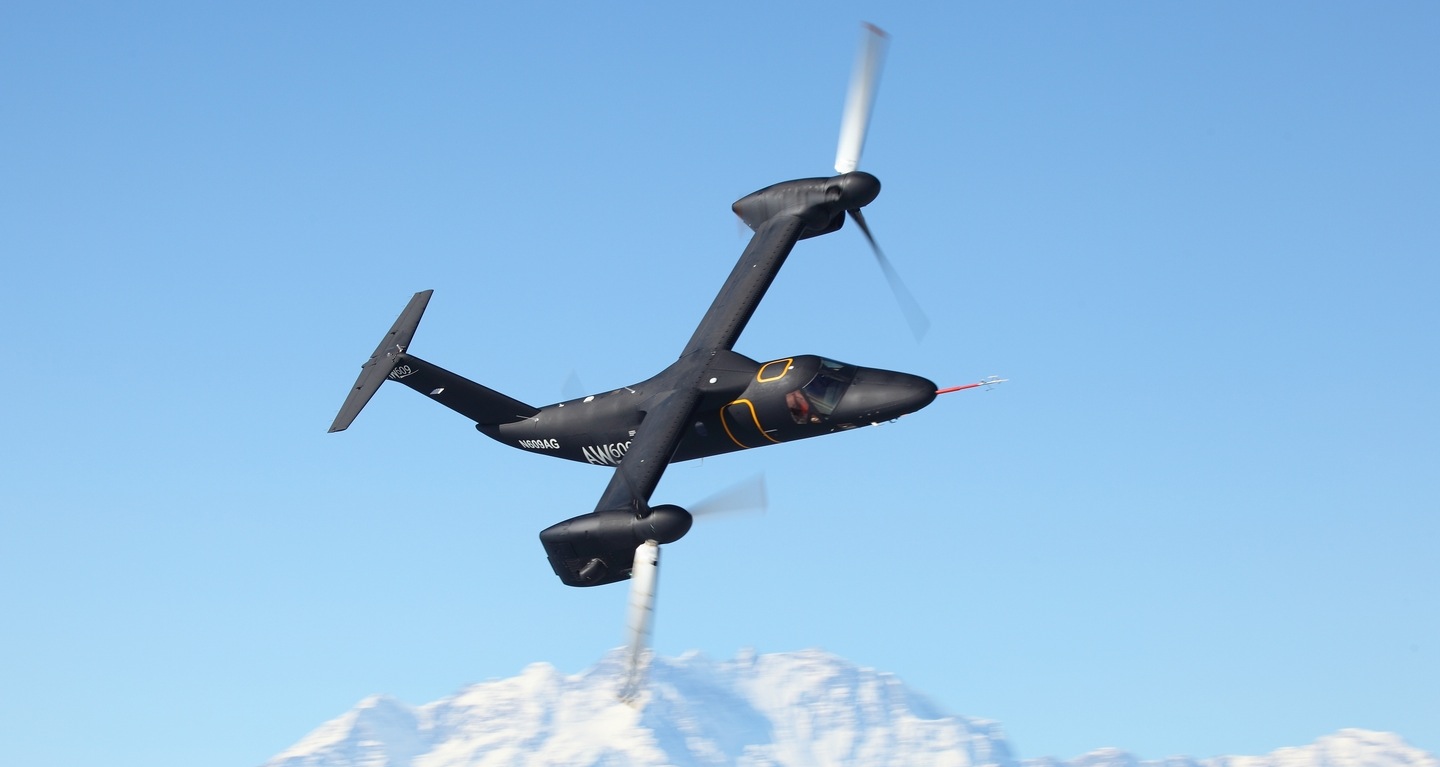 [/img]
I was just about to post about this, saw it above NW7 twice this afternoon, very distinctive sound, at first I though it was a Chinook approaching but it's quite different, on its way to Northolt maybe?
I was aware of the Apache, a good aircraft with an eye watering unit cost compared to the US export price. The Phantom was a similar story, unit cost meant we got a third of the number.
The problem is (generally) without UK work share, things don't get brought.
It's not what the military are overly concerned about, they just want kit that works, but The Right Honourable Gentleman for Little Aircraft Works on The Wold may be, so to the Chancellor of the Exchequer.
Buying the Apache (for instance) from the US at export price might mean more individual a/c, but those millions spent are all disappearing Stateside.
they'll be standard US rather than customised at great expense to be less capable
the standard V22 is an absolute dog, so hopefully not. 😆
[url= https://warisboring.com/your-periodic-reminder-that-the-v-22-is-a-piece-of-junk-db72a8a23ccf#.2x6q2263g ]War is Boring[/url]
Yeah also people forget, we could buy more aircraft - but the huuuge expense/elephant in the room is operating costs and manpower. If we cant support 100 Apaches, why buy 100 Apaches and mothball 50 - when we could have 50 really well specced models.
It flew right over my office, noisy bugger.
Even as a man hugely proud of what the British aviation industry has achieved, the MOD still hasn't realised that the halcyon days of improving US aircraft purchases ended with the Merlin engined P51.
RAF F4 pilots generally preferred the small number of F4J jets we imported in the 1980s, complete with American engines, guns and avionics compared with the Spey engined jets.
Moreover, we could have saved billions of pounds and gained incalculable betterness by having the two new (and currently sans aircraft) carriers refitted with EMALS catapults and F-18Es and Grumman Hawkeyes.
RAF F4 pilots generally preferred the small number of F4E jets we imported in the 1980s, complete with American engines, guns and avionics compared with the Spey engined jets.
Except they weren't F-4E's but refurbished, ex-US Navy F-4J's which still didn't have an internal gun, and used the same external gun pod as the Spey-engined FG.1's/FGR.2's
[img]  [/img]
/pedantry
You were too quick for my ninja edit - you are correct, they were indeed ex-US Navy F4Js.
I can only doff my cap to your pedantry, normally I'd be there like a shot myself. 🙂
Expensive and over complex - SAS need us to bring back the Fairey Rotodyne!
RAF F4 pilots generally preferred the small number of F4J jets we imported in the 1980s, complete with American engines, guns and avionics compared with the Spey engined jets.
A bit of a generalisation that. Those who flew the Phantom in the Air Defence role generally preferred the F-4J(UK) because it's engines were better optimised for higher altitudes. Those in the RAF though who originally operated the F-4M (FGR2 in UK parlance) very much liked them, more so than the gutless eventual replacement (the Jaguar). This is because they operated at low-level, carrying both conventional and nuclear ground attack weapons, which the Spey-equipped Phantoms were actually designed for. At low-level they had a 10-15% longer range than a similarly loaded F-4E or F-4J. The Spey-equipped Phantoms were also far less 'smokey' than the J79-equipped ones, a not insignificant fact when you're trying to sneak in under a Warsaw Pact CAP in the days before reliable doppler radars.
When the FGR2s were moved to AD duties they undoubtedly came out badly, but this was always a very secondary consideration when they were first re-designed for British service.
Of course compared to the Mighty Bucc the Phantom was second best in the ground attack role, but that is another story.
was it over Westminster? I heard a noise chopper when Queenie was on the way to open Parliament.
The level of technical know how and geekery on this thread is really quite awe inspiring! I doth my cap.
That Osprey over London popped up in three different places on my FB feed yesterday. Seems to have caused quite an understandable stir!
They are impressive, but seeing them land is even more so. I never cease to be amazed that something as ungainly as they look in transition can actually take off and land. They make helicopters look normal.
My favourite way to travel is still the Wokka though. Love them to pieces.
The pilots I've met loved the Jag as it was a single seater and lacked fly-by-wire.
The pilots I've met loved the Jag as it was a single seater and lacked fly-by-wire.
Oh don't get me wrong, most Jag pilots loved them as the strange noise coming from behind them in previous a/c c disappeared, but when they were new many of those on the Germany-based squadrons who gave up their Phantoms for Jag expressed feeling 'short-changed'.
As new the Jag was a gutless beast compared to the Spey-equipped Phantoms.
Willard - I agree with you about the Chinny, I spent my last posting working with them and my last tour in Afghanistan pretty much living in them!
The Ospreys used to keep me awake at night when i was in Kandahar but having said that they also spent a lot of time on the ramp being maintained - far more so than any of the other aircraft types being operated out of there.
Jaguar - they say that if the earth wasn't curved then they wouldn't have been able to get airborne!
Jaguar - they say that if the earth wasn't curved then they wouldn't have been able to get airborne!
Norfolk's loudest hairdryers.
(Having managed to get a flight in a T2 when I was an Air Cadet I can confirm that, on a hot day, the end of the runway loomed large quite late in the take-off roll!)
There were 2 regularly flying around as a pair local to me most days the week before the Obama visit, and have seen one a couple of times since personally, others have seen them on several occasions too.
I live about 15 miles from Credenhill..........
I'm surprised there are not more of them about to be honest. Having the range and speed of a plane, but the landing ability of a helicopter is a pretty attractive proposition.
Why none with actual jet engines instead of props??
I'm surprised there are not more of them about to be honest
At £50,000,000 a pop, I am not that surprised.
I'm surprised there are not more of them about to be honest
they're obscenely expensive, and rumour has it, very difficult to develop the flight controls to do the transition from hover to forward flight
Why none with actual jet engines instead of props??
Because jet engines are effing useless at low speed, i.e. in a hover.
Hence why helicopters have whacking big rotors.
My old boss who is ex-RAF, said they had a saying "God made the world round to give the Jaguar a chance to take off"
Damn, Rockhopper beat me to it........
Lightning's on the other hand he was full of compliments about.
I'm sure I remember reading somewhere that the test pilot for the Tornado F3, said the Jaguar was his fav plane.
Here is one landing on the M55 and a few other interesting bits and bobs.
[url=
- Jaguar[/url]
love that video, he just chucks it at the ground
The Harrier and F35 use jet engines to hover and take off and land vertically. The problem with them is that they use a huge amount of fuel, create alot of noise, melt or set fire to whatever surface it is they're landing on and tend to spit their dummies out if they suck in debris and hot air into the intake. It is far more efficient to use a jet engine to drive a huge prop or fan as the Osprey does as well as helicopters and passenger aircraft.
Not convinced about the Osprey. Far to much gearboxery going on for my liking. One of the biggest causes of problems in helicopters are the gearboxes, and helicopters have relatively simple gearboxes compared to this thing is which is basically one big gearbox with a couple of turboprops attached. Time will tell.
When a pilot tells you they like the way an aircraft flies is the same a someone saying of an ugly girl that she has a nice personality. There is not a pilot i've spoken to who wouldn't want to trade a 'nice handling' slow out of date aircraft with an overpowered after burning high performance plane. Certainly if they had to go and fight in one.
The government uses big military expenditure programmes to piggy back the nations technology capability retention. If we just bought everything off the shelf from the US then we'd soon forget how to build these things ourselves.
The F35 also sets fire to itself, the software to fire it's cannon won't be ready for years and when it does it'll carry a woefully small amount of ammo.
The big issue with the Osprey is that (in the very rare) event of double engine failure a) the wings are not big enough to generate enough lift for it to glide and b) the rotors are too small to hold enough energy for it to autorotate.
There is not a pilot i've spoken to who wouldn't want to trade a 'nice handling' slow out of date aircraft with an overpowered after burning high performance plane. Certainly if they had to go and fight in one.
Really?? Ask the A10 pilots.
Actually, ask the people that also like having quality close air support. A10s are far better at that than just about every other fast mover.
The government uses big military expenditure programmes to piggy back the nations technology capability retention. If we just bought everything off the shelf from the US then we'd soon forget how to build these things ourselves.
Britain hasn't put into service a fully British built supersonic military jet since the 1950s - the Lightning in fact. Since then we've co-opted with Germany, Italy (Tornado) and Spain (Eurofighter Typhoon) or with France (Jaguar). Harriers are also built by McDonnell Douglas (now Boeing), who've been responsible for radical redesigns.
Israel, Turkey, Japan and South Korea all assemble American procured designs locally, often with indigenous enhancements to weaponry and avionics.
Not one but [i]two[/i] Ospreys overflew central London this morning. right noisy buggers too, could hear them from miles away.
No we haven't put our own jet into service, but through the very many collaborations we've retained key design and manufacturing capability that we would have lost if we'd just always bought off the shelf. We could build an aircraft ourselves - we still have all the key design and manufacturing skills, it's just not commercially viable to do so.
And what's the A10 being replaced with? F16's, Apache Hellfires and drones.
The A-10 is not being replaced yet. It was supposed to be replaced by the F-35, but that's not ready and people have really objected to this, so it is staying.
Each of the alternative platforms have advantages and disadvantages compared to the A-10. The F-16 can carry all the same bombs, is better at air-2-air, but flies faster and is not as good at the close air support role. The Apache lacks the all up ordnance carry capacity and range, the predator the same really. As a package, the A-10 works and is far, far cheaper than the F-35.
But the A10 is 30 years old and the airframes are coming to the end of their life. There is no doubt that it's an excellent CAS aircraft and has been superb in Iraq and Afghanistan against an enemy with no real integrated air defence system. Against a peer/near peer adversary with reasonable (read soviet double digit SAMs) I think the A10 would struggle. Your equipment should be ready for the next war and not the last one.
I'm not denying that, but for the sort of conflict that we are fighting _now_ it's perfect.
Yes, if I was on the ground against a modern opponent with a good/equivalent level of hardware, I'd want the best planes possible backing me, something with as much capability as I can get, but that's not the case with what we are doing now. The A-10 fits that bill better than anything the UK has and, arguably, the US has too. That's not bad for a 30 year old airframe.
The F-35 might just make it to operational deployment by the time we fight our next war, but I suspect that by the time the bugs get ironed out (and with the software suite as it is, that's an apt pun) it will be out-dated.
Back this afternoon, PJM. Followed 10 mins later by a pair of big, open sided helicopter gunships (? pointy bits, bulbous dangly bits, Huey sort of thing but newer) and a Chinook about 20 mins ago.
Yes, I saw two Blackhawks, with refuelling probes (US Marine Seahawks?).
The Chinook is a regular flyover and seemed to be following it's usual route.
I reckon it's a sales demo courtesy of the US Marines. A V22 makes sense for our two carriers, given the lack of airborne AWACS cover dictated by no catapults/arrestor gear. They've just got to figure a way of hanging a big enough radar on it.
Your equipment should be ready for the next war and not the last one.
In an ideal world, of course but that hasn't happened in the UK since 1939.
There's immense budgetary pressure on the US Air Force thanks to the F-35 and now the B-21, something [i]has[/i] to give and the A-10 has been the preferred option to drop for some time, even though it's perfect for the limited, counter-insurgency conflicts the US fights today. Arguably, with modern avionics and jamming equipment (remember, the A-10 has been starved of upgrades since the Cold War), it could still be a potent threat to a modern army's armoured divisions with or without SAM cover.
The US is facing a similar problem to the UK forty years ago - mergers and acquisitions mean a smaller group of aircraft manufacturers are responding to an increased demand for standardisation, with stiffer global competition (Sukhoi/MiG, Shenyang, Eurofighter, Dassault, Saab, Embraer, etc). The obvious response is to produce one do-it-all platform in the hope that the market will buy it.
The B-52 is pretty cheap for what it does, the B-1's design is pushing a half century in age, likewise the F-15, F-16 and A-10. The 1970s vintage F117 has been retired, the twenty B2s are too expensive to risk and suffer pitiful serviceability. F-22 aside (design and concept dates from the late 1980s), the most modern jet fighter in the US inventory is the Super Hornet - which dates from the mid 1990s.
There's speculation that whoever lost out on the B21 deal would withdraw from the defence market entirely. Likewise Boeing - who bought McDonnell Douglas is threatening to close down it's defence division and is demoing evolved versions of the legacy F-15 and F-18E lines in the hope of finding buyers.
To cap it all, the F-35 is monstrously expensive and highly compromised. The US Senate has ordered a feasibility study into restarting F-22 production...read into that what you will.
In summary, budgetary pressures and the inherent inflexibility of the design process for modern warplanes means that it's bloody difficult to ensure the right aircraft are ready for whatever conflict might erupt at a given time. Even more worryingly, certain projects like the F-35 have been deemed "too big to fail" and money is thrown at them because cancellation is likely to mean the end for Lockheed, so three totally distinct mission requirements have been cobbled together into one airframe, with predictable results.

