UPDATE: Reviews section refreshed, redesigned, searchable: Go take a look
Just wanted to say thanks for taking the time to do this. Whilst I didn’t ask anything, I found your responses really interesting and several of the questions were similar to what I would have asked. Hopefully in the future I’ll be able to also say your suggestions and advice particularly useful too.
I work a four on, four off shift pattern. Two day shifts, followed by two night shifts. Twelve and half hour shifts starting at 5.30. It’s impossible for me to build a routine in as you suggest, I feel permanently jet lagged and sluggish and contributes to my lack of motivation etc (blaming that anyways) Add in a two year old who understandably hasn’t a clue her Dads trying to sleep during the day and it causes me havoc in all aspects of life!
Any tips other than going to normal working hours??
This was partly answered a few questions above, but the long and short of it is that this shift pattern is going to be very hard to work around. I think that if it's two nights out of eight days, I'd just try and minimise the impact of those two nights on my other days.
So when I was on the first night, I'd come home and go straight to bed, and get up six hours later and do the second night, and then stay up as close as I could to my normal bedtime after the second night. This is to try and stop your circadian rhythm shifting too much so that you can maximise your sleep quality when you're on your days and days off. On all those days I'd try and have exactly the same getting up time on each one, so no lie ins to catch up on sleep.
Thank you for doing this Kramer. it's interesting.
I can only sleep face down, neck turned 45 deg to the left, occasionally I can sleep on my left side. I would like to sleep on my back but have never been able to do this other than when I had my leg in a cast and couldn't get into my normal position and I slept well during that time.
I can fall asleep in bed watching the telly on my back but, I can't stay there. Any tips?
Thanks Kramer, appreciate it and the time you’ve taken!
this associating the bedroom with not sleeping thing is very interesting. Are there other examples of this kind of association that I can see and try to understand better?
It's a Pavlovian response. The stimulus is being in bed, and the response is to think about lots of things other than sleep that you could be doing there.
If blue light/screen time is a bit of a myth, especially earlier in the night, regarding melatonin levels, then is scrolling and internet things some kind of behaviour likely to increase dopamine levels in place of serotonin?
Yes, I think the danger in late night internet use comes from the cortisol and adrenaline stress response from arguing with Pink Bikers rather than the light from a screen which is unlikely to be intense enough to inhibit our melatonin peak.
Does slowing your breathing down decrease excitatory hormone levels?
I believe it does if you're practiced at mindfulness, which is more about acknowledging your thoughts and sensations than the actual physical act of slowing breathing rate. ie concentrating on your breathing can distract you from the things that are stressing you out. WRT mindfulness some people swear by it, but for some it doesn't work at all, and can actually make things worse.
Thanks Kramer - some very interesting stuff!
Thanks for the response about smart watches! I have noticed that every time I feel like I've slept well, it has been reflected in Garmin connect with an excellent sleep score so nice to know it's not totally off base!
Re: shifts.
Thanks for the advice @Kramer
My pattern is 4 on 4 off, 2 X days 2 X nights 6-6.
I'll try and follow the advice of seeking light and darkness.
Other than my split day morning I just concentrate on resting as much as possible during my working block so as to be as trash as possible for my 4 off.
I'll read the rest of the thread later, but I bet similar has been asked already.
I work on a ship doing offshore work, so I have 4 weeks on / 4 weeks off. Currently the ship is in Korea, but moving to Gulf of Mexico soon.
So, I travel to a different time zone, do two weeks on a midnight to midday shift, the 2 weeks midday to midnight. Then fly home to to the original Time Zone.
When I get to work, The first 3 days are virtually sleepless. I try to relax, and just be happy that I'm in my bunk with nothing to do. I still get very tired while on shift though, and try to avoid more than 3 cups of coffee. When I change to midday to midnight, I'm able to flop over to the new sleep routine with little bother. When I fly home again, The first day I'm shattered, but that is more to do with the flights. Geting into UK timing for sleep isn't too much trouble, normally a couple of night where I find it hard to stay awake until bedtime, then a short deep sleep and wake very early.
I can't do anything about the disruption, it's my job. What's the best I could do to help offset any bad effects of all this messed up sleep?
I should have got involved in this thread sooner, been awake for an hour now, maybe more, but it's all COVID induced.
What a good thread.
I often wake up with a headache and feel generally knackered for the first hour or so of waking up, never really feel refreshed after even what I think was a full nights sleep. Can't remember last time I woke up with a spring in my step. Where could I be going wrong?
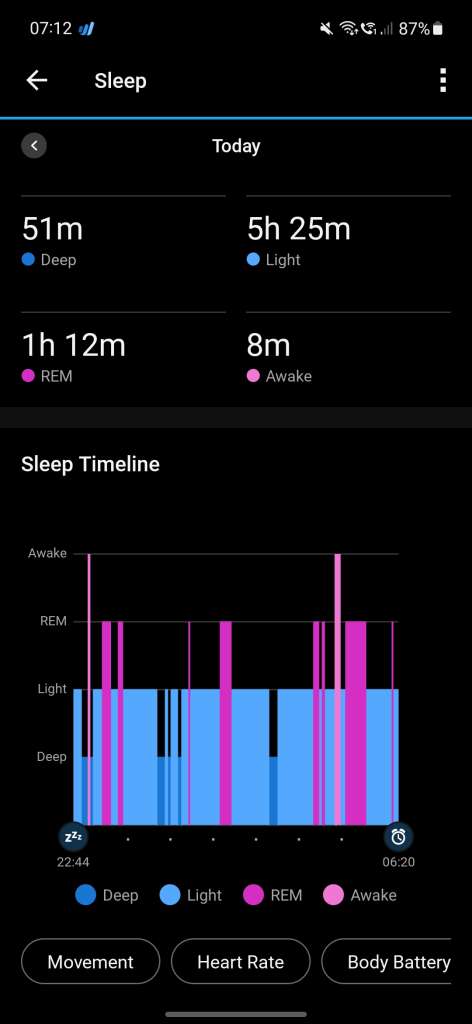
Re. Smart watch sleep tracking. This is from my Garmin last night.
I went to sleep around 60 mins before it says I did - 🙈
Re: shifts.
Thanks for the advice @Kramer
My pattern is 4 on 4 off, 2 X days 2 X nights 6-6.
I’ll try and follow the advice of seeking light and darkness.
Other than my split day morning I just concentrate on resting as much as possible during my working block so as to be as trash as possible for my 4 off.
Yeah, these sporadic night shift patterns are very common. Usually because that's how people want to work to minimise the impact on their home lives. Often they're also historical as well, from before we knew how much it impacts people's health.
I think that when you're doing only one or two night shifts in a row, the best idea is to try and minimise their impact on the rest of your sleep. Better to have six nights of reasonably good sleep and two of disturbed sleep (where you're going to be feeling jet lagged anyway) than have poor sleep for all 8 nights.
The rule of thumb for shifting our sleep patterns and not feeling it is by 15 minutes per day, although we tend to feel it more when we move our times earlier rather than later. This is because our "natural" circadian rhythm is actually towards 25 hours rather than 24.
It's not possible to shift our sleep patterns enough for two days for them to be effective, therefore the better strategy is to have a sleep pattern that works for the other six days, and then minimise the disruption of the two night shifts.
I’ll read the rest of the thread later, but I bet similar has been asked already.
I work on a ship doing offshore work, so I have 4 weeks on / 4 weeks off. Currently the ship is in Korea, but moving to Gulf of Mexico soon.
So, I travel to a different time zone, do two weeks on a midnight to midday shift, the 2 weeks midday to midnight. Then fly home to to the original Time Zone.
When I get to work, The first 3 days are virtually sleepless. I try to relax, and just be happy that I’m in my bunk with nothing to do. I still get very tired while on shift though, and try to avoid more than 3 cups of coffee. When I change to midday to midnight, I’m able to flop over to the new sleep routine with little bother. When I fly home again, The first day I’m shattered, but that is more to do with the flights. Geting into UK timing for sleep isn’t too much trouble, normally a couple of night where I find it hard to stay awake until bedtime, then a short deep sleep and wake very early.
I can’t do anything about the disruption, it’s my job. What’s the best I could do to help offset any bad effects of all this messed up sleep?
So this is a combination of jet lag and shift work.
With jet lag it depends on which direction you're flying in. If you're going east then you're moving your day earlier, which is harder than if you're going west, when you're moving your day later. This is because our natural tendency is to a ~25 hour circadian rhythm, ie our body naturally tends to want to get up a bit later and go to bed a bit later.
In your situation, I'd consider a prescription for Melatonin, it is licensed for jet lag in the UK, with limits on how many courses you can have (I think it's 14, but I haven't got my cheat book with me to check).
The second thing that I'd do is start moving my day towards the time table that you're going to be on (within limitations) after your flight. So if you know that you're going to be moving your day earlier when you're off shore, start by moving your day earlier before you get out there, move your getting up time forward by 15 minutes per day for the week prior to flying. When it's later on the way back, before you fly back, start staying up a bit later for the week before you fly back to help you get back on UK time when you get back.
One thing I thought about your particular shift pattern is that it would probably help to change the order of the two week blocks of days and nights depending on whether you'd flow east or west to get there. ie if you flew east to get there, start on nights, if you flew west then start on days? That way you'd reduce the amount that you were having to change your circadian rhythm by.
Brilliant thread! I have a temperature question. Is there a reason that I sleep best when our bedroom is freezing cold? If it’s too hot (I reckon more than 14º) I start sleeping badly. Is this a bit extreme? I’ve always liked the window open a bit for as much of the year as possible but I think being female hitting 50 seems to have exacerbated this. I just feel really groggy and prone to headaches if its too warm.
BTW the first thing I noticed when I had to take iron tablets a couple of years ago for anaemia was feeling like my sleep was more refreshing.
BTW, if I was in a job when I worked nights, when it came to pay negotiations, I'd be trying to include the subject of the impact of nights on health on the agenda.
Night shifts are bad for our health and the older we are the more impact they have. My understanding is that permanent nights mitigates this somewhat, but doesn't remove it entirely.
If I had the choice between two jobs, one where I worked nights, and one where I didn't, the one where I worked nights would have to have a lot of significant other benefits in order for me to choose it.
I understand that I'm privileged to be able to have that choice, and I'm not in any way criticising anyone who doesn't have the choice or has chosen to, I just think that there's a lack of awareness amongst both employers and employees of the impacts on health, and as such it tends to be discounted when it comes to pay and conditions.
Brilliant thread! I have a temperature question. Is there a reason that I sleep best when our bedroom is freezing cold? If it’s too hot (I reckon more than 14º) I start sleeping badly. Is this a bit extreme? I’ve always liked the window open a bit for as much of the year as possible but I think being female hitting 50 seems to have exacerbated this. I just feel really groggy and prone to headaches if its too warm.
BTW the first thing I noticed when I had to take iron tablets a couple of years ago for anaemia was feeling like my sleep was more refreshing.
Yes, there's a previous answer in the thread about this phenomenon, but basically our body temperature needs to drop a bit in order for us sleep effectively. Cool beds are objectively better than warm beds. 😉
I often wake up with a headache and feel generally knackered for the first hour or so of waking up, never really feel refreshed after even what I think was a full nights sleep. Can’t remember last time I woke up with a spring in my step. Where could I be going wrong?
Two possibilities:
- You may need longer in bed than you're currently getting. If you fall asleep straight away and are asleep for greater than 90% of the time that you spend in bed, then you probably need to move your threshold time earlier.
- You may have some form of disordered sleep such as sleep apnoea.
If you've tried spending more time in bed and it's not effective, then it would be worth making a routine appointment with your GP to discuss the second possibility.
I often wake up with a headache and feel generally knackered for the first hour or so of waking up,
You may have some form of disordered sleep such as sleep apnoea.
My apnea/sleep disorder driven headache recently celebrated it's second birthday.
I have literally had a headache since autumn 2021, at it's deepest points I've considered overdosing on painkillers to try and shift it even if there was a risk of it killing me.
Thankfully i'm now up to 4 or 5 hours passable sleep (from an hour of terrible sleep) so it's loads better now. Just annoying and "present" rather than like a migraine with flashing lights and an urge to vomit if you move your head too fast...
(Under hospital care now, so heading in the right direction!)
I can only sleep face down, neck turned 45 deg to the left, occasionally I can sleep on my left side. I would like to sleep on my back but have never been able to do this other than when I had my leg in a cast and couldn’t get into my normal position and I slept well during that time.
I can fall asleep in bed watching the telly on my back but, I can’t stay there. Any tips?
As far as I'm aware there's no benefit to sleeping on our backs, and it makes us more likely to snore.
The fact that you could do it when you were forced to means that it's likely just a habit, which you could change if you had to. One thing that you could try is using less pillows, or even none at all?
Thanks @kramer.
Unfortunately we can't take Melatonin offshore, there's very strict rules about the medication we can have. Anything that is close to sleep medication is totally banned.
I'll try to do the adjusting my routine to suit the upcoming shifts.
Heading home from the far east tomorrow. Generally don't find that trip too tiring, but will be out of phase until Xmas day I expect! Lots of daytime walks in the woods will be on the cards.
Thank you very much, Kramer.

