UPDATE: Reviews section refreshed, redesigned, searchable: Go take a look
https://twitter.com/Alexander_Lees
Is the person to speak to at the BTO. All the lit I have found is paywalled, if you get to your uni library its all there tho. If you are looking for somethign that says 'its fine to carry on using the feeders' it might take a while!
I don't think it is fine to carry on using feeders, I think?
I found this
RSPB Research Report 85
It's ok but quite a lot of the research is difficult to draw conclusion from as quite a lot was from other countries where they used completely different food type to feed birds etc.
I also wonder why goldfinches seem to thrive using feeders where other finches don't.
I stopped about 2 weeks ago and let the feeders run out over a few days. Probably had a week empty now.
We seem to still have lots of birds around but not the diversity - no finches or siskin, mostly blue tits and wagtails. Damn pheasant has cleared off too
This week has seen the air filled with various insect life which is a throwback to growing up in the 70s and 80s when cycling down the lanes was a mouth and eye filling cloud of bugs
On the plus side my two year old hedge is now seeing regular bird activities and we have a wagtail nest in the shed, which is quite exciting. I also planted a Blackthorn thicket this winter which will hopefully become good nesting scrub over time
I stopped about 2 weeks ago and let the feeders run out over a few days. Probably had a week empty now.
We seem to still have lots of birds around but not the diversity - no finches or siskin, mostly blue tits and wagtails. Damn pheasant has cleared off too
This week has seen the air filled with various insect life which is a throwback to growing up in the 70s and 80s when cycling down the lanes was a mouth and eye filling cloud of bugs
On the plus side my two year old hedge is now seeing regular bird activities and we have a wagtail nest in the shed, which is quite exciting. I also planted a Blackthorn thicket this winter which will hopefully become good nesting scrub over time
In our newest RSPB magazine the advice is:- Feed seasonally from....
1st November to 30th April, provide seeds, peanuts, suet/fat and mealworms.
1st May to 31st October, pause feeding, seed and peanuts.
Provide natural sources of food through planting in your gardens or balconies.
Feed safer,
Feed small amounts at a time.
Make sure seed is not accumulating on the ground below feeders.
Only offer water if you're able to change it everyday, and tap water is likely better.
Also advice is not to have any 'flat feeders' eg bird tables or feeding on the ground.
Obviously feeders should be cleaned thoroughly (we have a rotation system) and bird baths and any water containers cleaned too.
One feeder is now completely empty and the other is on its last few mouthfuls. I'm missing the siskins and greenfinches, the bullfinches are still around and this morning a sparrowhawk did a tour of the feeders (at high speed) without success.
A quote from the Chief Executive of the RSPB Beccy Speight - "You can be at the forefront of this movement for positive change. Protecting the birds we love means being willing to adapt and change how we help".
I'm not sure how this can be implemented, there's a huge difference between asking and telling.
Our 90 odd year old neighbour (he's an RSPB member) is ignoring the advice as is an elderly relative.
So far I'm really missing the finches, however the wildlife garden is supplying plenty of grubs and insects for the robins, sparrows, tits and blackbirds. The corvids are feeding from the pond (catching the tadpoles and water creatures). And the bird bath is being used as before with plenty of birds (it gets fresh water everyday).
On the plus side there have been fewer feral and wood pigeons.
The RSPB/Natural England would not have given out this advice lightly and imo it's a teeny bit selfish to carry on feeding unless it's by the guidelines.
We shouldn’t be feeding wild animals at any time of the year. They become dependent and loose their natural ability to hunt. Yes that may well mean you see them less often but they aren’t there for our enjoyment
I'm not sure how this can be implemented, there's a huge difference between asking and telling.
Our 90 odd year old neighbour (he's an RSPB member) is ignoring the advice as is an elderly relative.
So far I'm really missing the finches, however the wildlife garden is supplying plenty of grubs and insects for the robins, sparrows, tits and blackbirds. The corvids are feeding from the pond (catching the tadpoles and water creatures). And the bird bath is being used as before with plenty of birds (it gets fresh water everyday).
On the plus side there have been fewer feral and wood pigeons.
The RSPB/Natural England would not have given out this advice lightly and imo it's a teeny bit selfish to carry on feeding unless it's by the guidelines.
I've stopped filling the seed and nut feeders, I've set a twice-annual reminder as per the RSPB guidelines - I agree, they wouldn't have said it if they didn't think it important. Biggest change in our garden is clearance work over the back that's disturbed/displaced the foxes, and now we have a big, fat rat prancing about. 🙁
@chrismac for some species yes, it's better not to feed. However with red squirrels as an example, if the groups who are trying to protect this vulnerable species don't feed and look after them, they face certain extinction, which was brought about by man bringing in and releasing the non native grey.
We have had a couple of weeks of puzzled looking birds of all sorts in the garden. Not only did the feeders go, we dug lots of it up and started adding more plants / trees / flowers.... However, we also had a lapwing take up residence in the field behind and that came into the garden last night too.
We shouldn’t be feeding wild animals at any time of the year. They become dependent and loose their natural ability to hunt. Yes that may well mean you see them less often but they aren’t there for our enjoyment
Give a bird a fish ... and all that.
That's pretty much the standard advice in Oz - recognising it's obviously a different environment.
There's evidence that eating the wrong food leads to macropods developing a horrible bone infection called lumpy jaw. And lots of animals get aggressive trying to get food when they're used to being given it. I worked on a newpaper once that ran a story to remind people not to feed birds because a little girl almost lost her eye to a bird (noisy miner i think) at a park where people had been feeding them (presumably not eyes, though).
The people feeding wildlife next to the signs saying 'Keep wildlife wild - don't feed the animals' are often British.
@chrismac for some species yes, it's better not to feed. However with red squirrels as an example, if the groups who are trying to protect this vulnerable species don't feed and look after them, they face certain extinction, which was brought about by man bringing in and releasing the non native grey.
I agree it was wrong to import non native species like the greys. My question is how do you make sure that only the species you are trying to protect eats the food?
We recently watched the episode of secret garden set in the highlands. The home owner seemed to be doing everything he could to completely domesticate the local wildlife
It is a tricky one regarding feeding wildlife.
We belong to many wildlife charities and have been advised what to feed, when to feed and which animals. However in the case of the RSPB's advice, there are a few who are being selfish and only thinking of their pleasure and not the plight of the animal.
We in a way feed the bees and butterflies by growing only the type of plant they need eg nettles, oxeye daisies etc. This has to be done because once again man has ruined their food source and their habitat.
It's complicated and there isn't a straight 'no' to feeding wildlife, but if people are doing it, they need proper advice and only do so if it is the correct thing to do. But I agree with reeksy, if in a foreign country and it says DO NOT FEED, then don't.
I once caught a woman trying to feed my horse with her lunch, a salmon and cucumber sandwich, some people of stupid.
But I agree with reeksy, if in a foreign country and it says DO NOT FEED, then don't.
Why not follow that do not feed advice whilst in the uk as well?
Why not follow that do not feed advice whilst in the uk as well?
As I explained above. Some wild animals need our help. The species that do need our help have to be properly fed, with the correct information and food. There are far too many wild creatures that will be extinct in a few decades eg hedgehogs, if we don't feed.
I suppose we do have a network of wildlife carers that are licensed to take in injured animals etc. Due to declining habitat for Koalas there's areas planted specifically with the eucalypts that they eat, too, for the purposes of collection. We live near a famous wildlife hospital so any time we find injured possums, lizards, roos, snakes, etc we either take them round or call the hospital and they come and check them. It's a bit gruelling calling them up later to find out if the animal survives. I picked up a red belly black snake off the road a few months ago and put it on the verge for them to come and see - but it was already dead when they arrived.
If it's successful, then they bring the animal back to release them in the same spot, which is cool.
I could have sworn that I saw peanuts on tree stumps being eaten by martens in the most recent series. Must have been left by an itinerant snacker..
And I’ve seen plenty of footage from peoples gardens who regularly put out peanuts and other snacks for the wildlife, which obviously attracts the Beeb and the cameras when the wildlife is as beautiful and photogenic as Martens are.
Back on subject, I’m still putting food out, but it’s mostly sunflower hearts, suet pellets, fatballs, calciworms and coconut shells with suet in.
What I’ve noticed recently is that I’ve suddenly started getting significant numbers of Sparrows in both my front and back gardens, along with all the other regular birds.
Last year I put up a couple of sparrow boxes and a Swift box. The sparrows ignored their boxes, although a bluetit was investigating them, but a pair of sparrows purloined the Swift box, raised a small family, and they’re now on their second brood! It’s been years since sparrows used to visit my garden, now I have them raising young, with a possibility of a third brood this year!
I’m thrilled that sparrows seem to be doing well around here, their numbers have dropped significantly over the years, due to roof spaces being sealed up for insulation.
Not sure if it’s a feather, or a chick in the entrance, but I’ve seen the parent birds coming and going, with lots of cheeping!
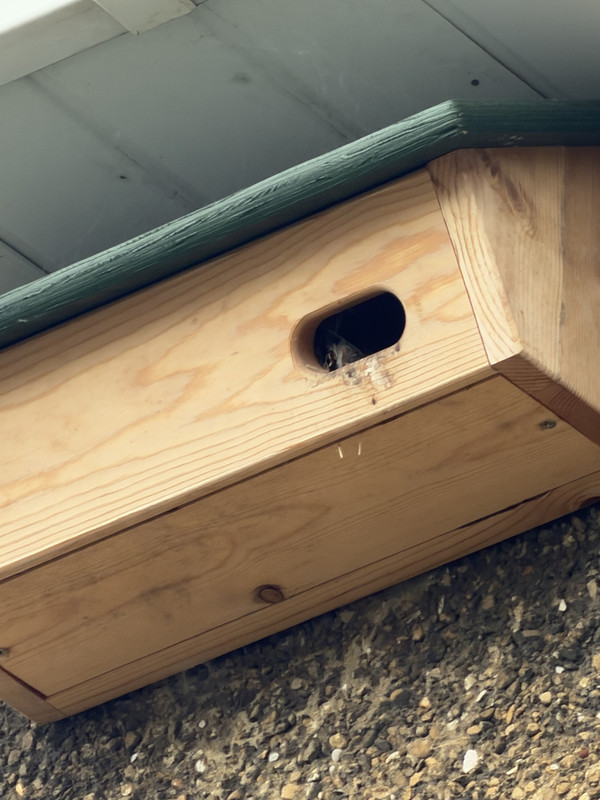
@CountZero - what great news that your bird boxes have worked and the sparrows are doing well.
The advice for feeding birds is not to use seeds (sunflower hearts) though, the other foods you mention are still advised in small quantities.
Sadly our elderly neighbour is still feeding the finches with big seed feeders and he should know better as he's an RSPB member.
Sadly our elderly neighbour is still feeding the finches with big seed feeders and he should know better as he's an RSPB member.
In the grand scheme of things this advice is fairly new and it's going to take a bit more time and reinforcement before it's more widely adopted. It was hard enough persuading my 5yo who loves filling the bird feeders that the kind thing was to leave them empty - I can only imagine how hard it must be to change habits when you've been feeding the birds for decades. I also am not going to say anything to my elderly neighbour with poor mobility for whom feeding and watching the birds in her garden is clearly an important part of her life.
We haven’t been asked to stop all feeding. Only Seeds and nuts. Only during the warmer months and it’s hard for everyone who loves nature and wants to view it.
yes this new (to some) information will take time to filter through. However if we are members of an organisation such as the RSPB, BTO or Natural England, sacrifices are needed for the good of these finches.
I’ve never used mixed seeds in feeders, the birds just ignored them and they’d just go mouldy! However, my front ‘garden’ has been gravelled over as a parking area, and tends to grow quite a lot of weeds, which I have to admit I ignore most of the time, however, I’ve been noticing that the sparrows, who love hanging out in my Pyrocanthus hedge, are scrabbling around in the dried leaves and grass below the hedge, and finding lots of seeds there - I’ve seen the parent birds feeding fledglings seeds from Forget-me-nots, and there’s lots of those around, so, with a mix of wild seeds and suet, the birds are getting a pretty good start in life!
It’s easily seven or eight years since sparrows were regular visitors to my garden, so to have them back is a delight, hearing their cheerful chirping is much nicer than the starlings screeching and squabbling!
It'll take an ages to filter all the way down. How many years have we been told not not feed bread to the ducks and it still happens
The finch feeders ran out a few weeks ago, and I'll admit I'm finding it tough to see the families turn up and see it empty.
I swear they're giving me the eyes. 😢
Spent ten minutes this morning watching the goldfinches eating the knapweed seeds in our front garden.
Plant flowers for the pollinators which have seeds and berries for the birds.

