UPDATE: Reviews section refreshed, redesigned, searchable: Go take a look
BR - you have been shown it many times. Its completely accepted by transport experts but not the roads lobby. Its pointless debating this with you because nothing will get you to accept it.
How about this BR - from the insitute of fiscal studies
"The economic rationale for road pricing is compelling. Road use generates costs which are borne by wider society instead of the motorist"
in a report for the RAC - so a right wing think tank and a road lobby organisation accept it
.
Road users, particularly road hauliers, do not pay the full cost of road use.— The road system should be operated on a commercial basis with higher charges, introduced gradually.
— Road users who have relied on long term subsidy will find change difficult and will need education and political understanding.
Taxes and charges paid by motorists (and road hauliers) do not even cover their direct costs by a large margin and fail to pay environmental costs by a larger margin. The independent Royal Commission Report on Environmental Pollution 1994 outlined the degree by which road users failed to pay their true costs by something like 100% and recommended the fuel escalator. Since 1994 road user charges have actually been reduced due to organised opposition by roads interests. Oil may have increased in costs but this is to the advantage of the oil producers rather than increased funds to the road system.
https://www.publications.parliament.uk/pa/cm200809/cmselect/cmtran/103/103we29.htm
Stop giving cars priority at pedestrian crossings
and cycle path crossings
Well, because if a points failure I'm late by 40 mins in a train which means i miss my connection, which means a return journey and a car to finish the journey.
This is why people don't take the train, it doesn't work
Of course the roads never have accidents, roadworks and traffic jams.
What you should have also said is that roads don't go on strike like train drivers and signalmen. Jimmy Knapp is the single reason I bought a car when I lived in Putney to commute daily.
Re-nationalise trains and buses, increase Council Tax to cover cost of using them by local residents
Don't need to be nationalised. "State ownership" can also be at a more regional or local level.
Local/regional transport union co-owned by the relevant local and county councils or unitary authorities. Bus, train, tram etc. companies provide services within a single ticketing/fare area. Doesn't matter where you buy the ticket from, it's valid on any transport between the start and end fare zone.
TFL, and I imagine manchester are the closest to that (can't speak for Scotland).
That's how it's done in Germany.
Scotland - In Edinburgh and Glasgow the buses are run by council owned arms length companies and have a monopoly in their areas
Looks like we might be able to take scot rail back into state ownership in a similar form now
[i]BR - you have been shown it many times. Its completely accepted by transport experts but not the roads lobby. Its pointless debating this with you because nothing will get you to accept it. [/I]
But again, you are putting all the cost of the roads on the private/business motorist and conveniently forgetting that you need roads for public transport to drive on. So no, not 'proved'.
From your link:
Q1 What taxes and charges are currently paid to government by road users, how much revenue do they raise and how does this compare with national and local government expenditure on the roads network and ancillary services?
A1 Road fuel duty and vehicle excise duty are direct charges on road use. VAT on fuel, MOT charges, "ordinary" fuel oil duty, etc. are part of general taxation and not a road user charge. Parking and congestion charges are debatable but probably are road user charges. Traffic regulation infringement penalties are, in principle, not road user charges but possibly should be commercialised or civilianised given the inordinate cost of policing the road system. The evidence, see Q3, is that true road charges fail to pay the costs of the roads by a very large factor, even excluding environmental costs.
So the only things that vehicles owners pay that this accepts as costs are road fuel and VED - no wonder it comes to its conclusions...
I knew that would be your reaction!
a right wing think tank believe it to be true. The RAC have accepted it, the UK government accept it. Its accepted by almost all transport experts.
These "car use is subsidised" reports all seem a little vague to me.
Income from motorists - 48 billion
Expenditure on road - 8-9 billion
Expenditure on external costs - 43-56 billion?
So all of the subsidised arguments rely on quantifying the "external costs" otherwise motorists would be paying way over the odds. This is where it starts to get tricky.
A graph from Carlton
[img] 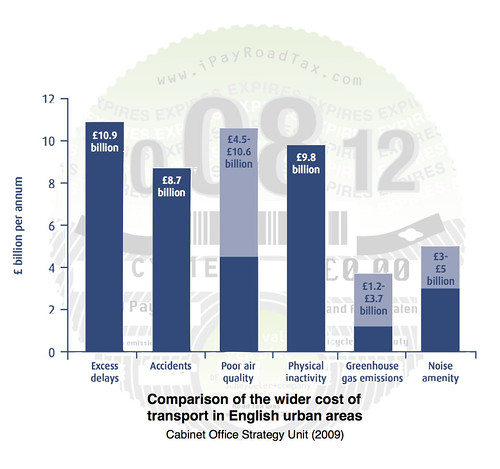 [/img]
What does "excess delays" mean? A cost associated with being late due to traffic, but a delay compared to what? Driving when there is no traffic? Scraping the all private motor vehicle use and replacing it with something else? How do you calculate a cost for noise? Is that the cost of sound insualation or ear plugs for everyone?
It's the same in this report...
https://www.publications.parliament.uk/pa/cm200809/cmselect/cmtran/103/103.pdf
Cost Type Weighted Average (p/km) in 2010
Congestion 13.1
Infrastructure 0.1
Accident 1.5
Local Air Quality 0.4
Noise 0.1
Greenhouse gases 0.3
Indirect tax (fuel duty and VAT on fuel) " 3.6
Total 11.9
By far the biggest cost is congestion, but theres almost no information on how they calculate that driving 1 mile causes 13p of costs in terms of "congestion" (this is separate from pollution or enviromental damage etc.).
I suspect they just multiply the time by the average wage or something??
These external costs seem absolutely crucial to the arguments but [b]quantifying[/b] their effects seems to be glossed over completely.
... and I suspect the reason "congestion" is shown to be so expensive is that these reports were produced while trying to justify road pricing, aka congestion charging.
TJ - wrong again. Unless you count the few SPT run routes (the sole users of electric buses in Glasgow) that First or McGills have slung because the subsidy wasn't enough. Again, Edinburgh is the exception, not the rule.
Squirrelking? Sorry I though SPT ran all the urban busses in Glasgow as well as the commuter trains. I just checked and you are right. I hadn't realised as the buses are all still painted as if they belong to the SPT are they not? Not been on a bus in glasgow for a long time - just seeing them on the street.
Ban the school run and change public perceptions about walking so they don't view walking a mile or 2 each way as some alien concept.
No, the only SPT services are the ones that follow the subway above ground and out to the unprofitable schemes. The rest are mostly First and McGills with a couple of wee operators thrown in the mix. Glasgow buses are a model of everything wrong with deregulation.
As for suburban rail, SPT got out that when they got a hoofing for essentially embezzling public funds, remember the "fact finding" trips to Manchester that just coincidentally fell over the same dates as the Rangers v Man U games? SPT do nothing more than a minibus service and operating the Subway now. Toothless and useless.
Make car doors only open 10 inches wide. That would sort it overnight
Ta squirrelking
https://twitter.com/CPRE/status/843869768553656320
The video on that tweet above is interesting. Basically, building roads causes more traffic and doesn't create the economic benefits claimed.
Watched [url= http://www.bikes-vs-cars.com/ ]Bikes vs Cars[/url] last night. Some interesting stuff in there, not especially in-depth, but shows some of what we're up against. I was supprised to find out that the system used in the EU for classifying how green a car is, means that a [url= http://www.bbc.co.uk/news/world-europe-32313997 ]tank is considered more green than a Fiat 500[/url]. Wasn't surprised to discover this is due to [url= http://europe.autonews.com/article/20131015/ANE/310159977/bmw-family-donation-to-merkels-party-starts-lobbying-row ]lobbying by the car industry[/url].

