peterfile - Memberstumpy, my mistake...I was reading figures for the auto.
I checked mine this morning and it's 2,000 rpm at 70mph (so not too far off though!), and engine noise is barely perceptible at that speed unless accelerating.
It's the B8 2.0 TFSI engine, which seems to be highly rated (although I know nothing about engines other than info I can find online!).
Ah. Erm, the thread seemed to be going in the direction of comparing the economy of diesels against small three cylinder petrols like the 1 litre Ford Ecoboost (well, it was at the start of the thread 😀 ).
It was that kind of engine that I was basing my comments of 'high revving, fizzy petrol engine' on.....not a 2 litre, which I wouldn't call a small engine.
One of the reasons I got rid of my old car - ignoring the almost terminal rust - was the fact that I couldn't get any more than about 40mpg out of it.
At the time I was doing 100 miles/day commute, so swapping to a diesel that was vastly quicker and got me about 40% more mpg (from 40 up to 55mpg, easily) was a no brainer.
When I got the car, petrol and diesel was about the same cost (petrol might have been about 2p/litre more than diesel) and the petrol was costing me about £51/week in fuel compared to £37 in the diesel (quick calc assuming fuel was about £0.90/litre when I bought the car, which I think it was). So, a £14/week saving in fuel costs.
Unfortunately, a car for me has become pretty much an appliance rather than something to particularly enjoy.
molgrips - Member[i]They are good engines but let me know how you get on when you rev it to 8000rpm[/i]
Why would he want to do that?
I imagine that comment came from this previous post....
peterfile - MemberMy petrol revs to 8k and sits at 1,800 at 70mph. Hardly fizzing away and not a big engine.
Oh I see.
Stumpy, the context for quoting 8k was because you referred to "high revving, fizzy petrol engine".
I don't really know what my car will rev to (and I'm unlikely to find out), but the dash shows a number 8 as the high point, so I figured that was a good guess.
[img]  [/img]
No way that'll rev to 8k anymore than it'll do 180mph.
You'll get to 7000, maybe 7200 before the limiter comes it, by which you'll be well out of the power band anyway.
18 months now with the Lodgy TCE. The fuel used is the same on the trip computer and filling station pumps but the trip distance over reads by about 3%. 5,8l/100km average over that time (so a real 6l/100) with a mix of town and mountain roads. I generally get better than 5.5l/100, Madame uses a little more and since junior has started driving the consumption has reached 6.
As Molgrips states the CO2 figures for diesel are misleading as they only include CO2 at the point of burning rather than the overall carbon footprint. There is also the supply and demand balance to consider; there is not enough demand for petrol in Europe so refiners export to distant land such as India and the US. Sending coals to Newcastle because there are too many diesel cars in Europe and not enough petrol ones. The tax system and the way CO2 emissions are calculated both need a rethink if the price you pay for fuel is to reflect the overall impact environmental of burning it. IMO diesel is too cheap.
You'll get to 7000, maybe 7200 before the limiter comes it, by which you'll be well out of the power band anyway.
I knew there was an electronic limit on the speed, didn't realise there was also one on the rpm. Maybe I'll try and find it on first gear coming out of the car park tonight 🙂
Also servicing on my 2.0CR Tdi seat is exactly the same cost as it is on the 2.0TFSI version which is a cheek really - those spark plugs can't be cheap.
They cost the same to buy new +/- 5% but that has more to do with the spec.
The Petrol ones are cheaper second-hand, but according to the dealer it's because no one wants a 25mpg saloon or estate now unless it's very sporty.
So I still can't see why you need to do so many miles to save any money.
peterfile - MemberYou'll get to 7000, maybe 7200 before the limiter comes it, by which you'll be well out of the power band anyway.
I knew there was an electronic limit on the speed, didn't realise there was also one on the rpm. Maybe I'll try and find it on first gear coming out of the car park tonight
Most cars since the early 80's have had some sort of rev limiter - mostly to stop you making the engine explode - something to do with 'overlapping' or something - anyway, even without it at some point or other they simply can't keep the air / fuel coming in fast enough to rev any higher and they stop naturally.
The Petrol ones are cheaper second-hand, but according to the dealer it's because no one wants a 25mpg saloon or estate now unless it's very sporty.So I still can't see why you need to do so many miles to save any money.
My car does about 10mpg less (over a tank) than the equivalent diesel and was £1,200 cheaper to buy (at 3 years old).
25mpg? I can barely get to that driving about town.
I have the same engine in my car. 6700rpm is the limit. The red bit on the rev counter is just decoration
It doesn't bounce of the limiter like something like a Civic Type R would. It just sits there not revving any further. Pointless to take it passed 6000 rpm anyway, peak torque is around 2000 and peak power from 4300-6000rpm.
Not sure it needs a speed limiter though (other than drag squaring with speed that is)
I bought a Skoda Fabia estate new two years ago. its a 1.6 diesel 105bhp.
I chose the diesel over the petrol, but in hindsight I would choose the petrol version now.
The only factor governing my choice was I prefer the diesel torque. Financially ( for me) its not worth it.
richmtbNot sure it needs a speed limiter though (other than drag squaring with speed that is)
Tyres probably.
Valve bounce (the valve spring not strong enough to keep the valve following the cam) and hydraulic pump up (on cars with hydraulic valve followers) used to be what limited how high engines would rev without a limiter.
When "tuning" engines one usually uses stronger valve springs and suitable followers to raise the rev limit. Even with lots of lightening, balancing and stress relief the higher rev limit soon uses up the fatigue life of other engine components such as the valves, pistons, rods and crank. My competition engines were base on stock engines with a red line at just over 6000rpm. They would run for years at that speed but using 7000rpm needed a rebuild each season (if they lasted that long). Engine life at 7500rpm was a few minutes and it was only ever worth risking if backing off the throttle was going to result in going off the road. I never used a rev limiter and 7000rpm was as familiar to my ears as the e-string of my guitar.
Valve bounce (the valve spring not strong enough to keep the valve following the cam) and hydraulic pump up (on cars with hydraulic valve followers) used to be what limited how high engines would rev without a limiter.
On a conventional road engine piston speed becomes is as much of a limiting factor as valve bounce. Honda VTEC's typically had redlines above 7500 rpm with conventional valves
You need a short stroke engine to lower piston speed (like a motorbike) or a short stroke engine and pnuematic valves (like an F1 car) to get serious RPM
peterfile - MemberThe Petrol ones are cheaper second-hand, but according to the dealer it's because no one wants a 25mpg saloon or estate now unless it's very sporty.
So I still can't see why you need to do so many miles to save any money.
My car does about 10mpg less (over a tank) than the equivalent diesel and was £1,200 cheaper to buy (at 3 years old).
25mpg? I can barely get to that driving about town.
What are you getting? it's a 2.0 turbo A4 no?
I'm getting 50mpg (when roofrackless) from my Seat Exeo - I only spotted one Petrol version when I was looking which had the same engine as your A4 - I was told 25mpg was the norm for 'mixed driving' - my Exeo will get about 40 doing the same.
What are you getting? it's a 2.0 turbo A4 no?I'm getting 50mpg (when roofrackless) from my Seat Exeo - I only spotted one Petrol version when I was looking which had the same engine as your A4 - I was told 25mpg was the norm for 'mixed driving' - my Exeo will get about 40 doing the same.
My mates 300bhp V6 [i]S4[/i] Avant has an average of 25mpg.
Mine is the A4 B8 2.0 TFSI in manual flavour. It seems to be an pretty economical engine considering the moderate power.
(Honest John's real mpg and forum searches reveal that 35mpg is overall average for most, with most hitting high 30's/40 on a run.)
In the 2,000 miles since I bought the car I've been keeping brim to brim calcs and have hit 35mpg (but I've had a few more longer journeys in there over xmas period so will probably dip a bit now I'm back at work)
From my earlier post...
Mol, my 16 mile commute is a few miles of residential and city driving, with the rest being motorway driving at 40-60 mph, generally in medium traffic. I get about 38-40 mpg.Sitting at 75 on a long motorway journey will return about 40 mpg.
30 mins of congested city centre driving doesn't seem to dip below 26/27 mpg (on the DIS, but it isn't too far off my brim to brim calcs though).
What is most interesting (for me anyway) is that the mpg doesn't seem to take too much of a hit when you're on something a bit more twisty or are up and down the gears. Up the A82 for example...100 miles of a mixture of city, 30mph twisty stuff along the loch and then loads of quick and hilly A road with a few overtakes...making no attempt whatsoever to drive economically...I seem to get about 36mpg.
Honda VTEC's typically had redlines above 7500 rpm with conventional valves
As I understand it, the reason these can rev higher is that the valve timing switches to more valve overlap which is less efficient in normal driving, but at high revs when there's a lot of air flowing through it allows more air to flow more smoothly. Jolly clever.
Clever and now quite common, even the Dacia has variable valve timing as do all the Renaults and Merecedes that use the same engine.
Yeah Toyotas do, however they don't seem to do it the same as Honda, they don't rev to 8krpm.
EDIT from wiki:
"[Honda's VTEC] is distinctly different from standard VVT (variable valve timing) which advances the valve timing only and does not change the camshaft profile or valve lift in any way."
So VTEC has two different sets of cams, whereas VVT only adjusts the position of the camshaft itself.
@peterfile that's better than I expected, if the BIK isn't too murderous I'd consider petrol next time - although I've got my eye on a 3.0Tdi Quattro.
Your mate with an S4 is doing well, mate of mine has got a B7 RS4, it might have got better now it's not so new to him, but I know it was in the low teens for a long time ha ha.
P-Jay, I think the older V8 S4s were horrific on fuel (he had one too), but the B8 S4 is significantly more frugal (with two fewer cylinders too I suppose).
I've never driven his car, but it seems to me to be a great compromise between practicality, cost and sporting ability. His running costs are much, much smaller than an RS4...but still high enough to put me off for now. I very nearly bought an S4 Avant (mrs PF works for Audi), but just couldn't get the numbers to add up over 3/4 years.
Yep very clever, especially given how long ago they developed the system.
There are other cleverer systems though. BMW valvetronic allows constant variation of the intake valves lift.
Lexus have a V8 that can switch between Atkinson and Otto cycles depending on engine speed
If you fancy properly geeking out on the subject there is a good description of various VVT schemes [url= http://www.autozine.org/technical_school/engine/vvt_5.html ]here[/url]
There are other cleverer systems though.
Fiat multiair
Lexus have a V8 that can switch between Atkinson and Otto cycles depending on engine speed
Damn, another idea I came up with stolen by a manufacturer...
Koenigsegg trumps all - no camshaft to get in the way. Been working for years on marine diesels and I'd imagine it would scale down very easily with direct injection and hydraulic/electronic operated valves.
Choose profile, point, shoot.
peterfile - Member
P-Jay, I think the older V8 S4s were horrific on fuel (he had one too), but the B8 S4 is significantly more frugal (with two fewer cylinders too I suppose).I've never driven his car, but it seems to me to be a great compromise between practicality, cost and sporting ability. His running costs are much, much smaller than an RS4...but still high enough to put me off for now. I very nearly bought an S4 Avant (mrs PF works for Audi), but just couldn't get the numbers to add up over 3/4 years.
The manual B6/7 S4 was worse than the auto...at a motorway cruise they would rev pretty highly for a lazy V8.
RS running costs are somewhat scary. My step uncle had a B7 RS4 that never did more than about 17mpg...the RS6 that came after that was even worse. That had mental running costs.
I thnk well look at an S4 next now that BMW have pretty much killed their 6 cylinder engines.
What are you getting? it's a 2.0 turbo A4 no?I'm getting 50mpg (when roofrackless) from my Seat Exeo - I only spotted one Petrol version when I was looking which had the same engine as your A4 - I was told 25mpg was the norm for 'mixed driving' - my Exeo will get about 40 doing the same.
PJay
I took a snapshot of my DIS when I arrived at work this morning. I'm still trying to work out exactly how far out the DIS is, but from the calcs I have it seems to be less than 10%.
I reckon this is pretty good for a fairly stop start commute in winter, with winter tyres on a relatively big car (avant) with more than 200bhp.
I've never had a diesel, but would be interesting to see what sort of mpg a similarly sized diesel would get to on a 15 mile commute.
[img] 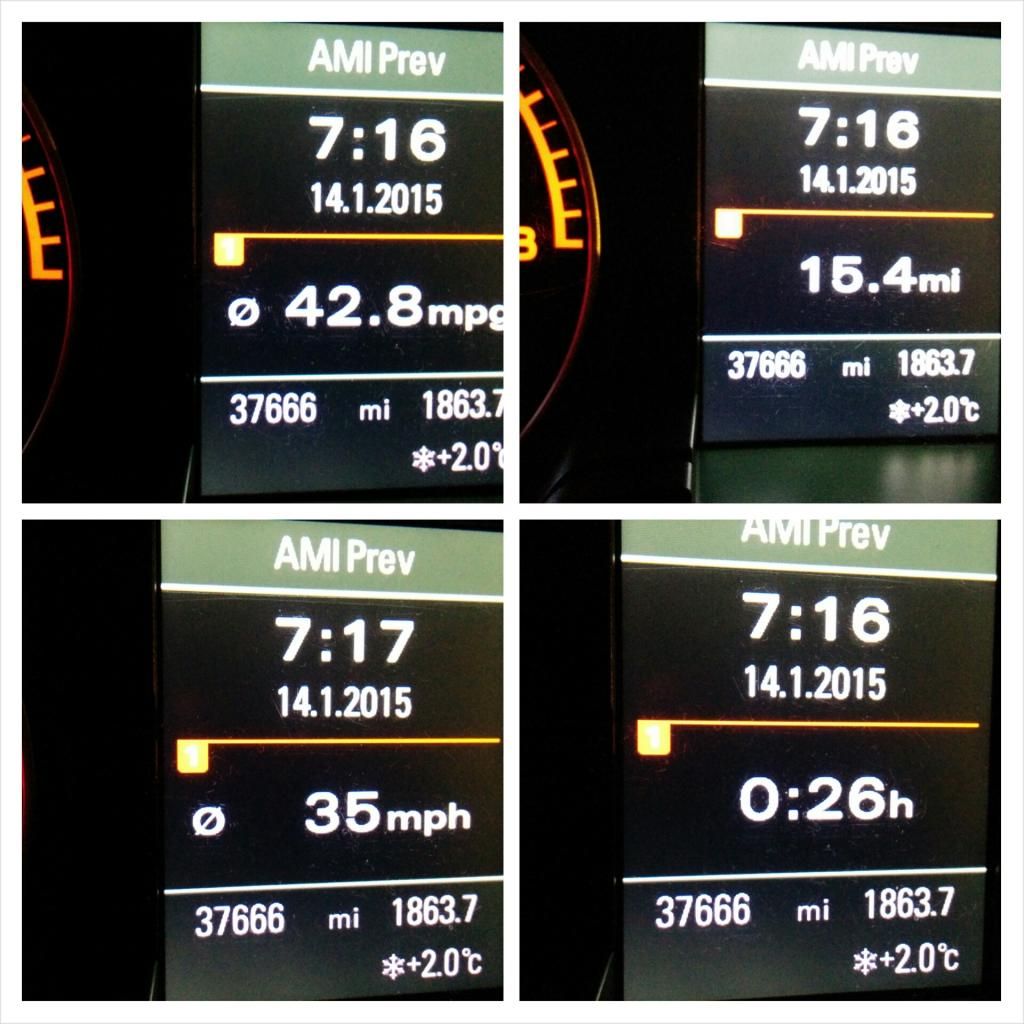 [/img]
That is pretty good for a big petrol car.

