I can't get to work without a car.
I moved house so I would be close enough to cycle.
2 things:
1.
[i]fuel taxes are not high enough.[/i]
agreed entirely. Petrol should be at least £2 a litre IMO, but no politician is going to line himself up for a lynching from the numpties for suggesting this.
2)[i]'Bollocks' ............ if you don't mind me saying.
I can't get to work without a car.
Or do you think having a job is a 'luxury'[/i]
I'd suggest you could probably get a job which you could get to without a car. Presumably you had some kind of choice in which job to have?
Hooray ! Stoner has posted a 'pretty graph' !
Mind you, it took you a while mate .................. what kept you ? 😯
Ernie - IIRC you are a self employed carpenter. Yes people in your situation need a car to work and once again I am too simplistic. However the vast majority of car use is luxury - commuting to work is a luxury, driving to the shops is a luxury. Etc etc.
Driving in the course of your work often is a luxury but not always.
The poor have lower levels of car ownership than the rich.
If despite all the oil they have, they can introduce rationing, then so can we.
Of course not a communist proposal. A security one.
I moved house so I would be close enough to cycle.
*chuckles at the thought of cycling to work and moving house every time I start on a new site*
.
EDIT :
btw 'enjoying life' by indulging in reasonable pursuits [i]is not[/i] a 'luxury' ........ in my not-so humble opinion.
Er where's the key on that graph?
I think this one is just as useful
[img] 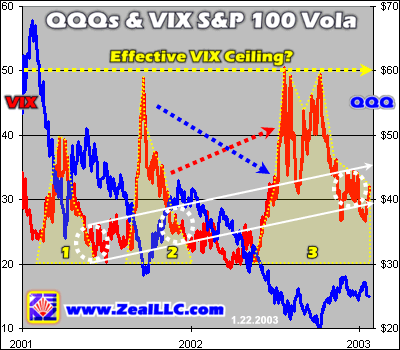 [/img]
😛
Of course not a communist proposal. A security one
Nope. Not a security issue ..... more a question of petrol being a precious commodity which they don't have enough of.
*chuckles at the thought of cycling to work and moving house every time I start on a new site*
You could become a nomad and live in a tent!
You see, there's always choices difficult ones maybe, but choices nonetheless.
To really "need" something like a car is really incredibly rare.
here's a better graph:
page 2
Original income and final income by income quintile group, 2007/08
taht graph shows total household income [i]after[/i] redistributions as a result of direct and indirect taxtion [i]and[/i] benefits and tax credits etc.
However (and here, ransos I shall apologise as I was too quick to criticise your point) in terms of JUST taxtion (i.e. excluding the effects of tax credits and benefits) then the proportionate tax rate is NOT very redistributive OVERALL
[i]HERE is a disturbing fact you won’t have read anywhere else: the poorest families in Britain today pay a greater proportion of their income in tax than the wealthiest. Such a claim may sound crazy but here are the figures: the bottom fifth of earners pay 38.7 of their gross income in total tax, the next fifth 32.7 per cent, then 34.6 per cent, 35.4 per cent, falling to 34.9 per cent for the top fifth of higher-earning households. For those of you about to email in disbelief – after all, we have just had 12 years of Labour government – feel free to check out my sources. All these explosive figures are contained in The Effects of Taxes and Benefits on Household Income, 2007/08, a 38-page report by Andrew Barnard, published online yesterday by the Office for National Statistics.[/i]
SOurce: http://www.cityam.com/news-and-analysis/Allister-Heath/v3wex9416u.html
but, it is the indirect taxation which we've already agreed is regressive that's causing the most problems, and this mainly stems from the costs of fuel duty, ostensibly for environmental reasons, which is difficult for the left to have worked around yet.
[i]... [the] anti-poor bias is entirely due to indirect taxation – value added tax and duties on alcohol and tobacco [and fuel duty] – which hit those on lower incomes much more severely. The bottom fifth pay 27.9 per cent of their gross income in indirect tax, the next fifth 18.6 per cent, then 15.9 per cent, 13.7 per cent and just 10.0 per cent for the top fifth.[/i]
Stoner, I was looking up the same information! Read page 41 of this link:
Interestingly, the poorest quintile spend less on fuel duties than the 2, 3 & 4th quintiles, which supports my contention that they drive less. However, it is a higher proportion of their disposable income.
"especially those on lower incomes do not own a car."
"which supports my contention that they drive less."
but would they if they could ? I'm betting "yes"
but would they if they could ? I'm betting "yes"
If I earned more, I'd have a nicer bike and and a bigger house.
[i]If I earned more, I'd have a nicer bike and and a bigger house.
[/i]
when I earned more, I got a smaller house and work less. I also got a nicer bike, natch 😉
Given the [b]huge distances that food is routinely transported [/b]before it gets to the shelves, are you really arguing that fuel prices are a significant factor in the affordability of food?
..and how is food "routinely transported" over those "huge distances"? By pedal power or by big lorries with a fuel consumtion of around 8 mpg?
..and how is food "routinely transported" over those "huge distances"? By pedal power or by big lorries with a fuel consumtion of around 8 mpg?
Err, that's my point - food is transported long distances only because transport costs aren't significant enough to outweigh other factors. 2p on fuel duty is not going to make food less affordable.
I can't provide the data ATM but I recall that the average transport cost for items in Europe is less than 1% of their retail price
This obviously encompasses everything from a locally grown cabbage to a bike from China
I apologise in advance, but Im bored.
assuming a container is approximately 6m x 2.5m x 2.5m I reckon you can fit about 130 On-One 456 frames at £125 each into a lorry, or about £16k worth.
In the same lorry (but not at the same time, obviously), I reckon you could probably fit about 9,000 cabbages at £1 a cabbage.
for an average trip of 300 miles at 8mpg and 110p per litre of diesel then the fuel cost represents 1.15% and 2.10% of the RRP value of the loads, frames & cabbages, respectively.
You'll all sleep better for knowing that.
Well done Stoner 😉
There are of course some economies of scale to be made too
[img]  [/img]