UPDATE: CLASSIFIEDS section refreshed, redesigned, searchable: Go take a look
[img]  [/img]
My mates and I keep arguing about this one. I'm not particularly sure to be honest. Got a few very different answers.
No conveyor belts involved.
how depressing i have no idea how to do it. 🙁
About 15.7 kilos?
how?
My guess is 0 😀
5.5kg?
27.43 Newtons.
42. Same as the meaning of life, not 42kg.
Logic (please rip appart as its 20 years since I had to work owt like this out!)
Block B pushes in the direction opposite F by 25 kilos.
Block A has a force of 9.3 kilos in the direction of F.
Reason for this is that 90 degrees would be 100% of mass so 20 degrees is 2/9ths of mass (is this right).
F = difference of 25kg less the 9.3kg from block A slope.
Probably wrong.
92
Is slope any form of conveyor belt? This would naturally change the calculations.
Can we at least get the units of force correct.
kg = mass.
Is my answer similar to any of your mates?
252.76 N
CHB is the only one to show workings so marks awarded even if it's wrong.
I'm with amt on this one.
So if I lean a book against the left hand side of my iMac - there is a force on the right hand side??? Puzzled.
I'd imagine you're looking at a cosine of 20 degrees not 2/9ths...?
i think 340.5N
106.4N
460.44N by B
386.77N by A
73.67N
[img] 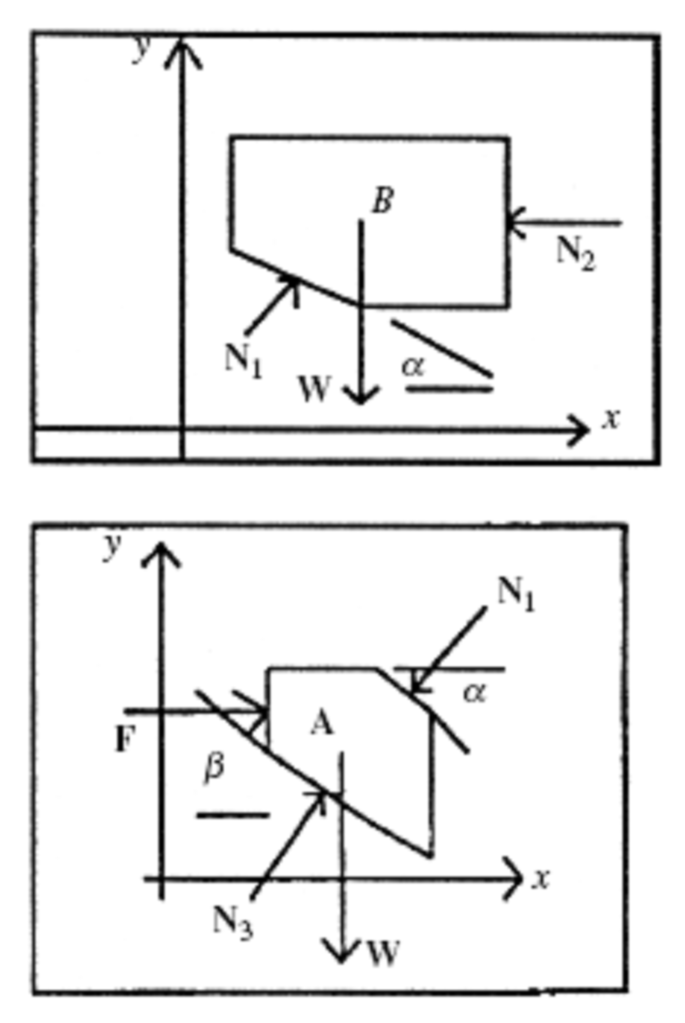 [/img]
[img] 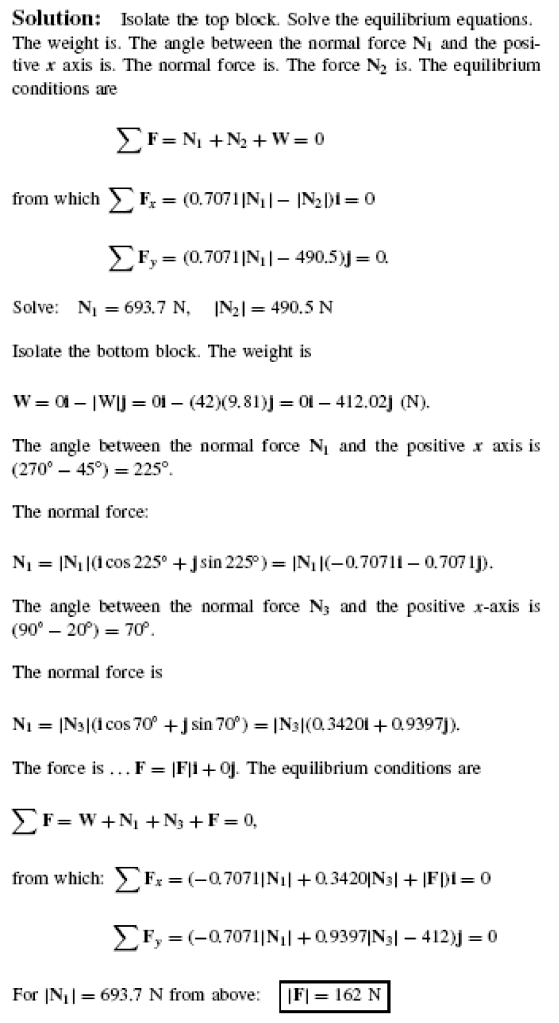 [/img]
😀
I new there was a 2 in the answer.
Ah, wrong quadrant
[url=  ]No. There is an Elephant in the way.[/url]
<engineer>Of course the question says the surfaces are smooth, it doesn't say they're zero friction (such surfaces don't exist). As it doesn't give the coefficient of friction the problem is insoluble</engineer>
<mathematician>We'll assume smooth means zero friction. Correct answer, IanMunro (surprised it took so long and so many attempts), though [s]you[/s] your textbook overcomplicates things by solving in the normal axes and using simultaneous equations - if you turn your reference frames you can do without.
Borrowing your diagrams:
Resolving in the vertical direction for the top block (which removes N2 from the equation):
N1*cos45 = 50g
N1 = 70.71g
Resolving parallel to the inclined plane for the bottom block (which removes N3 from the equation):
F*cos20 = N1*sin25 - 42g*sin20
F = (70.71g*0.4226 - 42g*0.3420) / 0.9397
F = 16.51g = 162N
</mathematician>
<engineer> [b]So about 15.7kg [/b]</engineer>
So about 15.7kg
<QC>I suppose at least you're in the right order of magnitude, though you're a good 5% out. That's not what we call engineering round here.</QC>
My brains have just tried to leak out of my ears trying to make head or tail of that lot.
As Ian Dury once so eloquently put it 'there ain't 'alf some clever buggers'
<bike mechanic> my nuber 3 hammer,an M6 bolt and some blue threadlock <bike mechanic>
10 years ago I would have understood that (and maybe even worked it out) Quite worrying how much I've forgotton...
If only we knew of someone qualified to answer such a puzzle? Maybe with membership of an organisation dedicated to dealing with the intricate nature of such mysteries...?
[img]  [/img]
<field engineer>[b] Hmmm 15.7kg eh? Well lets add 20% to be sure...erm thats...oh bugger, lets call it 19kg.[/b]</field engineer>
If you're a proper physicists, mathematician or Engineer, you'd have let a computer do all that maths for you..
Sitting there doing derivations is less cost effective than letting a computer do it.
anto164 - Member
If you're a proper physicists, mathematician or Engineer, you'd have let a computer do all that maths for you..
Why bother for something like this?
Sitting there doing derivations is less cost effective than letting a computer do it.
There is no need to use any calculus to solve this problem.
Zero, second word of the question.
Zero, second word of the question.
What?
Resolving in the vertical direction for the top block (which removes N2 from the equation):
N1*cos45 = 50g
N1 = 70.71gResolving parallel to the inclined plane for the bottom block (which removes N3 from the equation):
F*cos20 = N1*sin25 - 42g*sin20
F = (70.71g*0.4226 - 42g*0.3420) / 0.9397
F = 16.51g = 162N
This looks pretty good, cheers.
You're confusing mass with weight. from the information given, the objects have no weight, only mass.
Sigh. I think it's fairly safe to assume you're on the surface of the earth, and not in space. But yes I'm sure everyone thinks you're very clever.
Why? In that case the question is worded incorrectly and should say 'weighs' not 'has a mass of'
Why? In that case the question is worded incorrectly and should say 'weighs' not 'has a mass of'
But yes I'm sure everyone thinks you're very clever.
I'm taking this back lol.
[img]  [/img]
I cba to do this. It's not hard, there's just a lot of it. Not the same thing!
overcomplication factor
It says the block is smooth
are the surfaces frictionless
You're confusing mass with weight. from the information given, the objects have no weight, only mass.
Who, me? You'll note my solution uses 'g' until the last line, so substitute whatever value for 'g' you like there (it can even be in zero gravity if you like).
In that case the question is worded incorrectly and should say 'weighs' not 'has a mass of'
Not really. The intrinsic property is mass. You only have to consider weight if you want to know the force (as in this case you do). From an engineering perspective it's perfectly normal to define stuff in terms of mass in the earth's gravitational field and expect to know force.
How about an easier one for you:
A block of mass 52.3kg sits on a flat surface perpendicular to the earth's gravitational field. What force does the block exert on the surface?

