UPDATE: Reviews section refreshed, redesigned, searchable: Go take a look
Cool, criticise the folks who’ve named it that then. I’m just using the convention.
Who are the folks who call nuclear deterrence "weapon-less defense?" Saying that a heavily armed nuclear power like India "weapon-less" is just laughable. If India is "weapon-less", then so is the U.K.
Normally you'd say a country doesn't have a first strike capability if it doesn't have sufficently accurate nukes to take out the oppositions (or mostly take out) strategic forces. The point being that if you do you would in theory not be at risk of retaliation. If you only had missiles that could get within say a mile of your target then all you can do is nuke cities which is a second strike capability.
Are you just muttering to yourself now?
I find announcing this to be a bit strange in a foreboding sort of way.
So are we going to embark on a new cold war 😕 A new build up of nuclear armaments.
Normally you’d say a country doesn’t have a first strike capability if it doesn’t have sufficently accurate nukes to take out the oppositions (or mostly take out) strategic forces.
Most nuclear armed countries have submarine launched weapons. Nobody really has a first-strike capability in the sense of having a very high degree of confidence that they can take out all of an enemy's nukes. Nukes are really only useful as a second-strike deterrent.
The trouble with most of this nuclear weapon stuff is that it's posturing from the 70s and 80s
Threats today are often either conventional or hybrid in nature. Do the Houthis care if the US parks a nuclear-equipped task force off the coast of Yemen?
Did the nuclear deterrent stop damage to undersea infrastructure?
Computer hackers, etc, etc
In no particular order:
I may be in a minority on here but I see having a working, and just as importantly seen to be working, nuclear capability as extremely important, and nothing which has happened since 2014 has changed my mind.
In either a nuclear scenario or ICBMs laden with nerve agents (for example) then absolutely +1000
Failures occur, that’s why trials occur, for a war type of scenario they’d just spin up another one and fire it.
I'd take a minimum deterrent of (max) 260 warheads that are properly maintained and are likely to work over 6000 that aren't. Only N.Korea has tested its nuclear weapons during this century.
Various things can fail over time including explosives, electronics, and the radioactive core. The US has around 3700 warheads and employs 27500 people in "science-based" maintenance, e.g. the known chemistry and use-by date of the explosive ( https://en.wikipedia.org/wiki/Stockpile_stewardship ) The UK will spend £3bn on this in 2023/24, how much will Russia spend I wonder?
Also how has technology affected the security of the submarines – can you still hide a missile boat and if so for how much longer?
Who knows? We're building some new ones to replace the Vanguard-class boats that should be ready in 10 years with a new missile compartment design. We also started a new warhead programme in 2020. https://commonslibrary.parliament.uk/research-briefings/cbp-9077/
snip...times 4 subs
They won't all be available. A floppy Trident landing in the sea off Scotland from a boat under maintenance would be frowned upon 🙂
But I think I am right in saying that is OUR entire nuclear deterent? We have no other way to launch them? So IF there is a fundamental flaw we have no actual deterant; therefore we would be better doing something useful with the money.
Yes and no. France has sea and air-launched weapons and NATO has US weapons based around Europe
Info graphic here... 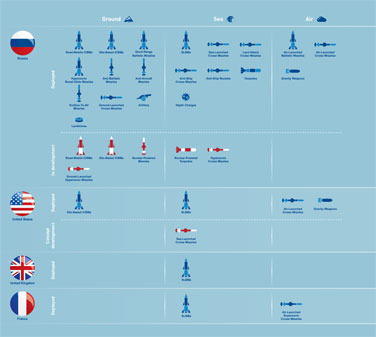
The term "first-strike" is probably a bit outdated now. Originally it was intended to destroy your enemies' nukes before they could be launched, but surveillance is so much better now and a counter-attack would be launched prior to that happening. You can probably take any of these terms at face-value because the threat of the counter-attack is as potent as the threat of an overwhelming first-strike
The trouble with most of this nuclear weapon stuff is that it’s posturing from the 70s and 80s
Threats today are often either conventional or hybrid in nature.
Nuclear weapons are useful to deter other nuclear-armed countries from attacking. They are useless in a conventional conflict.
So are we going to embark on a new cold war 😕 A new build up of nuclear armaments.
I think that the conventional/hybrid threat rather than nuclear is greater, but a cold war is looking likely. Russia says that its manufacturing is on a war-footing and NATO countries are pumping money into their defence and industries.
It would have been helpful if Russia hadn't invaded Ukraine, hadn't threatened nukes and hadn't threatened to invade NATO nations. Nobody seems to care as much about the conventional wars that are happening around the globe, despite the huge loss of life during the last 80 years
Nuclear weapons are useful to deter other nuclear-armed countries from attacking. They are useless in a conventional conflict.
Yes, as long as it remains conventional. Nukes, Biological and Chemical up the ante; Russia has announced using chemical weapons (contravening the Chemical Weapons Convention) in Ukraine, for example https://www.rusi.org/explore-our-research/publications/commentary/have-chemical-weapons-been-used-ukraine
Nuclear weapons are useful to deter other nuclear-armed countries from attacking. They are useless in a conventional conflict.
Someone should have told the Japanese.
Nukes are very useful for terrorizing civilian populations, but Americans who witnessed what had happened to Hiroshima and Nagasaki were utterly horrified by what they saw. As well as causing horrific injuries, nukes mean that your own soldiers will be exposed to fallout and will have to fight on contaminated ground. The U.S. contemplated using nukes in the Korean war, but didn't. Same with Vietnam. Russia keeps making threats about using nukes in Ukraine, but hasn't. They just aren't very useful except as doomsday weapons.
The deterrence ultimately comes down to being an insurance policy. And whilst right now you could argue there's been little need for it in the last 20 years, it was needed in the cold war and it would take 20+ years to regain the deterrent if it was scrapped. And we have no idea what the world will look like in the future so it goes back to it being an insurance policy.
Also one point on the cost is that the huge headline figures are before a substantial part of the is reclaimed in taxation. UK nuclear and marine engineering jobs are well paid and support industries in alot of cities, with relatively little of the total cost going abroad. Therefore you have UK companies paying corporation tax, income tax on well paid workers + the VAT and income tax generated by the money they spend in the local economy. So the net spend is actually probably 30-40% less than the headline figure.
And places like Barrow, Glasgow (Faslane), Plymouth (Devonport), Bristol (DE&S), Reading (AWE), would take a substantial blow if all those well paid jobs disappeared.
It's not a reason for it to exist in itself, but its worth noting the economic impact scrapping the deterrent would have. Long term you could probably argue that money can be spent on incentives to grow other industries, but the short term pain would be immense.

