UPDATE: CLASSIFIEDS section refreshed, redesigned, searchable: Go take a look
We're going to knock through from our living room into the room behind it (known as the Non-Room). This will give us an open plan dining area.
The living room, being at the back of the house, is very quiet. The Non-Room adjoins the integral garage and also has a window at the side (frosted for privacy as the next door house is pretty close). The Non-Room has a door into the garage, as well as into the hall.
The Non-Room (1) is noticeably cooler than the Living Room and (2) is noisier, with sound coming from the garage and also the window at the side.
If we knock through, I want to reduce both the sound entry and also heat loss.
The window at the side is already double glazed, but not that new. What would work best there?
I figured I could insulate the wall adjoining the garage (on the garage side) - what is the best way to achieve this? Oh, and one factor: garage has an asbestos ceiling, so I can't touch that.
Pic of layout below.
Cheers
[img]  [/img]
it might just be that the non-room is cold because no-one ever uses it? You could put some insulated panels on the inner wall of the garage (between the garage and the non-room) and that'd help with both heat and sound
celotex all over the garage side of the non-room back wall (you can just use grab adhesive to hold it on). Outside door and seals around the non-room to garage door.
secondary glazing to side window.
Tell me more about insulated panels?
I'm loath to lose any interior space of the non-room - it's no more than 7ft wide (i.e. between Living Room and Garage walls).
EDIT: just seen wwaswas' reply - can the celotex go straight against the wall, or would it be better within a separate stud wall arrangement to create an air gap?
[url= http://www.toolstation.com/shop/p10635 ]http://www.toolstation.com/shop/p10635[/url]
this stuff - good insulation for volume, you can just stick it to garage wall as long as you seal around it or do a better job and put battens up/plasterboard over it. it'll be in garage so no internal space lost.
you need to find out what's up stairs from the non room dividing wall - you don't want the upstairs wall coming through the ceiling...
[edit] no air gap needed, best to minimise air circulation against that garage wall, really.
wwwaswas - cheers. Makes sense. Will look into it further.
Will be knocking through properly with steel beam - no wall upstairs (bungalow), but definitely a lot of ceiling joists..!
plasterboarding over the celotex would help sound insulation from garage too if you went for that.
plasterboarding would be useful. Trouble is, I've got my bikes hanging off that wall, so will need to rethink bike storage strategy (hence considering a stud wall - figured I could hang the bikes from the battening).
put studs against garage/small room wall, insulate between them and then plasterboard over the top. attach bike hangers to battens through plasterboard.
put a long horizontal batton where you want to hand from so its flush with the insulation board, plasterboard over the top, then try to remember where the batton is
What is on top? going to insulate the roof? What about the small external wall?
this is the easy bit - what about that wall you are going to knock down?
@wwaswas - you've confirmed what I'd imagined isn't crazy. Or we're both crazy...
@llama - existing room upstairs. I'm not touching the garage ceiling - it's made of rather unpleasant asbestos insulating board.
Not planning to insulate the rest of the garage, mainly because the mahoosive double door (which weighs a tonne - has counterweights etc) is always going to be a weak point.
To the left of the garage is the hallway and beyond that more house (bedrooms, bathroom, kitchen) - just didn't sketch the whole thing. So, garage has 2 outside walls only: door + RH wall.
You're better off insulating the warm side of the wall rather than the cold side (garage).
Insulated plasterboard would suffice (glued & screwed directly to the wall). You'll only lose 70mm of space.
mk1fan - cheers. Why's that?
You've got it all mixed up, surely the non-room should be knocked through into the garage to create a downstairs shower/utility sink/tea facilities to the bike garage/man cave?!
spooky - I am contemplating something related, with a concomitant re-doing of the conservatory into a proper sized extension of the kitchen, to make an open plan kitchen/dining room.
Which will cost even more money...!
(Oh, and since the pic isn't to scale, I ought to point out the garage is currently 15ft wide x 17.5ft long, so already has scope..!
Various reasons, some specific to what you posted and some general.
Insulating the warm side helps control water vapour in the air and reduces condensation issues.
For the situation you've described it'll use less materials, be easier to do and less involved - you'll not have to re-arrange the garage.
mk1fan - cheers.
It's all a little academic (won't be getting the work done until next year, but I wanted to test out STW's thinking whilst the thought was in my head..!)
mk 1 fan,can you explain?
If you insulate the garage walL on the outside face,then the block/brick beneath is warm so you eminate any problem of condensation at source and eliminate cold bridging,no?Condenation forms at the interface btween the warm and cold part of the structure,in this case behind the insulation,within the wall desn`t it?
Insulating the warm side helps control water vapour in the air and reduces condensation issues.
Will lessen condensation, but does nothing for moisture levels.
Insulate on garage / external side as it is more effective, cheaper and simpler. As is done on most houses on continent for whole house. As said, use simple insulation either dot n dabbed on, or I prefer to use gert long screws and washers or battens instead of washers if you then want to plasterboard/os board for mounting stuff on.
http://apps.fischer.de/poc/default.aspx?page=layer&sprache=en&ekat=$ekat-hk-en&kat=$mart-hk-$mkat-hk-$mpg-wdvs
celotex / kingspan +1
except, buy it from this place for much cheapness: [url= http://www.secondsandco.co.uk/ ]http://www.secondsandco.co.uk/[/url]
I've just ordered a load of the ecotherm panels in the 'special offers' bit for doing the 'storage bit' of my loft.
Dave
If you want some advice about sound insulation try Sound Reduction Systems www.soundreduction.co.uk If you ring 01204 380074 and ask to speak to technical they will point you in the right direction and give you decent advice.
OK, so we don't appear to have condensation or moisture issues.
matt - cheers. That's reassuring.
So, is it still agreed that the insulation is against (i.e. touching) the wall and there isn't any sort of airgap?
EDIT: [s]How will this work for noise?[/s] Cheers Mr Sparkle
as a rough rule (and it is pretty rough) sound and heat insulation tend to be different materials. thermal insulation needs to be light. sound insulation tends to be heavy.
wool materials go against this rule though...
Aye, slap it up hard against a wall - much more effective. Having a gap is a bit like having a nice warm jacket and leaving the zip undone to let air circulate...
Condensation occurs when warm damp air meets a cold surface. Insulating inside or out will increase the surface temperature and cut condensation. Insulating the inside eliminates the thermal bridge from the lower part of the wall around the floor boards to the air space under the house and the ground. I had condensation problems around the skirting boards before insulating on the inside and agree with MK1fan that inside is better if you are not worried about losing space.
@edukator - space along that plane is problematic. Also, house has solid concrete floors - 60s built bungalow.
@thomthumb - seen that. sound insulation need isn't *that* great, but it would be nice to cut it down (given how quiet living room currently is).
@matt - cheers
My two penneth! Dot dab with insulated pboard on internal aspects. Quicker, cheaper and all round easier. Replace garage/non room door with half hr fire dr poss even hr fire door (unless this is already a modern double glazed type) use a rebated frame that can also take brush seals. This will help with draught sealing and also protect in case of garage fire. Can you insulate the loft space above this room? Also as for the window if you think it's a source of the noise then replace frame and use a combo of laminated external and standard internal for the double glazed unit. I would suggest any heat loss difference between the existing and a new one would be negligible!
HTH
@wrightyson - cheers. Having been back into the non-room to look, I've realised that the layout of the window means that I can't lose any depth from the wall as this will overlap the window. So, it would need to be done on the back of the garage wall.
What I didn't draw properly was that the door from the non-room into the garage is recessed by c.2ft. There is already a firedoor here (not v well sealed, though). My plan is to build a stud wall across the non-room/garage wall and install a door in there - effectively like an airlock.
Aye, slap it up hard against a wall - much more effective. Having a gap is a bit like having a nice warm jacket and leaving the zip undone to let air circulate...
Not entirely true.
If the air can not circulate it will offer you good insulation, I think this is why they use it in double glazing. It's the air/gas that insulates and not the glass. Wear layers too keep warm kiddies, it's the trapped air that insulates.
If you want to work out the best materials for insulating have a look at the (uk)r values, add them up and then get yourself the u value. The lower the better.
Broadly speaking. Insulation is dealt with differently in Europe because of the different climate and construction methods.
In this situation I would insulate the warm side as, if properly installed, it would also act as a vapour barrier.
Doing it this way means there are no works in the garage where there is asbestos. Something that is of concern to the OP.
There would be an improvement in sound insulation but, as already pointed out, effective thermal and sound insulation are acheived differently.
Doing it this way means there are no works in the garage where there is asbestos. Something that is of concern to the OP.
Only the ceiling. I'd just avoid getting too close to that.... (it being AIB, and so containing around 30% brown asbestos 😯 )
So you're only going to insulate half the wall then? If you insulate in the garage you'll need to go floor to ceiling (where the asbestos is). If this is of concern, then insulating in the non room dismisses the risks.
So you're only going to insulate half the wall then?
All bar a tiny gap at the top of the wall.
Leaving a cold bridge then.
if you're that worried about the garage ceiling then you should be doing more than just not running insulation upto it.
is it painted on the underside? If not I'd investigate doign that - it would bind the fibres.
Leaving a cold bridge then.
a small one though. you can get high density plaster board as acoustic insulation. I'd be inclined to bang up a load of celotex/ kingspan then HD plaster board on top.
Insulation is dealt with differently in Europe because of the different climate and construction methods.
Like, in Spain it doesn't exist, broadly speaking. 😆
Leaving a cold bridge then.
What exactly does that mean? Is 90% coverage going to offer a level of insulation? Or is the 10% uninsulated area going to draw all the heat out of the space leaving the OP with no benefit whatsoever?
Any area not insulated is going perform poorly. This will have the effect of reducing the performance of insulated areas next to it and (simply put) it will 'draw heat' out of it quickly.
As I have said, my choice in this instance would be to insulate the 'non room' side using insulated plasterboard.
Any area not insulated is going perform poorly. This will have the effect of reducing the performance of insulated areas next to it and (simply put) it will 'draw heat' out of it quickly.
The cold bridge will draw more heat out of an insulated room than an uninsulated room then.
No DS it won't, but cold bridging causes moisture and this is best avoided! Going back to our man, not sure I understand re the window. Surely all you would be doing is making the window reveals deeper? You wouldn't have to replace those reveals with insulated if that's the problem. Just abut the current reveal, introduce a skim bead and re skim the reveals when doing the main wall. Also I'm not sure how the door is working, are you saying it's in a 2ft reveal??? If so how thick are the bloody house Walls 😯
@wwaswas - it's already painted. It's also in good nick, so isn't going to be touched (been inspected by a pro).
@mk1fan/don simon - fair enough, so the insulation would be less effective. Any idea what the percentages are?
@wrightyson - I'll do a better drawing in a bit.
You're over thinking the situation.
OK - new drawings.
First is a plan view of non-room, showing reveal for garage door.
Second is end on view (elevation?) of non-room end wall with window. The window reveal is straight up to wall adjoining garage. the garage window on the other side of the wall is effectively a continuation of the window. Yes, it is odd, but this is a one-off house designed by the bloke who built it.
What that means is that any insulation on the non-room side of the garage wall would effectively overlap the window frame on that side, and may overlap the glass itself.
Have I made any sense?!!
[img] 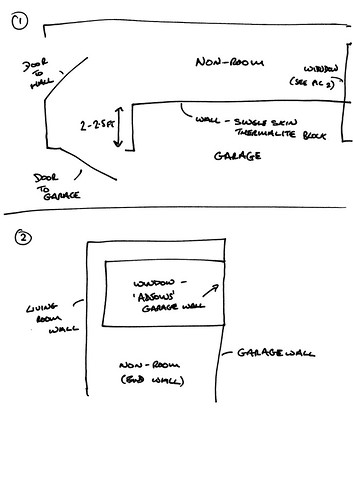 [/img]
You're over thinking the situation.
Probably. Feels like neither option is ideal. Just trying to work out which is better for the circs of the house.
Cheers
Have I missed something here or is there a valid reason for no mention of cavity wall insulation?

