Madame has been on a jolly in Germany over the last week so I couldn't be bothered to fire up the wood burner just for me initially. It started at 18 and lost a couple of degrees a day (frosty nights) until the weather warmed up and it stabilised at 12°C. At that point I had a burn which took it to 14 and today it was 17 outside so I opened up the whole house which got it up to 16. Madame is home in a few hours so the wood burner is roaring getting it back up to here acceptable range. Quite pleased with how slowly it cools down.
I was in a 280 odd year old house today seeing friends, proper blue blood toffs.
Abso-bloody-lutely freezing everywhere but the kitchen.
No thanks. With that money, I'd be in Kenya with the rellies from December to March on their sprawling estates.
They're wired a bit different though 😅.
Turn on bedroom radiator before we go to bed and turn it off when we get up etc…
do people normally heat their house at night? I wouldn’t be able to sleep with the heating on
Seems like a cherry picked number though as it’s equally very inefficient heating up a concrete slab that’ll store heat all day if you’re only in the house for short periods.
Properly designed UFH isn't heating up a concrete slab though. It's heating the floor tiles, and the material it's encased in. Maybe 30-50mm of material. Then you're effectively into 100-200 mm of insulation.
Slap it down on top of an old school concrete raft, with all the insulating properties of a Barretts built house, then you're on a whole different calculation. It's like trying to convert an existing 80's build into a proper passivehaus, never going to work.
However, I think the efficiency comes from the fact the heat is spread evenly around the whole room and you are not just heating a small area to quite a high temperature and relying on convection to spread it through the room.
If you're in the position of needing a log burner, get one of the circulating fans on the top, either a sterling cycle or peltier.
Mines pretty much halved my log consumption and means the whole upper storey of the house warms up when it's running, rather than superheating a column of air immediately round the burner.
18° is the recommended night time bedroom temperature.
19-21° is the recommended daytime temperature range for occupied rooms.
I'd be doing a daily wash if my house was that warm, i'd be sweating continuously. Bedrooms are usually about 16 degrees, and the ones in permanent use are in the (semi) basement. Living space/upstairs is between 16 and 18.
do people normally heat their house at night? I wouldn’t be able to sleep with the heating on
There's an easy solution to this: just pretend all those pennies £££ you're counting are sheep. Voila!
Being static in a cool room when layered up does not prevent the body temp from falling; try it – extremities will gradually become cold as the body tries to maintain core temp.
Don't worry I've been trying it for several years! So I'm well aware that you can sit in front a computer for 7 hours and be fine at 16 degrees.
I read that pdf you posted. It just seems to say that 18 degrees is a threshold for the over 65s and those with health conditions.
There is a link on the first page of it to the evidence and that doesn't seem to contain the 18 degree claim. It also makes it clear that it's cold houses in the context of poverty. I imagine it is hard to work out what proportion of negative health outcomes is due to poverty and due to living in a cold house - the two are clearly correlated.
At the back of the evidence report in a section titled areas for further research it does mention the 18 degree number but only in the context of 'Uncertainty remains over whether the current guidance (21°C for main living room and 18°C for all other occupied rooms of the home) should be directed only at vulnerable groups or the population'. It goes on to say there is a lot of uncertainty about whether the interventions studied were increasing the temp of the house or just making the people less poor which in itself increased the health of them.
Obvs I'm not suggesting sitting in a cold damp room full of mould is a good idea. But there is a world of difference between someone who is already in poverty sitting in a cold damp house and a stw middle class IT manager putting their thermostat at 16.
5 bed, 3 storey, 20 year old detached house, high area in south Lanarkshire. Currently -7 outside, last night was -10.8 on our outside thermometer. A few of us in all day, between my working from home, wife and teenage sons, school, work shifts etc. outside temperature hasn’t been over -3 for days. Heating is on a Hive and is set to 18 at night, 21 by 9 am and then creeping up a little through the afternoon to around 22.5 by 6pm, back to 18 for 11pm. It’s set on ‘at temp x by…’.
It’s nice to feel comfortable, and our heating is never switched ‘off’, rather it’s Hive controlled all year.
We are in a fortunate position to be able to afford it, and being a fairly modern house with new windows etc it doesn’t take a huge energy amount to heat in the summer, but right now it’s around £25 a day all in gas and electric, which is a bit scary. From May to September it’s more like £8 a day.
do people normally heat their house at night? I wouldn’t be able to sleep with the heating on
Yes but only to 12*C. It’s been -10 this last week, it’d be pretty uncomfortable by morning if we turned it off completely.
Bloody hell, that's about £6.5k a year!
Worth noting that in a setup like ours having the thermostat set at 16 doesn't mean the rooms you are in are at 16. Our thermostat, like most people's is in the hallway, and in our case that's quite a bit colder than the rest of the house. Setting the thermostat to 17 means the living rooms are about 20.
I have had to turn my flow temp up to about 60C. The living rooms with TRVs had all shut down, and at lower temps the hallway rad (which is reasonably large but single layer) couldn't emit enough heat to warm the hallway to 17C when it's -2C outside. The boiler was then short cycling as it had more or less reached a steady state but one that was lower than the stat temp. So I've lowered the stat temp and raised the flow temp so now the stat turns off.
^^^ currently DD is set at £480 a month, so around that, however we had new windows and doors installed late September so it may come down a bit..
how quickly it heats up can massively depend on the boiler spec. my (new build\well insulated, 140sqm) house has a 15kw boiler in it. The valient website suggests I need one approx double the size, and most people would probably get whatever they're told to by british gas. Even in this cold snap the house is perfectly warm, but it does take an hour to add 1C to downstairs
I think there is either a problem with my heating system Vailiant EcoTech & 7 radiators. Or the house has started bleeding heat? In late 2010 when the whole of the UK showed as a white frozen mass & I was off sick following a double hernia OP. It was toasty warm (18degC in the coldest part of the house) by 10pm if the heating was off during the night.
Today I had it on till my earlier post and its been back on since 4pm after my fingers and nose got cold yet its only 14.3 in the coldest part and 17.1 in the lounge. 1960 semi with 450mm of loft insulation, cavity wall insulation, thermal lined roof structure. double glazed in 2003. Nothing has changed in the structure I know of. yet its cold a lot of the time?
First burn at 18:30 got the centre of the house from 16 up to 19. I've just added another two logs, that should satisfy Madame.
How quickly it heats up depends wheter the insulation is on the inside or outside and how much mass there is to heat up. Our insulation is on the inside so it responds quite quickly.
my (new build\well insulated, 140sqm) house has a 15kw boiler in it. The valient website suggests I need one approx double the size
I don't think you do. Mine is 12kW, it can modulate down to 9kW, and that's still far too much for my 2007 3-bed semi if I want to run it low and slow i.e. efficiently even in the current weather. If I crank up the temps so it's delivering its 9kW it will warm the house up quicky but have a high return temp and be inefficient. However, if I turn the flow temp down it will hit its temp before the rooms are warm and start turning itself off and on frequently which is also inefficient.
Your 30kW boiler might be able to modulate down very low, but there'd be no point in having that much headroom I don't think.
Re insulation when pointing my IR thermometer at the walls and cupboards in the kitchen at head height they are showing 18C, but the ones lower down are at about 14C. So the cold floor is really the problem here. I think that the builders put a hole in the inner wall for the utilities and didn't seal it, letting cold air under the house, as the floor is much colder in the corner where the drainage goes.
How quickly it heats up depends wheter the insulation is on the inside or outside and how much mass there is to heat up. Our insulation is on the inside so it responds quite quickly.
Speed of response Also massively depends on delta T across the insulation.
Your house will warm up considerably quicker than 90% of folk on here as it's about +10 in your corner of France right now is it not ? ....much of the UK is currently between -5/-10 right now.
I don’t think you do.
I don't think I do either, but I guess if I had a 30kw boiler the house would be able to heat up really fast 🙂
...an old school concrete raft, with all the insulating properties of a Barretts built house, then you’re on a whole different calculation.
This is exactly what we've got, with a solid wood floor on top of most of it. You can feel the floor get noticeably colder within a metre or so of the external walls, and there's quite a gradient from floor to ceiling. I'm not sure what to do about it, to be honest... the two options seem to be (a) dig it up and replace it with an insulated floor or (b) put insulation on top and raise the floor level. Both are enormously disruptive options...
I think the downstairs rads (hallway and kitchen) are obstructed, probably gunked up, but mildly at the moment. The flow temp from the boiler is 63 or so, the top of the hallway rad is 60 and the top of the kitchen one never gets above 50.
That's today's job, then. According to the internet, if I want to do a proper job I need to fit a filter and put some de-gunking chemical in it.
If you put de-gunking chemicals in, you'll need to drain it off after a couple of weeks ! Then add inhibitor and silencer fluids.
We have given up trying to use the heating less after finding black mould appearing (mainly behind stuff piled on windowsills in the kids' bedrooms). So we have cleaned it off as best we can, turned the heating up (still only to 15deg) and have the dehumidifier on full blast. No turkey for me at Christmas!
It's always had inhibitor in but yes. Seems like de-gunking is a common thing so yes I could do it, and possibly without a filter. I'm not sure where I'd put one.
Well our brand new 4 bed detached with internal garage is certainly not what we expected when it comes to keeping warm.
I think we are bleeding heat from the garage door. There is a 10-15mm gap on the sides. The hallway thermostat dropped to 9 deg C last night, and my office which is upstairs and at the end opposite side of the house dropped to 12. With the heating on for a few hours we struggle to get it up to 18 with the rads wide open. The bedroom above the garage was 10 last night. I'm off to B&Q later to buy some insulation strips to try and solve the garage door issue.
Unless you have an insulated door then heat is pouring out no matter what the gap is.
Those are my thoughts. To be fair, I've just been to the car and it's currently -8.
We don't have a filter. My trusty Baxi Solo has been in the house from new, 27 years ago. It's a tiny boiler.
It was kettling a fair bit in early autumn, and the water was inky black. Put in de-gunking fluid, left it a couple of weeks, drained down the systme till the water ran clear, then put in a load of inhibitor - bought 5 litres via Trade for £40, so shoved in half of it (suggested dose was 500ml), and also some boiler silencer. All is running nice and quiet again.
This is exactly what we’ve got, with a solid wood floor on top of most of it. You can feel the floor get noticeably colder within a metre or so of the external walls, and there’s quite a gradient from floor to ceiling. I’m not sure what to do about it, to be honest… the two options seem to be (a) dig it up and replace it with an insulated floor or (b) put insulation on top and raise the floor level. Both are enormously disruptive options…
Yeah, it's a shock getting into a properly built and insulated house.
My current place in Sweden is 3 times the size of my last place in the UK, and the first three or four years i was here, my energy bills were broadly similar. 60-80 quid a month in the UK for electricity and gas, about 70-90 and maybe up to 100 a month Dec/Jan/Feb in Sweden. And i can assure you, it never got to -25 in the Midlands... One year we had nearly 3 weeks where the maximum temp we saw was -10.
Bills are now about 160-180 a month, but i've added 2 kids to the mix, and energy prices have gone up a lot!
Triple glazing and 300mm of encapsulated insulation in the attic, a heat reclaim/recirculation pump in the attic, GSHP and so on. All adds up.
Kids still wander off and leave the front door open when it's 3 degrees and raining outside though.
Well our brand new 4 bed detached with internal garage is certainly not what we expected when it comes to keeping warm.
I think we are bleeding heat from the garage door. There is a 10-15mm gap on the sides. The hallway thermostat dropped to 9 deg C last night, and my office which is upstairs and at the end opposite side of the house dropped to 12. With the heating on for a few hours we struggle to get it up to 18 with the rads wide open. The bedroom above the garage was 10 last night. I’m off to B&Q later to buy some insulation strips to try and solve the garage door issue.
how are companies allowed to build houses like this?
A downside to having a colder house is possibility of frozen water pipes - our house is a converted Victorian industrial building so nowhere near current/any building regs but our cold water feed had a slug of ice that rattled through the boiler first thing this morning. The workshop tap also froze and just about managed to flow and unblock itself.
how are companies allowed to build houses like this?
They've ticked all the boxes on the check-list and not spent a penny more that they have to.
how are companies allowed to build houses like this?
have a look at pretty much any modern housing estate, it's the norm on detached houses - integral garage or double, often with roller doors. That's what we have (see earlier post on energy useage), and the room I am sat in right now was the 3rd bedroom and now an office and right above the garage. When we refloored the room last summer we lifted the carpet and underlay and laid lux vinyl 'wood' panels, with a layer of high spec insulating stuff under it, as the room always felt colder than others. It has made a big difference.
We also put some decent insulating edging on the door from the kitchen into the garage. In current weather the temperature differentials are huge - I have just checked - air temp outside is -5.5, in the garage it is +2.1 and in the office room it is 21.4. The last few nights, when the outside temp has gone to around -10, the garage has got down to +0.4 as a minimum - too cold for me to go in there on the Wattbike for sure !!
If you put de-gunking chemicals in, you’ll need to drain it off after a couple of weeks ! Then add inhibitor and silencer fluids.
We seem to have one rad downstairs with a large cold spot. Ideally I'd take it off and flush it through properly in the garden, but not doing that in sub zero temps!
Was wondering about trying some treatments....
I have used DS-40 in the past for limescale removal, but I don't think I can use that again as our boiler heat exchanger weeps a bit and adding acid into the system risks making that worse...
Yeah, my mates internal garage had no proper insulation between it and the outside world, and no insulation between it and the rest of the house.
So the bathroom that was above it (and the pipes in the floor void) used to freeze occasionally.
The last leak resulted in half the garage ceiling coming down.
So there's now something like 150mm of insulation, a new ceiling and a load of hooks for assorted outdoor kit and both internal walls have been insulated (not much, but better than nothing), and the garage door has been insulated. Still cold in there, but no where near as bad as it used to be. No frost on the bikes on a morning!
-8 here last night, temp in hallway dropped from 18c at 10pm to 14.5c at 7am this morning, think that's okay for an 80s* built 4 bed detached 🤔
* new windows & doors + added loft insulation when I moved in 9yrs ago
Fortunately, my garage is detached ! Not insulated, so all I do is put in a dehumidifier, although the bikes that aren't being used have silicone spray on this year - saving 200w from not using the dehumidifier
We have given up trying to use the heating less after finding black mould appearing
Found some of this in our bedroom, not coincidentally on one of the original Victorian single skin walls. There's an obvious couple of centimetre hole in the corner of the room where the skirting boards meet which seems to be causing a draft. Would filling it up with caulk be a sensible low effort fix?
Expanding foam better for filling holes and gaps.
I’m off to B&Q later to buy some insulation strips to try and solve the garage door issue.
I doubt that's going to have any effect TBH..... if it's a roller door there will be gaps all over it and if it's a steel up and over then it will be freezing!
You might be better insulating the rest of the house from the garage.... but that would be more expensive.
Well our brand new 4 bed detached with internal garage is certainly not what we expected when it comes to keeping warm.
Whats teh EPC rating? We moved into a new build and the EPC rating is pretty good (B). We do have a detached garage though (and very thick doors that go to outside)
do you not have am internal door to the garage from the house?
how are companies allowed to build houses like this?
Would you believe, because they lobby the government against increasing standards??
https://unearthed.greenpeace.org/2021/07/05/housing-net-zero-climate-target-lobbying /">Leading housebuilder pushed for weaker climate targets
see also
and let's not forget
We got to this point through choices. UK made choices. The only upside of this difficult winter is that hopefully more people see this.
Unless you have an insulated door then heat is pouring out no matter what the gap is.
I stuck a layer of what looks like foil-backed bubble wrap on the inside of my garage door and it helped a little bit. The giant gaps around the outside are now filled in with some foam strip but nothing will fix rest of the gaps short of replacing the door or bricking it up.
I would never buy anything from Hormann, they're the epitome of cost-cutting, shoddy build quality and price-gouging for spare parts. A truly shit company.
UK house building with the big construction companies just isn't up to it quality wise. Everything done to a price, trades not paid for time taken, all costed on a per property basis it seems hence the awful quality issues. Taking a bit more time over the important stuff like insulation and window/door fitment would go a long way to sorting out these issues but they won't of course. It seems to be "the way it is" and house buyers just accept it.
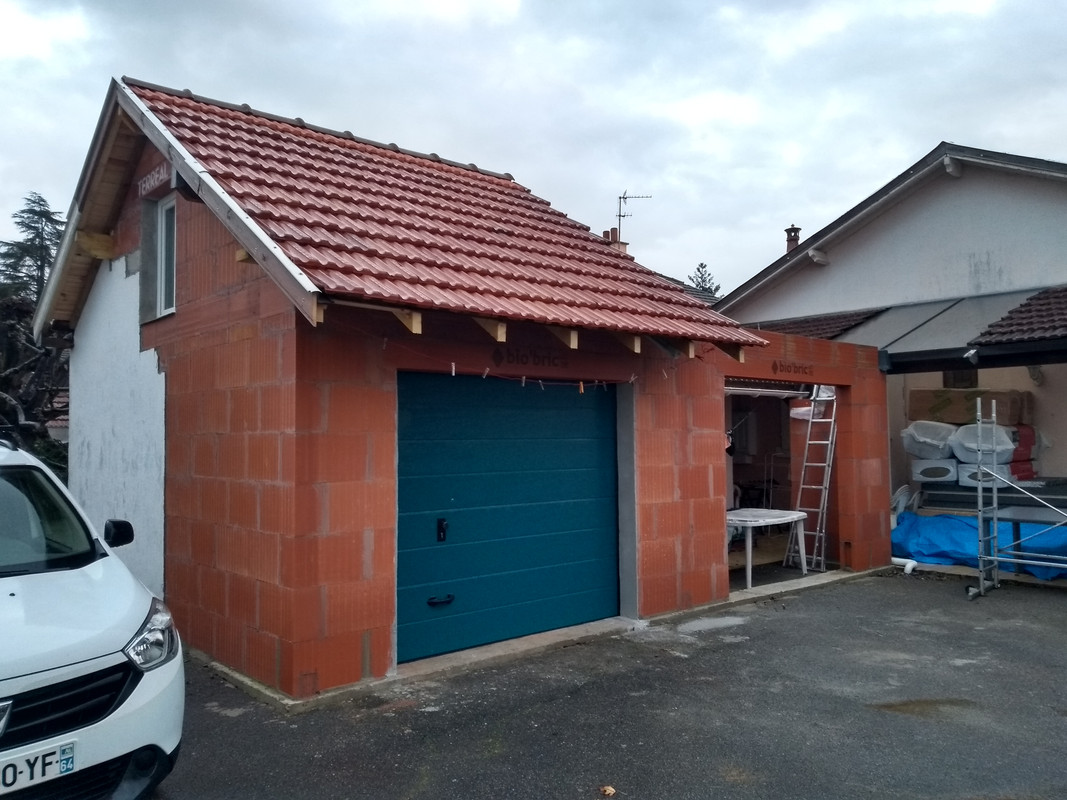
Most garage doors in these parts are four panel things. The panels are 45/50mm thick steel sections filled with polyurethane foam. There are lip seals between the panels, on the sides, at the top and bottom. The internal frame/runners butts up to 100mm insulation nicely to cut the thermal bridge around the frame.
They cost about 800e but I picked this one up second-hand for 150e from someone converting their garage to a living room.
tried turning the boiler flow temp down as suggested above, house was far colder this morning (13 degrees). I know its supposed to be more efficient but surely if you have to have the heating on much longer its going to be about the same?
Also tried more fudging about with balancing. Big rads remains midly warm even with other rads restricted. I'm thinking I need to stop faffing and just leave it during this freezing period as I just seem to be making things worse!

