
I think either my battery or alternator on my car is duff (absolutely no charge in the battery, no ignition light even) so before spending loads of money on fixing one thing and finding its the other I was going to buy a multimeter to test the voltage to the battery. Can anyone recommend one that is suitable for this and which might be useful generally?
Fluke, but not the cheapest.
Which model do you reckon?
richmars....Fluke
Dont be so stupid, thats total overkill.
OP: Any from halfords or a DIY store will do your job just fine, just check it can measure DC volts for car stuff, most of them should do.
B&Q:
Yeah, anything will do. I think the one I use here at work was £2.something..
What the previous said. Any cheapo meter will be fine.
Less than £4, this will do the job
[img] 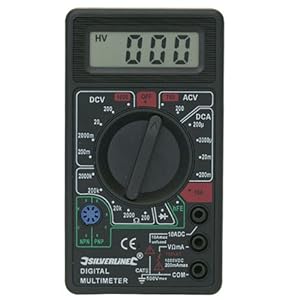 [/img]
Maplin had some on 2 for 1 a while back. Think £3 or £4 for a DMM nowadays!
I got a Gunsons test-tune as I used to do loads of car stuff.
The beauty of these is that the scale shows you where the readings SHOULD be so you don't need to look them up.
Volts
Volts while cranking
Resistance
Resistance of HT leads, coils,
RPM
Stuff like that. Obviously 12v and less only, though.
Like I said, Fluke aren't the cheapest but it's like any tool, you get what you pay for.
Like I said, Fluke aren't the cheapest but it's like any tool, you get what you pay for.
Not sure that is the case. I've got a Fluke and its no better then my £60 Maplin own brand one. The Flukes we had at work were worse, really slow and often wouldn't work with fluctuating supplies. I've used the £3 ones a fair bit too and they really are surprisingly good.
EDIT: Also the car specific ones can be quite good giving rpm.
I've got a super-cheap one that's fine for that. Maplin have one for a fiver that would do the job:
http://www.maplin.co.uk/Module.aspx?ModuleNo=37279
I've got the Maplin one linked to by Simon_G. You won't be handing it down to your grandchildren, but it'll do the job, and has so far survived 2 years of being knocked around in the back of my Landy.
No doubt the fluke ones are awesomeness in a box, but he just wants to see what voltage is across the battery?
Mine looks like that B&Q one, but was about 1/10th of the price from CPC.
Continuity function is very handy around the house.
Don't bother use a 12v car bulb with a couple of bits of wire and if it's bright you've got enough volts/amps to the battery, much cheaper to!
Unfair perhaps, but if somone 'owns' a Fluke, I naturally assume it's stolen from work 😉
Very unfair. Used loads at work so I know they work. Hence when I needed one I brought what I knew would last.
Hence when I needed one I brought what I knew would last.
If you use it EVERY day and your job required accurate calibrated measurements and is demanded because its an become a bit of an industry standard then yes, Fluke is the way to go, if you use it ONCE a year then a Fluke is total overkill, end of story.
No, I don't use it every day. I just like using well made equipment.
I got one from ebay, I looked for one with a temperature probe and also a high current measurement (50 amp or something) as I was doing lots of electrics in my campervan at the time.
In hindsight, I would recommend to go for one which turns on via the dial. Mine came in a soft bag and has three push buttons for on/off, backlight and hold. So whenever it gets taken out of the toolbox/door pocket etc, its either turned itself on and is flat, meaning I need to find a 9v battery and a silly small screwdriver, or I knock the hold button whilst using it and then get confused when I have no continuity (as it remembers the last result on the screen)
OK, I've got one. But I'll be bu$$ered if I can get it to measure anything.
To test the car battery I put the black cable in COM and the red one in VomA, set the dial to 20 DC Volts and put the black end on the -ve terminal and the red on the +ve. Nothing. Not even a "1" to show its over set.
Is there an easy way to test the unit itself. (Yes, I have connected the battery:0)
Sounds like you have done the right thing. Try it on a battery from something that works (bike light?)
Another quick self test for the meter would be to put it in resistance mode. It'll be max/9999/1--- with the probes not attached an zero-ish if you touch them to each other.
Thanks nick. I've tried the unit with each resistance setting and none will change from "1" when touching the probes together. Can't get any reading off a new AA battery either.
Broken meter or broken lead. Do you have another meter to test the lead 🙂
If you are struggling with how to use a multimeter perhaps you should put it away and get somebody who knows what they are doing, electricity will bite if you are lucky and if you are unlucky _______________________
Has it got a hold button ? If its in hold mode it will say hold in the display
It's ok Mikeypies, I've only bought one to test my car battery not the national grid. :0)
Right. Just tested the battery with a neighbours unit and I'm getting 11.55v
from the disconnected battery. Connect it up and try to start the car it gives up after a couple of turns of the starter motor. Hmmmm....
My last van wouldn't start with 11.5v, is it a diesel?
2L petrol.
[u]Multimeter[/u]
If it looks like the one in the picture in my post above, the black lead plugs into the top hole, red lead into the middle hole. Neither of them should be plugged into the COM hole.
At least that's how mine is set up and it works 🙂
[u]Battery[/u]
11.55v is a bit low. Can you try jump leads to start it, then see what the reading is with the engine running. IIRC mine rises to about 18v with the engine running. If the voltage doesn't increase significantly then the alternator is on its way out. If it rises, but then the battery loses charge quickly then its the battery.
Good luck.
11.5 is very low for battery voltage, mine wont even crank with anything less than 12
Thanks everyone. I'll jump it and retest. Hope it's just the battery as a new alternator sounds expensive (if £100 for a new battery isn't!)
I use Flukes in work. I own one of the Maplin £5 ones linked above. Have yet to notice anything I'm missing, and I use it a lot to test electronic stuff.
You'll be needing more than 11.5v to crank an engine. A fully charged battery is nearer 13v. Try starting using jump leads then once it's running check the terminals, if the alternator is working properly you'll see around 14.8v, if a lot lower then your alternator might be goosed. If it has good voltage then it indicates that the battery may be duff.