UK is the worst performing G7 country, and worst performing European country… theres a common denominator here, brexit.
Do you honestly believe that? That the UK is the worse performing country in Europe? And do you realise 5 of the G7 countries aren't even in the EU?
Can MMT help when people want to trade (import/export) with other economies? We still have a world with different currencies...
I think it should be called MMP
Modern Monetary Policy
It’s time the BoE was put under direct fire from the government
That had not worked out well for Turkey. Why would the UK fair better?
My argument against it (as an economic theory) is that it only works in isolation. It doesn't seem to explain how two, (possibly competing) interests, would interact.
E.g. Foreign investment is affected by the relative attractiveness of each sovereign economy.
Do you honestly believe that? That the UK is the worse performing country in Europe? And do you realise 5 of the G7 countries aren’t even in the EU?
Note the comma.
worst performing G7 country, and worst performing European country
Although I do conceed I meant EU member, rather than European country, as if we are talking strictly geographically, the UK certainly brings the average down.
That had not worked out well for Turkey. Why would the UK fair better?
How is it working out well for us currently?
Turkey are cutting interest rates to cut inflation now as raising rates shock horror raises interest rates.
(I'm not saying interest rates caused the inflation) but there is scant evidence that raising rates actually works. But banks just keep at it.
Turkey's inflation has fallen since they lowered interest rates as much as I can discern.
Supposed we should always qualify that inflation is different for everyone and we are often referring to CPI or PPI.
My argument against it (as an economic theory) is that it only works in isolation. It doesn’t seem to explain how two, (possibly competing) interests, would interact.
E.g. Foreign investment is affected by the relative attractiveness of each sovereign economy.
There is large chapter in the deficit myth about about trade balances.
Point is if you invest in your own economy with your own money and become productive you are likely to attract foreign interest.
It works in isolation because a sovereign currency issuer is exactly that.
Crucially the big economies all tend to be economies that MMT describes. USA, JAPAN, CANADA etc.
It's not a model of how business affairs are conducted.
And also it's not really an economic theory, it's an actual description.
I know it's labeled a Theory but it's different to say - something like the laffer curve which is just made up. MMT is different as it is based on a set of actual trackable real procedures rather than being an idea.
Although I do conceed I meant EU member
Well Sweden is an EU member state and its economy is performing worse.
https://www.aa.com.tr/en/europe/sweden-struggles-with-poverty-as-recession-looms/2862911
And have you seen Poland's inflation rate?
The UK's economy isn't doing well, without doubt, but it isn't the worse in Europe, and most G7 countries aren't in the EU. You might want to blame brexit for poor economic performance but there is no obvious evidence of a brexit "common denominator" from the examples that you give.
* Turkey mistake. Should read:
Turkey are cutting interest rates to cut inflation now as raising rates shock horror adds to inflation.
Sorry I put interest rates twice. Didn't make sense.
Can MMT help when people want to trade (import/export) with other economies? We still have a world with different currencies…
Sigh. Can we please get past the lazy counterpoints to MMT where there is lots of material refuting these points.
Wiemar Germany
Zimbabwe
If it worked why isn't everyone doing it?
It will devalue the currency.
You won't be able to trade with other countries
etc..
Please just go and read The Deficit Myth. All these points are covered in a lot of detail. Now, does anyone have anything original to say against MMT? If so lets have it.
Yea that book looks interesting (I read chapter 5), very US-centered though. I just think there will always be competing pressures and individuals who want to do their own thing.
All eyes on the Fed this afternoon. Expected 0.25%
Could pivot? Unlikely.
Relevance is - we usually follow. Consensus is - close to pivoting but I think they will go until they break something.
Yea that book looks interesting (I read chapter 5), very US-centered though. I just think there will always be competing pressures and individuals who want to do their own thing.
It is but most of it is interchangeable with slightly different terminology and obviously the dollar being the reserve currency.
Recent Richard Murphy (as guest) stream talking clearly about MMT. FF to 12mins if you want to get past the intro as it's Scottish centric. I'd watch it all because there's some nice clarity at the beginning.
That video sums up my scepticism about the proponents of MMT. The video is not really about MMT, it is a series of policy assumptions that MMT is crowbarred into supporting, in this case Scottish independence.
In terms of supporting your argument through this thread, none of the people in that video have any professional credibility as economists. Murphy is a retired accountant. Van Sweeden has a degree in Anatomical Sciences. Thomson has a degree in Green Economy.
That video sums up my scepticism about the proponents of MMT. The video is not really about MMT, it is a series of policy assumptions that MMT is crowbarred into supporting, in this case Scottish independence.
In terms of supporting your argument through this thread, none of the people in that video have any professional credibility as economists. Murphy is a retired accountant. Van Sweeden has a degree in Anatomical Sciences. Thomson has a degree in Green Economy
Just stuff of interest that's all.
Yes there is a Scottish thrust to it of course but there's plenty of info for MMTers that stands.
I think you're underselling Murphy there. He's done a lot of stuff and for sure he's been an accountant but these are the numbers people that stumble upon the reality of government spending.
If you want a the full picture then I listed plenty of comprehensive links above without the Scottish slant.
In terms of supporting your argument through this thread, none of the people in that video have any professional credibility as economists. Murphy is a retired accountant. Van Sweeden has a degree in Anatomical Sciences. Thomson has a degree in Green Economy
That's not a fair appraisal. I'm simply posting clips of interest - the supporting material is all the way through this thread.
In this thread we have mentioned.
Professor Stephanie Kelton:
Stephanie Kelton is a professor of economics and public policy at Stony Brook University. She is a leading expert on Modern Monetary Theory and a former Chief Economist on the U.S. Senate Budget Committee (Democratic staff). She was named by POLITICO as one of the 50 people most influencing the policy debate in America.
Professor Bill Mitchell:
William Mitchell is Professor of Economics and Director of the Centre of Full Employment and Equity (CofFEE) at the University of Newcastle, NSW Australia. He is also the Docent Professor of Global Political Economy at the University of Helsinki, Finland, and JSPS International Fellow at Kyoto University, Japan.
Professor Richard Murphy - Sheffield
Professor Richard Murphy co-founded the Tax Justice Network, the Fair Tax Mark and Finance for the Future. He founded and directs Tax Research UK. He co-created the Green New Deal and remains an active member of the Green New Deal Group. He is the founder-director of the Corporate Accountability Network.
Richard created the concept of country-by-country reporting which, with the backing of the OECD, is now in use in more than 90 countries around the world to identify tax abuse by multinational corporations. Richard created the concept of sustainable cost accounting.
Steven Hail:
Steven Hail is Adjunct Associate Professor at Torrens University and Research Scholar at the Global Institute for Sustainable Prosperity, with a Ph.D. from Flinders University, and a M.Sc from the London School of Economics. He was from 2002 until December 2020 a lecturer in the School of Economics at the University of Adelaide.
Assc -Prof Pavlina R. Tcherneva
Pavlina R. Tcherneva, Ph.D., is an Associate Professor of Economics at Bard College, the Director of OSUN’s Economic Democracy Initiative, and a Research Scholar at the Levy Economics Institute, NY. She specializes in monetary and fiscal policy coordination and employment policy.
And if you want some gravity on the mechanics of how the spending works -
Here is the paper on UCLs site for "Accounting Model of the UK Exchequer/The self-financing state: An institutional analysis of government expenditure, revenue collection and debt issuance operations in the United Kingdom"
https://www.ucl.ac.uk/bartlett/public-purpose/publications/2022/may/self-financing-state-institutional-analysis
I suppose you could just believe Larry Summers?
None of the people above have tenure at a major university in an economics chair. Your position in this thread appears to be that MMT helps to understand how government income/spending works and why classical economics doesn't necessarily explain this well. The word 'policy' keeps appearing in their bios supporting my point that MMT seems to be crowbarred into supporting a set of assumptions about how the world could and should be.
None of the people above have tenure at a major university in an economics chair. Your position in this thread appears to be that MMT helps to understand how government income/spending works and why classical economics doesn’t necessarily explain this well. The word ‘policy’ keeps appearing in their bios supporting my point that MMT seems to be crowbarred into supporting a set of assumptions about how the world could and should be.
They have political opinions and roles too? Stephanie Kelton was an advisor for Bernie Sanders but her book avoids too much political posturing with examples of Reps and Dems doing stuff incoherently.
Happy to discuss or look at any model you might have with the supporting evidence.
None of the people above have tenure at a major university in an economics chair.
I don't know how to respond to that really other than to ask are they the ones currently advising UK political parties?
None of what you say puts forward an argument for MMT not being an accurate description. Just because an economist then goes to make a prescriptive case - so what?
there's no doubt that 4 professors support MMT, but thats a really really small number. looking at them
Bill michell - not mentioned on the university of helsinki economics dept https://www.helsinki.fi/en/faculty-social-sciences/research/disciplines-and-research-units/economics or newcastle economics dept https://www.newcastle.edu.au/school/newcastle-business-school/people/people/economics
Steven hail is part time at a university thats been in existance all of 11 years
stephanie kelton isn't mentioned on the economics department of stony brook university
https://www.stonybrook.edu/commcms/economics/people/faculty.php
there's far more qualified people in economics (more qualified anyone on this thread) who think its nonsense
A 2019 survey of leading economists by the University of Chicago Booth's Initiative on Global Markets showed a unanimous rejection of assertions attributed by the survey to Modern Monetary Theory: "Countries that borrow in their own currency should not worry about government deficits because they can always create money to finance their debt" and "Countries that borrow in their own currency can finance as much real government spending as they want by creating money"
https://www.kentclarkcenter.org/surveys/modern-monetary-theory/
there’s far more qualified people in economics (more qualified anyone on this thread) who think its nonsens
So you show me a survey and that is evidence of what? That some economists have an agenda to support monetarism?
You know I'm embarrassed for the one of them put this:
"On the second statement, Eric Maskin at Harvard observed: ‘There will come a point where the currency is so debased that further spending becomes difficult if not impossible.’ And Larry Samuelson at Yale added a further reference to history: ‘Creating money can finance a great deal of spending, but incidents of hyperinflation, collapse and other crises indicate there are limits."
I mean did he not notice that when the USA spent/created trillions its currency got stronger?
It's pure neoclassic twaddle. You can't debase a currency just because MMT is a thing. And virtually all historical records of hyperinflation relate to supply shocks. There's plenty of research.
Looks it's up to you what you believe and who you believe but that survery tells me nothing about government spending. It tells me some economists might have an agenda. And Summers' name is all over it. He was made to look silly by Jon Stewart recently.
Of course some economists don't believe it! And of course MMT is heterodox. But I'm not going down a route of here is a bit of info I found on the net that someone else might be better at economics because they filled out a survey or went to a better University.
There are more MMT detractors than supporters for sure. So what?
Given that neo-classical economists have designed and supported economic policy which has resulted in the trainwreck of an economy we now see where in the US 0.1% of the population own 90% of the wealth, where the market has completely failed to deliver the supposed competition which would keep prices down and productivity up, where public services are collapsing due to lack of govt investment, and monopolies in every sector extract unjustifiable profits from working people, I'm not sure we should give them too much respect. The system all these economists have pushed on us as being the only solution has failed. If MMT was being proposed by this lot I'd run a mile.
Creating money can finance a great deal of spending, but incidents of hyperinflation, collapse and other crises indicate there are limits.”
Isn't that what's being said by MMTers? I don't think anyone supporting MMT says that you can spend unlimited money, do they? I think it's just a different model of the same thing, and the main difference seems to be simply the order in which you do things. Traditionally you'd expect to have to have a view to balancing the books before spending, whereas with MMT you can spend and then tax later. Which is the same as borrowing loads, isn't it? The only difference is that traditionally borrowing loads is seen as bad, but in MMT it's not, because MMT. Right?
Given that neo-classical economists have designed and supported economic policy
I thought the point about neoliberalism is that you don't design economic policy, you just let people get on with it, which results in massive inequality but that's the natural order of things and if it makes us really rich then that's hardly our fault is it?
Isn’t that what’s being said by MMTers?
Yes you are correct but we keep going around in circles about this I reckon.
It's practically the first thing MMTers say but detracters use it all the time for some crazy reason.
MMT would also say it's never borrowing to spend - it's issuing bonds to drain reserves. It funds nothing.
Mainstream conflates bond issuance with borrowing - which takes place right at the end of the spending cycle and doesn't fund spending.
here's the visual for the daily spending cycle:
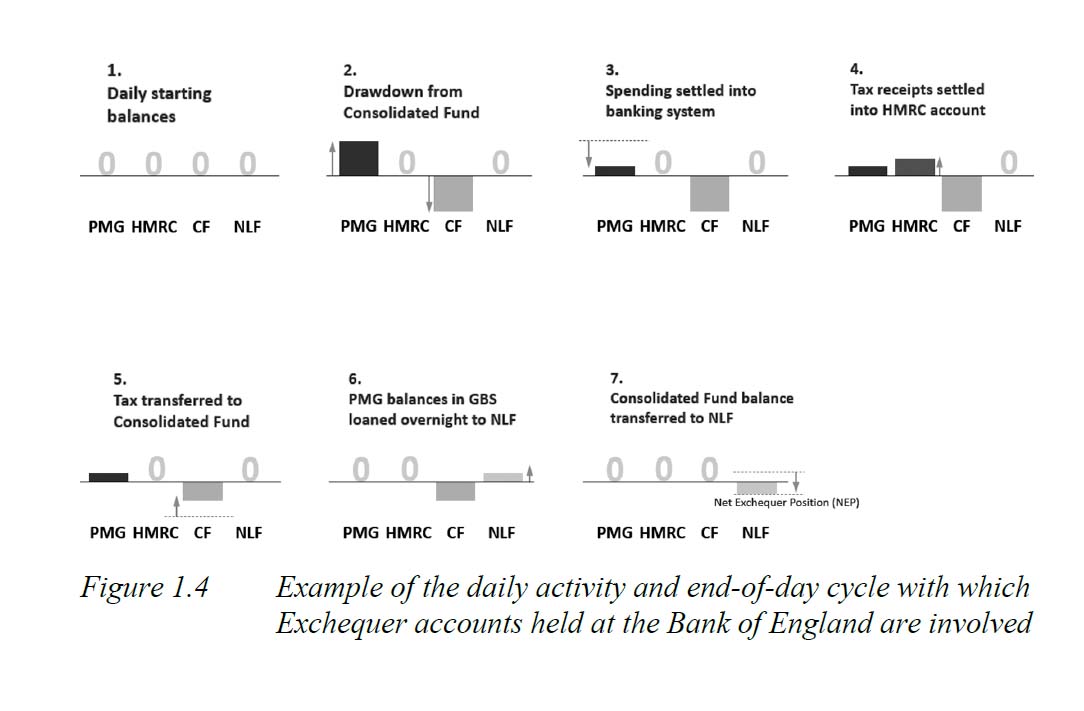
Some Notes:
"The daily accounting cycle results in a net cash surplus or cash debt being
held in the National Loans Fund. Under the current policy framework, this
end-of-day position motivates reactive policy undertaken by the DMO known
as ‘cash management’ and which involves the trading of government securities
with the private sector. This activity is usually construed as a ‘borrowing’
exercise where the government has to raise funds in order to spend. As we’ve
seen, though, the government has no requirement to source cash from the
private sector in order to be able to spend because cash is made available by
the legislative processes described."
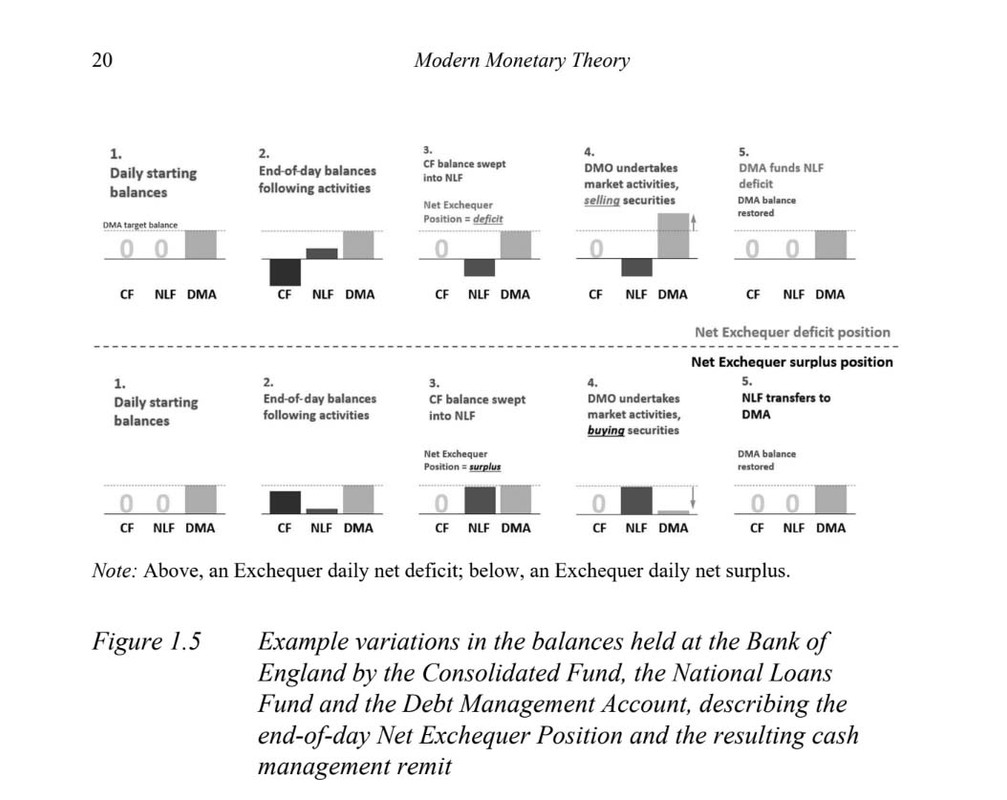
"The cash management process is illustrated in Figure 1.5 which describes
two scenarios: that of a daily Exchequer deficit (above), and a daily Exchequer
surplus (below). In the first step illustrated, the Consolidated Fund and the
National Loans Fund start the day with a nil balance whereas the DMA has its
prescribed target balance. During the day, activity on the Consolidated Fund
and National Loans Fund (see Section 1.4.3) causes variations in their respec-
tive balances (step 2), and at the end of the day the balance on the Consolidated
Fund is swept into the National Loans Fund (step 3). The resulting balance
then represents the Net Exchequer position and it is the DMO’s task to offset
that quantity. In the case of an Exchequer deficit, the DMO achieves its objec-
tive by selling government securities which serves to increase its own balance
over the mandated target balance (step 4). The DMO then transfers its excess
balance to the National Loans Fund which has the effect of zeroing the latter
and restoring the Debt Management Account to its target level (step 5). In the
case of an Exchequer daily surplus, the process is similar except the DMO
needs to buy securities from the private sector in order to dispose of the excess
cash."
I thought the point about neoliberalism is that you don’t design economic policy, you just let people get on with it, which results in massive inequality but that’s the natural order of things and if it makes us really rich then that’s hardly our fault is it?
That's because they believe markets are naturally levelling, and better without goverment inteference. Trickle down etc.
But it drives money upwards.
The point being the markets have actually been enabled by governments and central banks.
whereas with MMT you can spend and then tax later
Which is what already happens.
I thought the point about neoliberalism is that you don’t design economic policy
Nope. Neo-classical economists have spent the last 40 years telling us there is only one way to run an economy, by removing the intervention of the state and the bargaining power of workers to allow capital and the market to operate unhindered. The result was supposed to be higher productivity, lower prices, the widespread availability of goods and services, and the empowerment of an asset-owning population. Not quite worked out that way has it?
Damn I missed my edit time window.
Here is Fig 1.5
I'm not dismissing MMT as an academic theory to aid understanding of how government spending/borrowing works. My view is that MMT is used to justify public policy rather than as a neutral position to approach public policy.
My view is that MMT is used to justify public policy
Politicians will use anything to justify the crap they come up with.
My view is that MMT is used to justify public policy rather than as a neutral position to approach public policy.
MMT follows policy decision. It happens good or bad every time the UK government decides to spend.
Simple as that.
It's neutral in the sense that lack of money can't technically be used to justify not doing something.
Thread resurrection I know, but this is something that seems to be perenially relevant and especially pervading the current election situation.
I have some knowledge of MMT, but have some questions, and here seems to be the best place:
1: I don't quite get one of the fundamental principals of MMT ie Taxation being a motivation for people to earn that currency. I listen to experts saying that sanctions for not paying taxes results in people working for wages so they can pay the taxes. In my experience, people's motivation to work and earn money is so that they can buy nice stuff, and the tax is just an undesirable side-product of those earnings. How is my thinking flawed?
2: Why do politicians not embrace MMT? In my way of thinking, it's either because:
a: they don't understand that that's how things work
b: they get it, but fear that it will put voters off
c: they get it, but are stealthily using it for nefarious purposes
Any clarification welcome
thanks
2: Why do politicians not embrace MMT? In my way of thinking, it’s either because:a: they don’t understand that that’s how things work
b: they get it, but fear that it will put voters off
c: they get it, but are stealthily using it for nefarious purposes
d: its a fringe theory rubbished by most mainstream economists and not a model of how the world works that is generally considered accurate.
d: its a fringe theory rubbished by most mainstream economists and not a model of how the world works that is generally considered accurate.
And from the election thread...
There’s nothing Reeves could say to convince you short of totally signing up to your somewhat esoteric economic theory.
Yes it's so fringe and esoteric that every western economy uses the model described by MMT. Fiat money has been around since 1971 and is now an almost universal standard for countries which have a sovereign currency. The economists and politicians who still push the neo-classical view do so because they have a vested interest in its continuity. The politicians are in hock to the top 1% who benefit from the illusion of austerity, the economists mostly because it's hard to accept that your 30-40 year career was based on a fallacy. If the general public ever do begin to understand the reality of where money comes from (and where it goes) there'll be a revolution in very short order.
1: I don’t quite get one of the fundamental principals of MMT ie Taxation being a motivation for people to earn that currency. I listen to experts saying that sanctions for not paying taxes results in people working for wages so they can pay the taxes. In my experience, people’s motivation to work and earn money is so that they can buy nice stuff, and the tax is just an undesirable side-product of those earnings. How is my thinking flawed?
2: Why do politicians not embrace MMT? In my way of thinking, it’s either because:
a: they don’t understand that that’s how things work
b: they get it, but fear that it will put voters off
c: they get it, but are stealthily using it for nefarious purposes
1) Its an interesting question, because I know people who cut their hours to stay under the 40% threshold. they obviously earn less overall now, but decided that the stress of working 5 days wasn't worth 4.5 days pay.
Hypothesis:
But for the other 90%, people work enough to get by. At the lower end that's 60h weeks and 2 jobs. At the middle it's a 37.5h week and choosing jobs that you find least stressful but still pay the mortgage. If you put income tax up, those in the middle would probably go out and find better jobs.
Same logic if you put up corporation tax:
- might get passed on to employees as lower pay rises -> same result
- might drive "efficiencies", i.e. productivity goes up
etc
Same with VAT or any other sales tax:
- people need to work more to afford to live so take 2nd jobs (or ask for more remuneration which means those companies need to invest in productivity)
If people work more/harder then productivity goes up.
More productivity means more goods and services
Which means price deflation on those goods and services.
If you've got deflation you can create more money to counter it, and the circle is complete (more tax, more spending and people working more productively) or the system reaches a new equilibrium.
2) All of the above except a?
a) Hunt isn't an idiot. He probably knows more economic theories than the rest of us have forgotten.
b) The "current account" model is easy to grasp and probably covers 90% of the cause and effects anyway. Even MMT explains you can't spend money without taxes, just with extra steps. You could write MMT the other way round to the way it's commonly stated and say "If you don't balance the books you'll have some combination of inflation and/or high interest rates"
c) They're using lots of models to do lots of things with lots of small levers (thousands of departments schemes, initiatives etc) as well as the big one (tax).
Yes it’s so fringe and esoteric that every western economy uses the model described by MMT
they all have a fiat currency, I agree, but claiming that's the model described by MMT is misleading. MMT is one interpretation of how an economy with FIAT works. Flat earthers have a model of how the world works. Just because we all live on the earth doesn't mean the flat-earth model is anything other than fringe and esoteric
MMT is one interpretation of how an economy with FIAT works.
No it's not, it's a simple description of the facts. MMT is an explanation of how fiat currencies impact the operation of govt finances and spending in the economy. You can't run a fiat currency without deficits, 'debt' and taxes*. It's a simple accounting model where the govt creates money at one end, and removes it at the other, with the surplus representing the money active in the economy. All the rest of it like govt borrowing, bonds etc are just mechanisms to obscure the reality towards enriching a small number of people at the cost of everyone else.
*Well you could, but it would result in deflation, depression and economic collapse which no sane govt would want.
Where MMT differs from classical economics is the recognition that govt spending and the monetary system can be used for the benefit of everyone in society, rather than private investment and competition being the only drivers of wealth and productivity.
MMT is one interpretation of how an economy with FIAT works.
Will help with that.
It's the only one. Ground up. No neoclassical system has ever modeled the government finances accurately. There is an assumption there is a competing description. There isn't. There's just what many economists believe happens.
If you want the regular classical interpretation - you can call on one of Biden's senior advisors. I'm guessing most economists don't know. Poor fella.
From the film:
I think the film Finding the Money might help. Came out in the USA recently.
But UK to follow shortly.
Flat earthers have a model of how the world works. Just because we all live on the earth doesn’t mean the flat-earth model is anything other than fringe and esoteric
That's a bit disingenuous because the financial model most understand to be correct is actually the flat-earth theory because it assumes right at the start the government can't create its own currency. You'd have to be bordering on crackers to believe that. Many do.
I always say to people where do you think central bank money comes from then? (reserves.) Who has the power to underpin our financial system? The government and central bank!
Why is it difficult for some to accept MMT when they have bought into FIAT?
The FIAT banking system literally magics more money out of thin air (by lending more than is received) every time a deposit in made into an account somewhere.
Is it because somewhere along the line it democratises the money supply and removes the power from those hoarding wealth?
Why is fiat capitalised? It is not an acronym, it is a word. In Latin.
"The FIAT banking system literally magics more money out of thin air (by lending more than is received) every time a deposit in made into an account somewhere."
I believe that MMT folks pooh pooh the status of bank lending according to the fractional reserve principle as not really being newly created money - only money created by the central bank is that.
But economists have several definitions of money depending on what they want to know about.
Why is it difficult for some to accept MMT when they have bought into FIAT?
Not sure if it's just confusion, but fiat is just the legal tender we use, i.e. money, MMT is more of an economic theory, so more akin to Keynesian than fiat, both models would use fiat, infact MMT can't really work unless it is in a fiat system.
As for MMT, it's been talked to death on here, in model form it looks good, but real world is where it could fall apart, nobody has used it, even those countries who have fiat and have been politically and financially volatile in the last few decades, reality is it's all about the worlds confidence in the currency involved, outside the $, i don't see any working well with MMT, without some serious risks involved for countries who attempt it.
Fiat is more than the tender used, it's the means of supporting the value of that currency. Previously there was a physical thing (gold) that underpinned the value inherent in the tender (commodity currency). Now it has value by dint of how it is loaned out by the bank on receipt of a deposit.
Somewhere online there is a youtube video explaining it better than I can remember. One like this one
Why is fiat capitalised? It is not an acronym, it is a word. In Latin.
Haven't you seen the badges? Fabbrica Italiana Automobili di Torino.
Now let me sit on that SEAT over there.
The FIAT banking system literally magics more money out of thin air (by lending more than is received) every time a deposit in made into an account somewhere.
This doesn't happen at all, you're confusing money supply with creating money, and neither are linked to fiat or a gold based currency.
Banks can lend an amount of the money you deposit with them, which is less than the amount you deposited (the rest is held back for liquidity reserves). This can happen regardless of the currency base. This increases money supply (a technical term that confuses lots of people), but does not magic money out of thin air.
"Haven’t you seen the badges? Fabbrica Italiana Automobili di Torino.
Now let me sit on that SEAT over there."
Ha ha.
The motor company is now called Fiat Automobiles SpA. Along with other companies like BP and IBM it changed its corporate name to reflect the brand name. So Fiat on a car is now just a made up word which confusingly is the same as a real(ish) one. The DVD consortium has declared that the initials have no meaning, it is just a name.
I think this is the marketing/pr folk at work. When something is used as a brand name it loses any meaning it may have generally and simply represents the values of the brand. So the company is named after the brand it sells products under rather than the reverse (which is generally how things start off).

